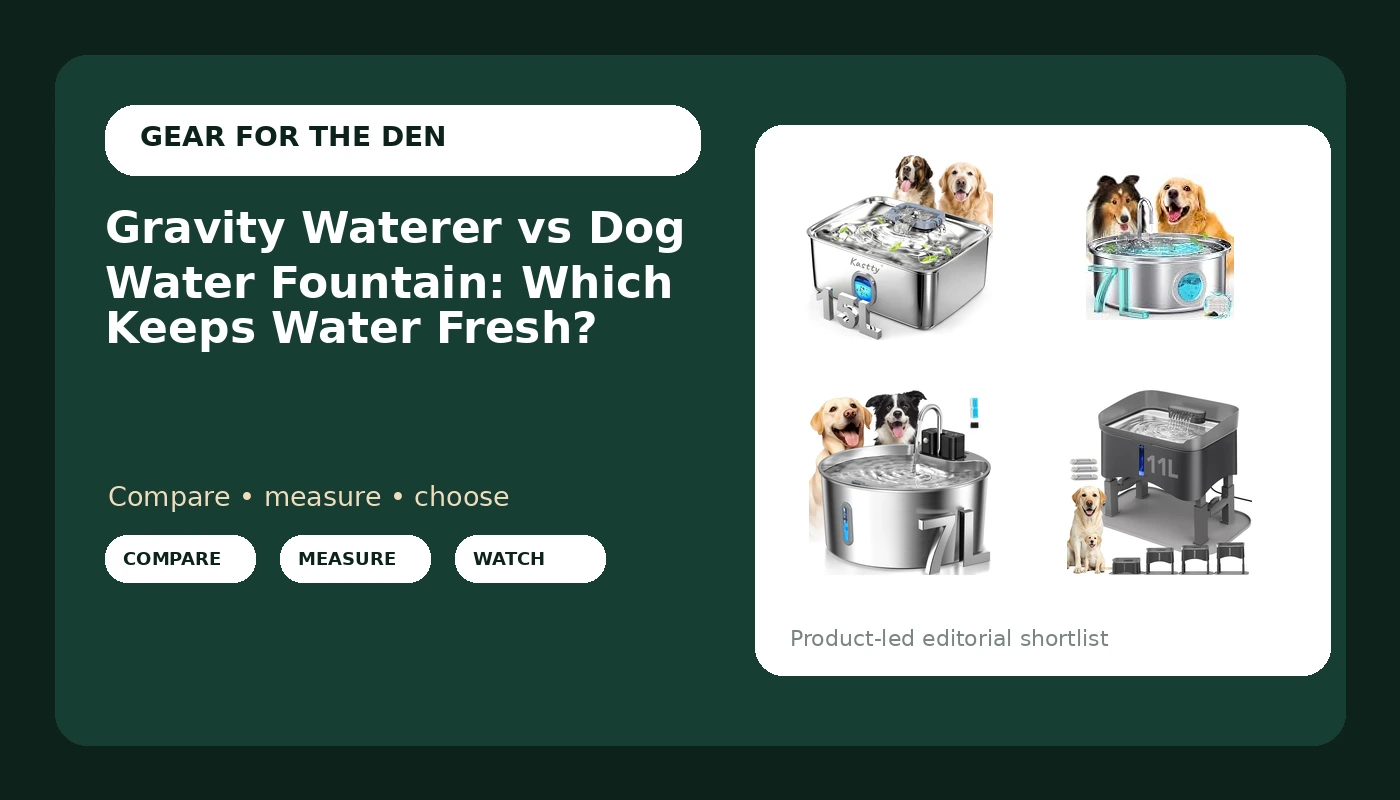
The gravity waterer vs dog water fountain question looks like a preference call until you watch a two-dog household drain a bowl before lunch. One design leans on a sealed reservoir and lets physics refill the basin. The other runs a pump, pushes water through a filter cartridge, and returns it over a spout or ramp. The two behave nothing alike once you stack up water capacity, cleaning time, noise, and how far your dog has to reach down to drink.
The best pick for most households in 2026 is a stainless steel fountain in the 7L range, because it pairs a replaceable filter cartridge with a basin you can rinse every morning and a footprint that still fits a kitchen corner. That is the short version. The longer version is about whether a pump is worth the maintenance at all, and there are four current designs worth comparing side by side.
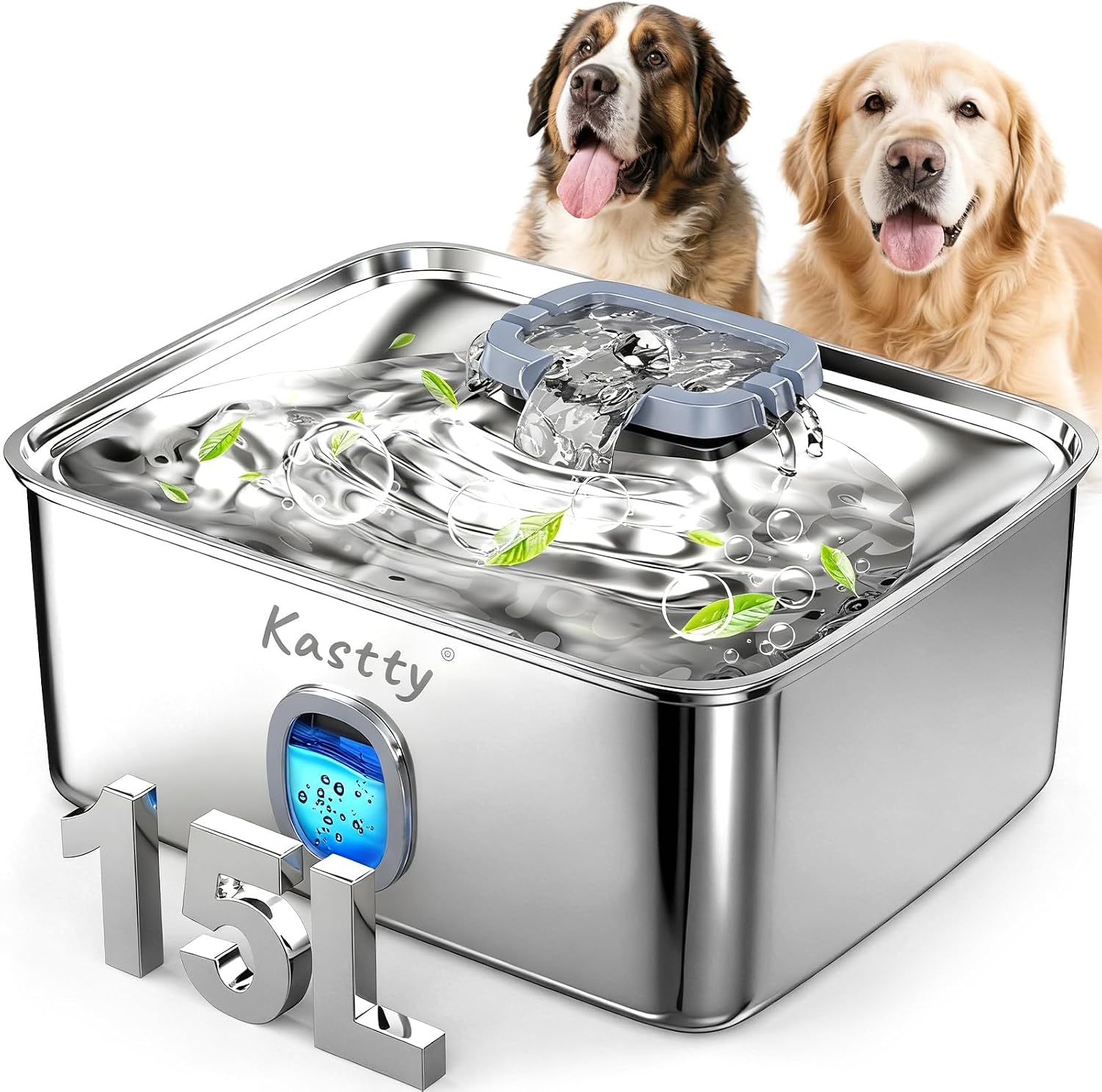
Kastty 4 Gal/15L Stainless Steel Dog Water Fountain for Large Dogs
Biggest stainless basin in the group and the only one named for large dogs, so a big dog is not fighting a shallow puddle
Largest footprint here, and a full tank is a lot of water to dump and refill if your dog drinks slowly
oneisall 7L/230oz Dog Water Fountain for Multi-pet Household,PWF002
A 7L reservoir with pumped circulation, sized and named for multi-pet homes
No stainless steel in the name and no height adjustment for a senior dog
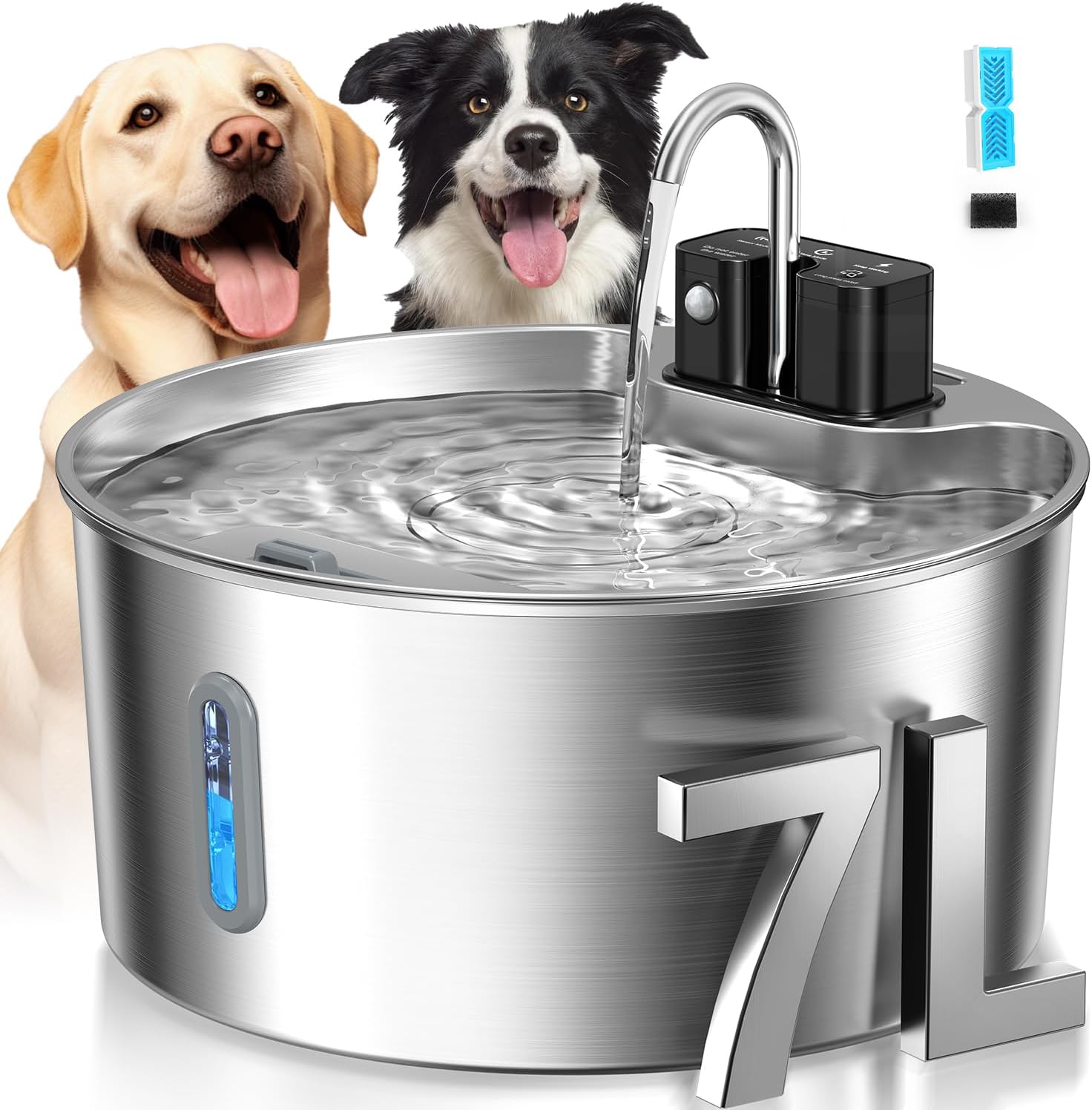
Voluas 7L Wireless Dog Water Fountain with 1 Filter, Stainless Steel
Wireless operation removes the cord from the equation, and it ships with a filter cartridge and a stainless steel build
You trade a wall outlet for a charging routine, and the reservoir is still 7L
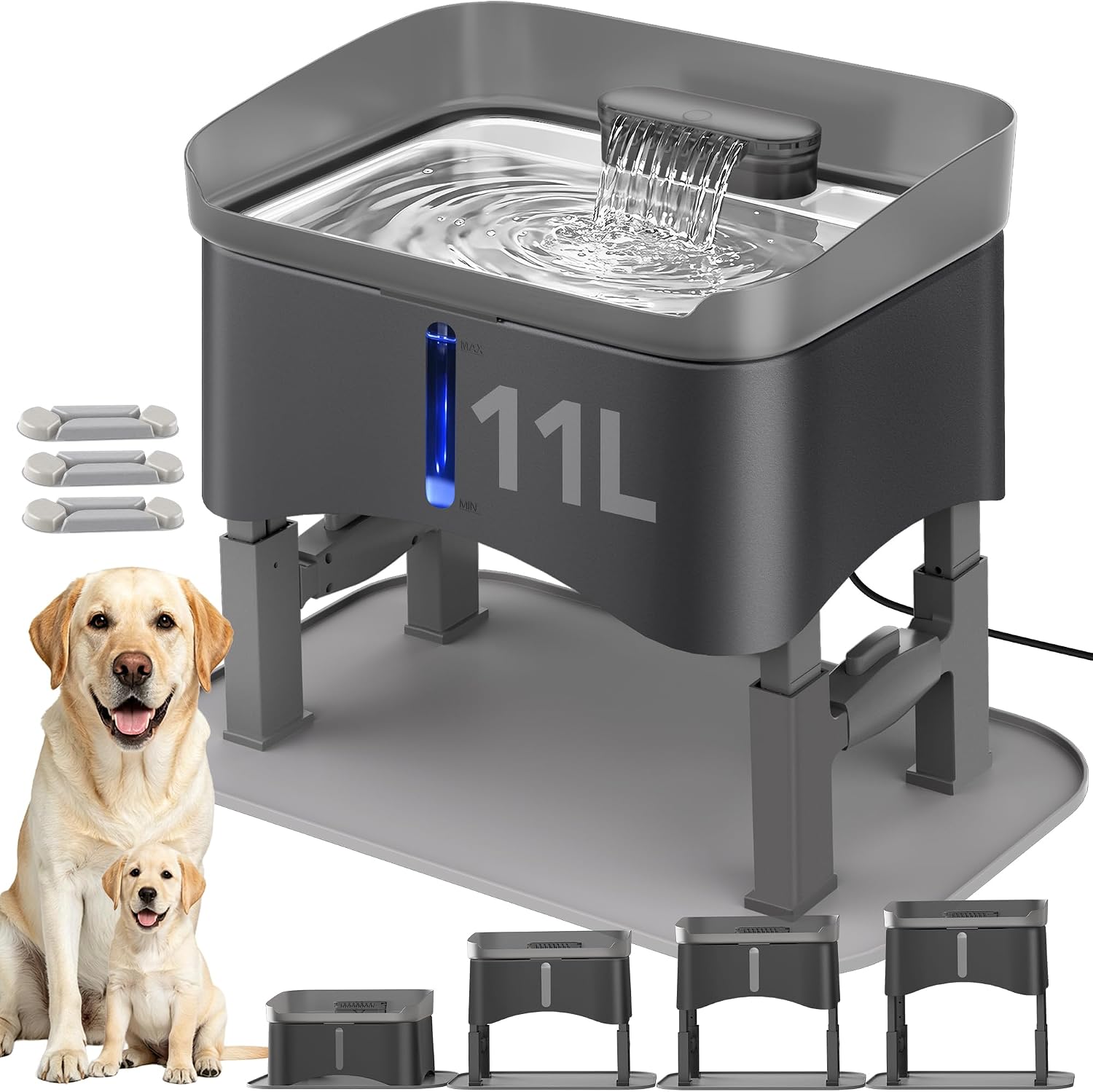
Twinsing 11L Elevated Dog Water Fountain No-Spill with 4 Heights Adjustable
11L of water plus four adjustable heights, the only setup here that can lift the drinking surface for a tall or senior dog
The tallest and most involved unit of the four, and the no-spill design adds parts to rinse
Prices and availability may change.
The gravity waterer vs dog water fountain question, answered
A gravity waterer is a reservoir that sits upside down over a bowl. Water flows down until the bowl level covers the opening, then the vacuum holds the rest back. As the dog drinks, the level drops, air slips in, and more water flows. No pump, no cord, no filter cartridge to replace. It is the same principle as a poultry drinker, scaled up for a Labrador.
A dog water fountain does the opposite: it moves water on purpose. A pump lifts water from a reservoir and lets it fall or stream back into a basin, and most models route it through a filter on the way. Moving water stays aerated, catches crumbs and hair in the cartridge, and gives a dog a reason to drink more because the surface is not flat and still.
The difference between gravity waterer and dog water fountain designs comes down to three practical things: power, filtration, and surface area. A gravity waterer needs a wall outlet for nothing, but it also filters nothing, and the water sits in a narrow column where a determined cat can knock the reservoir loose. A fountain needs electricity or a charged battery, but it keeps water moving, which matters in a warm house and matters more when several animals drink from the same basin.
The dog water fountain vs gravity waterer debate usually gets settled by one question: how long does water sit in your house before it is gone? A single small dog may take two days to work through a bowl, which is long enough for a still surface to collect dust, drool, and the occasional kibble. Three dogs will empty it twice a day, which is exactly the situation where a gravity reservoir's simplicity beats a pump you have to clean.
Water capacity, bowl capacity, and how fast it disappears
Water capacity is the number that sells fountains and the number that gets ignored after week two. Here is the useful math. A healthy dog drinks roughly an ounce of water per pound of body weight per day, so a 70-pound dog goes through about 70 ounces, a little over two liters, before you count evaporation, splashing, and the cat that drinks from the same basin.
That puts the 7L units, the oneisall and the Voluas, at roughly three days for one large dog and a day and a half for two. The Kastty's 15L reservoir doubles that. The Twinsing's 11L sits between them, and it is the only one of the four whose name includes a height claim, which matters more than capacity once a dog is older.
Bowl capacity is the separate number people confuse with reservoir size. A deep reservoir feeding a shallow basin still means your dog's tongue is working the bottom of a puddle. Look at how much water sits in the drinking area at rest, not how much the tank holds. Fountains with a wide basin and a gentle flow keep more water available at the surface than a narrow spout that drops into a cup-sized well.
Two practical checks before you buy. First, measure the space you are giving up. A 15L unit is a floor object, not a countertop one. Second, decide who refills it. A gravity waterer with a 15L reservoir can go a week. A fountain with a 7L reservoir and a filter cartridge needs a top-up and a rinse more often, and the pump will complain loudly if it runs dry.
Filter cartridges, the airtight seal, and water that stays fresh
Filtration is the strongest argument for a fountain and the strongest argument against a cheap one. A filter cartridge traps hair, dust, and food particles before they settle, and moving water stays aerated, which is why some dogs drink noticeably more from a fountain than from a still bowl. The catch is the cartridge itself. It is a consumable, it needs rinsing every week or two, and a clogged filter turns a quiet pump into a grinder.
Only one of the four units here advertises a filter in its name, the Voluas with its single included cartridge, so plan on checking the product page for filter fit and replacement intervals on the others. That is not a knock. It is the part of fountain ownership people forget when they compare a pump to a bucket.
The airtight seal belongs to the other design. A gravity waterer only works if the reservoir seals against its base. Break the seal, whether by a cracked gasket or a reservoir set down crooked, and the whole tank empties onto your floor while you are at work. That single failure mode is why gravity units get a bad reputation they mostly do not deserve. Check the gasket, seat the reservoir straight, and the vacuum holds.
Which design keeps water fresher? A fountain, clearly, because the water never sits still and the filter catches debris. Which design keeps water available during a power cut? The gravity waterer, by a mile. Neither is universally better, and the honest answer depends on how much you trust your household to notice a pump that has gone quiet.
Feeding height, spill control, and the non slip base
Feeding height is the variable most buyers skip and most senior dogs care about. A dog with arthritis in the neck or elbows does better when the water surface is closer to chest height, which is why elevated designs exist. The Twinsing is the only unit in this group that advertises adjustable heights, four of them, and that flexibility is the reason it sits at the top of this set. If your dog is a tall breed, a senior, or recovering from surgery, an elevated basin is not a luxury.
Spill control comes down to three things: how wide the basin is, how hard the water falls, and what the base does when a dog noses the unit. A no-spill design like the Twinsing's keeps the drinking area contained, but the same is true of any fountain whose basin has a lip. Gravity waterers are the wild card. A dog that bumps the reservoir can tip the whole thing, and a full tank on a tile floor is a genuinely bad afternoon.
That is where a non slip base earns its place. Rubber feet or a grippy ring do not look like a feature until you watch a 90-pound dog slide a full reservoir across the kitchen. If the unit you like does not advertise one, budget for a mat underneath it.
One aside on the rest of the feeding station: slow feed ridges and puzzle bowls are food-side features, not water-side ones, but they usually live on the same mat, and a mat that holds water is worth more than either. Whatever you choose, put a lip between the water and your floor.
Cleaning, dishwasher safe parts, and daily rinses
Cleaning is where the gravity waterer vs dog water fountain gap shows up most. A gravity reservoir has two parts that touch water: the tank and the bowl. Rinse both, scrub the bowl with a bottle brush once a week, and you are done. No pump housing, no impeller, no cord to keep dry.
A fountain has a pump, a basin, a spout or ramp, and usually a filter housing, and every one of those surfaces grows a biofilm if you ignore it. The routine that actually works is a thirty-second rinse of the basin daily, a full teardown weekly, and a filter cartridge swap on whatever schedule the maker recommends. Stainless steel basins, which the Kastty and the Voluas both advertise, hold up better to that routine than plastic, resist the scratches that harbor slime, and generally are dishwasher safe when the maker says so. Check the product page before you put anything in the top rack.
The pump is the part that fails. Hair wrapped around an impeller is the number one cause of a fountain that hums but does not move water, and the fix is a five-minute soak in vinegar and water rather than a new unit. Cordless models trade that maintenance for a charging habit, which is a fair trade if the fountain sits where no outlet reaches.
The practical takeaway: if you will not commit to a weekly rinse, buy a gravity waterer. A fountain you never clean is worse than a still bowl, because it is actively circulating whatever is growing inside it.
Trade-offs, product by product
This is where the four units here actually separate, and it is the practical end of the gravity waterer vs dog water fountain argument, because the design question matters less than which model fits your floor.
The Kastty 4 Gal/15L is the answer for a household with one or more genuinely large dogs. Fifteen liters is the biggest reservoir in this group, the basin is stainless steel, and the whole thing is built around the assumption that a big dog drinks a lot. The trade-off is real: it takes up floor space, it is heavy when full, and with a single small dog you will be dumping water you never used. Visit on Amazon
The oneisall 7L is the multi-pet workhorse of the group. Seven liters with pumped circulation covers two or three average dogs for a day and a half, and it does it without asking for stainless steel money. What it does not offer is a height adjustment, so if your household includes a senior dog, look at the Twinsing instead. Visit on Amazon
The Voluas 7L is the one to pick when the outlet is nowhere near where the water belongs. Wireless operation plus a stainless steel basin and an included filter cartridge is a genuinely different package from the other three, and the only cost is remembering to charge it. Visit on Amazon
The Twinsing 11L Elevated is the specialist. Four adjustable heights and a no-spill design make it the right unit for a tall breed, an older dog, or anyone tired of mopping. It is also the most involved to clean and the tallest object of the four, so it needs a dedicated corner. Visit on Amazon
None of these is a bad purchase. They are four different answers to the same question, and the question is not which one is best.
Which one fits your household
Run the checklist in order and the choice usually makes itself.
If your dog is small, drinks steadily, and you have an outlet where the bowl belongs, the oneisall 7L is the least fuss for the money. If the outlet is the problem, the Voluas 7L solves it. If you have a large dog, or two, the Kastty's 15L stainless reservoir means fewer refills and a basin that stands up to daily scrubbing. If your dog is tall, old, or recovering, the Twinsing's four adjustable heights are the only feature here that changes how your dog stands while it drinks.
If none of those fit, or if you travel and cannot rely on a pump, a gravity waterer is still a perfectly good answer. Buy a well-sealed one, check the gasket, and put it on a non slip base. Whether you end up with a gravity waterer or dog water fountain, the maintenance habit matters more than the mechanism: rinse the basin daily, deep clean weekly, and replace the filter cartridge on schedule.
One last thing. Whatever you pick, place it away from the food bowl if your dog is a messy eater. Water plus kibble dust equals a biofilm problem by Thursday.
What I'm watching next
Two things worth watching in dog water gear. Cordless fountains like the Voluas are pushing battery life further, which slowly removes the outlet from the decision entirely. Elevated fountains like the Twinsing are adding more height positions, which is the feature senior-dog owners have been asking for and the one most listings still ignore.
If neither applies to you, buy the 7L stainless fountain that fits your corner, set a weekly rinse reminder on your phone, and stop thinking about it. That is the whole gravity waterer vs dog water fountain decision in one line: match the water capacity to your household, then pick the design you will actually clean.