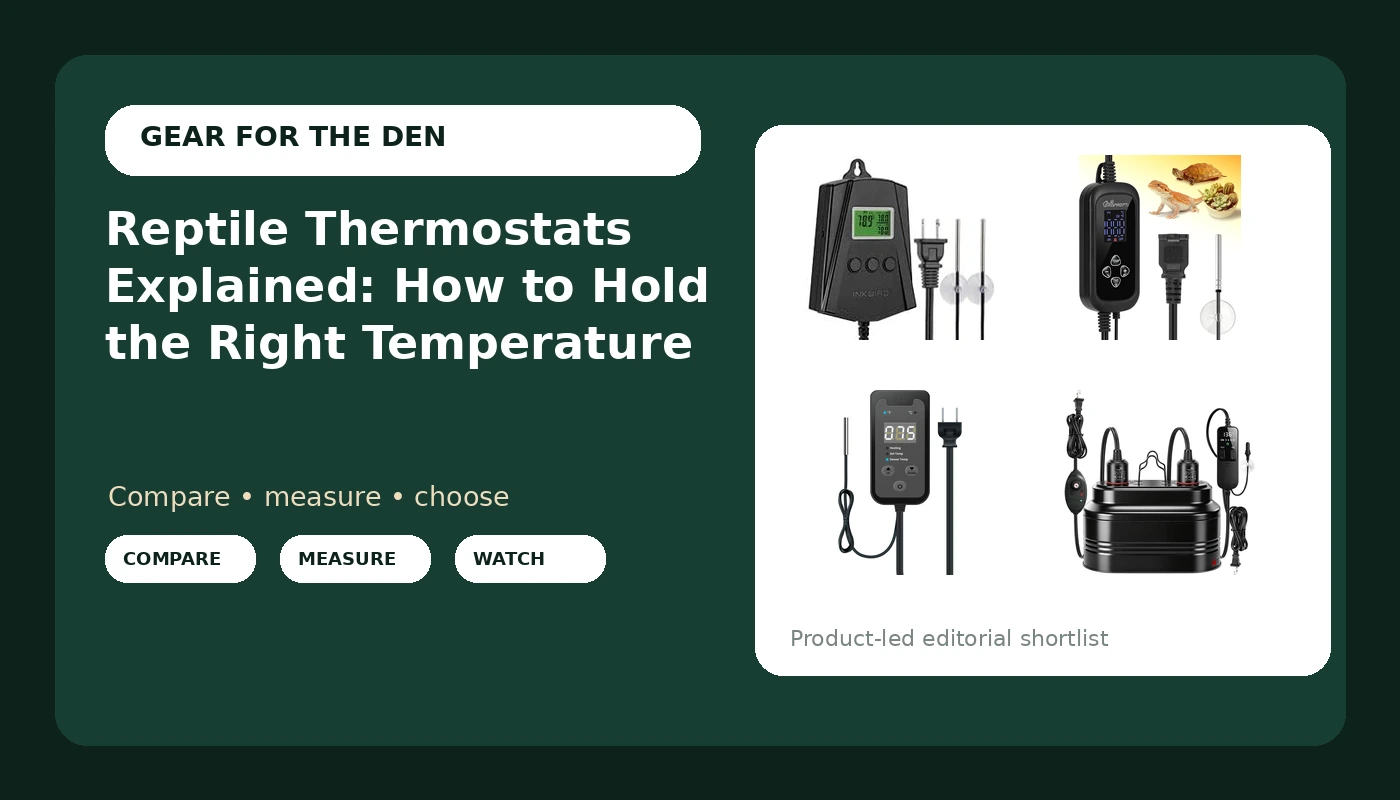
Heat is the part of a reptile enclosure that runs every hour of the day, and the device deciding how much of it reaches the tank is usually the least exciting item on the shelf. The goal here is reptile thermostats explained in practical terms rather than spec-sheet terms, because the mismatches that hurt animals are almost always about control type. Most reptile thermostats fall into three families: on/off controllers that cut power when a probe reads above the set point, dimming or PID controllers that throttle power to lamps and radiant heaters, and multi-outlet or app-connected units that run more than one device at once. Pairing the wrong family with the wrong heater is the usual mistake, and it is the mistake this guide is built to prevent.
Quick answer
Match the controller to the heater, not to the enclosure's price bracket. Dimming or PID control suits lamps and other radiant heaters, plain on/off control suits heat mats, cables, and pads, and a two-outlet unit suits keepers running two heat sources or two tanks. What counts as ideal reptile thermostats behavior for your setup depends on the thermostat range you need, how far the probe sits from the heater, and whether a timer is built in. Whichever type you buy, the set point should come from a measured basking temperature at the basking spot, not from the number printed on the box.
Four useful options
| Model | Best fit | What stands out |
|---|---|---|
| Inkbird IPT-2CH Wi-Fi controller | Tanks running two heat sources | Two probes and two outlets, with a stated 250W maximum per outlet |
| RAPREPTI PID dimming thermostat | Basking lamps and heat lamps | PID dimming with a 1-24 hour timer and a memory function |
| SYSAI 100W-1A thermostat controller | A single heat mat or pad | On/off switching with a stated 60-94°F range and a °F/°C display |
| FMATOZ dual reptile light fixture | Enclosures that need a lamp and its control together | Two sockets with a built-in thermostat and timer |
Two-outlet Wi-Fi control: Inkbird IPT-2CH
The trade-off with an on/off design is that the heater is either fully on or fully off, so the measured surface drifts a little above the set point before the probe catches up, then a little below it afterwards. On a heat mat that swing is usually mild, because the mat and the substrate above it hold some heat. On a high-wattage basking bulb it is more noticeable, which is why lamp-driven enclosures are usually better served by dimming control. Two probes also mean two cables to route, and both sensor leads have to reach their spots without crossing the hottest part of the enclosure.
Dimming control for basking lamps: RAPREPTI PID thermostat
Dimming and PID controllers are the closest thing to a dial for heat. Because output is reduced rather than interrupted, the lamp stays lit and the basking surface settles nearer the set value instead of cycling around it, which matters for species that bask in a tight temperature band. The catch is the load: dimming only makes sense on a heater that can be dimmed, so this is not the controller to connect to a plain heat mat. The built-in timer is a genuine convenience for lamps, because a basking bulb normally runs on a day cycle rather than around the clock.
Simple on/off switching: SYSAI 100W-1A thermostat controller
The appeal of an on/off controller is that there is nothing to tune. There is no dimming curve to configure and the display shows the probe reading directly, which makes it easy to confirm a mat is holding its target. The limits matter just as much. It switches power rather than throttling it, so it should not be used to dim a basking bulb. Its stated 60-94°F range also rules it out for species kept at higher warm-side temperatures, where a controller with a wider range is the better fit.
Lamps and control in one housing: FMATOZ dual light fixture
An all-in-one fixture works well when the lamp is the only heat source and the enclosure layout is already settled. It is less flexible than a standalone controller: if you later want to dim a different bulb, or move to a heat mat plus a lamp, a separate controller can follow that change while a fixed fixture cannot. Mounting reach matters too, since the fixture has to sit over the basking area rather than off to one side, and the timer and thermostat settings live inside the same housing as the heat.
Prices and availability may change. Product images, names, and retailer links are matched to verified listings. No current price, rating, stock status, or measured result is stated here without current evidence.
What reptile thermostats actually control
A thermostat does not measure an enclosure. It measures one point, wherever the probe sits, and holds that point near the set value by regulating power. Everything else about the thermal gradient is a product of tank size, heating wattage, and where the probe was placed.
That single detail explains most thermostat complaints. If the probe is taped to the glass above a heat mat, the controller is reading glass temperature, not the surface where the animal lies. If it is buried under the substrate, it reads a value that lags well behind the surface the reptile actually touches. The practical approach is to place the probe where the animal spends its time and to verify the result with a separate thermometer before trusting the number on the display.
The two control styles behave differently around the set point. On/off units allow a swing, because a heater keeps releasing stored heat after the power cuts and the probe keeps reading ambient air after power returns. Dimming and PID units reduce output instead, so they settle closer to the set value. Getting correct reptile thermostats behavior from an on/off unit mostly means accepting that swing as normal rather than chasing it with constant adjustments.
Thermostat range is a separate specification from the set point. A controller that cannot be set above a certain temperature is not a fit for an enclosure that needs more, however accurate it is at the top of its scale. Read the range first, then compare it to a measured basking temperature.
Matching the controller to the enclosure
Heater type comes first. Heat mats, cables, and pads are resistive loads that can simply be switched, so an on/off controller suits them. Lamps and other radiant heaters change output as they warm and cool, and dimming control handles that better. heat mat wattage matters against the controller's stated switching capacity, because a single mat still has to sit within the maximum the unit is rated to switch.
Enclosure dimensions come second. In a large tank, one probe cannot represent the whole footprint, so a heater that is oversized for the measured area is a recipe for a hot spot at one end. Basking temperature should be read at the basking spot itself rather than in the middle of the enclosure. If you run a UVB output lamp, remember that the lamp producing the light is not always the lamp the thermostat controls, and mixing the two roles makes the setup harder to read.
Then there is the setup layer. Substrate depth changes how quickly the surface above a heat mat warms, and a deep layer insulates a buried probe from the surface the animal feels. Hide size and position decide where the animal actually rests, and a hide placed directly over a probe will produce different numbers than one placed to the side. A humidity range belongs to a separate controller or a misting routine, since no thermostat will hold humidity for you.
- Measure the basking surface temperature with an independent thermometer before changing anything, so you know the target you are trying to hold.
- Identify the heater: a mat, pad, or cable points to on/off control, while a basking bulb or heat lamp points to dimming control.
- Count the devices, because two heat sources or two tanks call for a two-outlet controller and a single heater does not.
- Check the thermostat range against your measured target, then check heat mat wattage against the controller's stated switching limit.
- Place the probe on the surface the animal uses, secure it so the reptile cannot move it, and confirm the reading against a second thermometer.
Practical setup notes
- Route probe cables away from the water bowl and away from the hottest part of a lamp's arc, where insulation can dry out over time.
- Never bury a probe under a substrate depth you have not measured, because the reading will lag the surface.
- Run lamps on a timer that matches the species' daylight period rather than letting the thermostat switch a light every few minutes.
- Recheck temperatures after any change to substrate depth, hide size, or heater wattage, since all three reshape the gradient.
- Keep the controller outside the enclosure on a dry surface with airflow, because warm humid air is hard on electronics.
Which option should you choose?
Choose the Inkbird WiFi Heat Mat Reptile Thermostat Controller Temperature Controller with 2 Probes and 2 Outlets, IPT-2CH Reptiles Heat Mat Thermostat (Max 250W per Outlet) when you run two heat sources or two enclosures and want them regulated and monitored from one place. Choose the RAPREPTI PID Dimming Thermostat for Reptiles with 1-24H Timer Setting Temperature Controller with Memory Function for Heat Lamps, Basking Bulbs & Heaters when your main heat source is a basking bulb or heat lamp and you want output reduced rather than switched. Choose the SYSAI 100W-1A Non-Dimmable Thermostat Controller with Probe, 60-94°F Digital Temperature Outlet for Reptile Heating Pad, Ceramic Heater, Brooder, Fermentation Belt & More, °F/°C Display when you have a single heat mat or pad and want a simple switched controller with a clear display and a range that covers your target. Choose the FMATOZ Dual Reptile Light Fixture,Reptile Heat Lamp with Thermostat & Timer when you would rather buy the lamp housing, thermostat, and timer as one unit.
No thermostat repairs an enclosure that cannot hold heat or a room that swings wildly overnight. The descriptions above cover what each unit is built to do, while the set points, checklist steps, and probe guidance are general husbandry practice rather than results from testing these units.
The bottom line
Reptile thermostats are not interchangeable parts: the controller type has to follow the heater type, and the set point has to follow a measured basking temperature rather than a guess. For a single mat or pad, a switched controller with a range that covers your target is enough. For lamps, a dimming or PID unit is the better match. For two heat sources or two tanks, a two-outlet controller keeps the wiring and the monitoring in one place, and an all-in-one fixture suits the keeper who wants the lamp and its control in a single housing. Whichever you pick, probe placement does more for accuracy than any feature on the box.