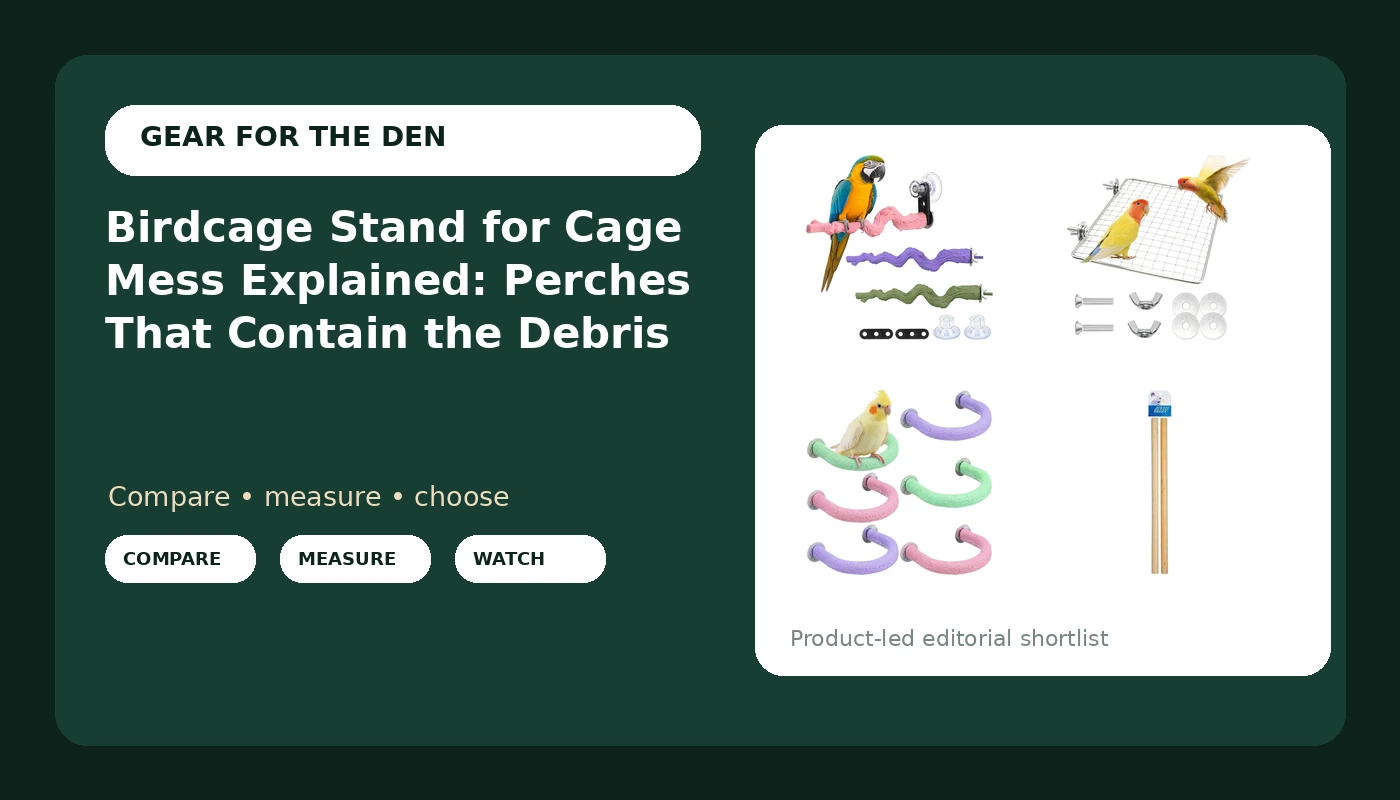
Cage mess is rarely a cleaning problem. It is a placement problem. Seed hulls, feather dust, and droppings do not spread evenly across a cage floor; they fall from the two or three places where your bird actually sits, eats, and sleeps. That is why the phrase birdcage stand for cage mess keeps coming up among bird owners: people are looking for a physical fix, a perch or platform that decides where the debris lands and how easily the tray can be wiped out afterward. No accessory makes a cage self-cleaning. What a perch stand can do is shift the drop zone, keep waste away from the cage wall and the floor outside it, and give you a surface you can lift out and rinse. The four options below take different routes to that job, from an out-of-cage window perch to an open-grid platform to a low-cost six-piece set.
Quick answer
Here is the birdcage stand for cage mess explained in one line: mess follows the perch. Pick a perch by where it puts the bird, not by how it looks. A perch positioned over the tray drops waste where you can collect it; a perch pushed against the cage wall, or sitting above the food cup, drops waste onto the wall, the floor, or into the food. Measure cage height and bar spacing before you buy, match perch diameter to foot size, and keep the highest perch inboard of the tray edge. The four products below cover out-of-cage perching, an open-grid platform, a multi-piece set, and a plain replacement perch.
Four useful options
| Model | Best fit | What stands out |
|---|---|---|
| OBreezify 3 Pcs Dual-use Bird Perch | Birds that perch outside the cage | Three perches with suction cup and screw mount |
| FUATY Stainless Steel Bird Perch for Cage | Owners who want a flat, wipeable surface | Stainless steel open-grid platform |
| Wettarn 6 Pcs U Shape Parakeet Perch Stand | Adding several perch spots at once | Six pieces, including a swing stick |
| Prevue Pet Products Pacific Bird Cage Perch | Replacing one worn perch | Single perch from a cage brand |
The out-of-cage option: OBreezify 3 Pcs Dual-use Bird Perch
The trade-off is honest: anything the bird does outside the cage happens outside the tray. A window perch relocates droppings from the cage floor to the sill, the wall, or the glass below, so plan on a wipeable mat or a sheet of paper underneath whatever surface you use. Suction cups also need a clean, smooth, non-porous surface to hold, and they are worth checking before every use. Where this design earns its place is travel and out-of-cage time: a perch that mounts in a bathroom or on a car window gives a bird somewhere to sit that is not the top of a carrier, which matters when carrier size is already tight. If you want a birdcage mount for cage mess that sits outside the cage entirely, this is the shape to look at.
The open-grid platform: FUATY Stainless Steel Bird Perch for Cage
A platform changes the drop pattern in a useful way. Because the bird stands in one defined rectangle, waste lands in a narrower band than it would from a long dowel, and the open grid lets most of it fall straight through instead of smearing on the perch. Think of it as a birdcage riser for cage mess control: the platform holds the bird at a fixed height above the tray, so the tray liner underneath catches nearly everything. The grid does need a brush or a rinse now and then, since hulls and dust collect in the openings, and a metal surface feels different underfoot than wood. Flat platforms suit birds that prefer to stand rather than grip, and they are a reasonable option for a bird that grips a round dowel less securely than it used to.
The multi-piece set: Wettarn 6 Pcs U Shape Parakeet Perch Stand
More perches do not mean less mess by themselves. They mean more drop zones, spread across more of the cage floor, which helps when your bird currently spends all day in one corner and leaves a single dense pile there. Spreading the bird's time across several perches spreads the waste, and a spread-out mess is easier to manage with a tray liner than a concentrated one. The counterweight is cleaning: rope perches absorb moisture and need to be rinsed and dried, and six pieces means six surfaces to keep an eye on. The swing mount on the swing stick also moves, so its drop zone is not fixed. This is the set to consider when a cage looks empty above the tray and you want the bird moving around more of it.
The simple replacement perch: Prevue Pet Products Pacific Bird Cage Perch
A spare perch is one of the least glamorous ways to reduce cage mess, and one of the most effective. With a second perch on hand, the dirty one can go straight into the sink while the clean one goes back into the cage, so the bird is never standing on a soiled surface while you decide when to clean. The limitation is that this is a single perch. It does not change where the drop zone is, it does not add mounting options, and it does nothing for a cage that needs more perch positions. It is a replacement part, and it should be judged as one.
Prices and availability may change. Product images, names, and retailer links are matched to verified listings. No current price, rating, stock status, or measured result is stated here without current evidence.
What a birdcage stand for cage mess setup actually changes
Bird droppings and seed hulls fall almost straight down, so the horizontal position of a perch decides what is underneath it. There are only three zones that matter. A perch over the tray drops waste where the tray liner can catch it, which is the outcome you want. A perch near the cage wall or the door drops waste onto the wall, the bars, or the floor outside the cage. A perch above the food cup drops waste and hulls into the food, which is the one zone worth fixing immediately.
Cage height sets how much room you have to work with. A taller cage lets you place the highest perch well above the tray, so there is distance for waste to fall cleanly and less chance of it catching on lower perches on the way down. A short cage forces perches closer to the tray, which means more frequent liner changes but also less scatter outside the cage.
Two more variables feed into the mess. Food cup size and position matter, because a wide open cup placed under a perch collects husks and debris that a cup set away from the main perch would not. Foraging difficulty matters too: a harder foraging toy holds a bird in one spot for longer, concentrating waste in a single place that is easy to line and clean, rather than scattering it as the bird wanders. The perch a bird sleeps on overnight is usually the biggest single contributor.
Matching perch size, bar spacing, and placement to your cage
Perch diameter should match the feet. As a working rule, a bird's toes should wrap roughly two thirds of the way around the surface; a perch that is too thin concentrates pressure on the foot, and one that is too thick gives a poor grip. If you keep birds of noticeably different sizes, use different perch diameters rather than one compromise size.
Bar spacing decides what will actually mount. Check the spacing where the perch will sit, because a mount that fits loosely can rattle or be pushed out of position. For screw-mounted and clamp-style perches, the cage bars need to be close enough together for the fitting to grip. Suction-cup mounts are a different case: they need a smooth, non-porous surface, so they belong on glass, tile, or a smooth wall rather than on cage bars.
Cage height and placement go together. Measure the interior height from the tray to the top of the cage, then leave clearance above the highest perch for the bird's head. Keep the highest perch inboard of the tray edge so the drop zone stays over the tray. Finally, think about whether you want a fixed perch or a swing mount. A swing moves, and a moving drop zone is harder to plan for.
- Watch your bird for a week and note the two or three spots it uses most for eating, sleeping, and resting.
- Measure interior cage height and check the bar spacing at each spot where a perch will mount.
- Match perch diameter to foot size, using a thinner perch for smaller birds and a thicker one for larger birds.
- Move the main perch inboard so it sits over the tray rather than near the cage wall or the door.
- Place a tray liner under the busiest perch and change it on a fixed schedule rather than when the mess becomes visible.
Practical guidance for a cleaner cage floor
- Keep food cups out from directly under the main perch, and prefer a narrower cup over a wide open dish when hull scatter is a problem.
- Line the tray with paper or a tray liner and change it on a set day; a liner that can be rolled up and thrown away beats scrubbing a bare tray.
- Treat each perch as a birdcage holder for cage mess: it holds the bird in one spot, and that spot decides where everything below it lands.
- A birdcage stand for cage mess plan only works when the perch sits inboard of the tray edge, so check placement after every cage rearrange.
- Rinse rope perches and wipe platform perches regularly, and keep one spare perch so a soiled one can be swapped out mid-clean, as covered in this bird cage cleaning routine.
- If you travel with your bird, pack the perch you already know it uses, so a new environment does not become a new drop zone.
Which option should you choose?
Choose the OBreezify 3 Pcs Dual-use Bird Perch with Rough Grinding Stone, Suction Cup & Screw Mount Window Perch Multi-Functional Bird Perches for Small and Medium Birds when your bird spends time out of the cage and you want perching on a window, a wall, or in a car without setting up a second cage. Choose the FUATY Stainless Steel Bird Perch for Cage, Open-Grid Easy Clean Parrot Perch Stand Platform, Claw-Friendly Grip Bird Cage Accessories for Cockatiel, Conure, Budgie, Parakeet, Small Medium Birds when you want a flat, wipeable platform and a narrow, predictable drop zone over the tray. Choose the Wettarn 6 Pcs U Shape Parakeet Perch Stand Toys Bird Perches Climbing Rough Rope Paw Grinding Perch Swing Stick Cage Accessories for Conure Budgie Cockatiel Caique to Clean Stick Exercise when a cage needs more perch positions and you want the bird moving instead of sitting in one corner. Choose the Prevue Pet Products Pacific Bird Cage Perch when you simply need a replacement or a spare perch for a setup you already like.
None of these products collects waste, and none of them changes how much a bird produces. They change where the waste lands and how easily you can remove it. Mounting fit, bar spacing, and bird size vary from cage to cage, so check the listing details and dimensions before buying rather than assuming a perch will fit. No current price, rating, or stock status is stated here.
The bottom line
Cage mess is a placement problem with a physical solution. Put the perch over the tray, keep it away from the wall and the food cup, line the tray, and the daily cleanup shrinks to a task you can finish in a minute. An open-grid platform gives you the tightest drop zone and a surface that wipes down. A multi-piece set spreads the bird, and therefore the waste, around the cage instead of leaving one dense pile in a corner. A window perch moves the whole problem outside the cage, where it becomes a mat you can rinse. A plain spare perch keeps a bird off a soiled surface while the dirty one soaks. Start by watching where your bird actually spends its day, then buy the perch that puts that spot over the tray.