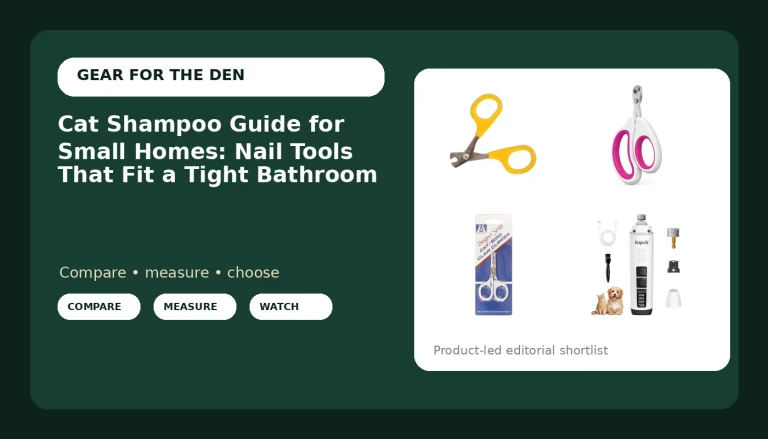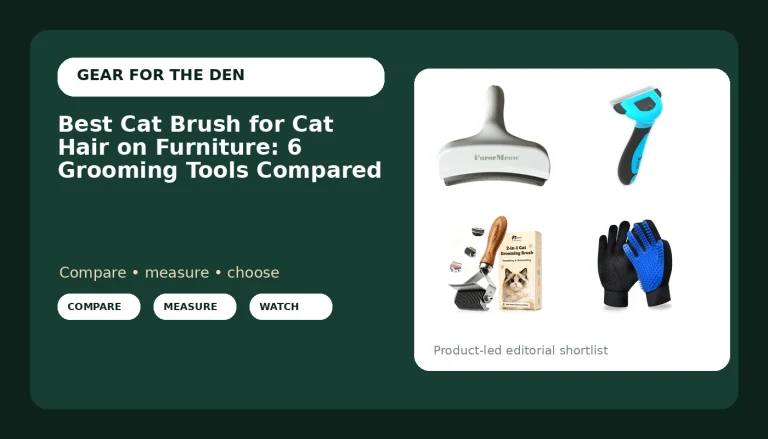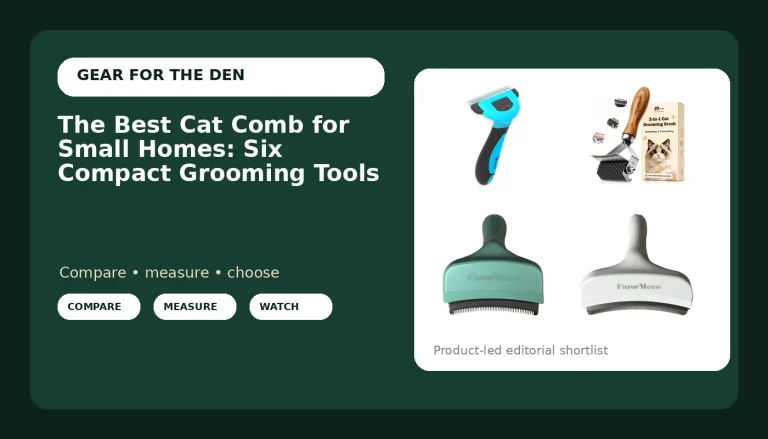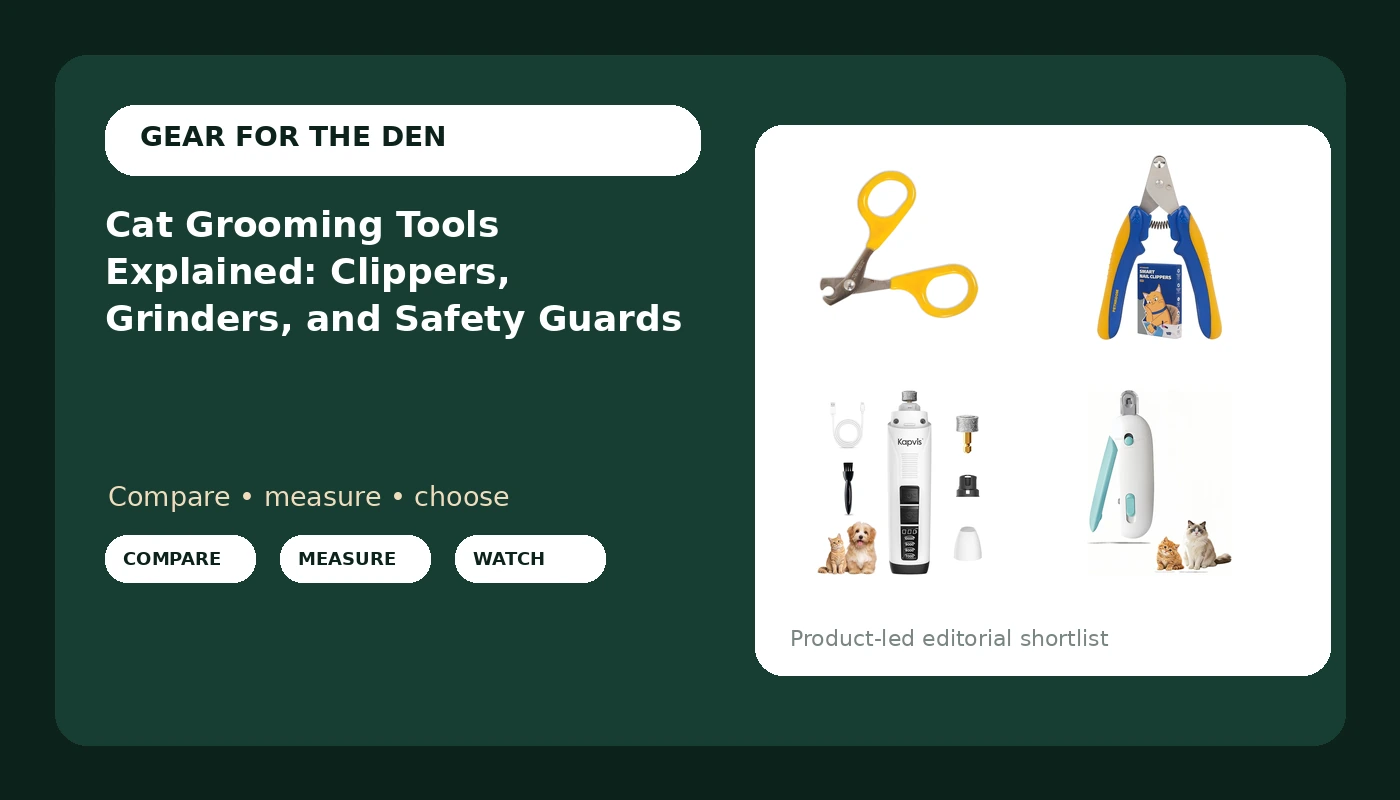
Most cats keep their own coat in reasonable shape, which is why owners rarely think about equipment until a claw snags the sofa or a mat tightens behind the shoulders. That is when the search for cat grooming tools begins, and the results are confusing. Scissors, clippers, trimmers, grinders, brushes, combs, and grooming gloves all sit in the same aisle with similar wording on the packaging, and the product photos rarely show the part that actually matters, which is how the tool behaves in your hand with a cat that has opinions.
Claw care and coat care are separate jobs that use separate equipment, and claw care alone splits into cutting and grinding. Buying one tool and expecting it to cover both is the most common mistake, and it usually ends with a cat that learns to hide whenever the drawer opens.
Quick answer
Cat grooming tools explained in one pass: most indoor cats need one claw tool and one coat tool, not a drawer full of both. For claws, scissor-style clippers such as the JW Pet GripSoft cover routine trimming, while a rotary grinder can smooth the cut edge afterward. Circular-hole trimmers and guarded clippers exist for owners who want the claw held steady in a fixed opening or a physical stop behind the blade. For the coat, the brush has to match coat length and undercoat density. No spec sheet can tell you how your cat will react to being handled, and that matters more than any feature list.
Four useful options
| Model | Best fit | What stands out |
|---|---|---|
| JW Pet GripSoft Cat Nail Clippers Non-Slip Handle, One Size Fits All | Routine claw trims on a short-haired indoor cat | Non-slip GripSoft handle, one size fits all |
| PETHROOM Cat Nail Clipper Trimmer for Indoor Cats, 2mm Circular Cut Hole | Owners who want the claw held in a fixed opening | 2mm circular cut hole |
| New Pet Nail Grinder for Dogs, 4-Speed Cat Nail Grinder for Dogs&Cats | Smoothing a cut edge after trimming | Four speed settings, listed for dogs and cats |
| SAYUANVA Adjustable Cat Nail Clippers with Safety Guard & Hidden File | Kittens and nervous cats that need a physical stop | Adjustable, with safety guard and hidden file |
The everyday clipper: JW Pet GripSoft Cat Nail Clippers Non-Slip Handle, One Size Fits All
For most owners the first purchase is a scissor-style clipper, because it is the tool most people already understand. You place the claw between two blades, squeeze, and a tip comes off. The non-slip handle matters more than it sounds, since trimming is a two-hand job and one hand is usually steadying a paw. The single-size design removes a decision, but it also means the handle is a compromise shape; someone with very small or very large hands may find a different grip easier. This is a good starting point if your cat tolerates having its paws handled and you only need to shorten tips.
The fixed-opening trimmer: PETHROOM Cat Nail Clipper Trimmer for Indoor Cats, 2mm Circular Cut Hole
A circular cut hole does part of the aiming for you. The claw tip drops into the opening, the blade closes across it, and the amount removed is limited by how much claw went through the hole. That is useful with a wriggling cat, because the opening holds the claw in place for the split second the cut happens. The trade-off is fit: a 2mm opening is small, which tends to suit the narrower claws of indoor cats and younger animals, while a thicker claw may not seat properly in the hole. If your cat's claws are wide or the tips have thickened with age, an open scissor jaw gives you more room to work.
The grinder: New Pet Nail Grinder for Dogs, 4-Speed Cat Nail Grinder for Dogs&Cats
A grinder works differently from a clipper. Instead of removing a section of claw at once, the rotating head sands away thin layers, so you can stop as soon as the sharp point is gone. That makes it a natural second step after clipping, and some owners use it on its own for maintenance. Speed settings give you a place to start slowly with a nervous cat, though grinding takes longer than cutting and the head can warm up with prolonged contact, so short passes are the sensible approach. Cats divide sharply on vibration and sound; some ignore it, others want nothing to do with it, and no listing can predict which yours will be.
The guarded clipper: SAYUANVA Adjustable Cat Nail Clippers with Safety Guard & Hidden File, Splash-Proof Trimmer for Kittens & Indoor Cats, Painless Blue Claw Scissors
A nail guard is the feature to understand here. It is a plate, ring, or raised stop positioned behind the cutting edge so the blade cannot travel as far into the claw as it otherwise would. For someone learning where the quick sits, that limit is the whole point, and it is why guarded clippers turn up in kitten kits and first-time-owner setups. The hidden file handles the sharp edge left behind after a cut without needing a second tool on the table. The usual trade-off applies: a guard restricts how much claw you can remove per squeeze, so a thick adult claw may take more passes than it would with an open jaw clipper.
Prices and availability may change. Product images, names, and retailer links are matched to verified listings. No current price, rating, stock status, or measured result is stated here without current evidence.
How cat grooming tools split into claw tools and coat tools
Claw tools come in two families. Cutting tools include scissor-style clippers, where two blades pass each other, circular-hole trimmers, where the claw sits inside a fixed opening, and guarded clippers, where a nail guard limits travel. Grinding tools use a rotating abrasive head that removes thin layers rather than a section. Neither family is universally better; cutting is faster, grinding is more gradual and controllable.
Coat tools have their own vocabulary, and it is worth learning before you buy. Coat length drives comb spacing: short coats work with wider-spaced teeth, while long coats need wider or two-tier combs to reach the undercoat underneath the topcoat. Bristle type decides what a brush does, from fine wire pins on a slicker that loosen undercoat, to softer bristles that only lift surface debris and add shine. A deshedding edge is a blade-toothed tool that reaches below the topcoat; used too often or pressed too hard it can irritate skin, so it belongs in a rotation rather than a daily routine. Glove fit matters more than most buyers expect, because a grooming glove covers the hand and trades precision for a wider stroke. Roller adhesive sheets lift loose hair off furniture rather than off the cat, which is a different job entirely.
For a closer look at the coat side, see our guide to brushing a cat that hates being brushed.
What to check before you buy claw tools
Four things decide whether a claw tool gets used or buried in a drawer.
The first is the stop. A nail guard, ring, or plate between the blade and the quick reduces the chance of cutting too deep for an owner who is still learning where the quick sits, especially on dark claws where it is hard to see.
The second is the opening. A clipper that holds the claw in a fixed hole limits how much can come off in one pass, which is helpful with a wriggling cat and less helpful when the claw does not fit.
The third is the action. Cutting removes a section at once; grinding removes thin layers and lets you stop sooner. Grinders run at whatever speed settings the unit offers, and slower settings give more control, at the cost of time.
The fourth is handling. A non-slip handle or a lighter body often matters more than the blade style for cats that pull their paws away.
- Start when the cat is relaxed, after a meal or a nap, rather than after a chase around the room.
- Handle the paws for a few days before trimming anything, one paw at a time, with a treat after each.
- Trim or grind one or two claws per session at first, then end the session while the cat is still calm.
- Work in small amounts and check the tip after each pass instead of removing a full section in one squeeze.
- Stop the moment the cat starts pulling away, and pick up again the next day.
Practical guidance for a calm session
- Keep sessions short at the start; a few minutes is enough to build tolerance.
- Choose one goal per session, either length or smoothing, so the cat is not held for two jobs in a row.
- Steady the paw from behind rather than gripping from the front, which most cats resist less.
- Keep a styptic powder or pencil within reach in case a cut goes too deep, and know that it is a stopgap rather than a fix.
- Store clippers closed and grinders with the head covered, and wipe the head after use so dust does not build up.
Which option should you choose?
Choose the JW Pet GripSoft Cat Nail Clippers Non-Slip Handle, One Size Fits All when you want a straightforward scissor-style clipper for routine trims on a cat that will let you hold a paw. Choose the PETHROOM Cat Nail Clipper Trimmer for Indoor Cats, 2mm Circular Cut Hole when you want the claw seated in a fixed opening so the cut is controlled without you aiming a blade. Choose the New Pet Nail Grinder for Dogs, 4-Speed Cat Nail Grinder for Dogs&Cats when you want to smooth edges gradually rather than remove length, or when your cat tolerates vibration better than a squeeze. Choose the SAYUANVA Adjustable Cat Nail Clippers with Safety Guard & Hidden File, Splash-Proof Trimmer for Kittens & Indoor Cats, Painless Blue Claw Scissors when you are new to trimming, are working with a kitten, or want a guard plus a file in one tool.
There is no universal set of ideal cat grooming tools, because coat length, claw thickness, and temperament all change the answer. The correct cat grooming tools for one household can be a single clipper and a comb, while another needs a guarded clipper, a grinder, and a slicker brush.
The evidence limit here is worth stating plainly. Everything above describes the tools named in this article and the features their listings carry. No product in this set was tested, measured, or compared against the others, and no noise level, cut quality, or durability claim is made. A tool that suits one cat can be rejected outright by another.
The bottom line
Claw care and coat care are separate jobs, and buying for both at once usually produces a drawer of unused tools. If you are starting out, pick one claw tool that matches your comfort level: an open scissor jaw for speed and flexibility, a fixed circular opening for control, a guard for a physical stop, or a grinder for gradual smoothing. Then add coat tools only when you know your cat's coat length and how much undercoat it carries. Buy for the cat in front of you, introduce the tool slowly, and keep sessions short enough that the cat does not learn to dread them.