Cat litter odor is almost never a single problem. It is ammonia from urine, granules tracked past the box, litter too shallow to bury anything, and a box that is too small or too open for the cat using it. This is cat litter deodorizer for odor explained in practical terms: what actually reduces smell in a home, which products handle which part of the job, and where each one stops being useful.
Most people searching for a deodorizer expect a powder or a spray. In practice, the largest gains come from the litter itself, the depth of that litter, how often waste leaves the box, and how well the setup contains what the cat kicks out. Additives can help at the margin, but they cannot rescue a shallow box, a slow scooping schedule, or a litter that crumbles instead of forming firm clumps.
Quick answer
There is no single ideal cat litter deodorizer for odor that works in every home, because odor comes from several sources at once. The reliable combination is a clumping litter that forms firm clumps quickly, a litter depth of roughly three inches, daily removal of clumps and solids, and a box or enclosure sized so the cat can turn around and dig without spraying waste over the side. A mat at the exit and a covered enclosure address the tracked-granule and visibility half of the problem rather than the ammonia half.
4 useful options
| Model | Best fit | What stands out |
|---|---|---|
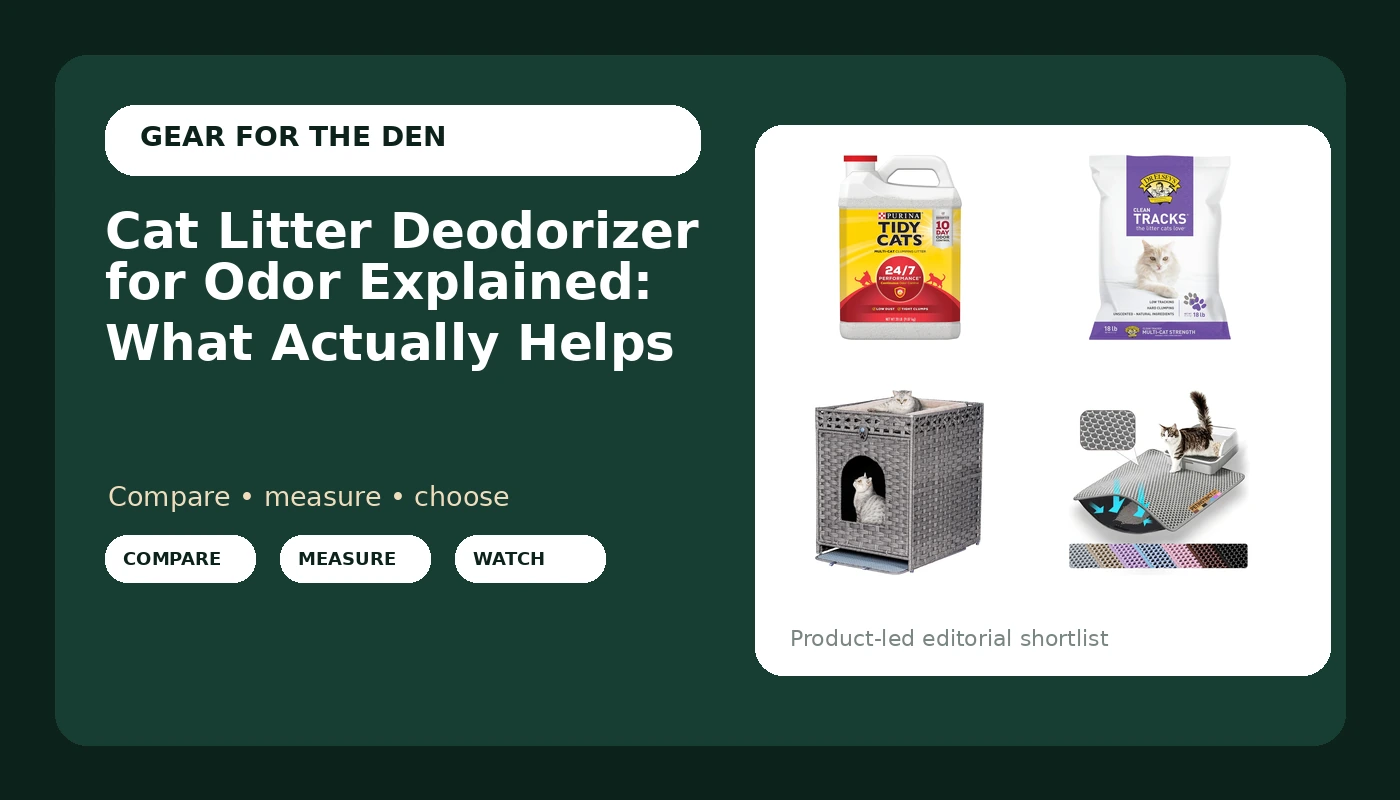
| Tidy Cats Scoop Cat Litter Box, For Multiple Cats, 20 Lbs | Homes with several boxes that want one litter for all of them | Scoopable litter labeled for multiple-cat households in a 20 lb size |
| Dr. Elsey's Clean Tracks Clumping Clay Cat Litter 18 lb. Bag | Homes where granules end up across the floor | Clumping clay formula named for reduced tracking |
| Snughome Cat Litter Box Enclosure Furniture Hidden with Cat Litter Mat | Living rooms and bedrooms where the box should not be visible | Enclosed washroom furniture with a door, a handwoven rattan finish, and a mat included |
| Petinstinct Cat Litter Mat, Double Layer Honeycomb Litter Box Mat | The exit path in front of any box | Double layer honeycomb surface built to catch what paws carry out |
The multi-cat litter: Tidy Cats Scoop Cat Litter Box, For Multiple Cats, 20 Lbs
The trade-off with a single litter across every box is consistency against preference. Consistency helps: when all boxes hold the same litter at the same depth, a cat is less likely to single out one box and avoid another, and your scooping routine stays identical from box to box. Preference cuts the other way. Some cats are particular about texture, and a 20 lb container is heavy to carry and store. If you switch litter, mix the new litter into the old over a week or two rather than replacing it in one go, because an abrupt change is one of the more common reasons a cat stops using a box and odor gets worse, not better.
The low-tracking clumping clay: Dr. Elsey's Clean Tracks Clumping Clay Cat Litter 18 lb. Bag
Clumping speed is the quiet workhorse of odor control. A clump that forms firm and fast can be lifted out in one piece; a clump that stays soft breaks apart on the scoop and leaves urine-soaked fragments behind in the litter bed, where they keep producing ammonia. That is why clay clumping litters dominate the category. The honest trade-off is weight and dust: clay is heavy, and tracking is reduced rather than eliminated. The name describes an intent, not a measurement. How much actually leaves the box depends on litter depth, the entry height of the box, and the mat texture on the other side of it. Plan on pairing any litter with a mat, and expect to sweep occasionally regardless.
The hidden enclosure: Snughome Cat Litter Box Enclosure Furniture Hidden with Cat Litter Mat, Hidden Cat Washroom Furniture with Door, Handwoven Rattan Cat Washroom Box, Indoor Pet House for Living Room, Bedroom(Grey)
An enclosure solves the half of the problem that has nothing to do with ammonia: the sight of the box, the litter sprayed against a wall, and the granules scattered across a carpet. What it cannot do is ventilate. A closed piece concentrates odor in a small volume, so an enclosure rewards a strict scooping schedule and punishes a loose one. Two more details decide whether it works for your cat. Entry height matters, because a tall lip or a narrow doorway is hard on a senior cat or a kitten, and a cat that finds the entrance awkward will go somewhere easier. Internal volume matters too, since the box still needs room for the cat to turn around and dig, and a box that fills the enclosure edge to edge defeats the point.
Prices and availability may change. Product images, names, and retailer links are matched to verified listings. No current price, rating, stock status, or measured result is stated here without current evidence.
The honeycomb mat: Petinstinct Cat Litter Mat, Double Layer Honeycomb Litter Box Mat
Mat texture decides how much of the mat's promise you actually get. A honeycomb surface lets granules drop through the top layer and sit in the lower one, so the cat walks across a relatively clear surface on the way out and the litter stays in the mat instead of on the floor. A flat mat with a rough pile catches some granules but also holds them against the fibers, and it needs shaking out more often. Either way, the mat only helps if it sits where the cat lands, which is directly in front of the entry, not several feet away. Empty it into the box or the bin every few days, because a full mat stops trapping and starts redistributing.
How a cat litter deodorizer for odor works inside a real box
Odor in a litter box comes from four places, and it helps to separate them. Urine breaks down into ammonia, which is the sharp smell people notice first. Solid waste produces its own odor within minutes of being left uncovered. Litter dust carries both smells into the air every time the cat digs. Tracked granules carry them out of the box and into the room, where they keep working from the carpet or the sofa cushion. A product that only addresses one of those sources will look like it failed when the others are still running.
That is why the strongest lever is not an additive. It is the litter bed itself. A clumping litter removes urine from the box in physical form, which is a bigger reduction than any powder can achieve by neutralizing what stays behind. Deodorizing additives, whether baking soda based or carbon based, absorb or mask some of the airborne odor, and they can be a useful supplement in a small apartment or a hot room. Treat them as a second layer, not a first one, and never as a substitute for scooping.
Box size, litter depth, and clumping speed: the odor control triangle
Three variables do most of the work. Box size determines whether the cat can turn around and dig without standing in what it just deposited. The common rule is one box per cat plus one extra, which also spreads the load so no single box saturates. Entry height determines access, and it matters most for kittens, senior cats, and cats with joint issues; a high-sided box reduces scatter but can push an older cat to a corner of the room instead. Litter depth determines whether burying is possible at all. A shallow bed, an inch or less, gives the cat nothing to dig into, so urine reaches the bottom of the box and pools there. A bed of roughly three inches gives the cat something to work with and gives clumps room to form without sticking to the floor.
If you use an automatic box, two more variables enter the picture. Sensor range decides when the rake cycle starts, and a sensor that triggers late leaves waste sitting in the open. Waste drawer capacity decides how long waste sits sealed inside the unit, which is usually the difference between a box that smells contained and one that smells like a warning. Neither setting replaces the litter choice or the scooping schedule.
- Count the cats, then set out one box per cat plus one extra in separate locations rather than side by side.
- Match box size and entry height to the smallest or oldest cat in the house, not the largest, because a box that is hard to enter gets avoided.
- Fill to a litter depth near three inches and top it up as clumps come out, since depth drops with every scoop.
- Choose the litter for clumping speed first, then texture, then tracking claims, and give the cat a gradual transition if you change brands.
- Scoop clumps and solids daily, and do a full litter change on a schedule rather than waiting for the smell to tell you.
What to check before you buy
- Measure the space before ordering an enclosure, and check that the internal volume leaves room for the box plus a turning radius.
- Look at entry height against your oldest cat, and consider a low-entry box if the enclosure door sits high.
- Check mat texture against your litter type, since honeycomb layers suit clay granules better than they suit large pellets.
- Decide whether you want one litter across every box or a different litter per box, because mixing brands makes it harder to tell what is working.
- Budget for a deodorizer additive last, after litter, depth, and routine are already in place, and expect a modest effect rather than a transformation.
The correct cat litter deodorizer for odor in a busy multi-cat home is usually a schedule plus a firm clumping litter, not a powder. A multi-cat litter box setup that spreads boxes out and keeps each one at the same depth will outperform any single product you can buy.
Which option should you choose?
Choose the Tidy Cats Scoop Cat Litter Box, For Multiple Cats, 20 Lbs when you have several boxes and want one litter and one routine across all of them. Choose the Dr. Elsey's Clean Tracks Clumping Clay Cat Litter 18 lb. Bag when tracked granules are the main annoyance and you want a clumping clay formula positioned around that problem. Choose the Snughome Cat Litter Box Enclosure Furniture Hidden with Cat Litter Mat when the box has to live in a room you actually use and needs to look like furniture. Choose the Petinstinct Cat Litter Mat, Double Layer Honeycomb Litter Box Mat when the box placement is already fine and the only remaining complaint is what the cat carries out on its paws.
The caveat is that none of these four listings is a complete odor solution on its own, and none of them removes the need to scoop. Litter and depth control ammonia, an enclosure and a mat control visibility and scatter, and additives only help at the edges. If odor persists after the routine is tight, the next thing to change is usually the box itself, its size, or its location, not the deodorizer.
The bottom line
Odor control is a system rather than a product. A clumping litter that forms firm clumps, a litter depth near three inches, daily scooping, and a box sized to the cat solve most of the problem before any additive enters the picture. The Tidy Cats Scoop litter covers the multi-cat routine in one 20 lb package. Dr. Elsey's Clean Tracks Clumping Clay addresses the granules that end up outside the box. The Snughome enclosure handles the sight of the box and the litter it scatters, and the Petinstinct honeycomb mat handles what the paws carry out. Buy them in that order of priority: litter and routine first, containment second, and deodorizer additives last, as a supplement rather than a fix.