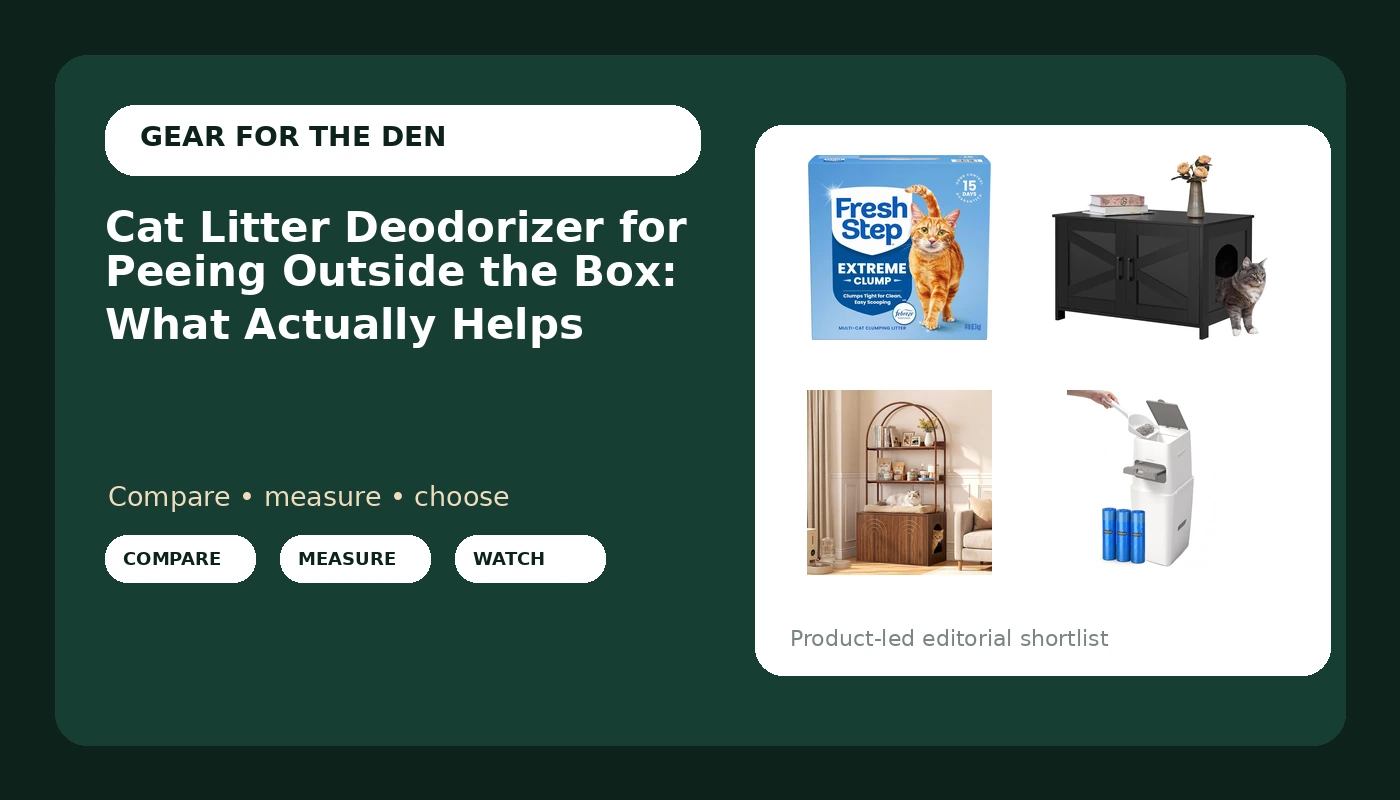
A cat that urinates outside the litter box hands you two problems at once: a surface that smells, and a box the cat has quietly stopped trusting. Most owners reach for a stronger scent first, which is understandable and usually the wrong end of the problem. A cat litter deodorizer for peeing outside the box only helps once the box itself is large enough, deep enough, and clean enough for the cat to use willingly. Odor control is what a working setup produces, not what replaces it. The four products below cover the separate parts of that setup: the litter that captures liquid, the enclosures that contain a box and its smell, and the waste handling that keeps ammonia from rebuilding overnight.
Quick answer
There is no product that fixes litter box avoidance through scent alone. The correct cat litter deodorizer for peeing outside the box is a combination: a clumping litter that captures liquid quickly, a box with enough floor area for the cat to turn around, litter deep enough to dig in, and waste removed often enough that ammonia never builds up. Adding a scented product to a box the cat already avoids can make the avoidance worse, because cats read a box by smell before they step into it. Fix the box first, then treat whatever odor is left on floors and furniture. That is cat litter deodorizer for peeing outside the box explained in the order that actually works, and the four options below show which part of the job each one covers.
4 useful options
| Model | Best fit | What stands out |
|---|---|---|
| Fresh Step Extreme Clump Multi Cat Clumping Cat Litter, 14 lb. | Households that need the litter itself to carry odor control | Multi-cat clumping formula in a 14 lb. bag |
| Homhedy 31.5" L Cat Litter Box Enclosure with Barn Door, Black | Rooms where the box needs to be hidden and contained | 31.5 in. enclosure with a barn door and black finish |
| Arched Cat Litter Box Enclosure with 2-Tier Shelves, 63" Tall Hidden Litter Box Furniture with Reversible Entry, Wood Grain Metal Frame Large Cabinet Cat House Washroom with Hooks & Anti-Tipping Kit | Tight floor plans that need storage above the box | 63 in. tall cabinet with 2-tier shelves and a reversible entry |
| Neakasa 2XL Cat Litter Trash Can for Multi-Cat Homes (White) | Multi-cat homes that scoop daily and need somewhere to put the waste | 2XL capacity sized for multi-cat waste volume |
The odor base: Fresh Step Extreme Clump Multi Cat Clumping Cat Litter
Litter is the base layer of odor control, and clumping speed is what makes it work. A litter that forms a firm clump quickly keeps urine from soaking down to the bottom of the box, where it becomes a lasting ammonia source that surface scooping will not remove. Litter depth matters just as much: too shallow and the cat cannot dig or cover, too deep and some cats refuse to sink in. Most cats do best with a consistent depth that gives them something to work with. Scented litters and added deodorizers sit on top of that foundation rather than replacing it. If your cat is already avoiding the box, a stronger fragrance is the one change most likely to push it further away, so treat the litter as the floor of the system, not the fix.
The hidden box: Homhedy 31.5" L Cat Litter Box Enclosure with Barn Door
Enclosures solve two problems at once and create a third. They stop litter scatter from reaching the rest of the room, and they hide the box from guests. What they also do is slow airflow, and trapped air holds ammonia, so a closed enclosure rewards a stricter scooping routine than an open pan does. The practical question is whether the box you already own fits inside with room for the cat to turn around, which is why the interior footprint matters more than the exterior dimensions. Entry height is the other thing to check: a tall lip or a raised floor can be a barrier for a kitten or an older cat, and a door that stays propped open until the cat is comfortable is a reasonable first step rather than a failure.
The tall cabinet: Arched Cat Litter Box Enclosure with 2-Tier Shelves
In a small apartment, floor space is the constraint that decides everything, and a tall cabinet is the version of an enclosure that spends height instead of width. The shelves give you somewhere to keep litter, bags, and a scoop within arm's reach, which matters more than it sounds when the alternative is walking to a closet with a full scoop. A reversible entry is genuinely useful in a narrow room, because it lets you point the opening away from the sofa or a doorway. Two cautions apply. The anti-tipping kit is not decorative on a 63 in. cabinet, especially if a cat launches off it, and the same airflow rule applies here as with any enclosure: closed furniture plus infrequent scooping equals a smell that no deodorizer will cover.
The waste side: Neakasa 2XL Cat Litter Trash Can for Multi-Cat Homes
Ask most owners where the smell comes from and they point at the box. Often it is the bucket beside it. Scooped clumps release ammonia as they sit, and an open container in a warm room turns a clean box into a room that smells like a box anyway. A closed container sized to your scooping interval fixes most of that. Capacity is the variable worth thinking about: a multi-cat home fills a small bin in a day or two, which means it never really gets closed. If you are comparing options, check whether the lid is manual or sensor driven, because sensor range determines how reliably the container shuts behind your hand. Whatever you choose, empty it before it is full, since a container that is packed to the rim does not seal.
Prices and availability may change. Product images, names, and retailer links are matched to verified listings. No current price, rating, stock status, or measured result is stated here without current evidence.
Why cat litter deodorizer for peeing outside the box is a setup problem
Cats do not stop using a box because it smells like a cat. They stop because something about the box stopped being acceptable: it got too dirty between scoops, the litter was switched to something with a sharp scent, the box is too small for a cat that has grown, a second cat guards the only box in the house, or the location became noisy. Urine outside the box is usually a message about the box, and sometimes it is a medical message. Bladder inflammation, crystals, and other conditions send cats to cool floors and soft laundry, and no litter product addresses any of that. When the behavior is new, a veterinarian visit comes before any gear change.
That is why the phrase cat litter deodorizer for peeing outside the box describes a system rather than a bottle. Odor control happens in layers. Clumping litter captures liquid at the source. Daily scooping removes it. A box of the right size, with the right litter depth, keeps the cat using the box at all. Waste storage keeps the removed clumps from becoming the new smell in the room. Skip one layer and the others work harder for less. Skip the box itself and the rest is decoration. If you are still working out the cause, our breakdown of why cats stop using the litter box covers the common triggers.
There is no ideal cat litter deodorizer for peeing outside the box in the sense of a single product that reverses the behavior. What exists is a sequence: rule out medical causes, make the box acceptable, then manage the smell that remains.
What each part of the setup controls
Every part of a litter setup controls one variable, and knowing which one makes shopping much shorter.
Box size sets whether the cat can turn around, dig, and cover without touching the sides. A common guideline is a box at least one and a half times the cat's length from nose to the base of the tail, and many cats do better with more room than that. Entry height decides whether a kitten, a senior, or a cat with achy joints can walk in without a jump. Litter depth is the digging layer: enough to cover, not so much that the cat sinks. Clumping speed is what keeps urine from reaching the bottom of the pan. Odor control is the result of those four working together, plus how often you scoop. Mat texture decides how much litter travels out of the box and how much grit gets ground into the carpet. Inside a covered box or an enclosure, airflow matters, because trapped air holds ammonia. On automated boxes and lidded waste containers, sensor range is worth checking, since a lid that trips late or not at all leaves you with an open bin of waste.
Here is the order that works:
- Rule out medical causes with your veterinarian before you change any gear.
- Measure your cat and choose a box that gives it room to turn around.
- Set a litter depth you can keep consistent, and scoop at least once a day.
- Move the box away from food, water, and appliances that switch on suddenly.
- Add an enclosure or a waste container only after the cat is using the open box reliably.
Matching the setup to your cat's habits
- Keep one box per cat, plus one, and place them so no cat has to pass a rival to reach one.
- Lower the entry height for seniors and kittens, or add a step, before you conclude the cat has given up on the box.
- Scoop daily and top up litter rather than waiting for a full change, because clumps sitting in the pan are the odor source.
- Store scooped waste in a closed container sized to your scooping interval, and empty it before it is full.
- Check airflow if you use an enclosure, and leave the door open or off until the cat is using the box consistently.
Which option should you choose?
Choose the Fresh Step Extreme Clump Multi Cat Clumping Cat Litter, 14 lb. when the litter itself is your odor base and you scoop every day. Choose the Homhedy 31.5" L Cat Litter Box Enclosure with Barn Door, Black when the box sits in a living space and you want it closed off behind a door. Choose the Arched Cat Litter Box Enclosure with 2-Tier Shelves when floor space is tight and you would rather use height for storage than add a second cabinet. Choose the Neakasa 2XL Cat Litter Trash Can for Multi-Cat Homes (White) when the scooping bucket, not the box, is the thing you can smell from the hallway.
None of these products treats a medical problem, and none of them should be expected to change a behavior that has a physical cause. If the behavior is new, sudden, or comes with straining, blood, or repeated trips to the box, call your veterinarian first. Setup changes are worth making after that, and they are worth making one at a time so you can tell which change helped.
The bottom line
Odor from a cat peeing outside the box is a symptom, and the fix is a setup rather than a scent. A clumping litter you scoop daily handles the source, a box sized for your cat keeps it in use, an enclosure keeps the room livable, and a closed waste container keeps the scooped clumps from becoming tomorrow's smell. Start with the box, rule out medical causes first, and let the products here support the routine rather than replace it.