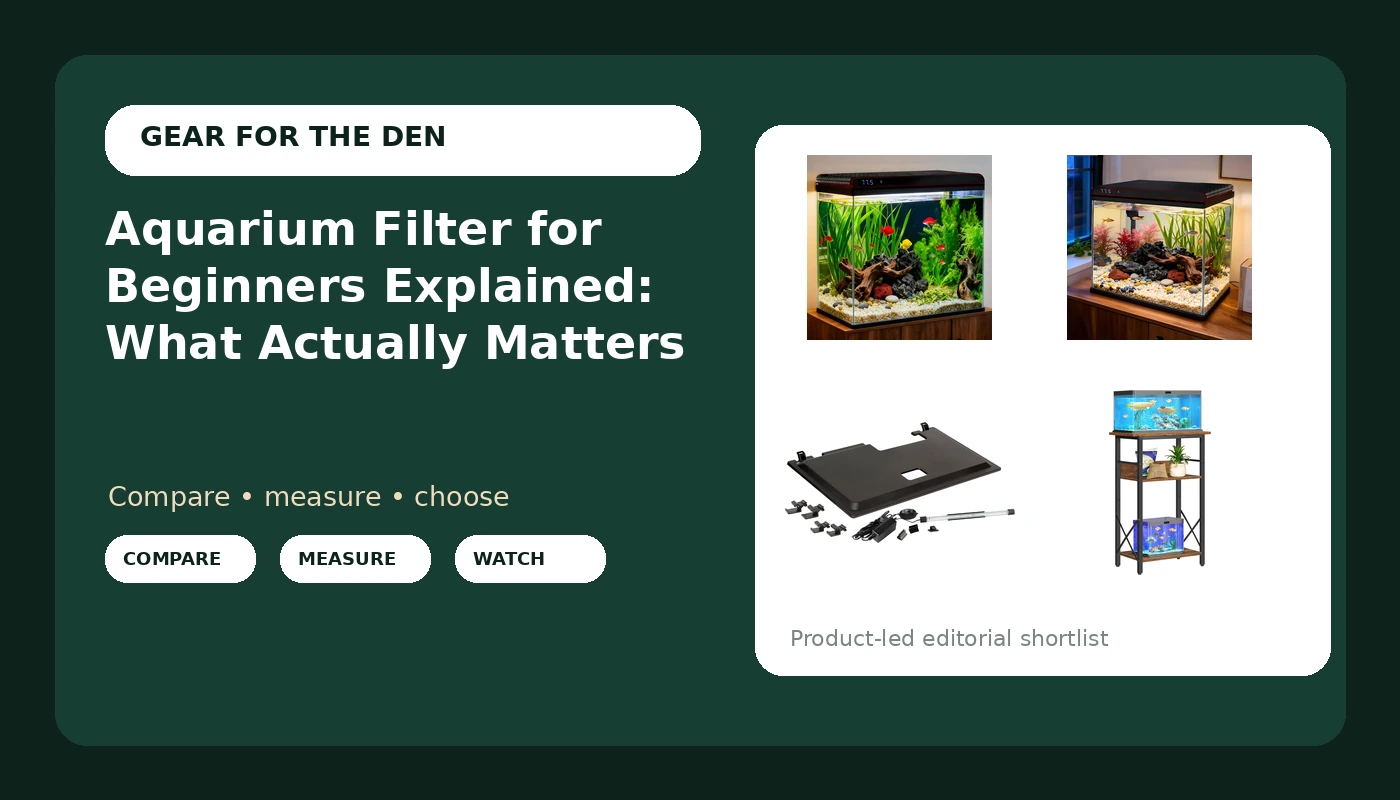
Setting up a first freshwater tank usually starts with the same question: which filter do I need? The honest answer is that the aquarium filter for beginners is rarely a separate purchase, because most small starter kits arrive with a pump already matched to the glass. What decides whether the water stays clear is how the filter fits the tank volume, the flow rate it produces, and how you clean it. This aquarium filter for beginners explained guide covers what each part of a small setup does, which filtration stage does the real work, and four verified options for a 10 or 20 gallon first tank.
Quick answer
There is no single correct aquarium filter for beginners. The right choice is the one sized to your tank volume rather than the one with the biggest numbers on the box. In a 10 or 20 gallon freshwater setup, a pump that turns the water over several times an hour and holds reusable media does more for clarity than an oversized unit you have to throttle back. If you are starting from nothing, a starter kit with a matched pump removes most of the guesswork. If you already own the glass, match the filter to your tank volume and the fish you plan to keep. Nothing here is called the quietest, the fastest, or the best option, because the available listings do not support those rankings.
Four useful options
| Model | Best fit | What stands out |
|---|---|---|
| Coospider 20 Gallon Glass Fish Tank, Aquarium Starter Kit, Simple Self-Cleaning Aquarium with 3-Color LED Lights, with Quiet Filter Pump, with Temperature Monitoring for Fish, Shrimp, Kids Gift Ideas | A first 20 gallon tank | Glass tank sold with a matched quiet filter pump, 3-color LED lighting, and temperature monitoring |
| Coospider 10 Gallon Glass Fish Tank, Aquarium Starter Kit, Simple Self-Cleaning Aquarium with 3-Color LED Lights, Quiet Filter Pump, Temperature Monitoring for Fish, Shrimp, Kids Gift Ideas | A first 10 gallon tank | The same starter-kit formula in a smaller footprint, with pump and lighting included |
| Tetra LED Aquarium Hood 20 in x 10 in, Low-Profile Fish Tank Cover | Covering an open 10 gallon footprint | Low-profile hood with LED lighting, sized 20 in x 10 in |
| HOOBRO 10 Gallon Aquarium Stand, 3-Tier Fish Tank Stand with Storage | Raising a 10 gallon tank off a desk or floor | Three tiers with storage space for food, tools, and test kits |
The larger starter kit: Coospider 20 Gallon Glass Fish Tank
The appeal of a kit this size is that the pump, the lighting, and the temperature monitoring arrive matched to the tank volume. You are not guessing at gallons per hour or wondering whether a filter body will clear the rim. The trade-off is flexibility. An all-in-one starter kit gives you fewer choices about media and flow than buying glass and a filter separately, and if you later decide you want a different pump, you are paying again for one you already own. Treat the included pump as the start of your filtration stage rather than the whole of it. If the kit does not include reusable media, add a sponge or a small bag of ceramic rings, because those surfaces are where the bacteria that keep the water safe will live.
The smaller starter kit: Coospider 10 Gallon Glass Fish Tank
A 10 gallon tank is the classic first aquarium because it fits on a desk or a dresser and takes less water to fill, but the smaller tank volume works against a beginner. Waste concentrates faster in less water, so a mistake that clouds a 20 gallon tank for a day can cloud a 10 gallon tank for a week. That makes the flow rate of the included pump and your cleaning routine more important, not less. Rinse media in removed tank water, change a portion of the water on a schedule, and avoid replacing filter media wholesale, because that discards the bacteria doing the actual work. Smaller also means faster swings in temperature, which is why the built-in temperature monitoring here is worth using rather than ignoring.
The cover: Tetra LED Aquarium Hood 20 in x 10 in
A hood is not a filter, but it changes how one behaves. Covering the tank slows evaporation, which keeps both your water level and your filter intake stable, and it keeps dust, pet hair, and curious cats out of the water. The 20 in x 10 in measurement matches the standard footprint of a 10 gallon tank, so measure your rim before ordering rather than assuming. The LED lighting built into the hood also sets the kelvin rating of the light your plants and fish see, which affects plant growth and how quickly algae appears. The trade-off is gas exchange: a tight lid can hold in heat and limit oxygen transfer at the surface, so leave a small gap and keep the filter outflow moving the water.
The stand: HOOBRO 10 Gallon Aquarium Stand, 3-Tier Fish Tank Stand with Storage
Once you add water, substrate, and rock, a 10 gallon tank is far heavier than the empty glass suggests, and furniture built for books is not designed for a permanent load of that kind. A stand made for the tank spreads the weight and puts the water line at a height where you can watch the fish and reach in with a siphon without kneeling. The two extra tiers give you somewhere to keep food, a test kit, and a towel, which keeps clutter off the top of the tank where it can end up in the water. Check the footprint against your tank before assembly, put the stand on a level floor, and remember that a full tank should not be moved once it is filled.
Prices and availability may change. Product images, names, and retailer links are matched to verified listings. No current price, rating, stock status, or measured result is stated here without current evidence.
What an aquarium filter for beginners actually does
A filter does three jobs, and beginners usually notice only one of them. Mechanical filtration traps particles: fish waste, uneaten food, and plant debris that would otherwise cloud the water. Chemical filtration is optional and usually means carbon or another resin that pulls color, odor, or medication out of the water. Biological filtration is the one that keeps fish alive. Beneficial bacteria colonize the filter media and convert ammonia from fish waste into nitrite and then into nitrate, which you remove with water changes. That process is the filtration stage people mean when they say a tank is cycled.
Because the bacteria live on surfaces, the media is the filter. A pump is only the thing that moves water past it. That is why replacing a cartridge every month, as some packaging suggests, can crash a tank: you throw away the colony and start over. Rinse media in a bucket of removed tank water instead of under the tap, and only replace it when it is falling apart.
Tank volume sets how much waste the system has to process and how quickly problems appear. A larger volume dilutes waste and buffers mistakes; a smaller volume shows you the same mistake sooner. Neither is easier to filter, but they demand different habits from you.
Wattage matters too. Pumps and lights add heat to a closed tank, and a hood that traps warmth can push a heater past the point where its thermostat range still makes sense. If you add a heater, set it against a thermometer rather than trusting the dial. The kit listings here include temperature monitoring, which is a useful starting point, but it is not a substitute for testing water.
Matching flow rate to tank volume
Flow rate is measured in gallons per hour, and the useful comparison is turnover: how many times the pump moves the entire tank volume in an hour. Many freshwater setups sit comfortably somewhere around four to ten turnovers per hour, though the right number depends on stocking and on whether you keep a slow betta or a fast shoal of danios. A 10 gallon tank at five turnovers calls for a pump rated near 50 gallons per hour, and a 20 gallon tank at the same turnover calls for roughly double. That is why a filter bought for one tank rarely suits another.
Substrate grain belongs in the same conversation, because it decides where debris ends up. Fine sand packs at the surface and holds waste on top, where a siphon lifts it easily. Coarser gravel lets particles settle into the gaps, so you have to push the siphon deeper. Either way, the filter cannot reach what the flow never disturbs, so aim the outflow across the bottom now and then.
- Measure the tank and write down the tank volume in gallons before you shop for anything.
- Choose the livestock first, because a single betta and a group of goldfish place very different loads on the same water.
- Check the flow rate in gallons per hour against the turnover you want, then check whether the intake can be adjusted, aimed, or baffled.
- Look at the media: reusable sponge or ceramic rings hold bacteria longer than thin disposable cartridges.
- Plan the maintenance before the purchase, including how much water you will change, how you will rinse the media, and where the substrate grain will trap debris you need to vacuum.
Practical guidance for a first filter setup
- Cycle the tank before adding fish, and test for ammonia and nitrite instead of trusting clear water.
- Leave the filter running continuously, because the bacteria on the media need oxygen and a steady flow of water.
- Rinse media in removed tank water rather than under the tap, since chlorine kills the colony you are trying to grow.
- Cover the intake with a sponge if you keep shrimp, fry, or very small fish, and aim the outflow at the surface for gas exchange.
- Watch where debris collects against the substrate grain, then set a vacuuming routine that actually reaches those spots.
Which option should you choose?
Choose the Coospider 20 Gallon Glass Fish Tank when you want the largest first tank in this group and would rather have the pump, the lighting, and the temperature monitoring matched for you. Choose the Coospider 10 Gallon Glass Fish Tank when space or budget points to a smaller tank and you are willing to test water more often. Choose the Tetra LED Aquarium Hood when you already own a tank with a 20 in x 10 in rim and want a low-profile cover with LED lighting. Choose the HOOBRO 10 Gallon Aquarium Stand when the tank needs a dedicated, stable place to sit with storage underneath.
There is no universal ideal aquarium filter for beginners, and no list can settle it for you, because the deciding factor is the tank you actually own. The specifications quoted here come from the product listings. Nothing about noise, durability, or real-world flow has been measured for this article, and prices change.
The bottom line
For most first setups, the filter decision is really a tank decision. Buy glass with a pump already sized to it, or buy a filter rated for the tank volume you own, then spend your effort on the parts that move the needle: keeping the media wet and cycled, matching the flow rate to the fish, and changing water on a schedule. A 10 gallon tank with a matched pump and a cover will serve a beginner better than a 20 gallon tank with the wrong one. If you are still assembling the rest of the setup, work through our freshwater aquarium setup checklist before you buy the filter. Start with the tank you can maintain every week, and add equipment as the tank tells you it needs it.