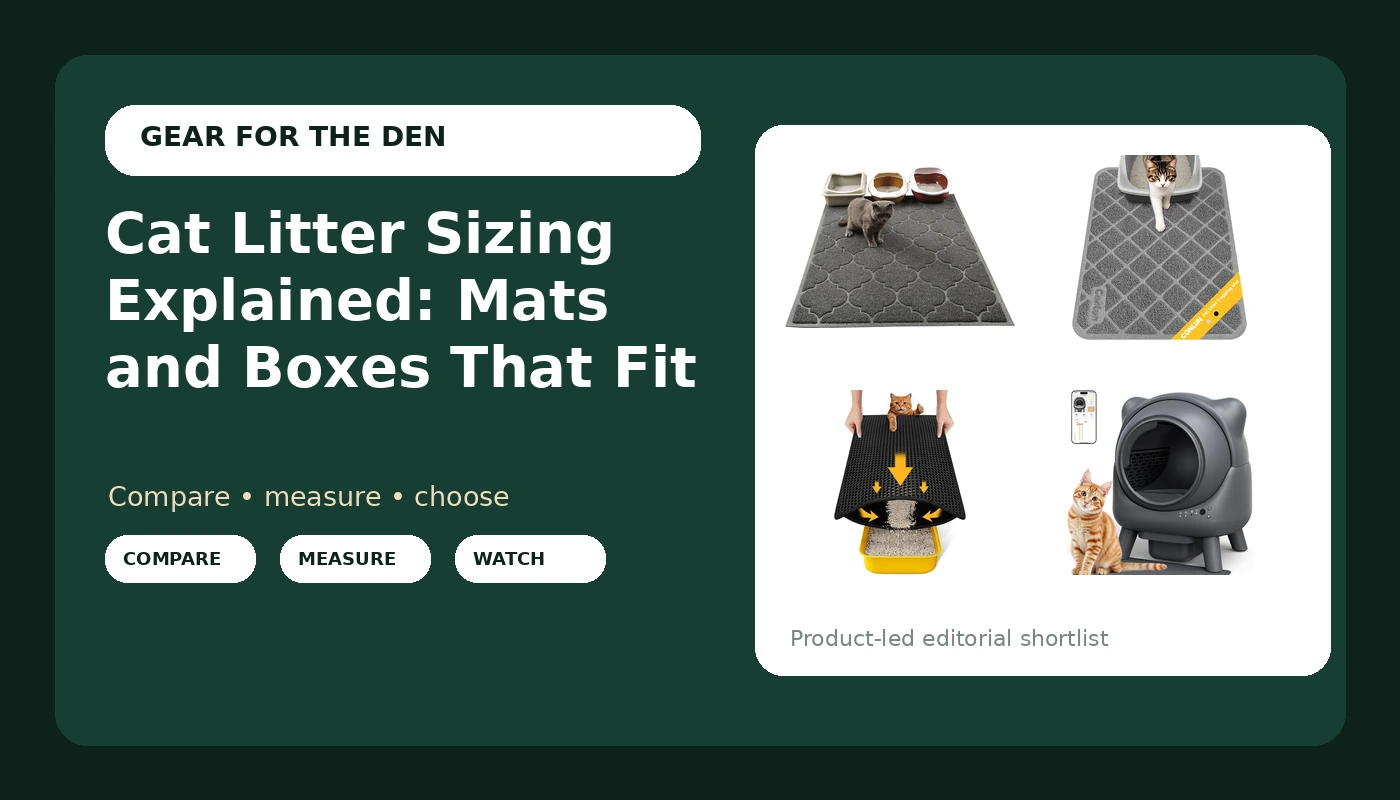
Getting cat litter sizing right is less about buying a bigger box and more about matching three measurements to one animal. A cat needs room to turn around, squat, and cover without stepping into what it just buried, and the gear around the box has to catch what the paws carry out. Most litter box complaints, from scattered granules in the hallway to an odor that never quite clears, trace back to a mismatch between the cat, the box, and the floor mat sitting under it.
This guide works through cat litter sizing from the cat's side of the equation: box size first, then entry height, litter depth, and the mat that handles the exit. It covers four pieces of gear that solve different parts of that problem, including two trapping mats at very different footprints, one compact mat built for tight spaces, and a self-cleaning box with app monitoring. None of them fixes a box that is too small, which is why the sizing rules come before the shopping list.
The short version: measure your cat from the nose to the base of the tail, add a few inches, and treat that as the minimum interior length. Then check the entry height, the litter depth you pour in, and the texture of the mat waiting outside the door.
Quick answer
Here is cat litter sizing explained in one line: the litter box should be roughly one and a half times the length of your cat, measured from nose to the base of the tail, and everything else, including entry height, litter depth, and the mat outside the door, is tuned around that number. A box that is too small forces the cat to stand in a corner or hang over the edge, and no mat, deodorizer, or automatic rake compensates for it. If you can only change one thing, change the box size. If the box is already right, the fastest wins usually come from litter depth, litter type, and the mat texture just past the entry.
Four useful options
| Model | Best fit | What stands out |
|---|---|---|
| LittleTiger Cat Litter Mat, XL Super Size | Large boxes and wide landing areas | Listed 46 by 35 inch footprint, phthalate free, soft on paws |
| Conlun Cat Litter Mat Litter Trapping Mat | Standard boxes in average rooms | PVC grid mesh top, listed 24 by 17 inches, non-slip backing |
| Cat Litter Mat Compact Size | Small apartments and tight corners | Listed 23.6 by 14.6 inch footprint, waterproof back layer, honeycomb trapping |
| Automatic Litter Box, FEELNEEDY Self Cleaning Litter Box | Multi-cat homes that want scooping handled | Listed 65L drum, app monitoring, safety sensors, one trash bag included |
XL floor coverage: LittleTiger XL litter mat
The math behind a mat this size is simple. A large box with a tall entry height throws litter further than a shallow pan, and a cat that digs sends granules well past the door. A 46 by 35 inch mat gives you a landing zone in front of the box and a margin on the sides, which matters if the box sits against a wall or in a corner where a smaller mat would leave bare floor. The trade-off is floor space: this mat takes up real estate, and in a narrow hallway or a small bathroom it may cover more ground than you want to give up. If your box is a large open pan or your cat kicks, the extra coverage earns its keep. If your box is compact or your floor space is tight, a smaller mat does the same job with less footprint.
Grid-mesh trapping: Conlun litter trapping mat
Grid and mesh mats work on a different principle than a flat pile. Litter falls between the openings and stays there instead of being walked across the room, and the openings give paws somewhere to shed granules before the cat reaches bare floor. A 24 by 17 inch mat suits a standard box in an average room, and the non-slip backing keeps it from sliding when a cat launches out of the box. The grid texture is also easy to shake out or rinse. The limitation is size: a mat this size will not catch everything from a very large box or a determined digger, so it works well as the primary mat under a mid-sized box or as one of two mats along the exit path. If your cat leaves the box at speed and turns, a longer mat may serve you better.
Small-space coverage: compact honeycomb litter mat
Compact mats answer a specific problem: a laundry nook, a bathroom corner, or an apartment hallway where a full-size mat would block a door or curl up a wall. At 23.6 by 14.6 inches this one fits those spots, and the waterproof, leakproof back layer is the detail that separates it from a plain carpet square, since it keeps urine and spilled litter from reaching the floor underneath. The honeycomb pattern is designed to hold granules below the surface, and the mat is listed as washable. The trade-off is coverage: a mat this size catches what a cat tracks out in the first step or two, not what it carries across a room. Pair it with a second mat or a regular sweep if scatter is your main complaint.
Scooping handled: FEELNEEDY self-cleaning litter box
An automatic box changes the sizing conversation because the drum does the scooping and the waste drawer holds what it collects. This unit is listed at 65 liters, a drum size aimed at multi-cat households, and the listing covers app-based real-time monitoring, safety sensors, and a cat ears design. For a home with several cats, that combination addresses the two things manual scooping struggles with: consistency and odor control between cleanings. The caveats are worth stating plainly. An automatic box needs a power source and clearance around it, and the sensor range and safety features are what determine whether it works around kittens, seniors, or a cat that approaches slowly. Sizing still matters here, because the drum has to be large enough for your cat to turn around inside.
Prices and availability may change. Product images, names, and retailer links are matched to verified listings. No current price, rating, stock status, or measured result is stated here without current evidence.
Why box size comes first in cat litter sizing
Box size is the one number that changes everything downstream. A useful rule of thumb is a box roughly one and a half times the length of your cat, measured from nose to the base of the tail. For an average adult cat that lands near 24 inches of interior length, and for a large or long-bodied cat it climbs from there. Width matters too: a cat should be able to turn around without its head touching a wall. Covered boxes need to be larger than open ones for the same cat, because the walls take up usable interior space.
Entry height is the second variable, and it matters most for kittens, seniors, and cats with arthritis. A high entry keeps litter inside but can be a barrier for a cat that cannot jump. A low entry is easy to use but throws more litter onto the floor. If you cannot change the box, a ramp or a step solves part of the problem, and a mat with some grip helps on the landing side.
Litter depth is the third. Most cats do best with roughly two to three inches of litter: deep enough to dig and cover, shallow enough that paws do not sink to the bottom of the pan. Too little litter leads to scraping and more tracking, and too much gets kicked over the side or makes a covered box feel cramped. Litter type interacts with depth, since fine clumping litters behave differently at the same depth than coarse pellets do, and clumping speed determines how quickly the box is ready for the next visit.
What none of this changes is that a mat is a cleanup tool, not a sizing fix. If the box is too small, the cat will hang over the edge, and no mat texture will catch what never lands on the mat in the first place.
How to measure for correct cat litter sizing
Measuring takes a few minutes and a tape measure. Work through these in order, because each step narrows the next.
- Measure your cat from the tip of the nose to the base of the tail while it stands. Add a few inches and treat the total as your minimum interior box length. In a multi-cat home, size for the largest cat.
- Match the box footprint to the room. Mark the dimensions on the floor with tape before you buy, and check that the box will not be jammed into a corner with no approach space.
- Set the entry height for the cat you actually have. Kittens, seniors, and cats with mobility issues do better with a low entry or a step, while healthy adults can handle a higher wall that keeps more litter inside.
- Fill to the right litter depth. Two to three inches is a workable starting point for most clumping litters. Litter kicked over the side suggests too much, and litter scraped into a pile suggests too little.
- Place the mat and check the landing zone. The mat should sit flush against the box with no gap a cat can step over, and it should extend at least one body length past the entry if scatter is a problem.
Practical cat litter sizing habits that cut scatter and odor
- Keep the mat flush against the box. A gap of a few inches gives a cat a place to land on bare floor and defeats the mat's purpose.
- Match the mat texture to your litter. Grid and honeycomb mats hold granules below the surface, while flat plush mats rely on fibers to grab dust. Neither is better in the abstract, but the wrong one for your litter means more sweeping.
- Recheck litter depth weekly instead of topping up blindly. Depth creeps upward when litter is added without removing clumps, and an overfull box tracks more.
- Watch the exit path, not just the box. If your cat has to cross a room to leave the area, scatter spreads. A longer mat or a second small mat along that path contains it.
- Clean the mat on the same schedule as the box. Mats hold dust and urine residue, and a mat that is never washed becomes an odor source rather than an odor control tool.
In a multi-cat home, the same logic scales up: more cats means a bigger box or more boxes, and it means a waste drawer that fills faster on an automatic unit. Sensor range and safety features on a self-cleaning box matter most in homes with kittens or elderly cats, where a cat may enter and leave slowly.
Which option should you choose?
Choose the LittleTiger Cat Litter Mat, XL Super Size when your box is large, your cat is a digger, and you have floor space to spare for a single wide landing zone. Choose the Conlun Cat Litter Mat Litter Trapping Mat when you want grid-mesh trapping under a standard box in an average room and a smaller footprint is fine. Choose the Cat Litter Mat Compact Size when space is tight and a waterproof back layer matters more to you than coverage. Choose the Automatic Litter Box, FEELNEEDY Self Cleaning Litter Box when you have multiple cats and want scooping and odor control handled between visits, and when the drum size fits your cat.
One caveat applies to all four. There is no single ideal cat litter sizing that fits every cat, so treat every dimension here as a starting point to check against your own tape measure and your own floor plan.
The bottom line
Cat litter sizing explained in the simplest terms comes down to three numbers: the interior length of the box, the height of the entry, and the depth of the litter. Get those right for the cat in front of you, and the mat becomes a small cleanup detail instead of a daily battle. The LittleTiger mat covers a large floor area around a big box, the Conlun mat handles a standard footprint with grid-mesh trapping, the compact honeycomb mat fits tight spaces with a waterproof back layer, and the FEELNEEDY self-cleaning box takes over scooping and odor control for multi-cat homes.
None of these products substitutes for correct cat litter sizing, and none of them needs a perfect setup to help. Start with the box, measure your cat honestly, and adjust from there as you learn how your cat uses the space.