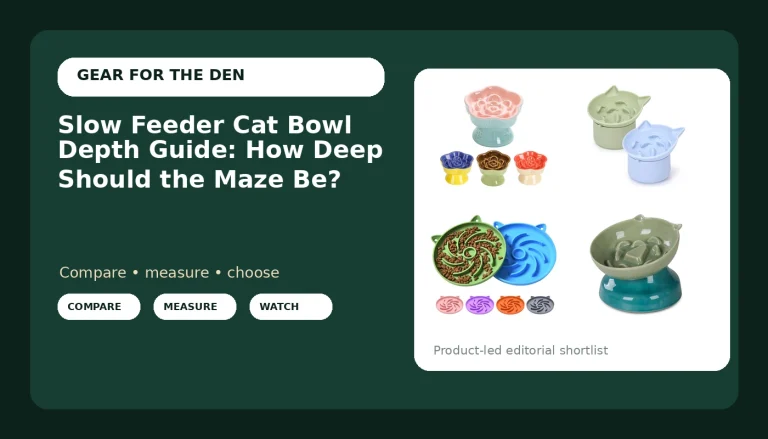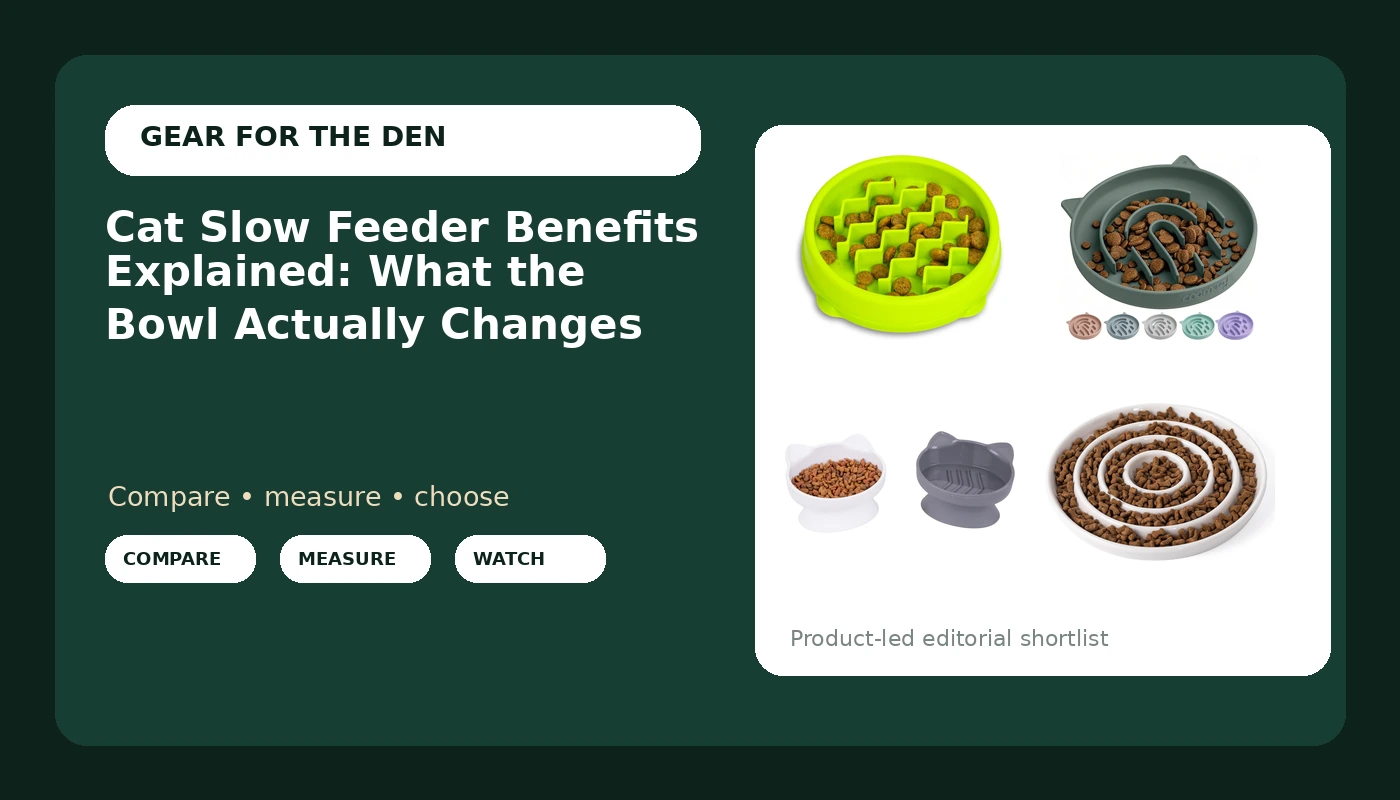
Slow feeders change how a meal unfolds rather than just where it sits. Most people start looking for one because their cat empties a bowl in under a minute, then begs, then sometimes brings the food back up shortly afterward. The conversation around cat slow feeder benefits usually begins there, but the mechanics matter more than the marketing copy: ridges, pockets, and maze walls force a cat to lick, paw, and work around obstacles instead of taking whole mouthfuls, which spreads a small meal across a longer stretch of time. This explainer covers what those bowls actually change, how bowl width and whisker clearance decide whether a cat will use one at all, and four current options in plastic, silicone, ceramic, and an elevated set.
Quick answer
Cat slow feeder benefits explained in one line: the bowl adds friction to eating, so a portion that took thirty seconds takes several minutes, and the cat has to use its tongue and paws rather than swallowing in bulk. The outcome depends on the individual cat. A shallow ceramic dish with a wide opening suits a cat that refuses to put its face into a deep maze, while a ridged bowl suits a determined gulper. None of these bowls is a treatment for a medical problem, and a cat that vomits repeatedly, loses weight, or eats compulsively should be seen by a veterinarian before you shop for gear.
Four useful options
| Model | Best fit | What stands out |
|---|---|---|
| Catstages Kitty Slow Feeder Bowl for Cats & Kittens, 3/4 Cup, Green, 5" | Kittens and small, measured portions | 3/4 cup capacity in a 5 inch bowl built for cats and kittens |
| Coomazy Slow Feeder Cat Bowl Silicone Pet Puzzle Feeder for Slow Eating | Flexible placement and flat storage | Silicone body with a puzzle pattern for slow eating |
| Kitty City Elevated Slow Feeder Cat Bowls (Set of 2), Whisker-Friendly Raised Cat Food Dishes with Ridges, Helps Reduce Fast Eating & Digestion Issues, Dishwasher Safe, 6.5 oz, White & Gray | Two-cat homes | A pair of raised bowls with ridged interiors, 6.5 oz each, listed dishwasher safe |
| Ceramic Cat Slow Feeder, Shallow and Wide Opening Dish for Whisker Friendly | Whisker-sensitive cats | A shallow, wide ceramic opening instead of a deep maze |
For kittens and small portions: Catstages Kitty Slow Feeder Bowl for Cats & Kittens, 3/4 Cup, Green, 5"
Capacity is the first thing to check and the easiest to get wrong. Portion size drives everything else here: a bowl that holds less than your cat's normal meal means a refill mid-meal, and a bowl that holds much more than your cat eats encourages free-feeding habits that a slow feeder cannot fix. The 3/4 cup figure on this one lines up with a typical measured serving for a kitten or a cat on a weight-management plan, and the 5 inch footprint keeps it compact enough to sit on a mat without crowding a water bowl. The trade-off is straightforward: this is a plastic bowl, so it is light and easy to tip if a cat paws hard at the rim.
For flexible placement: Coomazy Slow Feeder Cat Bowl Silicone Pet Puzzle Feeder for Slow Eating
Silicone is the material to consider when a bowl gets moved, washed, and packed away regularly. The flexible body can be pressed flat, which matters in a small kitchen, and a soft material is gentler against a hard floor than rigid plastic or ceramic is. The trade-off runs the other way too: a light, flexible bowl can slide or tip when a cat paws at the edges, so a mat underneath is worth adding. Silicone also picks up food oils from wet food, so a rinse right after each meal keeps it from holding onto smell.
For two-cat homes: Kitty City Elevated Slow Feeder Cat Bowls (Set of 2), Whisker-Friendly Raised Cat Food Dishes with Ridges, Helps Reduce Fast Eating & Digestion Issues, Dishwasher Safe, 6.5 oz, White & Gray
Elevation is the variable people argue about most. A raised bowl changes the elevation angle of the head and neck, which some cats prefer and others ignore entirely; there is no rule that says every cat needs a raised dish. The set-of-two format is the practical part. In a two-cat home you can give both cats the same bowl shape instead of one cat guarding a single dish, and each bowl holds 6.5 oz. Dishwasher-safe construction simplifies cleanup after wet food, which is the main chore a ridged interior creates.
What this set does not do is stop one cat from eating another cat's food. If that is the actual problem, the tool for it is a selective feeder that opens on a microchip range, which is a different category of product entirely and solves a different problem than a slow feeder does.
For whisker-sensitive cats: Ceramic Cat Slow Feeder, Shallow and Wide Opening Dish for Whisker Friendly
Whisker clearance is the reason to look at a shallow dish before anything else. Cat whiskers are sensitive, and a bowl that presses them against the sides can make some cats eat awkwardly, eat faster than usual, or walk away from the dish altogether. A shallow, wide opening keeps the rim away from the face, and ceramic is a heavier material than plastic or silicone, so the bowl is harder to flip than a light one. The trade-off is that a shallow dish slows a cat less than a deep maze, because there is less structure for the cat to work around.
Prices and availability may change. Product images, names, and retailer links are matched to verified listings. No current price, rating, stock status, or measured result is stated here without current evidence.
How cat slow feeder benefits work in practice
The mechanism is unglamorous. A standard bowl presents food as one flat surface, so a motivated cat can take large bites with minimal tongue movement. A slow feeder breaks that surface into pockets, ridges, or a spiral, and the cat has to reach each piece individually. The extra time comes from repositioning, licking, and pawing rather than from any change in the food itself.
That matters for two reasons. The first is eating speed: a cat that finishes in thirty seconds tends to swallow more air and eat past the point where fullness signals would normally arrive. The second is portion size: when a meal takes longer, the same measured amount of food occupies more of the cat's mealtime, and the cat spends part of that time working instead of waiting beside an empty bowl.
The benefits are not automatic. A shallow, wide dish slows a cat far less than a deep maze with narrow channels, and some cats simply hook a paw under a light bowl and flip it. If your cat is one of those, a heavier ceramic dish or a silicone bowl with a broader base will hold position better than a thin plastic one. Keep the old bowl nearby for the first few days so the switch is not a sudden change in routine, and watch whether the cat actually eats rather than just investigating. A slow feeder a cat refuses is worse than a fast meal.
Matching the bowl to your cat
Work through these five checks before buying. They take about ten minutes and prevent most of the mismatches people run into.
- Time one normal meal. Under a minute is the classic fast-eater profile; four or five minutes is already a normal pace, and a slow feeder may add little.
- Measure the portion size you actually feed, in cups or ounces, and match it to the bowl's stated capacity. A 6.5 oz bowl and a 3/4 cup bowl are close in volume, but a cat on a larger portion needs two servings or a bigger dish.
- Look at bowl width and whisker clearance together. If your cat's whiskers touch the rim or the inner walls, it may eat with its head tilted back or refuse the bowl, which is exactly why shallow and wide designs exist.
- Decide where the bowl will live and how you will clean it. A dishwasher-safe pair is convenient in a two-cat home, while a ceramic dish is heavier and stays put but needs hand washing if it is not labeled dishwasher safe.
- Pick a material and an elevation angle. Flat on the floor suits most cats, a raised bowl can help a cat that prefers not to crouch, and silicone is softer against a hard floor than rigid plastic or ceramic.
Practical notes before you buy
- Introduce the slow feeder with food the cat already likes, and put a small amount in it rather than a full meal for the first attempt.
- Keep water in a separate, wider bowl. Most cats do better when food and water are not crowded into the same tight space.
- Watch for frustration: pacing, pawing at the bowl edge, or walking away after a minute or two are signs the pattern is too difficult for that cat.
- Clean the bowl after wet food. Dried food in narrow channels is the main practical downside of maze designs.
- If one cat guards the bowl in a multi-cat home, feed the cats in separate rooms rather than expecting a slow feeder to settle the tension.
Which option should you choose?
Choose the Catstages Kitty Slow Feeder Bowl when you feed a kitten or a cat on a small, measured portion and want a compact plastic dish. Choose the Coomazy silicone puzzle feeder when you want a flexible bowl that stores flat and sits on a hard floor. Choose the Kitty City elevated set when two cats eat at the same time and you want a raised, dishwasher-safe pair with ridged interiors. Choose the ceramic shallow dish when whisker clearance is the deciding factor and your cat backs away from deep or narrow bowls.
What counts as ideal cat slow feeder benefits depends less on the bowl than on the cat. A design that slows one cat to a crawl may be ignored by another, and no product listing can tell you which one your cat will accept. Getting the correct cat slow feeder benefits means matching capacity, bowl width, and whisker clearance to one specific animal, then watching the first few meals closely. If the cat eats more slowly and finishes without distress, the bowl is doing its job. If the cat stops eating, the bowl is the problem.
The bottom line
Cat slow feeder benefits are real but narrow. They stretch a meal across more minutes and force a cat to work for each bite, and that is the whole of what a bowl can do. They are not a fix for a medical issue, and they do not replace portion control, a feeding schedule, or a vet visit for a cat that vomits or loses weight. Pick the design that matches your cat's face and your household routine, start with a small amount of familiar food, and give the switch a few days. If you want to review the rest of the setup, our guide to cat feeding stations and mat placement covers the surrounding gear.