Most gate purchases go wrong at the same moment: the box arrives, the gate fits the doorway, and the dog clears it in one easy hop. Dog gate heights are the part of that purchase people guess at, and guessing is avoidable. What follows is dog gate heights explained from the ground up: how to measure your dog standing rather than sitting, why a stairway gate follows different rules from a doorway gate, and how the space on either side of the gate changes how much height you actually need. There are also four elevated dog beds here, because the gear around a gate matters as much as the gate itself.
Quick answer
Gate height should be driven by your dog's standing height, not its weight. As a working rule, look for a gate that reaches at least one and a half times your dog's shoulder height, and closer to two times for a dog that jumps. In practice that lands most small dogs under about 12 inches at the shoulder in the 24 inch range, medium dogs in the 30 to 36 inch range, and large or athletic dogs in the 36 to 48 inch range. The other half of the answer is the opening: measure the doorway, stair top, or hallway at its narrowest point, then check the gate's panel count and bar spacing against that number. A tall gate that does not fit the opening is not a solution.
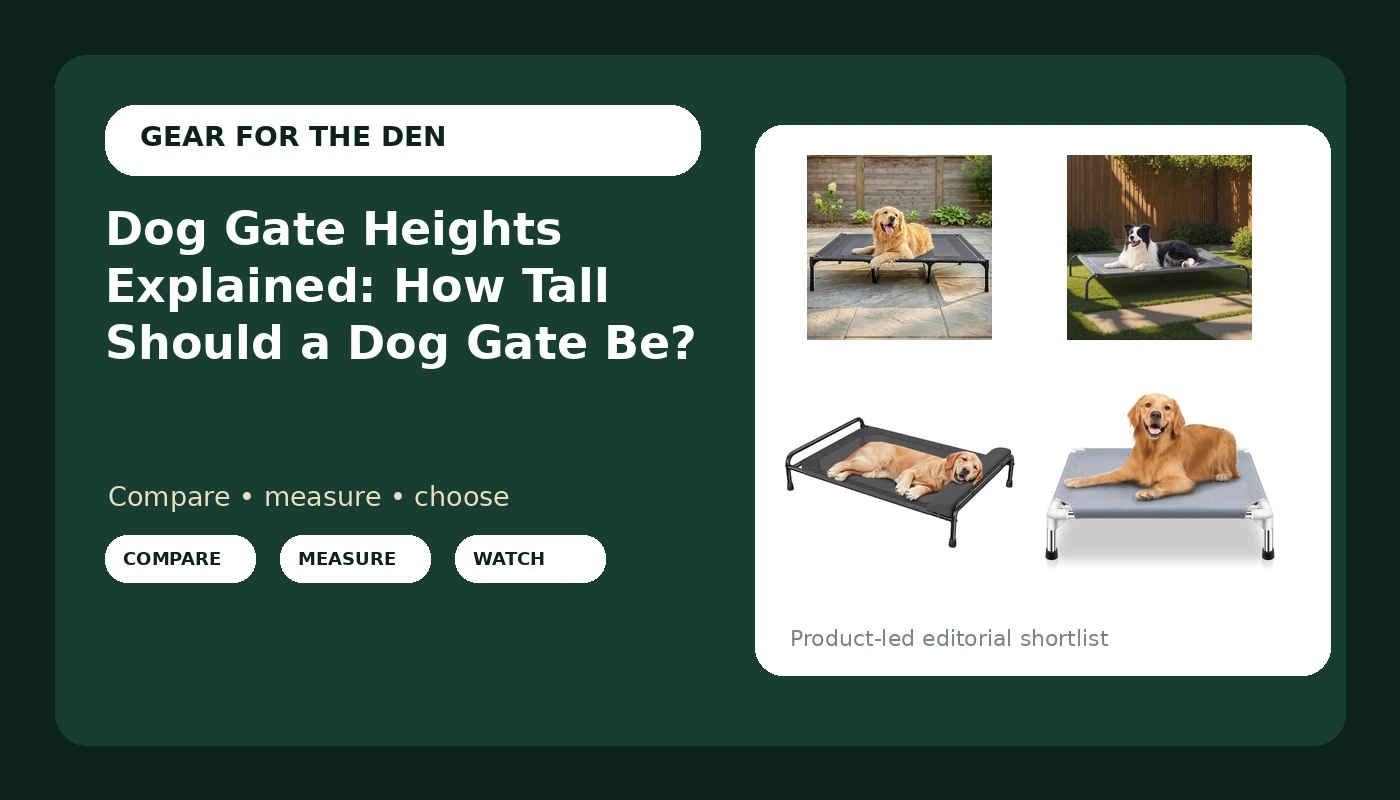
4 useful elevated bed options for gated rooms
| Model | Best fit | What stands out |
|---|---|---|
| suddus Elevated Dog Bed for Large Dogs 120lb, Cooling Raised Dog Cot with Dual Support Bars & Metal Frame, No-Slip Feet, Waterproof Pet Bed for Indoor/Outdoor, X-Large, 48 36 9in, Grey | Extra-large dogs in a gated living area | Dual support bars, metal frame, no-slip feet, waterproof surface |
| Bedsure Outdoor Elevated Cooling Dog Bed Large Sized Dog, 49in Grey | Patios and sunny rooms behind a gate | 49 inch raised cot sized for large dogs |
| Simple Trending Elevated Dog Bed for Large Dogs, 44.5" x 31", Black | Rooms where floor space is tight | Compact 44.5 by 31 inch footprint |
| Elevated Dog Bed, Raised Outdoor Dog Bed for Medium Dogs, Portable Pet Cots | Medium dogs and beds that move between rooms | Portable cot design |
Extra-large dogs: suddus Elevated Dog Bed for Large Dogs 120lb, Cooling Raised Dog Cot with Dual Support Bars & Metal Frame, No-Slip Feet, Waterproof Pet Bed for Indoor/Outdoor, X-Large, 48 36 9in, Grey
Where this fits a gated setup: the dog most likely to clear a gate is the dog with the longest legs and the most momentum, and that is the same dog that needs a cot rated for the weight it lands with. The suddus bed puts dual support bars and a metal frame under a 48 by 36 inch surface, with no-slip feet for hard floors and a waterproof top for indoor and outdoor use. If the bed sits on the landing side of a stair gate, a cot that does not slide when the dog launches off it keeps the corner tidy. The 9 inch deck height also gives a big dog an easy step up rather than a climb off the floor.
Patios and sun: Bedsure Outdoor Elevated Cooling Dog Bed Large Sized Dog, 49in Grey
This cot earns its place at the far end of a patio or a sunroom, where the dog can watch the gate without pressing against it. Elevated surfaces let air move underneath, which is the practical reason cots are popular in warm rooms, and a raised bed keeps a large dog off a hot deck. Match it to the gate rather than the other way around: a 49 inch bed sitting beside a 24 inch gate tells you the gate was sized for a different dog. If your dog spends the afternoon outside the gate and the evening inside it, one cot that lives on the boundary is easier to manage than two beds.
Tight rooms: Simple Trending Elevated Dog Bed for Large Dogs, 44.5" x 31", Black
Not every gated space is generous. This bed keeps a large-dog surface in a footprint that slides beside a couch or under a window in a hallway the gate closes off. When you are working with a narrow room, check footprint first, then height, then whether the frame stays steady for a dog that steps on and off it a dozen times a day. A bed that is too wide gets pushed into the gate, and a bed pressed against a gate is an invitation to climb it. Leave enough clearance that the walk-through section stays clear even with the bed in place.
Medium dogs and travel: Elevated Dog Bed, Raised Outdoor Dog Bed for Medium Dogs, Portable Pet Cots
This is the lightest of the four to move, and portable cots suit homes where the dog follows the sun or where the bed travels between a kitchen, a balcony, and the car. For medium dogs the same measuring rules apply: size the surface to the dog stretched out rather than curled, and check that the cot's height still works for a dog that is growing. A bed that is easy to relocate is also easy to keep out of the gate's swing, which is one less thing to step over with your hands full.
Prices and availability may change. Product images, names, and retailer links are matched to verified listings. No current price, rating, stock status, or measured result is stated here without current evidence.
Dog gate heights by dog size
Start with the dog, not the gate. Measure shoulder height with the dog standing squarely on all fours, and measure the top of the head as well if your dog jumps, because the head clears the rail first. Weight tells you very little about the height needed: a dense 40 pound dog with short legs may need less gate than a leggy 25 pound dog that can bounce.
The ranges most gates fall into:
- 18 to 24 inches for small dogs and most puppies
- 30 to 36 inches for medium dogs, and for small dogs that jump
- 36 to 48 inches for large and athletic dogs
Treat those as starting points. The ideal dog gate heights for a specific home also depend on what the dog launches from. A dog that can back up four feet and build speed needs more clearance than the same dog squeezing past a couch. A gate at the top of a staircase changes the stakes entirely: a dog that lands on the first step is fine, and a dog that clears a stair gate into open air is not. There, buy the tallest gate the opening accepts and check that the mounting hardware is rated for pressure rather than for a hallway.
Puppies and seniors bend the math in opposite directions. A puppy that will grow into a 70 pound adult needs a gate bought for the adult, not for the eight week old in front of you. An older dog with weak hind legs may struggle to step over a threshold bar, so the bottom rail matters as much as the top one. That is where correct dog gate heights stop being one number and become a pair: top rail high enough to block, bottom rail low enough to step over, or a walk-through gate with no bar at all.
Measuring the opening and the space around it
Height is half the job. The other half is the opening, and openings are rarely square. Measure the narrowest point of the doorway, hallway, or stair top in three places: at the floor, in the middle, and at the top. Baseboard trim, a door frame that steps inward, and a floor that slopes all change the number.
Then match the hardware to the shape. Pressure-mounted gates need two flat, parallel surfaces to push against, and they lose grip on thick trim. Hardware-mounted gates need drilling but tolerate odd angles. Panel count decides how a gate handles an L-shaped hallway or a wide kitchen opening: a three-panel gate folds into a doorway, while a six-panel gate wraps a fireplace. Bar spacing decides whether a small dog or a puppy can squeeze between the bars, and it is the measurement people forget when they bought on gate height alone.
- Measure your dog standing, shoulder and head, and write both numbers down.
- Measure the opening at its narrowest point, floor, middle, and top, and note whether the surfaces are flat.
- Decide whether the dog jumps, and add height if it does; confirm the tallest size available before ordering.
- Check bar spacing against the narrowest part of your dog, and check the bottom rail against a senior dog's step-over.
- Plan the floor on both sides: a crate for a dog that settles badly, or a raised bed so a damp dog has somewhere to dry instead of pacing the gate.
Placement, gaps, and the gear around the gate
- Put the gate where the dog cannot build speed, ideally at a corner or against a wall rather than at the end of a long straight run.
- Keep the crate on the quiet side of the gate if your dog settles better enclosed; check crate size against the same shoulder measurement you used for the gate, and leave cover ventilation open on at least two sides.
- Choose a bed with a washable fabric cover and a waterproof layer if it sits near a door to the yard; mat thickness matters most for older dogs stepping off a raised cot.
- Leave the walk-through section clear of bowls, beds, and toys so you are not stepping over gear while carrying groceries.
- Recheck the setup after the first week: pressure-mounted gates work loose, and a dog that leans on the top rail will find any gap.
Which option should you choose?
Choose the *suddus Elevated Dog Bed for Large Dogs 120lb, Cooling Raised Dog Cot with Dual Support Bars & Metal Frame, No-Slip Feet, Waterproof Pet Bed for Indoor/Outdoor, X-Large, 48 36 9in, Grey when the dog is genuinely large and the bed lives in a gated room or on a covered patio. Choose the Bedsure Outdoor Elevated Cooling Dog Bed Large Sized Dog, 49in Grey when the bed stays outside or in a sunny room and you want a 49 inch cot for a large dog. Choose the Simple Trending Elevated Dog Bed for Large Dogs, 44.5" x 31", Black when floor space inside the gate is tight. Choose the Elevated Dog Bed, Raised Outdoor Dog Bed for Medium Dogs, Portable Pet Cots* when the dog is medium sized and the bed needs to move between rooms.
None of these beds changes how tall a gate needs to be. They change what happens on either side of it, which is usually what people are trying to fix when a dog paces, whines, or leans on the gate. No product listing substitutes for the two measurements that decide the gate itself: your dog standing, and your opening at its narrowest.
The bottom line
Gate height comes down to two numbers you can take with a tape measure in under a minute: your dog's standing height, and the narrowest point of the opening. Buy for the adult dog, add height for a jumper, keep the bottom rail low for a senior, and check bar spacing and panel count before you check the color. Then set up the space behind the gate so the dog has somewhere to settle, whether that is a crate or one of the raised beds above. Get the measurements right once and the gate stops being a daily negotiation.