The first sign is usually the sound. A dog that bolts when the clippers come out will often bolt just as fast for a rotary tool, and the reason is rarely the nail itself. It is the vibration you can feel traveling up your own hand, the whine of the motor, and the fact that the whole event happens close to the face. When people go looking for a dog nail grinder for anxious dogs, they are usually trying to remove the two worst parts of the job: the sudden squeeze of a clipper and the long, tense hold that follows it.
Grinding does not fix that on its own. What it does is swap one decisive cut for a series of short passes, and short passes are easier to pause, easier to reward, and easier to repeat tomorrow if today went badly. That rhythm is the real advantage for a nervous dog, which is why the tool matters less than the way you use it.
Quick answer
Here is dog nail grinder for anxious dogs explained in one paragraph: noise, vibration, and speed control matter more than power, and none of the four products below carries published decibel measurements, so any "whisper quiet" wording is a listing claim rather than a measured fact. A grinder you can set to a slow, steady speed and hold with a relaxed grip will do more for a fearful dog than a more powerful one you can barely control. If your dog panics at the sight of the tool, start with desensitization before you start with nails. No product here is labeled the quietest, the fastest, or the best, because the evidence to support that kind of ranking is not available.
Four useful options
| Model | Best fit | What stands out |
|---|---|---|
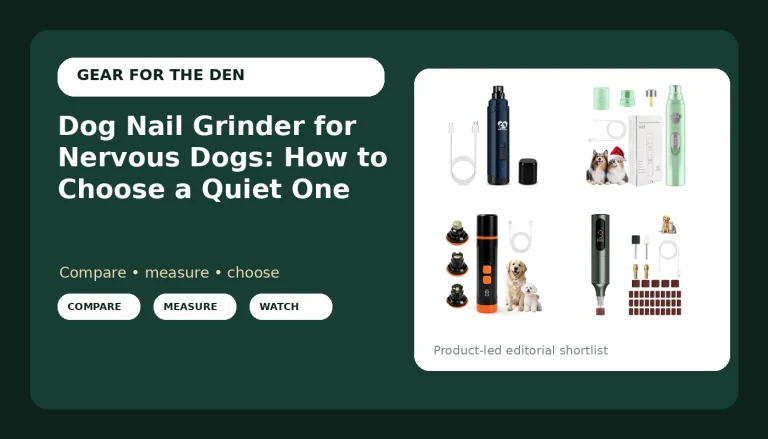
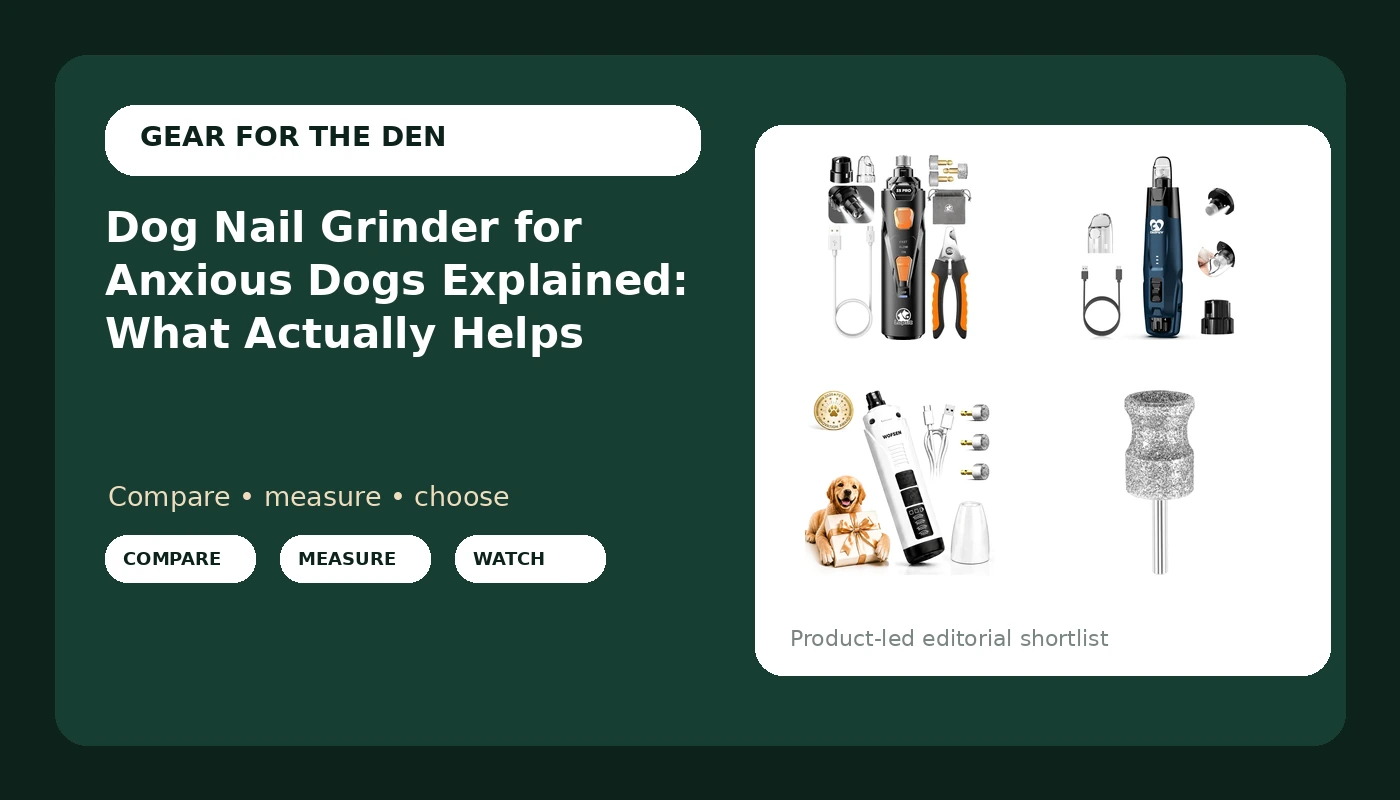
| Whisper Quiet Dog Nail Grinder Safe & Stress-Free for Sensitive Dogs Cats | Owners who want a complete grinder and have nothing at home yet | Sold as a standalone tool, not a replacement bit |
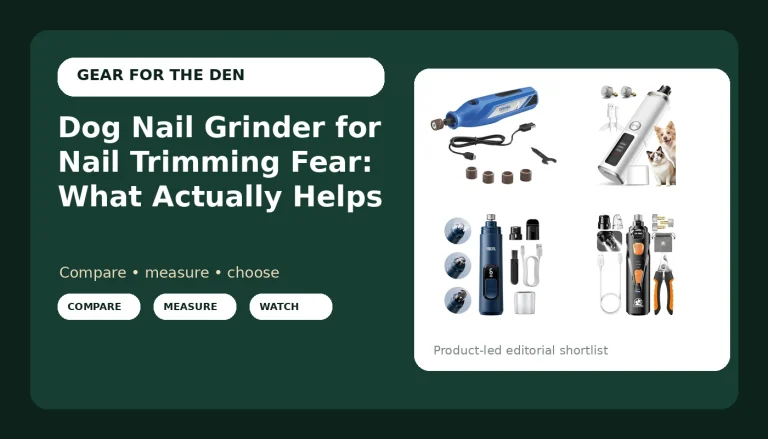
| Casfuy New 6-Speed Dog Nail Grinder – Whisper Quiet Safe Pet Nail Trimmers | Dogs that need the slowest possible starting speed | Six selectable speed settings named in the listing |
| Whisper-Quiet Dog Nail Grinder, Safe & Stress-Free for Sensitive Dogs Cats | Owners comparing two very similar low-noise listings | Same sensitive-dog positioning as the first option |
| Diamond Dremel Dog Nail Grinder Attachment, Diamond Rotory Bit for Dogs&Pets Nail Care, 1/8'' Pet Nail Grinder Wheel Work with Dremel Sanding Drums for Animals Nail Care & Home Grinder Tools, FlashA | Owners who already own a rotary tool | Diamond-coated wheel sized for 1/8 inch tools |
Complete grinder option: Whisper Quiet Dog Nail Grinder Safe & Stress-Free for Sensitive Dogs Cats
The appeal here is simplicity. You open a box, you have everything you need, and there is no separate handpiece to learn. That matters when your dog's tolerance is measured in seconds, because every extra step between "tool is out" and "one nail is done" is a step where the session can fall apart.
The trade-off is control. The title does not describe multiple speeds, so treat adjustable speed as something to confirm on the product page rather than something to assume. If your dog startles at the first touch, a single fast setting gives you no way to slow down and try again. Pair this grinder with the desensitization steps further down, and check the listing details before you commit.
Speed-control option: Casfuy New 6-Speed Dog Nail Grinder – Whisper Quiet Safe Pet Nail Trimmers
More settings sound like more complexity, and with a squirming dog on your lap, complexity is real. The counterargument is that a lower starting speed produces less vibration and less of the high-pitched whine that sends many dogs backward, and you cannot get that from a tool with one setting.
Keep in mind that speed settings are not a substitute for technique. Running a fast grinder in one spot heats the nail through friction, which is exactly the sensation that teaches a dog to pull away. Short touches at a moderate setting beat long holds at any speed, so use the lower settings for the first few sessions and move up only when your dog stays still.
Low-noise option: Whisper-Quiet Dog Nail Grinder, Safe & Stress-Free for Sensitive Dogs Cats
When two listings use almost the same language, the wording stops being a useful way to choose between them. What you can actually compare is what each product page says about speed settings, the shape of the head, and what comes in the box. Read both pages with the same checklist in hand, and pick the one whose details you can verify rather than the one whose adjectives you like.
One practical point applies to either: a grinder with a narrow head that reaches a single nail is easier to control around a paw than a wide drum. If a listing does not show the head clearly, that is a question worth asking before you buy.
Rotary-tool attachment option: Diamond Dremel Dog Nail Grinder Attachment, Diamond Rotory Bit for Dogs&Pets Nail Care, 1/8'' Pet Nail Grinder Wheel Work with Dremel Sanding Drums for Animals Nail Care & Home Grinder Tools, FlashA
Prices and availability may change. Product images, names, and retailer links are matched to verified listings. No current price, rating, stock status, or measured result is stated here without current evidence.
The logic is sound if there is already a rotary tool in your workshop. You skip buying a second motor and you get a diamond abrasive that holds its edge. The trade-off is that a general-purpose rotary tool is built for wood, metal, and craft work, not for a dog's paw. It is typically louder and faster than a pet grinder, it does not have a housing shaped around a nail, and your grip handle technique has to do all the stabilizing work. If your dog is sound-sensitive, that difference is the whole decision. If your dog is relaxed about noise and simply needs a cheaper path to the same result, this is a reasonable one.
Why a dog nail grinder for anxious dogs is not just a quieter clipper
Motor noise gets all the attention, but it is only one of three things your dog is reacting to. The second is vibration, which travels from the handpiece through your hand and into the paw even when the sound is muffled by a towel. The third is the pressure and duration of the hold: a clipper demands one quick, firm squeeze, while a grinder asks your dog to hold still through several seconds of contact. Some dogs find the second option easier. Others find it harder, because the contact lasts longer.
It also helps to know what causes the flinch. Friction from a spinning drum heats the nail, and heat is the sensation that teaches a dog to yank a paw away. That is why short touches in one spot are safer than long, patient grinding in the same place. A grinder with steady airflow around the head runs cooler than one that packs dust against the nail, so clear the drum between nails rather than at the end of the session.
Finally, remember what a grinder cannot do. It cannot make a dog who is terrified of handling suddenly accept a paw hold. If your dog will not let you touch a paw while the tool is off and silent, no product on this page will change that on its own. Desensitization comes first, nails come second, and the tool is simply what you reach for once the paw handling is already tolerable.
What to check before you buy
Start with the paw, not the motor. A grinder you cannot hold steadily is a grinder that slips, and a slip sets a nervous dog back weeks. Look for a body shape with a grip handle that suits your hand and a head small enough that you can see the nail while you work. A blade guard or safety guard around the grinding head limits how far skin and hair can travel into the drum, which matters more on a wiggling dog than on a still one.
Speed range is the second thing to verify, because a low starting speed is what you actually need for the first month. If a listing does not state the settings, that is a gap, not a detail.
Then there is the grooming context around the nails. Long hair over the paw hides the nail, so a dog with a heavy undercoat often needs the feet brushed and trimmed free before you can see what you are grinding. That is where coat type and the bristle type on your brush start to matter, because the wrong brush pulls instead of separates. The same logic applies to the wider routine: an oatmeal concentration in a shampoo is a skin-soothing choice for bath day, not a nail choice, and it does nothing for the paw you are trying to steady.
If you are still building out the rest of your kit, our dog grooming tools checklist walks through the pieces that pair well with a grinder.
- Run the grinder in another room while your dog eats, so the motor noise predicts something good before it ever predicts a nail.
- Bring it into the room switched off and let your dog sniff it while you hold one paw for a few seconds, then put it away.
- Switch it on at the lowest setting and touch a single nail for one beat, then stop while your dog is still comfortable.
- Work one paw per session, take two or three nails at most, and reward between nails rather than only at the end.
- Stop at the point your dog could still do one more nail, not at the point where they have had enough.
Practical guidance for the first few sessions
- Hold the paw from underneath with a flat, relaxed hand. A tight grip reads as restraint, and restraint is what a nervous dog is trying to escape.
- Use two or three brief touches per nail instead of holding the drum in one spot, and let the nail cool between passes.
- Brush the paw free first and work under good light, because you cannot judge how close you are to the quick if you are guessing.
- Put a non-slip mat under your dog. Slipping feet turn a steady dog into a struggling one within seconds.
- Keep treats tiny, soft, and immediate. A reward that takes ten seconds to chew is a break, not a reward, and breaks are what you want to finish on.
- If one nail is clearly worse than the others, leave it for a separate, shorter session rather than pushing through the whole paw.
- Have a fallback. A scratchboard or a veterinary groomer is a legitimate plan B, and using one is not a failure.
Which option should you choose?
Choose the Whisper Quiet Dog Nail Grinder Safe & Stress-Free for Sensitive Dogs Cats when you want one complete tool and there is nothing at home to build on. Choose the Casfuy New 6-Speed Dog Nail Grinder – Whisper Quiet Safe Pet Nail Trimmers when adjustable speed is the feature you care about most. Choose the Whisper-Quiet Dog Nail Grinder, Safe & Stress-Free for Sensitive Dogs Cats when you are comparing low-noise listings directly and want to weigh the details of each. Choose the Diamond Dremel Dog Nail Grinder Attachment, Diamond Rotory Bit for Dogs&Pets Nail Care, 1/8'' Pet Nail Grinder Wheel Work with Dremel Sanding Drums for Animals Nail Care & Home Grinder Tools, FlashA when you already own a 1/8 inch rotary tool and want to put it to work.
There is no single ideal dog nail grinder for anxious dogs, because the tool only sets the ceiling on what a session can look like. The floor is set by the dog. The correct dog nail grinder for anxious dogs is therefore the one you can operate calmly, at a speed you can hold, on a dog who is still willing to stay in the room.
None of these listings publishes verified noise measurements, and none of the claims on this page rest on hands-on testing. Dogs also differ enormously: a tool that works for a sound-sensitive shepherd may be irrelevant to a dog who is only unhappy about having a paw held. Treat the descriptions above as a framework for reading product pages, not as a prediction of how your dog will react.
The bottom line
For an anxious dog, the useful spec is not power or a quiet-sounding name. It is whether the tool lets you go slowly, hold steady, and stop early. A six-speed grinder gives you the most room to start slow, a complete grinder removes the extra steps that a nervous dog has to sit through, and a diamond attachment makes sense only if a rotary tool is already in your kit. Whichever you pick, spend the first two weeks on the desensitization steps and the last five minutes on the nails, and keep every session short enough that your dog is still willing to come back for the next one.