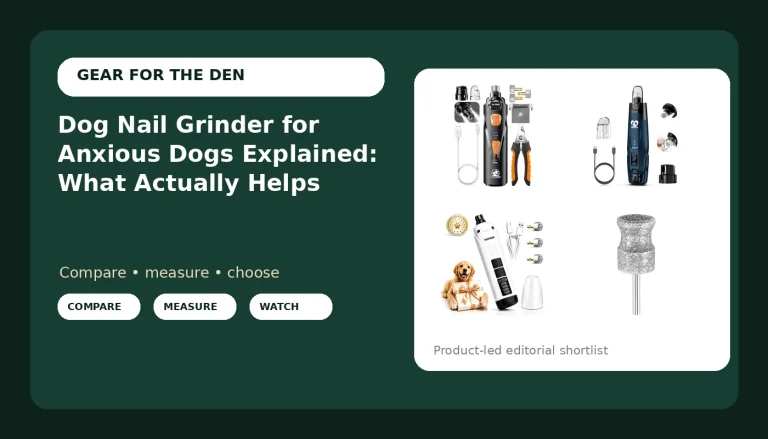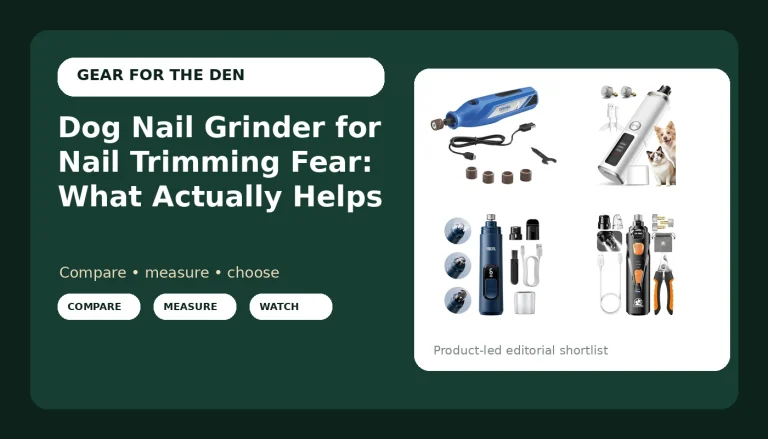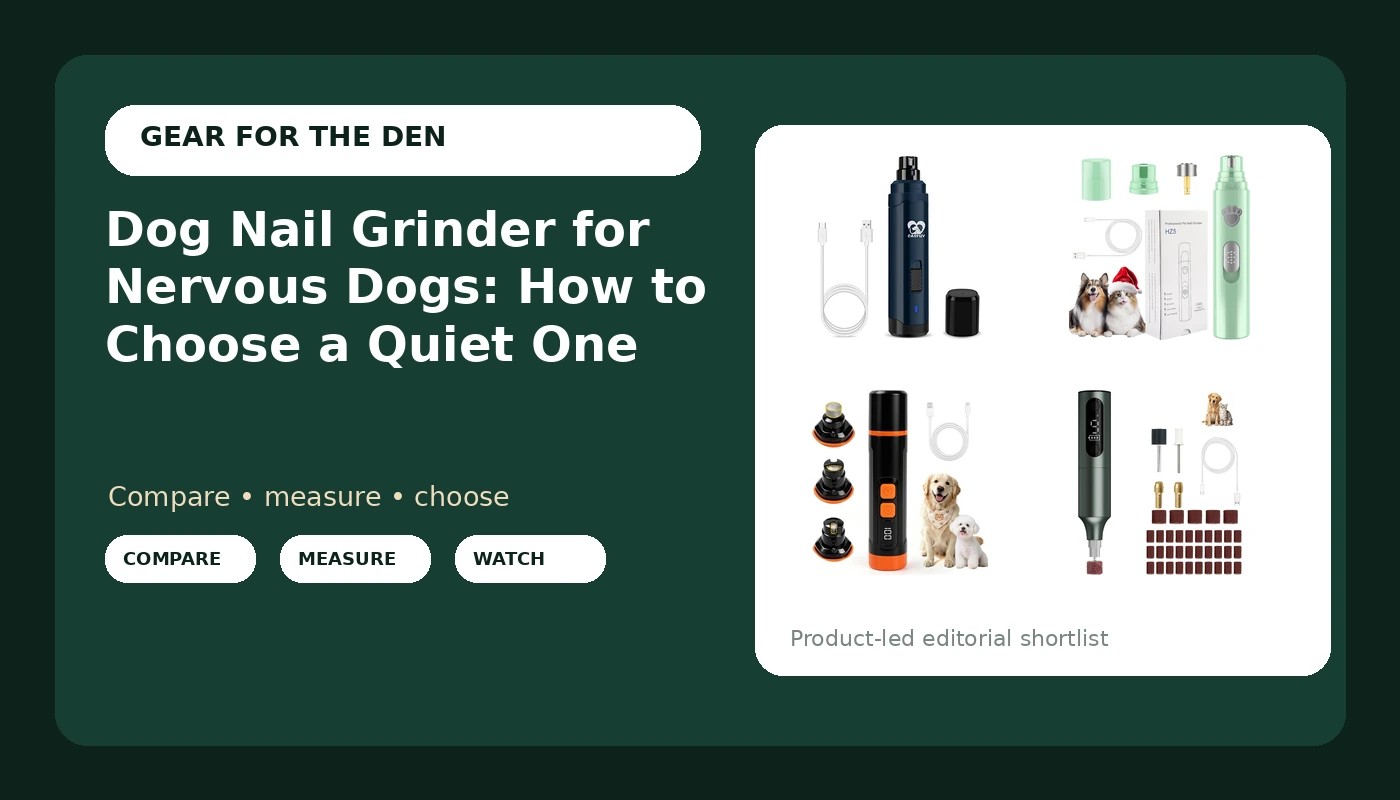
Choosing a dog nail grinder for nervous dogs is less about finding the most powerful tool and more about finding the least threatening one. A dog that panics at clippers will often tolerate a grinder, but only when the sound stays low, the vibration stays mild, and the first sessions end before the dog has had enough. The tool is only half of it. Handling, timing, and how quickly you stop matter just as much, and those are the parts you control. This guide compares four grinders that differ in speed control, motor noise, blade guard design, and grip handle, then walks through how to introduce one without turning nail day into a wrestling match.
Quick answer
Pick a grinder with a slow first speed and a covered grinding head, then use it on the lowest setting until your dog stops pulling the paw away. For most nervous dogs the workable combination is a rechargeable tool, two or more speed steps, and a guard that limits how much nail reaches the wheel in a single pass. That is the short version of dog nail grinder for nervous dogs explained: sound, speed, and how fast you stop. Raw power is not the limiting factor, because you are removing small amounts of nail slowly rather than shaping an entire paw in one sitting.
4 useful options
| Model | Best fit | What stands out |
|---|---|---|
| Casfuy Dog Nail Grinder Upgraded – Professional 2-Speed Whisper-Quiet Electric Pet Nail Trimmer Painless Paws Grooming & Smoothing for Small Medium Large Dogs & Cats (Dark Blue) | A first grinder for a dog that already dislikes clippers | Two speeds, cordless body, marketed for small, medium, and large dogs plus cats |
| VIWIK Dog Nail Grinder, 2-Speed Rechargeable Dog Nail Trimmers for Large Medium & Small Dogs, Upgrade Professional Electric Pet Paws Grooming, Quiet Puppy Grooming Tool, for Dogs Cats | A second unit or a low-commitment first attempt | Two speeds, rechargeable battery, positioned for puppy grooming |
| Outdoggy Dog Nail Grinder, Quiet 3-Speed with LED & Safety Guard | Owners who want to see each pass and cap how much comes off | Three speeds, LED at the head, listed safety guard |
| piig Rechargeable Dog Nail Grinder, 9‑Speed Adjustable Ultra Quiet Electric Pet Nail Trimmer for Small Medium Large Dogs Cats, 1800mAh USB‑C Professional Pet Grooming Nail Grinder Kit | Dogs that need one very specific slow setting | Nine speed steps, USB‑C charging, stated 1800mAh battery |
The familiar two-speed starting point: Casfuy Dog Nail Grinder Upgraded
The trade-off here is control. Two speeds give you a slow setting and a faster one with nothing in between, so a dog that needs something in the middle has to be managed by how long you grind rather than by how fast the wheel turns. The quiet wording in the name is the manufacturer's description, not a measurement, so treat it as a direction and test the sound in your own home before you plan a full session. Because this is the shape most owners encounter first, it is a reasonable default when you have no strong reason to choose otherwise.
The low-commitment rechargeable: VIWIK Dog Nail Grinder
This is the model to consider when you want a second unit for a second dog, a kit that lives in a travel bag, or a first grinder before you know whether your dog will accept the process at all. Two speeds and a rechargeable battery are the essentials, and nothing here adds a guard or a light. If your dog is already difficult about paw handling, the guard on the Outdoggy or the extra speed steps on the piig are more likely to change the outcome than a second two-speed tool.
The guarded pick: Outdoggy Dog Nail Grinder
A guard is not a substitute for technique, and it will not stop you from holding the tool in one spot for too long. What it does is cap the damage from a single mistake, which matters more with a dog that jerks its paw without warning. The LED is the smaller feature of the two and often the one owners notice first, because most nail sessions happen in the evening, in a room dimmer than it looks. Three speeds also give you a middle setting that two-speed tools do not have, which is useful for a dog that finds the slow setting too slow to make progress but is not ready for the fast one.
The most adjustable pick: piig Rechargeable Dog Nail Grinder
The trade-off is that more settings mean more decisions to make while a nervous dog waits. Decide the speed before you switch the tool on, and change it between sessions rather than mid-paw. The USB‑C port is the practical detail: it matches the cable you already own, so a flat battery stops being an excuse to skip a session. A stated 1800mAh battery is a capacity figure from the listing, not a runtime guarantee, and runtime will depend on which speed you use.
Prices and availability may change. Product images, names, and retailer links are matched to verified listings. No current price, rating, stock status, or measured result is stated here without current evidence.
What makes a dog nail grinder for nervous dogs different
Most dogs react to the sound and the vibration long before the wheel touches a nail. Dogs hear higher frequencies than people do, and a grinder's motor noise sits in a range that many of them find alarming in the air, before anything has happened. Vibration travels through the paw as well, which is why a tool that sounds acceptable from across the room can still be rejected the moment it makes contact. Speed settings exist to manage exactly that: a slower wheel produces less noise and less vibration, at the cost of taking longer to remove the same amount of nail. A blade guard addresses a different risk, limiting how much nail can be ground away in one pass so that a sudden movement does not remove too much at once.
There is no single ideal dog nail grinder for nervous dogs, because the trigger varies from dog to dog. Some object to the sound, some to the sensation, and some simply to being held still while a paw is handled. Watch which part of the process your dog reacts to and change that part first. If the reaction starts when you pick up the tool, work on handling. If it starts when the motor runs, work on sound. If it starts when the wheel touches the nail, work on speed and pressure.
Sound, grip, and the details a listing will not tell you
Two numbers are missing from nearly every listing in this category: how loud the tool is at the speed you will actually use, and how much it vibrates under load. Motor noise is easy to compare in a store and hard to compare online, and the airflow that cools the motor adds a constant hiss that some dogs notice more than the grinding itself. The grip handle matters more than it sounds. A handle that fits your hand lets you hold the tool steady with light pressure, and a steady tool is far less frightening than a wobbling one.
Battery format is the last practical detail. A rechargeable grinder with a common charging port is easier to keep ready than one with a proprietary cable, and a tool that is charged when you need it is a tool you will actually use. Everything else in a grooming cabinet belongs in a different lane. Coat type, undercoat, bristle type, and even oatmeal concentration in a shampoo matter for bathing and brushing routines, and none of them change how a grinder performs. If shedding is the bigger problem in your house, start with deshedding tools for double-coated dogs and come back to nails as a separate project.
The order below matters more than the tool you pick:
- Let your dog sniff the grinder while it is switched off, feed a treat, and put it away.
- Run it at the lowest speed in another room, then in the same room, then near the paw, across several short sessions.
- Touch the running tool to one nail for a second or two, then stop and reward even if nothing was removed.
- Grind one nail per session for the first week, starting with the easiest nail, which is usually on a front paw.
- Add a second nail only when your dog stops pulling away, and keep every session short.
Practical guidance for calmer nail sessions
- Choose a time when your dog is tired rather than already wound up.
- Work on a non-slip surface so your dog is not scrabbling for footing while you hold a paw.
- Take small passes and check the nail tip instead of grinding continuously.
- Keep treats within reach and reward after each nail, not only at the end.
- Stop while your dog is still calm, even if you have nails left to do.
Which option should you choose?
Choose the Casfuy Dog Nail Grinder Upgraded when you want a familiar cordless two-speed tool and your dog mainly needs a slow setting and patience. Choose the VIWIK Dog Nail Grinder when you want a rechargeable second unit or a low-stakes first attempt, especially with a puppy. Choose the Outdoggy Dog Nail Grinder when you want to see the nail clearly and cap how much comes off in one pass. Choose the piig Rechargeable Dog Nail Grinder when your dog needs one specific slow speed and you want the tool charged from a standard cable. The correct dog nail grinder for nervous dogs is the one your dog will sit still for, and that is often the slowest tool in the drawer rather than the most capable one.
No listing here states a measured decibel level at each speed, so quiet wording in a product name is a manufacturer description rather than verified data. Treat the number of speed steps as a proxy for control, not a promise of calm, and plan on several short sessions before you judge whether a tool works for your dog.
The bottom line
Slow speed, a guard or careful technique, and short sessions do more for a nervous dog than any single feature. Any of the four grinders here can work if you use the lowest setting and stop early; the real differences are in how finely you can set the speed and how much the tool helps you see and limit each pass. Buy for control and handling, keep the tool charged, and treat the first month as training rather than grooming.