A dog that leaves a wet ring around the bowl after every drink turns a small habit into a daily mopping routine. The search for an elevated dog bowl for spilling water explained in practical terms comes down to three variables: how high the drinking surface sits, how much water the bowl or reservoir holds, and how firmly the stand resists a large dog leaning into it. Raising a bowl does not make a dog neat on its own. What it changes is the angle of the neck and the distance a splash travels, which is often enough to keep more water in the bowl and less on the floor. This guide walks through the mechanics and then matches four verified options to different kinds of drinkers.
Quick answer
The correct elevated dog bowl for spilling water is one whose stand cannot tip and whose drinking surface sits near the dog's lower chest, with enough water capacity that you are not refilling mid-slosh. For a large breed that empties a standard bowl and drags a wet beard across the room, a high-capacity raised water bowl does most of the work. For a dog that gulps and then splashes, a slower feeding surface and a wide, non slip base help more than extra height. Height and capacity matter more than any single feature, and a bowl that is too tall for the dog can increase the mess rather than reduce it.
Four useful options
| Model | Best fit | What stands out |
|---|---|---|
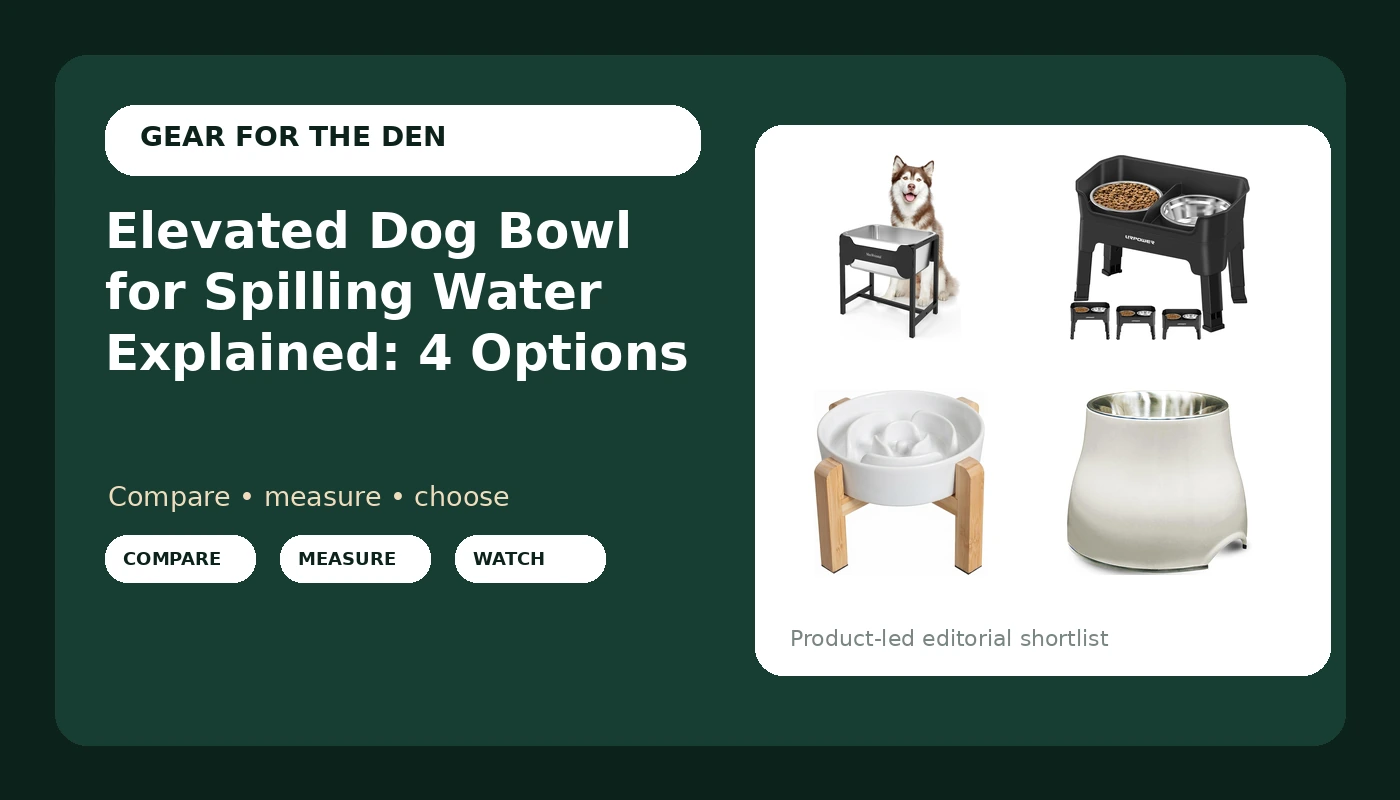
| 2.5 Gallon Elevated Dog Water Bowl for Large Breeds, 14.2" Tall Raised Stainless Steel Large Dog Water Bowl with Full Metal Stand for Relief Joint Pressure, Tip-Proof, Easy to Clean, Indoor & Outdoor | Large dogs that drain a bowl | 2.5 gallon water capacity and a 14.2 inch raised stainless steel bowl on a full metal stand |
| URPOWER Elevated Dog Bowls, 3-in-1 Double Deck Raised Dog Bowl Stand | Food and water at one station | Double deck raised stand holding two bowls |
| Elevated Slow Feeder Dog Bowl, 6.7" Ceramic Maze Dog Bowl with Stand | Fast drinkers and fast eaters | 6.7 inch ceramic maze bowl that slows gulping, sold with a stand |
| Dogit Elevated Dog Bowl for Large Dogs, White | A simple single bowl | Straightforward raised bowl sized for large dogs |
The high-capacity water station: 2.5 Gallon Elevated Dog Water Bowl for Large Breeds
The trade-off here is fixed height. A 14.2 inch drinking surface suits a tall dog, and a smaller dog at the same station would be reaching up rather than drinking comfortably, which can make the mess worse. The reservoir is also a commitment: water sits out in bulk, so it needs refreshing on a schedule rather than a top-off whenever the bowl looks low. There are no slow feed ridges on this bowl, so a dog that plunges its whole muzzle in will still displace water at the source; the reservoir simply means there is more water available before the bowl runs dry. The metal stand is the part that earns its place, because a heavy dog leaning on a light bowl is the most common way water ends up on the floor in the first place.
The two-bowl raised stand: URPOWER Elevated Dog Bowls, 3-in-1 Double Deck Raised Dog Bowl Stand
The advantage is consolidation. When the food bowl and the water bowl sit on the same raised frame, the dog drinks and eats in the same spot, and the floor protection you put underneath covers both. The limitation is capacity. A double deck stand holds standard bowls rather than gallons, so a large breed that drinks a lot will need more frequent refills than the reservoir option above. The frame also takes up more floor space than a single bowl, which matters in a narrow kitchen or a crate-adjacent corner. If your dog splashes mainly by dragging the bowl around, a stand with two bowls is harder to shift than one loose dish, and that alone can cut a surprising amount of spillage.
The slow-feeder option: Elevated Slow Feeder Dog Bowl, 6.7" Ceramic Maze Dog Bowl with Stand
A maze surface is the closest thing here to a fix for the dog that throws water with its own enthusiasm. Slower drinking means less gulped air and less water displaced in one motion, and the maze walls catch some of the slosh that would otherwise clear the rim. The trade-offs are real, though. It is a smaller bowl than a 2.5 gallon reservoir, so it is not the answer for a giant breed that needs water available all day. The maze pattern takes more scrubbing than a plain bowl, and a ceramic body deserves a careful look at the stand it sits on before you trust it around a dog that paws at the water. It is also a feeding bowl, so it works best as an addition to a water setup rather than a replacement for one.
The simple raised bowl: Dogit Elevated Dog Bowl for Large Dogs, White
This is the option for a dog that only needs the lift. If the mess comes from a low bowl and a dog that has to reach down for every mouthful, raising the water to a comfortable feeding height can be enough on its own, and a plain bowl is the least fussy way to do it. What it will not do is slow a gulper or hold a large volume. There is no reservoir to absorb a heavy drinking session and no slow feed ridges to interrupt one, so a determined splasher will still splash. Its value is as a clean baseline: if you have never tried an elevated bowl and you want to know whether height alone changes your dog's habits, this is the simplest way to find out.
Prices and availability may change. Product images, names, and retailer links are matched to verified listings. No current price, rating, stock status, or measured result is stated here without current evidence.
Why an elevated dog bowl for spilling water changes the floor
Water leaves a bowl in three ways, and only two of them respond to height. The first is displacement: when a muzzle pushes into the surface, water moves aside, and the lower the head, the deeper that push tends to be. The second is the drip, the water that clings to the jowls and beard after the drink and lands somewhere between the bowl and the dog's bed. The third is the bowl itself moving, sliding across tile or tipping when a large dog leans its weight on the rim.
An elevated bowl mainly addresses displacement. When the drinking surface sits near the lower chest, the neck stays closer to level, the muzzle enters the water at a shallower angle, and less water is pushed over the rim. The stand matters just as much as the height, because a perfectly placed bowl on a frame that slides will still leave a trail. That is where a non slip base or a weighted metal frame earns its keep. Bowl capacity plays a supporting role: a bowl that is nearly empty is a bowl that gets refilled in a hurry, and a dog drinking from a shallow layer of water tends to splash more, not less.
What no elevated bowl can do is stop the drip. A wet beard will still mark the floor on the way back to the couch, which is why a mat with a raised lip under the station does more for a tidy room than a taller bowl alone. Together, height and floor protection cover most of the problem; neither one covers all of it. If you are rebuilding the whole feeding corner, it helps to think about how feeding height and water access fit together rather than buying one bowl at a time.
Feeding height, bowl capacity, and water capacity
Height is the variable people guess at, and it is the easiest one to measure. Have the dog stand naturally on a level floor and note where the lower chest sits. That is roughly the level the bowl rim should reach. Too low and the dog is still reaching down, which keeps the displacement problem. Too high and the dog has to lift its head to swallow, which is uncomfortable and often ends with the dog backing away from the bowl mid-drink, leaving water behind.
Capacity is a separate decision. A single bowl is fine for a dog that drinks a few times a day while you are home. A reservoir makes more sense for a large breed, a multi-dog household, or a workday where nobody is around to refill. Water capacity and bowl capacity are not the same thing: a wide shallow bowl holds a lot of surface area and splashes easily, while a deep reservoir holds the same volume with a smaller target. There is no single ideal elevated dog bowl for spilling water, because the right combination depends on your dog's height, its drinking style, and how long the bowl has to last between refills.
Work through it in this order:
- Measure the dog's lower chest height while it stands, and treat that as the target rim height.
- Time one drinking session and watch how far the water level drops, which tells you whether a standard bowl or a reservoir fits your routine.
- Check the floor under the current bowl for slide marks or scratches, which show whether the stand or the base is the weak point.
- Decide whether the dog needs a slower drinking surface, a larger volume, or just a lift, and pick the option that matches that single need.
- Match the material to your cleaning habits, since stainless steel and ceramic stand up to a dishwasher cycle better than scratched plastic.
Practical guidance for a water station that stays dry
- Put a lipped mat under the whole station, not just under the bowl, so drips from the beard land on the mat instead of the floor.
- Keep the water level above halfway; a nearly empty bowl is the easiest way to turn a tidy drinker into a messy one.
- If the stand slides, fix the grip before you raise the height, because a tall bowl on a moving base spills more than a low bowl that stays put.
- Rinse a maze bowl under the tap after each meal, since dried food in the ridges is harder to remove later.
- Refresh a large reservoir daily rather than topping it up, and scrub the bowl itself on the same schedule.
- In a multi-dog home, give the splasher its own raised station so the neat drinker is not standing in the puddle.
Which option should you choose?
Choose the 2.5 Gallon Elevated Dog Water Bowl for Large Breeds, 14.2" Tall Raised Stainless Steel Large Dog Water Bowl with Full Metal Stand for Relief Joint Pressure, Tip-Proof, Easy to Clean, Indoor & Outdoor when you have a tall, heavy dog that empties a normal bowl and needs water available all day. Choose the URPOWER Elevated Dog Bowls, 3-in-1 Double Deck Raised Dog Bowl Stand when you want food and water at one raised station and your dog drinks a normal amount rather than gallons. Choose the Elevated Slow Feeder Dog Bowl, 6.7" Ceramic Maze Dog Bowl with Stand when the mess comes from fast gulping and you want the bowl surface itself to slow the dog down. Choose the Dogit Elevated Dog Bowl for Large Dogs, White when you simply need a single raised bowl and want the least complicated version of it.
No current price, rating, or stock status is stated for any of these options here, so check the live listing before you buy. It is also worth being clear about what these four bowls are not. A filter cartridge and an airtight seal belong to circulating fountains and travel bottles, not to open drinking bowls, so do not expect either feature in this group. What you are choosing between is height, capacity, stand stability, and whether the drinking surface slows the dog down.
The bottom line
An elevated dog bowl for spilling water works when the height matches the dog, the stand refuses to move, and the capacity fits how long the bowl has to last. The 2.5 gallon raised water bowl covers volume and stability for large breeds, the URPOWER double deck stand consolidates food and water at one raised station, the ceramic maze bowl slows the dog that drinks too fast, and the Dogit bowl is the plain single-bowl baseline. Fix the sliding and the height first, then decide whether you need more water capacity or a slower surface, and the floor around the bowl will need far less attention.