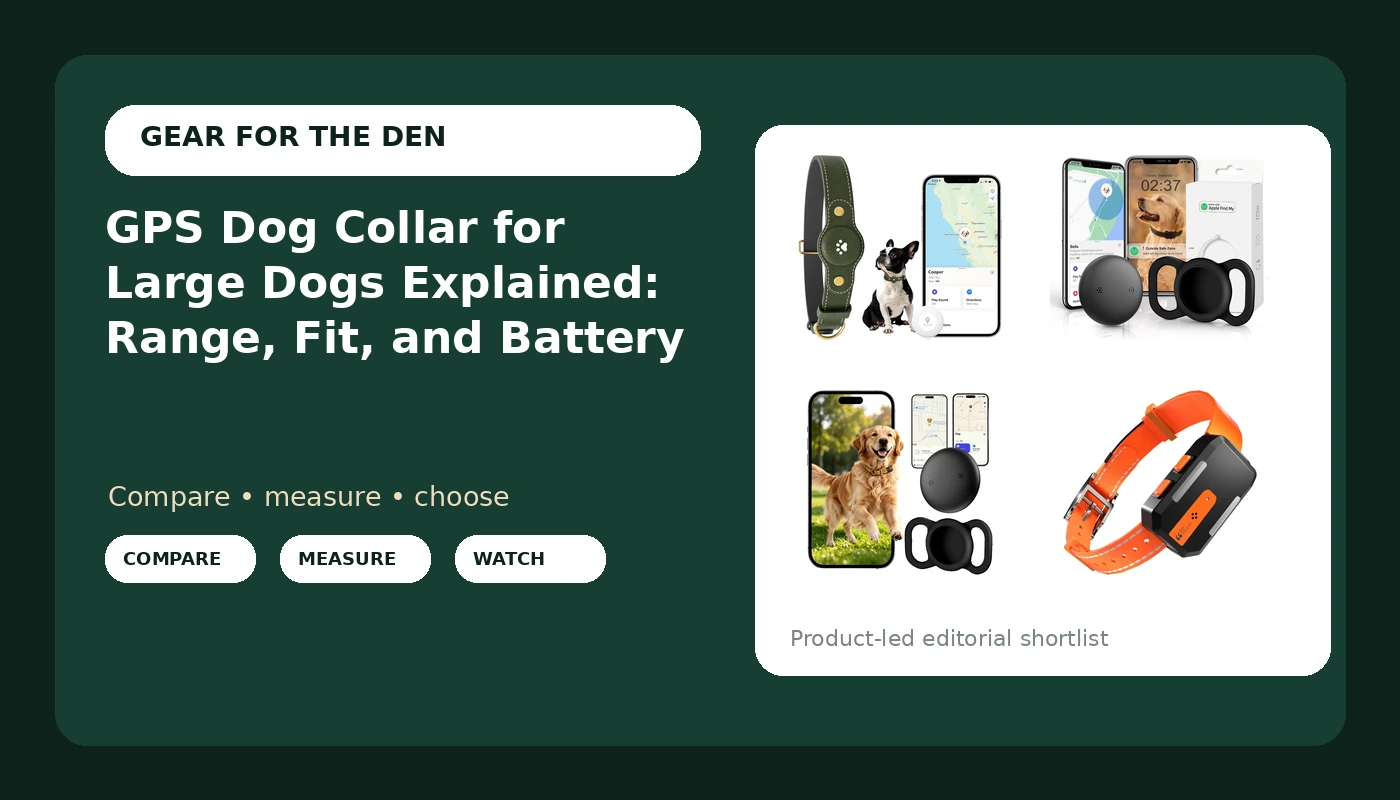
A gps dog collar for large dogs explained without the marketing language comes down to three questions: can the tracker hold a position where you actually walk, will it stay attached to a big dog that pulls, and does it keep working without a subscription. Large dogs add their own complications. A thick, tapered neck makes some collars ride up or slide, a tracker has to be light enough that the dog stops noticing it, and the dog that ranges far across a field is exactly the dog you least want to lose. The four listings below cover different versions of that problem, from a mini iPhone tracker to an add-on unit for a system you may already own.
Quick answer
Start with how the tracker attaches and how you pay for it. The GPS Tracker for Dogs with real-time location states support for both iOS and Android and a size range that reaches large dogs, which makes it the broadest starting point of the four. The iOS Smart GPS Dog Collar is the smallest and simplest, built around iPhone households. The Dog Tracking for Collar D2 adds tracking to a collar you already own, and the No Monthly Fee Dog Tracker is sold as an add-on unit only, so it fits owners who already run the system it pairs with. Every listing here states no monthly fee. None of the supplied product data includes a published gps range figure or a battery rating, so confirm both on the current listing instead of trusting a rounded number in a review.
Four useful options
| Model | Best fit | What stands out |
|---|---|---|
| GPS Tracker for Dogs, Smart Dog Collar & Pet Tracker with Real-Time Location, No Monthly Fee, Unlimited Range (iOS & Android), Fits Small to Large Dogs(Locator Included) | Owners who want one tracker across mixed dog sizes | Listing states real-time location, iOS and Android support, and a fit range that includes large dogs |
| iOS Smart GPS Dog Collar, Mini Pet Activity Tracker No Monthly fee 1 Pack | iPhone households that want the smallest unit | Mini activity tracker form factor in a single pack |
| Dog Tracking for Collar – Smart Tracker Dog Collar D2 | Adding tracking to a collar you already own | Collar-mounted tracker that does not replace your collar |
| No Monthly Fee Dog Tracker (Add‑On Unit Only),Off‑Grid GPS Collar Tracker | Owners who already run a matching system | Add-on unit intended for off-grid use |
The all-round pick: GPS Tracker for Dogs, Smart Dog Collar & Pet Tracker with Real-Time Location, No Monthly Fee, Unlimited Range (iOS & Android), Fits Small to Large Dogs(Locator Included)
The compatibility line is what earns this one the lead position. A tracker that speaks to only one phone platform is a problem in a household that mixes devices, and a fit range that stops at medium dogs is useless on a sixty-pound dog with a thick neck. Neither issue is fatal on its own, but together they narrow your choices fast, so a listing that answers both is worth reading first. The trade-off is that a broad claim tells you less about any single dog. Before you buy, measure your dog's neck at the widest point, check the width of the strap the unit is meant to sit on, and read the app requirements on the current listing. If your dog walks in a harness, note whether the tracker is meant to ride on the collar or on a chest strap, because that changes how much the dog feels it on every step.
The small iPhone tracker: iOS Smart GPS Dog Collar, Mini Pet Activity Tracker No Monthly fee 1 Pack
Weight is the quiet advantage of a mini tracker on a large dog. A heavy box on a collar swings when a big dog trots, and a swinging box is what turns a tracker into a chew toy. A small unit that clips on or threads onto a strap is easier for a dog to ignore. The trade-off runs the other way too. Small housings often mean smaller batteries and fewer features than a full collar unit, and a clip that holds on a thirty-pound dog may not hold on a ninety-pound one, so check the attachment hardware and not just the weight. The listing also ties the device to iOS, which means an Android household should look at the cross-platform option instead. Because this is described as an activity tracker, decide up front whether you want step and rest data or only a live position on a map.
The collar-mounted tracker: Dog Tracking for Collar – Smart Tracker Dog Collar D2
Keeping the existing collar is not a small thing with a large dog. Collars that fit a big neck well are often the ones an owner has already adjusted, broken in, and tested against pulling, and swapping to a new one resets all of that. A tracker that mounts on the collar can also move between dogs if you have more than one, which helps in a multi-dog household. The trade-off is that the collar becomes the weak point. A worn or frayed strap is a poor foundation for a tracker, and a collar that slips over a narrow head can be lost entirely along with the unit. Check the collar's condition, confirm the strap width the mount expects, and consider whether your dog walks in a harness with a chest strap, because in that setup the collar is not carrying the load at all.
The off-grid add-on: No Monthly Fee Dog Tracker (Add‑On Unit Only),Off‑Grid GPS Collar Tracker
Add-on hardware is a different purchase decision from a starter tracker. If you already run the matching system, an extra unit is a sensible way to cover a second dog or a second collar without rebuilding what works, and off-grid use is the specific case where a tracker earns its keep, because that is when a dog is out of sight and out of earshot. If you are starting from nothing, though, an add-on leaves you with hardware that cannot report anything on its own. Read the listing carefully to confirm what the unit pairs with and what the base system requires, and check whether the app needs a phone present or works through a separate base. That single detail decides whether this is the right purchase for you or the wrong one.
Prices and availability may change. Product images, names, and retailer links are matched to verified listings. No current price, rating, stock status, or measured result is stated here without current evidence.
What a gps dog collar for large dogs needs from a tracker
Fit comes first, and it is the part most buyers skip. Measure your dog's neck at the widest point and again behind the ears, because a large dog's neck tapers and a collar that sits well at the base can still slip over the head. Then look at the strap the tracker mounts to. A mount built for a narrow nylon collar will not grip a wide, padded strap, and a mount that pinches is the first thing a dog tries to scratch off. If your dog pulls, the tracker is better off on a harness with a chest strap and a front clip, where the load spreads across the body and the collar is not carrying the whole walk.
Range is the second thing buyers misread. A short-range tracker that talks to your phone over Bluetooth is fine in a house or a fenced yard and useless once your dog is two fields away. Longer reach usually means a cellular radio, which depends on network coverage where you walk, or a dedicated radio system, which depends on the base unit you own. Treat any "unlimited range" wording as a claim about the tracker's own system rather than a promise about your local coverage, and check what happens in a dead zone.
Battery life follows from how often the tracker reports. Frequent position updates drain a battery faster than a check-in every few minutes, and cold weather pulls runtime down on any small lithium cell. Look for a stated runtime and a charging method on the listing, then plan a charging routine around your longest walk of the week.
Finally, check the subscription. A no monthly fee listing means the tracker is meant to work without an ongoing plan, but you should still confirm what the app requires, whether maps are included, and whether any premium features sit behind a paywall.
How to judge a gps dog collar for large dogs before you buy
Work through these five steps in order and you will narrow four listings down to one.
- Measure the dog, not the box. Take a neck measurement at the widest point and note the width of the collar or harness strap you plan to mount the tracker on.
- Decide which phone platform the household runs. A listing that names only iOS is a dead end if everyone carries Android, and a mixed household needs the cross-platform option.
- Match the mounting style to your walk. A collar-mounted unit suits a dog that walks on a loose leash, while a harness with a front clip and a chest strap is the better base for a dog that pulls.
- Confirm the payment model. Read whether the listing states no monthly fee and what the app includes, because a low entry point with a required plan is not low cost over a year.
- Check battery life, charging, and coverage on the current listing. Runtime and gps range are the two numbers most likely to be missing from a product name, and they are the two that decide whether the tracker holds up on your longest walk.
If a listing does not answer one of these, treat it as unanswered rather than assume the best case.
Walking gear that pairs with a tracker
- A harness with a chest strap and a front clip spreads load on a pulling dog, which keeps a collar-mounted tracker from being dragged sideways.
- Leash length changes how much room your dog has to range. A six-foot leash keeps a big dog close in traffic, while a long line gives more freedom in open ground and gives the tracker more chances to be tested.
- In hot weather, a cooling fabric bandana or vest helps a thick-coated dog, and it is worth checking pavement temperature with the back of your hand before a midday walk.
- Winter walks mean salt and ice. Boots need correct boot sizing, measured at the widest part of the paw, and a traction sole that grips rather than slides.
- Keep a plain ID tag on the collar alongside the tracker. Electronics fail, batteries die, and a tag still works.
- Charge on a fixed day each week, and carry a power bank on long trips away from home.
Which option should you choose?
Choose the GPS Tracker for Dogs, Smart Dog Collar & Pet Tracker with Real-Time Location, No Monthly Fee, Unlimited Range (iOS & Android), Fits Small to Large Dogs(Locator Included) when you want the broadest stated compatibility and one tracker that covers a household with more than one dog size. Choose the iOS Smart GPS Dog Collar, Mini Pet Activity Tracker No Monthly fee 1 Pack when everyone in the house runs an iPhone and you want the smallest unit with activity data. Choose the Dog Tracking for Collar – Smart Tracker Dog Collar D2 when your large dog already wears a collar that fits well and you want to add tracking without changing hardware. Choose the No Monthly Fee Dog Tracker (Add‑On Unit Only),Off‑Grid GPS Collar Tracker when you already own the system it pairs with and want to extend coverage off-grid.
If you are looking for the ideal gps dog collar for large dogs in the abstract, there is not one. The correct gps dog collar for large dogs is the one that fits the strap you already own, works with the phone you carry, and does not add a bill you did not plan for.
One caveat applies to all four. The product data behind this article lists names, images, and links, not measured range, runtime, or water resistance, so nothing here should be read as a tested result. Ratings and reviews change, and listings get revised. Verify the details that matter to you on the current page before you buy.
The bottom line
A gps dog collar for large dogs does not have to be complicated, but it does have to fit. Start with a neck measurement and the strap width of the collar or harness you already use, decide whether the tracker needs to work with iPhone, Android, or both, and confirm the payment model before you commit. The GPS Tracker for Dogs listing covers the most ground for a mixed household, the iOS Smart GPS Dog Collar is the smallest option for iPhone owners, the Dog Tracking for Collar D2 adds tracking to a collar you already trust, and the No Monthly Fee Dog Tracker is an add-on for owners who already run an off-grid system. Whichever you pick, confirm gps range and battery life on the live listing, then charge it on a schedule and keep a tag on the collar.