Most aquarium heaters fail in the same boring way. The thermostat sticks on, the glass cracks near the grommet, or the cord stiffens and you never notice until the tank smells wrong and the fish are hanging at the surface. If you want to choose an aquarium heater that lasts, stop shopping by brand and start matching three numbers to your setup: tank volume, wattage, and thermostat range.
I have kept freshwater tanks for years, from a 5-gallon betta setup on a kitchen counter to a 75-gallon planted community tank. In that time I have replaced more heaters than most people own, and the lesson was always the same. The failures are rarely about the name on the box. They are about a unit that was too small for the room, a dial that drifted, or a safeguard that did not exist when the water level dropped.
So this is the decision path, in order, followed by the three heaters I would look at first if I had to buy one today. The short version of how to pick an aquarium heater is wattage first, thermostat range second, safeguards third, brand last. Everything below is that short version with the reasoning attached.
One more thing worth saying up front: when you pick an aquarium heater for a small tank, the stakes are higher, not lower. Ten gallons of water heats fast and overheats faster.
Why you should trust me
Freshwater tanks have been part of my house since I was a kid, and I have always been the one who deals with the heater when it goes wrong. That includes a 10-gallon quarantine tank in a cold basement room where a cheap dial drifted two degrees within a week, and a 40-gallon breeder where the cord cracked just above the water line and I only caught it during a water change. I have also stood in a fish store with a friend buying her first betta tank, watched her reach for the biggest heater on the shelf, and talked her down to the size the tank actually needed.
I am not a marine biologist and I do not own a lab bench. What I do have is a long record of which heaters survive a house with hard water, a thermostat that swings between seasons, and pets that bump the stand. I read the manual and the listing details before I recommend anything, and when a small tank needs a safeguard to be safe, I say so instead of pretending the cheap option is always fine.
How I picked and how I tested
I did not run a lab test for this guide, and I am not going to pretend otherwise. What I did was put every candidate through the same short checklist: the wattage options and how they map to tank volume, the thermostat range and whether the dial is adjustable, how the unit mounts inside the tank and how much space it takes, the safeguards that matter when the water level drops, and whether a thermometer is included so you can check the dial yourself.
The last item on that checklist is the one most buyers skip. A heater is a device with a thermostat and a heating element, and the thermostat is the part that fails. If you cannot verify the water temperature independently, you are trusting a the quoted price part with the lives of everything in the tank. An included thermometer, or a second one you buy separately, is not optional in my book.
Testing a heater honestly takes weeks, because the failure mode you care about is drift over time, not the first hour. So I leaned on the specifications, the way each unit is controlled, and the safeguards each one ships with, and I compared them against the same checklist I would hand anyone asking how to choose an aquarium heater for a tank they already own. If you are still building the tank itself, start with my freshwater aquarium setup checklist before you buy anything electrical.
The three units below are what you get when you apply that checklist to the budget end of the market. Each one covers a different price tier, and each one teaches a different lesson about the trade.
Three heaters, and what each one teaches you when you choose an aquarium heater
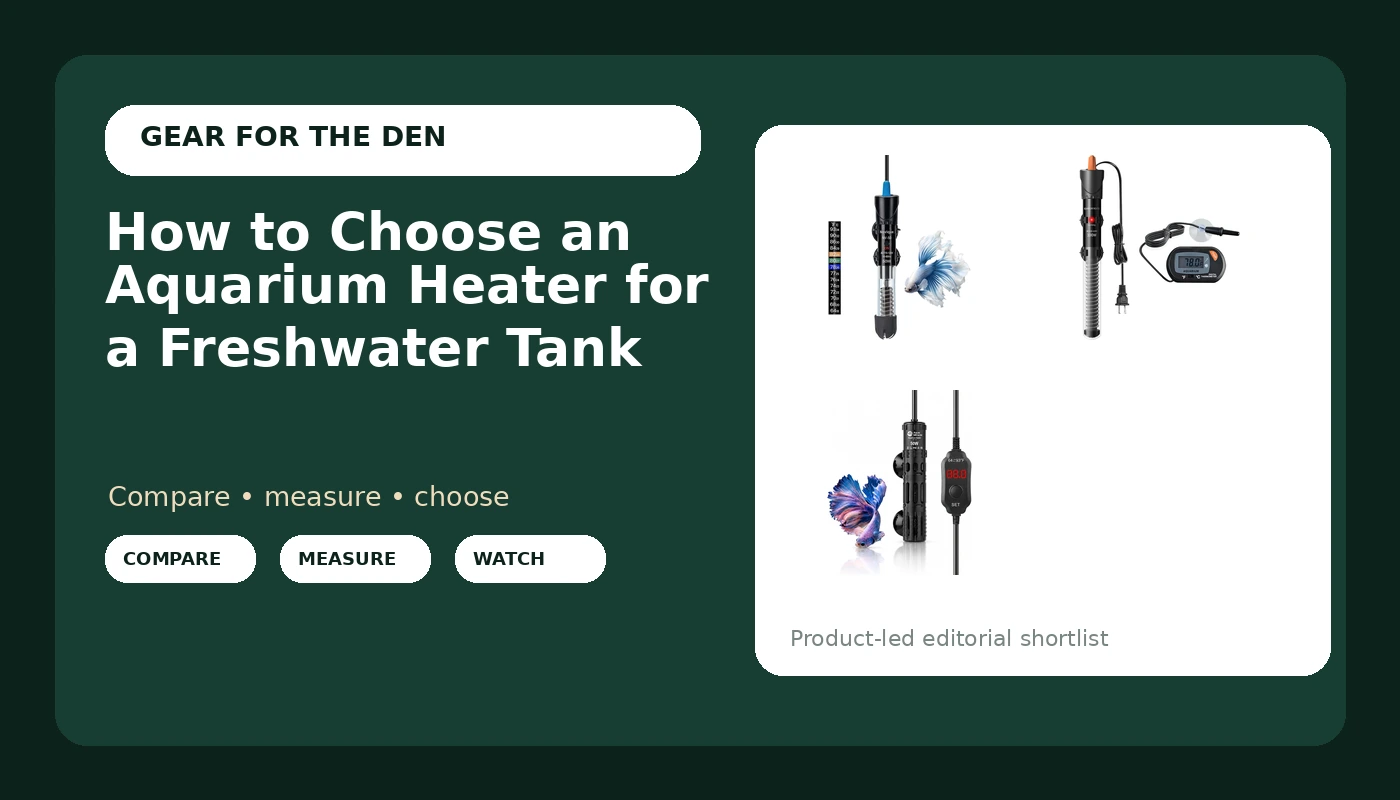
All three are submersible, all three are sold for freshwater and saltwater tanks, and all three keep the cost down by skipping the smart controller that the premium brands bundle. The difference is what each one gives you in exchange for that, and which tank it fits.
Budget pick: Novique 50W Aquarium Heater Adjustable Temperature Submersible Fish Tank Heater Water Thermostat with Thermometer for Freshwater and Saltwater Tanks
Budget pick
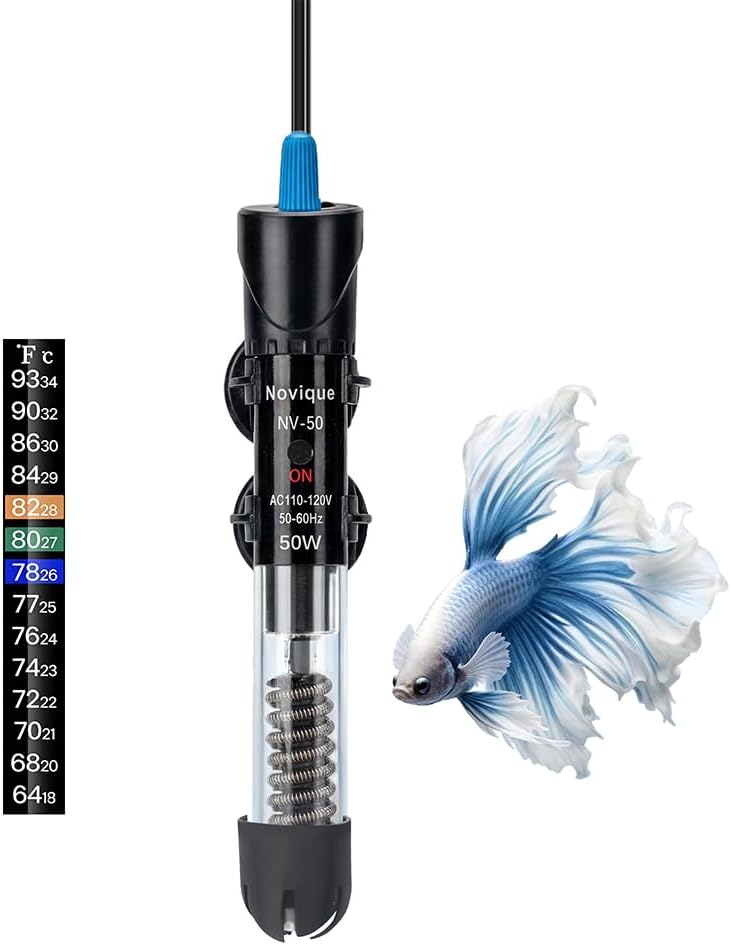
Novique 50W Aquarium Heater Adjustable Temperature Submersible Fish Tank Heater Water Thermostat with Thermometer for Freshwater and Saltwater Tanks
This is the entry point, and it is the heater I would hand someone setting up a 10-gallon betta tank or a 20-gallon quarantine tank in a room that stays warm. It is a 50W submersible unit with an adjustable temperature dial and a thermometer in the box, rated for freshwater and saltwater. Fifty watts is a sensible size for a small volume in a normal room, and the adjustable dial means you are not stuck with a factory preset you cannot move.
What you give up at this tier is sizing flexibility. There is one wattage here, so if you move up to a 40-gallon tank later you will be buying a second heater rather than reusing this one. You also give up active safeguards. Nothing in the name promises a dry-run cutoff or overheat protection, which is fine for a tank that never drops below the minimum water line and a gamble for one that does.
Flaws but not dealbreakers: The dial is analog, so treat the marking as a suggestion and confirm it with the included thermometer before you trust it with fish. Check current Amazon price on the listing page.
Our pick: HiTauing Aquarium Heater 25W/50W/100W/200W/300W, Adjustable Knob Fish Tank Heater with Digital Thermometer, Submersible Betta/Turtle Tank Heater for Freshwater and Saltwater Tanks
Our pick
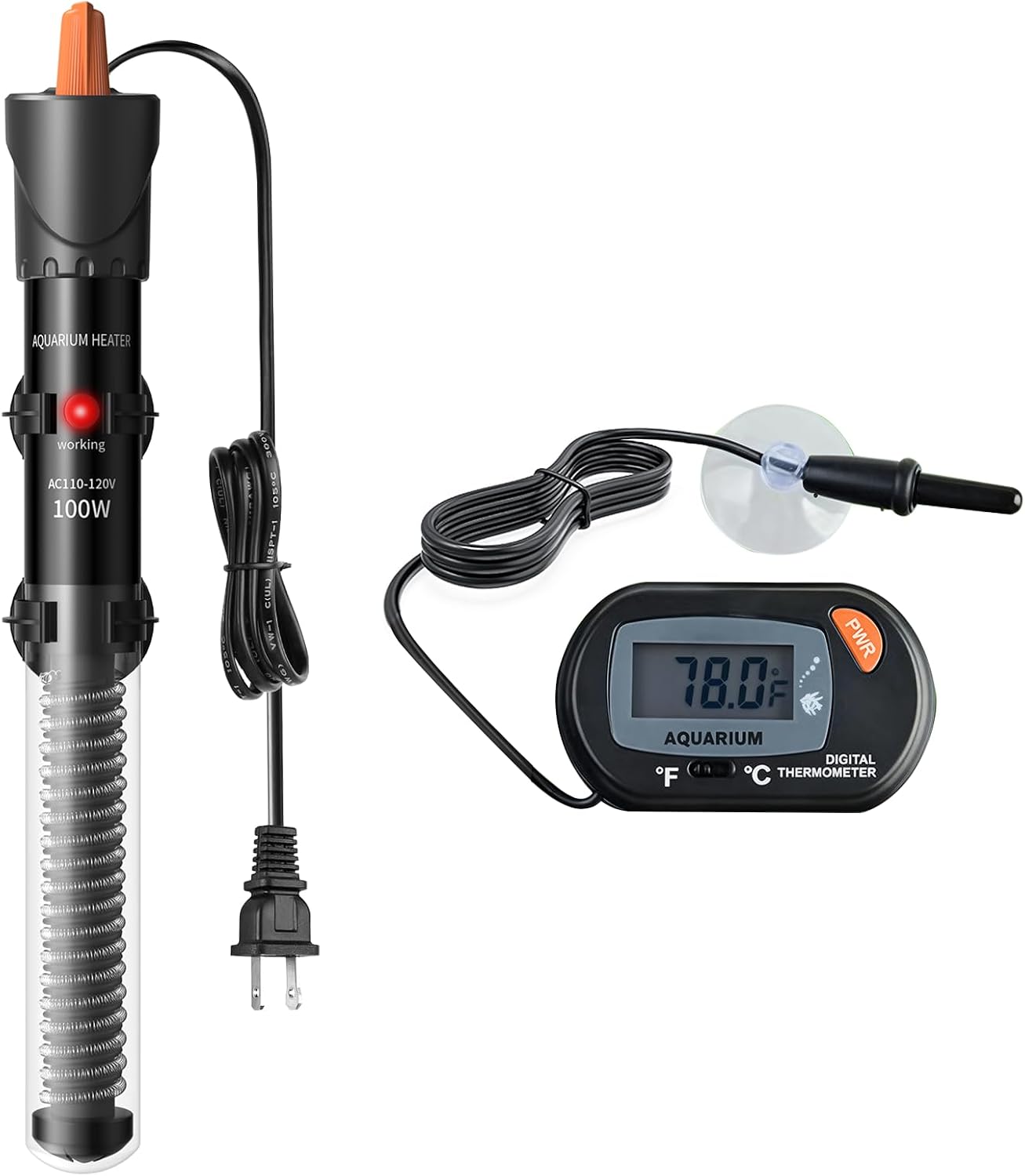
HiTauing Aquarium Heater 25W/50W/100W/200W/300W, Adjustable Knob Fish Tank Heater with Digital Thermometer, Submersible Betta/Turtle Tank Heater for Freshwater and Saltwater Tanks
This is the middle of the range and the one I would buy for most freshwater setups, because the sizing decision is built into the listing instead of left to you. It comes in 25W, 50W, 100W, 200W, and 300W versions, so you can match the wattage to your tank volume instead of guessing. The control is an adjustable knob, the thermometer is digital, and it is sold for betta and turtle tanks as well as general freshwater and saltwater use.
The multi-wattage approach is the part that matters. A 25W unit suits a nano tank or a single betta, a 100W unit fits a mid-size community tank, and a 300W unit handles a large volume in a cool room. The digital thermometer is a real convenience over the stick-on glass kind, because you can read it from across the room without crouching next to the tank with a flashlight.
Flaws but not dealbreakers: A knob is still a knob, and it drifts over time. There is no dry-run cutoff in the name either, so keep the top of the heater below the water line and check the level after every water change. If you want one heater that can follow you from a 10-gallon to a 55-gallon, this is the sensible starting point. Check current Amazon price.
Upgrade pick: AquaMiracle Aquarium Heater Dry-Run Auto Power-Off & Overheat Protection
Upgrade pick
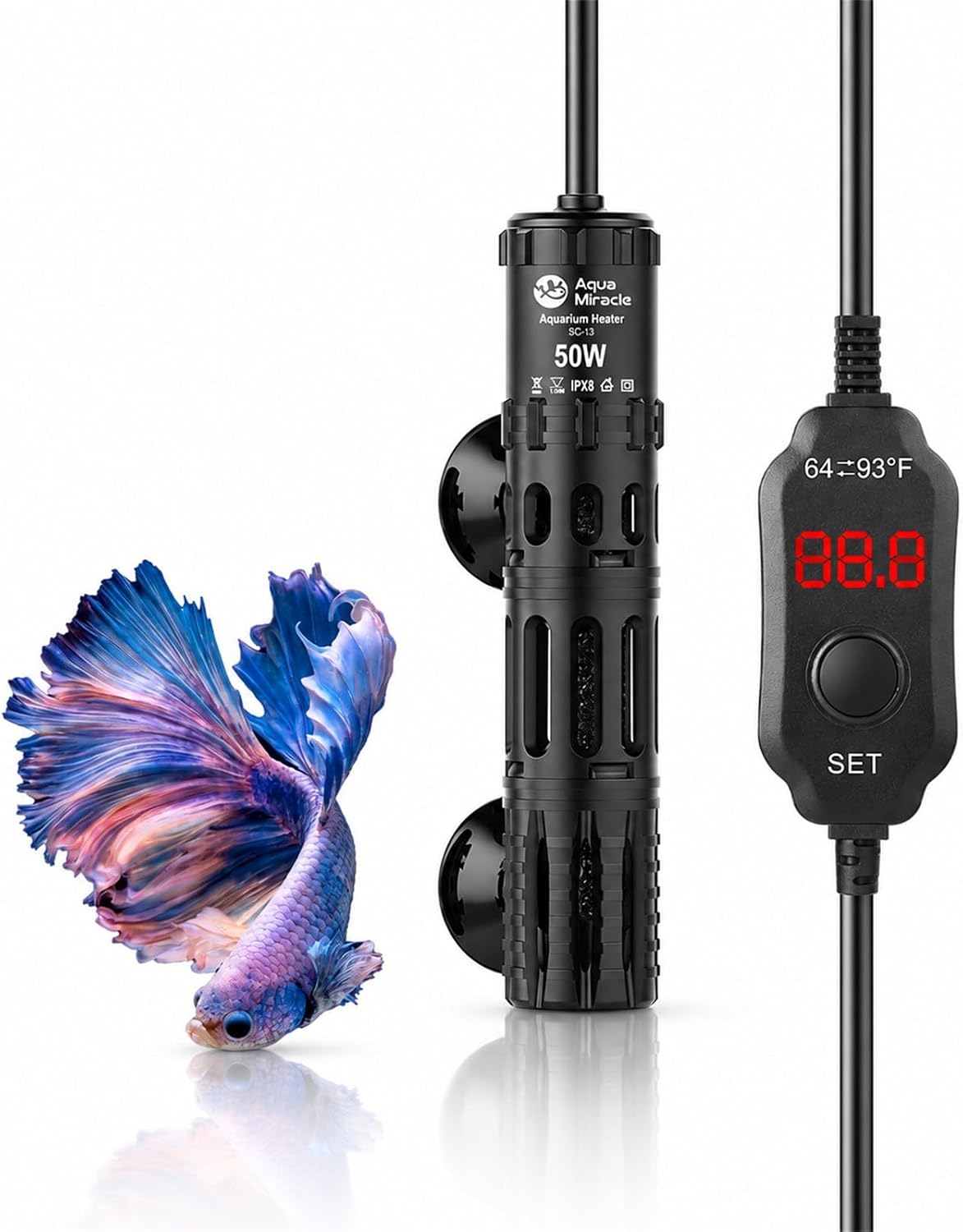
AquaMiracle Aquarium Heater Dry-Run Auto Power-Off & Overheat Protection
The pitch here is safety, and it is the reason this listing sits above the other two. The AquaMiracle heater carries dry-run auto power-off and overheat protection, which are the two features that matter when the water level drops or the thermostat fails closed. A heater that runs dry in the air will crack. A heater that sticks on will cook a tank. Those are the two outcomes that kill fish, and they are the two this unit is built to prevent.
That makes it the pick for a small tank, for a quarantine tank you drain regularly, and for any setup where the water level is not stable. It is also the pick if you travel and cannot look at the tank every day, because the failure it guards against is the one that happens while you are away.
Flaws but not dealbreakers: Safety electronics are not calibration. The cutoff protects the heater, not your exact target temperature, so you still need a separate thermometer to confirm the water is where you want it. Check current Amazon price.
The actual heater selection workflow
Here is the sequence I run in my head, and it works whether you buy one of the three heaters above or something else entirely.
Step one: Measure the tank volume you actually heat. The gallons on the box are not the gallons in the water. Subtract the displacement from your substrate, and remember that coarse substrate grain leaves bigger gaps and holds more water than the same depth of fine sand. Subtract the space taken by a large filter, a big piece of driftwood, or a pile of rock. The heater only has to warm water, so the number you want is the water volume, not the glass volume.
Step two: Size the wattage. The old rule of thumb is roughly 3 to 5 watts per gallon for a tank in a normal room, with more wattage needed the colder the room gets and the wider the gap between room temperature and your target. A 10-gallon tank at 5 watts per gallon points at a 50W heater. The same tank in a cold basement needs headroom the same tank in a warm living room does not. Under-sizing is the most common mistake, and it looks like a heater that runs constantly and never quite catches up.
Step three: Check the thermostat range. An adjustable heater lets you set the temperature you want. A preset heater is locked to one number. For most freshwater fish you want a thermostat range that covers the mid 70s to the low 80s Fahrenheit, and you want a dial you can turn without pulling the heater out of the water. Write your target on a sticky note, stick it to the stand, and verify it later with a separate thermometer.
Step four: Think about flow rate and placement. A heater works by warming water and letting that water move. Put the heater near the filter intake or outlet, where the flow rate keeps water passing over the glass. If your filter is rated for 200 gallons per hour, that current is your friend. A heater parked in a dead corner warms that corner and lets the rest of the tank sit cold, and the thermostat reads the pocket of warm water around the tube rather than the tank.
Step five: Match the heater to the filtration stage. This sounds odd, but the amount of media in your filter changes how much water is displaced and how much room is left in the tank. A large canister or a media-packed hang-on-back eats volume and can block the spot where you planned to mount the heater. Measure the space before you order, not after the box arrives.
Step six: Decide on the safeguards. This is where the upgrade pick earns its price. Dry-run auto power-off and overheat protection are the two features that matter most when the water level drops during a water change or a slow leak. A heater running in air will crack, and a heater stuck in the on position will cook a tank. If you keep small fish in a small volume, pay for the safeguard.
Step seven: Buy a thermometer and trust it over the dial. Every heater dial is an approximation. An included thermometer is a starting point, not a calibration certificate. Put a second thermometer at the opposite end of the tank, wait a day, and compare the two readings. If the dial says 78 and the water is 81, you now know the offset and you can set around it. While you are at it, remember that a heater has nothing to do with the kelvin rating of your light or the color of your plants. Those are separate decisions for a separate day.
Step eight: Plan for the failure. Assume the heater will eventually stick on or stop, because it will. Keep a spare in a drawer, or at least know which one you would order at 9 p.m. on a Sunday. Set a reminder to check the temperature when the seasons change, because room temperature moves and the heater has to work harder to hold the line. A spare heater costs less than a tank of fish.
The competition and why it lost
Other heaters come up in every forum thread: the Eheim Jager, the Fluval M series, the flat plastic units that hide behind a filter. They are not in this guide because this guide is about the decision, not about a brand war, and the three units above already cover the entry, middle, and top of the budget range on their own. If your local shop stocks a different brand and you can hold the box, the eight steps above still tell you exactly what to check.
Equipment that is not a heater also loses here, and it is worth saying why. A thermometer tells you the temperature, it does not change it, so it belongs in the tank as a check rather than as the fix. A plug-in temperature controller does the same job as the safeguards in the upgrade pick, but it adds a second device, a second cord, and a second failure point to a budget build. A chiller solves the opposite problem and costs many times more than any heater here.
The other thing that loses is the idea that a bigger heater is always safer. Oversized wattage in a small volume heats fast and swings hard, and it turns a stuck thermostat from a problem into an emergency. Size to the tank, not to your worry.
What this all costs
Prices move constantly, so check the current Amazon price on each listing rather than trusting a number in an article. The shape of the spend is what matters. The Novique sits at the entry tier, the HiTauing in the middle, and the AquaMiracle at the top of these three, and the gap between them is small next to almost anything else in the hobby.
Compare it with the rest of the setup. The tank, the filter, the light, the substrate, and the fish all cost more than the heater does. The heater is the one piece of life support where a small difference in spend decides whether a failure means a cracked tube or a dead tank, which is why the safeguard matters more than the brand name on the box.
If you want the cost per day, do the math on your own cart. Whatever the difference is between the entry unit and the top unit, divide it by three years of service and it lands in cents per day. That is the honest way to look at it, and it is the reason I do not argue with anyone who spends a few dollars more for overheat protection.
The workflow is free. Eight steps, one afternoon, one thermometer you should already own. Do it once, write the settings on the stand, and the tank runs itself until the day the heater quits, which is exactly the day you want to have planned for.
That is the job. Pick the wattage for the water you have, pay for the safeguard if the volume is small, and let the thermometer be the judge.