Cat fountains rarely die. They stall. The pump is the same little magnet and impeller unit that has been moving aquarium water for decades, and it stops for four predictable reasons: fur wrapped around the impeller, a packed foam pre-filter, mineral scale on the shaft, or a reservoir that dropped below the intake while you were at work. Learning how to fix a cat fountain that stopped working is mostly learning to tell those four apart, and the whole diagnosis takes about twenty minutes with supplies you already own.
The tools are unglamorous: white vinegar, warm water, a soft toothbrush, a cotton swab, and a towel you do not love. No meter, no parts cannon, no new pump on day one. This guide is the sequence I use for how to fix a cat fountain that stopped working, and the order matters more than the tools. Check the outlet, work forward to the impeller, and only then decide whether the fountain is actually finished.
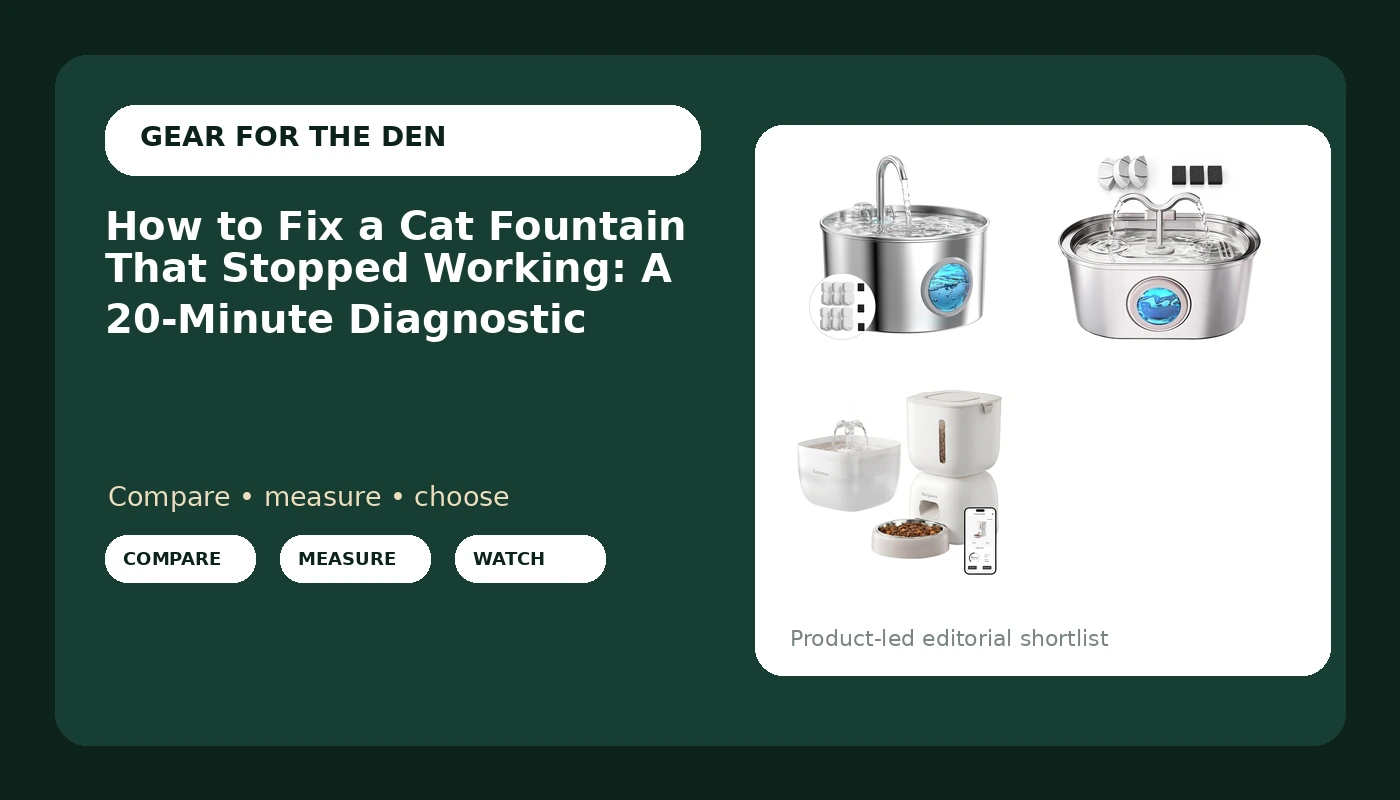
If the pump is beyond saving, the honest move is a replacement, and the three units below are the ones I would buy. If you would rather keep the fountain you already own, skip ahead to the walkthrough.
Why you should trust me
I write the cat feeding and water guides here at Gear for the Den, which means the fountains in my kitchen spend more time in pieces than my cats would prefer. I have cleaned, soaked, re-primed, and eventually retired stainless steel fountains, plastic reservoirs, and combo feeder and waterer units, and the failure pattern is almost boringly consistent: the pump is rarely the first thing that broke.
What I care about when I point someone at a replacement is the maintenance story. Can the pump be opened without a tool? Is the impeller reachable for a weekly rinse? Is the filter a standard carbon pad you can buy anywhere, or a proprietary cartridge from a single seller? Is the basin wide enough that a cat can drink without dragging its whiskers across the rim? I do not chase feature lists. I chase parts you can clean, because a fountain you can clean is a fountain that keeps working.
How I picked and how I tested
Three fountains instead of ten, because the useful question is not which fountain is best. It is which fountain is easiest to keep running, and that narrows the field fast.
I ruled out anything with a sealed pump housing. If you cannot reach the impeller, you cannot clean the part that causes most stalls, and you will be buying replacement pumps on a subscription. Then I weighed water capacity against how often a cat actually drinks. A two to three liter reservoir is the sweet spot for one or two cats, because a fountain that needs refilling daily is a fountain that runs dry and cooks its pump.
Filter type came next. A foam sleeve and a carbon pad are cheap and stocked everywhere. A proprietary cartridge is a long term tax on a cheap fountain.
From there I looked at pump noise, bowl width, and whisker clearance, plus the elevation angle of the drinking surface, which is the difference between a cat that drinks comfortably and a cat that shoulders the whole thing onto the floor. I ran the same checks on each unit below: can the reservoir be lifted off the base one handed, does the pump sit deep enough that a low level does not immediately starve it, and can the whole thing be rinsed in a sink. That is the same discipline you need if you are trying to repair a cat fountain that stopped working instead of replacing it, which is why the walkthrough below comes first in my own house. If you want the short version of the upkeep side, my cat fountain cleaning routine covers the weekly five minutes.
Replacement fountains worth buying
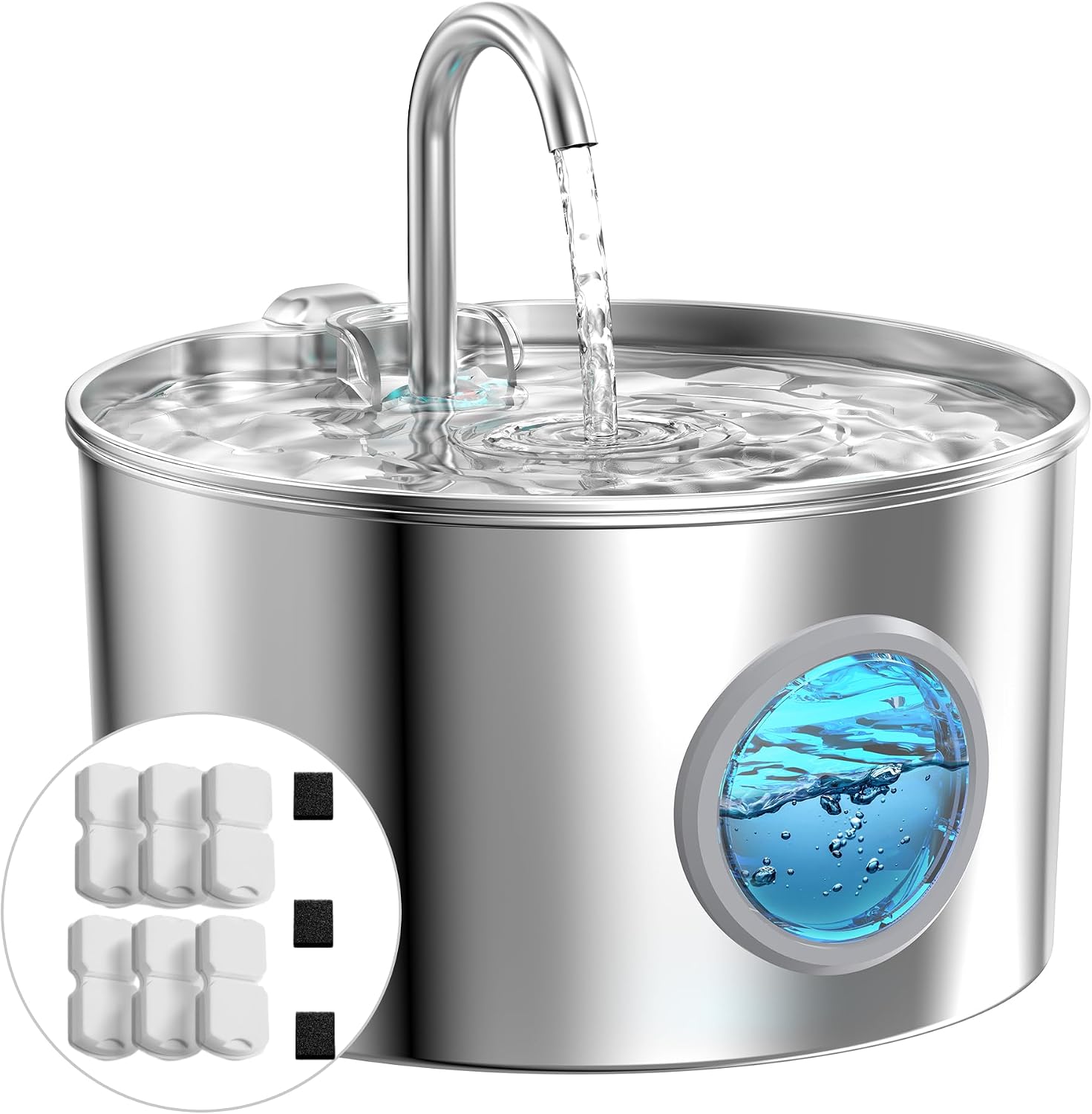
Budget pick: Cat Water Fountain Stainless Steel: Cat Fountain with 6 Filters + 3 Sponges
Budget pick
Cat Water Fountain Stainless Steel: Cat Fountain with 6 Filters + 3 Sponges
Check current Amazon price
The reason this one holds the budget slot is not the fountain. It is the six filters and three sponges in the box. Filters are the consumable that quietly turns a cheap fountain into an expensive one, and a starter pack that covers months of changes changes the math.
The stainless steel top plate matters more than the shape of the tower. Stainless rinses clean, does not hold the biofilm that collects in the corners of a plastic basin, and does not pick up the faint plastic smell that some cats refuse to drink past. The basin gives a cat room to drink without pressing its whiskers flat against the rim, and the reservoir lifts off the base in one motion, which is what you want at six in the morning with the sink already running.
Flaws but not dealbreakers: The impeller housing on this class of fountain opens with a quarter turn, and if yours is stiff, warm water loosens it. Expect to change the carbon pads on a monthly rhythm rather than the quarterly rhythm the packaging implies.
Anyone who wants spare filters on the shelf and a fountain they can fully disassemble in under a minute should start here.
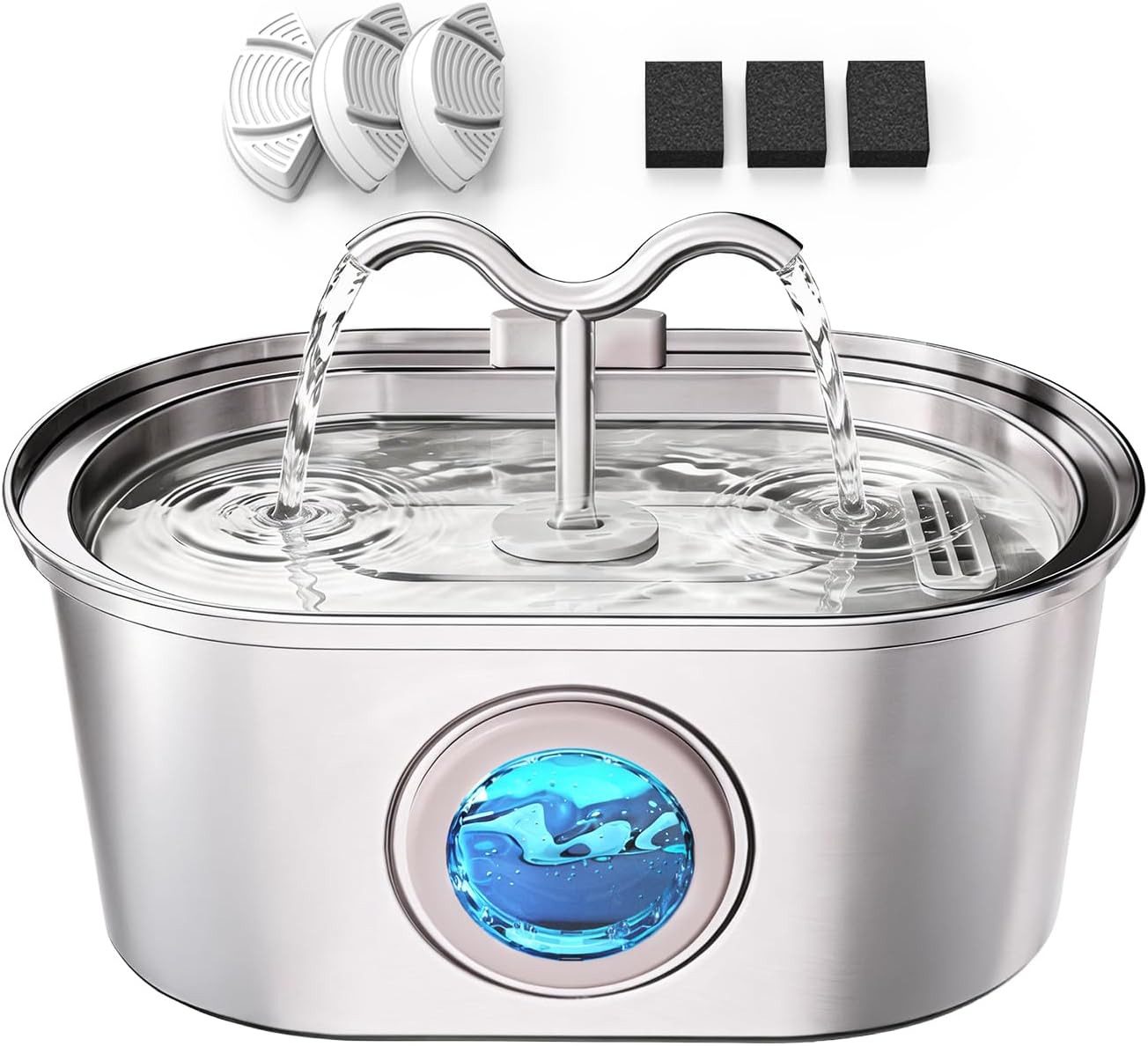
Our pick: SohoTeco 3.2L/108oz Stainless Steel Cat Water Fountain Pet Fountain
Our pick
SohoTeco 3.2L/108oz Stainless Steel Cat Water Fountain Pet Fountain
Check current Amazon price
This is the pick because of water capacity and quiet. A 3.2 liter reservoir means one cat drinks for days without a refill, and keeping the intake submerged is the single best way to stop a pump from running dry and dying early. The stainless drinking surface is the same easy rinse story as the budget unit, just in a larger footprint.
The pump mounts low in the reservoir rather than hanging near the surface, which is the design detail that keeps pump noise down and keeps the intake submerged longer. Deep placement also means the water level has more room to fall before the impeller starts gulping air.
Flaws but not dealbreakers: A full reservoir is a two hand lift. Empty it before you carry it to the sink, or you will be mopping. The larger footprint also needs a corner with more clearance than a compact tower.
Anyone with one or two cats who would rather refill every few days than every morning will get the most out of this one.
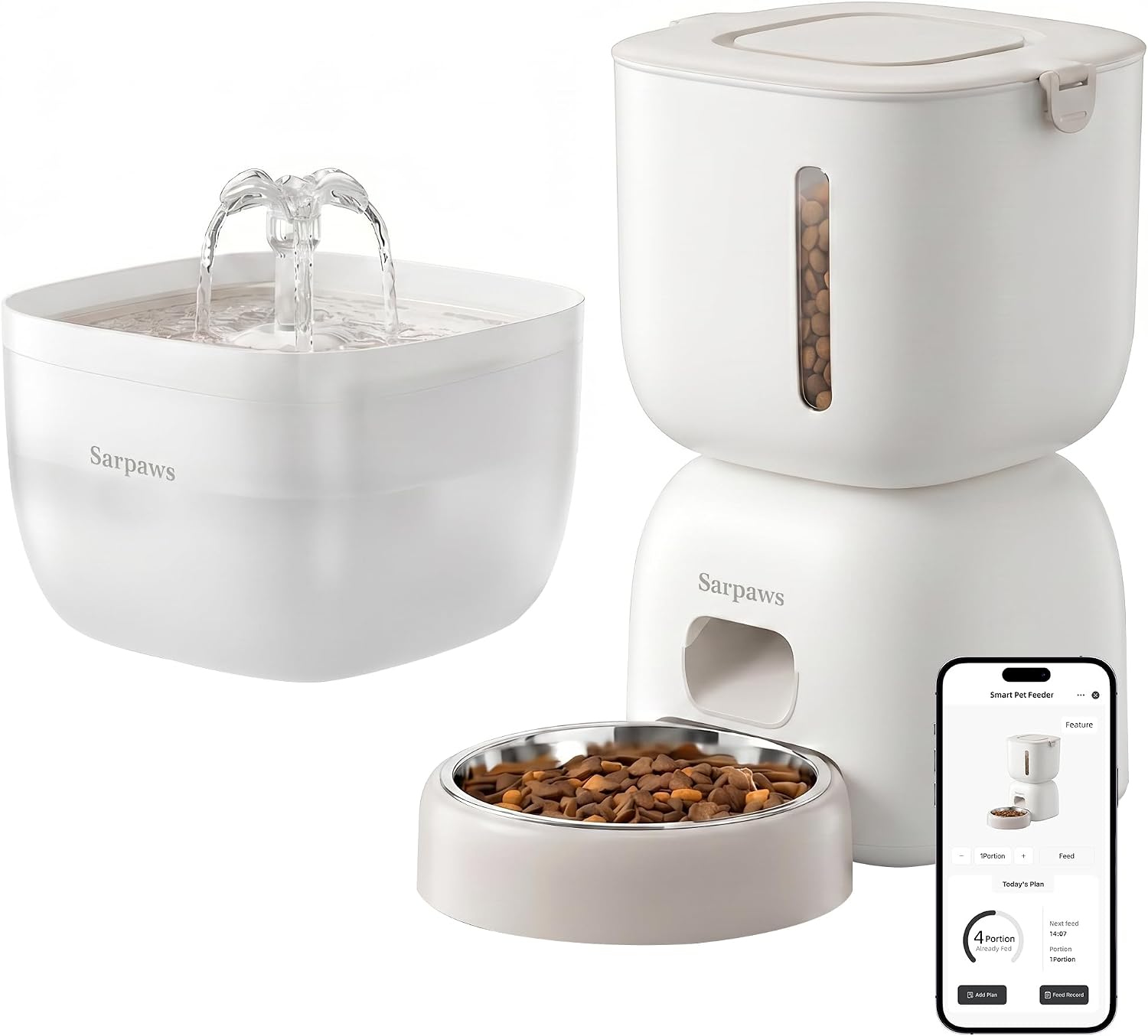
Upgrade pick: SARPAWS WiFi Automatic Cat Feeder and Water Fountain Set, App Control Smart Pet Food Dispenser with 304 Stainless Steel Bowl, 3L Feeder & 2L Quiet Waterer, 10s Voice Recorder, Dual Power, Secure Lock
Upgrade pick
SARPAWS WiFi Automatic Cat Feeder and Water Fountain Set, App Control Smart Pet Food Dispenser with 304 Stainless Steel Bowl, 3L Feeder & 2L Quiet Waterer, 10s Voice Recorder, Dual Power, Secure Lock
Check current Amazon price
The upgrade slot goes to the unit that handles two jobs on one power strip. The SARPAWS set pairs a 3 liter feeder with a 2 liter waterer, both app controlled, with a 304 stainless steel bowl, dual power so a short outage does not skip dinner, a secure lock on the hopper, and a ten second voice recorder you can use to call the cat to the bowl.
Two things make it worth the step up. First, portion size is scheduled rather than eyeballed, which matters in a multi cat house where one cat grazes and the other inhales. Second, the water side is a separate reservoir, so when the waterer stalls you can pull it and clean the pump without taking the feeder offline.
Flaws but not dealbreakers: App control means one more login and one more firmware update in your life. If you would rather not have a feeder on your WiFi, a microchip activated feeder that opens only for a chipped cat is the other honest option, and the microchip range on those units only has to cover the bowl.
Anyone feeding on a schedule, or splitting portions between two cats, will use the app more than they expect.
How to fix a cat fountain that stopped working
Here is the order I use. It is the fastest way to fix a cat fountain that stopped working in the overwhelming majority of cases, and it is also how to repair a cat fountain that stopped working when the problem is dirt rather than a dead pump. The sequence is the same on stainless steel fountains, plastic towers, and combo units. Work through it in order and stop when water moves.
Step one: Check the power before you touch the water. Plug a phone charger into the same outlet. If it charges, the outlet is fine and the problem is the adapter, the inline connector, or the cord. Run a hand along the cord where it enters the pump housing and wherever it crosses a furniture edge, because a cat chewing a low voltage cord is a real failure mode, and no amount of cleaning fixes a chewed wire.
Step two: Unplug everything, lift the top off, and set the pump on a towel. Feel the housing. A pump that is hot to the touch ran dry, which usually means the reservoir dropped below the intake. Let it cool before you open it, and note where the water line was sitting, because that tells you whether evaporation or a slow leak is the real problem.
Step three: Open the impeller housing. Most pumps have a front cover that twists off a quarter turn. Inside is a small magnet with blades on it. Pull it straight out and look at the shaft. Nine times out of ten there is a ring of cat hair wound around the magnet like thread on a spool. Pick it off with a toothbrush, rinse the parts under warm water, and keep track of the little rubber bushing at the back of the shaft, because the pump will not restart without it.
Step four: Deal with scale. If the magnet still turns stiffly once the hair is gone, soak the housing and impeller in a one to one mix of white vinegar and water for twenty to thirty minutes, then rinse thoroughly. Mineral scale is the second most common cause of a stalled pump, and you cannot see it. You feel it as drag when you spin the impeller with a fingertip.
Step five: Clean or replace the filter. A packed foam sleeve starves the pump and makes it work harder than it should. Rinse foam under warm water until the runoff is clear, and replace carbon pads on schedule instead of when they look bad. Filter type matters more than people think: a fountain that takes a standard pad is one you will keep maintaining, and a fountain that takes a proprietary cartridge is one you will quietly stop maintaining.
Step six: Fill to the maximum line and find the minimum. Water capacity only helps if the level stays above the intake. Fill to the top, then watch where the pump starts to suck air and mark that level on the reservoir with a piece of tape. In a dry room with the heat running, a reservoir can lose a surprising amount to evaporation in a day, and the tape tells you at a glance whether you are close.
Step seven: Prime the pump and listen. Set the pump back in the filled reservoir, plug it in, and give it ten seconds. If it hums without moving water, lift it, tap it against the side of the reservoir to burp the air out of the impeller chamber, and set it back down. If pump noise turns into a rattle, something inside the housing is still loose. If it is completely silent and the outlet is live, the pump is finished, and a replacement pump is the cheap fix.
Step eight: Fix the rhythm so this does not happen again. Rinse the impeller weekly, deep clean with vinegar monthly, and keep the reservoir above your tape line. Placement counts too. A fountain beside the food bowl collects kibble dust, and a fountain set at the wrong elevation angle for your cat is a fountain your cat avoids. If you run a combo unit, treat the feeder and the waterer as two separate schedules and check portion size and water level on different days.
The competition and why it lost
The plastic tower fountains that fill the first page of search results lost on one detail: the pump housing. On most of them the housing is sealed or needs a screwdriver and a hard tug to open, which means the impeller, the one part that actually fails, is the one part you cannot reach. A fountain you cannot open is a fountain you replace.
Gravity waterers lost for a different reason. They have no pump to fail, which sounds like a win, but a still bowl of water under an open reservoir collects hair and dust and gets tipped by a cat leaning on the rim. They are a backup, not a fix.
The tiny desktop fountains lost on water capacity. They look tidy on a counter, but the reservoir is shallow enough that a warm afternoon of evaporation puts the intake at risk, and a pump that runs dry even once will never sound the same.
Microchip activated feeders lost because they solve a different problem. They are the right answer in a multi cat house where one cat steals food, and they are excellent at it, but they do not water anything, and this article is about water.
And the fountain I actually retired lost because of the filter. It used a proprietary cartridge that only one listing carried, and when that listing went out of stock, the fountain became a very complicated bowl. That is the failure mode nobody warns you about.
What this all costs
The repair path is the cheap path. A bottle of white vinegar and a toothbrush cost less than lunch, and they will get a stalled pump moving again if the pump is not already burned out. A replacement pump costs a fraction of a new fountain, and it is the part I would buy first before replacing anything.
The replacement path is where the money goes, and the honest way to compare the three units above is not the sticker on the listing. It is the running cost. Check current Amazon price on each one, then look at what the filters cost and how often the maker wants them changed. A cheap fountain with expensive proprietary filters is an expensive fountain, and a mid priced fountain with a standard pad and a wide reservoir is the cheapest thing in the room over three years.
There is one more line item worth naming. A cat that stops drinking because the fountain is loud, low, or awkward to approach is a cat on the road to a vet bill that dwarfs every fountain here. Keeping the impeller clean and the reservoir full is not a hobby. It is the cheapest preventive care you own.
The math is simple. Twenty minutes with vinegar once, then five minutes a week forever, and the fountain you already own keeps running.
That is the job. Your fountain was built to do this. Let it.