A leaking cat fountain is rarely a broken fountain. The pump hums, the cat drinks, and a slow ring of water creeps out from under the base until the finish on your floor starts to cloud. In most of the units I have taken apart, the leak comes down to five things: a top plate that is not seated, a gasket that has gone flat, a tube pushed on crooked, a basin filled past its line, or a pump intake packed with fur. Four of those cost nothing to fix. This is how to fix a leaking cat fountain in the order that saves you the most money.
Water always finds the low spot, which is why the puddle shows up at the back of the base even when the leak starts at the front rim. You are looking at the destination, not the source. Diagnose from the top down and you stop chasing it.
Start with the boring checks. Seating, gaskets, tube fit, water level, and impeller hair cover the large majority of leaks. Only after those do you look at the motor, and only after that do you decide the basin itself is cracked and the unit is done.
Why you should trust me
I run a fountain in a house with more than one cat, and I have pulled every one of them apart at least once, usually late at night with a towel under the base. I am not a plumber and I am not a vet. I am the person friends send a photo of a wet counter to, which means I have watched the same failure points repeat across brands: the top plate that looks seated but is not, the gasket that has gone hard and flat, the tube that was pushed on at an angle, and the pump intake wearing a fur sweater.
I also know when to stop. A cracked basin does not heal, and no filter, gasket, or cleaning routine will fix it. If your unit is wet underneath the reservoir itself, the honest answer is a new fountain, not another round of mopping. Knowing which leaks are terminal is half of what keeps this cheap, and it is the part most people skip when they ask how to repair a leaking cat fountain.
How I picked and how I tested
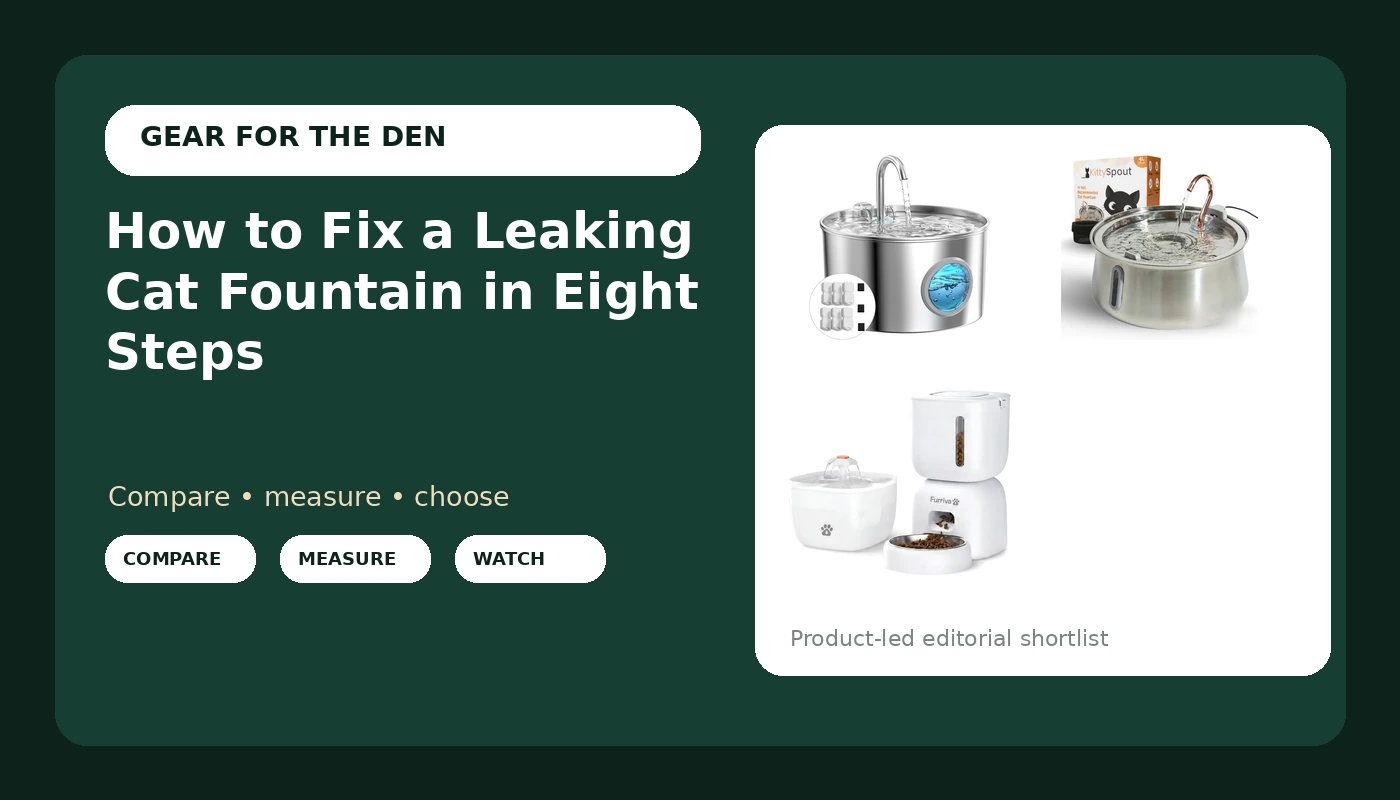
I did not run a lab bench, and I am not going to pretend a paper towel test is a pressure test. What I did was run the same eight point leak check against the three fountains on this page: the stainless budget unit with the spare filter pack, the 4L corded KittySpout, and the feeder and fountain set. Each one got filled to its marked line, run, and then checked underneath at the base seam, the pump outlet, and the cord exit with a dry paper towel.
The criteria that decide whether a fountain leaks are the same ones that decide whether your cat will use it. Bowl width sets how much drinking surface a cat has to work with. Whisker clearance decides whether a cat with a wide face will approach the rim or slap the water and walk off. Water capacity decides how often you refill, and pump noise decides whether you keep the thing plugged in at 2 a.m. Filter type matters because a clogged filter slows flow, and slow flow is what pushes water over a marginal seal.
On the feeder side of the set, portion size and elevation angle matter more than the app. A cat that eats fast off a low bowl is a cat that knocks things over.
The gear that helps you fix a leaking cat fountain
None of the fountains below fix a leaking cat fountain by themselves. What a good one does is remove the design quirks that cause the leak in the first place: a top plate that seats squarely, a basin with a real gasket channel, and a pump you can open and clean. If you are still shopping rather than repairing, my cat water fountain guide covers the wider field.
Budget pick: Cat Water Fountain Stainless Steel: Cat Fountain with 6 Filters + 3 Sponges
Budget pick
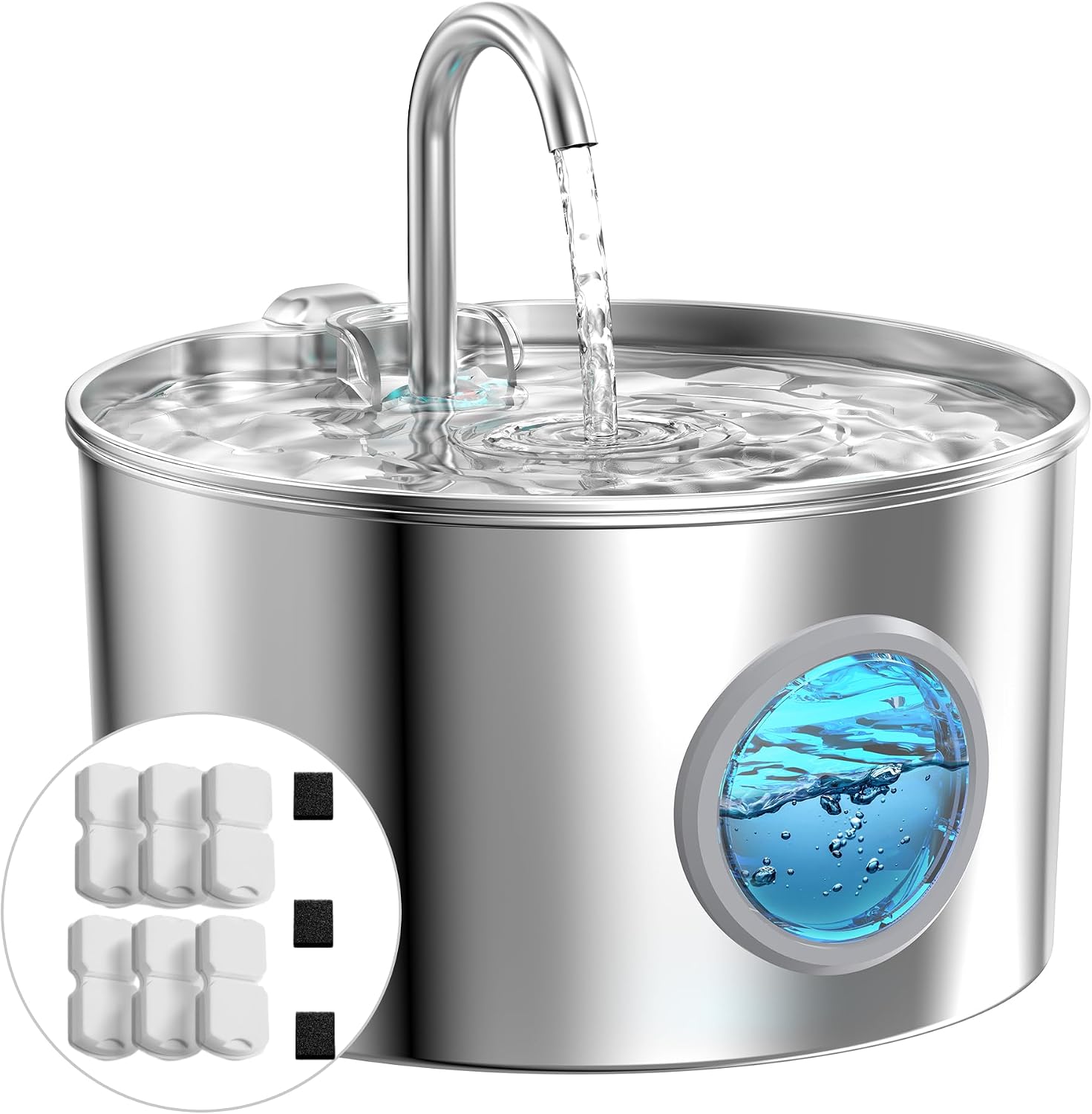
Cat Water Fountain Stainless Steel: Cat Fountain with 6 Filters + 3 Sponges
Check current Amazon price.
This is the one I point people to when the goal is a cheap fountain they will not feel bad about opening up. The basin is stainless, which matters more than it sounds: plastic scratches, scratches hold biofilm, and biofilm is what makes you stop cleaning the unit, and a fountain you stop cleaning is a fountain that leaks. It ships with six filters and three sponges, so you get a season of changes without another order. Filter type is the recurring cost on any fountain, so a spare pack in the box is real value.
The pump is a standard submersible with a removable front cover, which is the part you want. The impeller comes out, the fur comes off, and the flow returns close to where it started. Low flow is the number one cause of water escaping over a rim.
Flaws but not dealbreakers: The top plate is light and easy to set down crooked. If you hear a faint trickle that was not there before, that plate is the first thing to reseat. The basin is also not enormous, so a two cat house will refill it often.
Anyone who wants a stainless fountain with spare filters included and does not mind a smaller reservoir should start here.
Our pick: KittySpout Stainless Steel Cat Water Fountain Automatic Drinking Fountain, Quiet Circulating Water Bowl, Dishwasher Safe, Indoor Pet Fountain for Hydrated Healthy Cats (Stainless Steel, 4L Corded)
Our pick
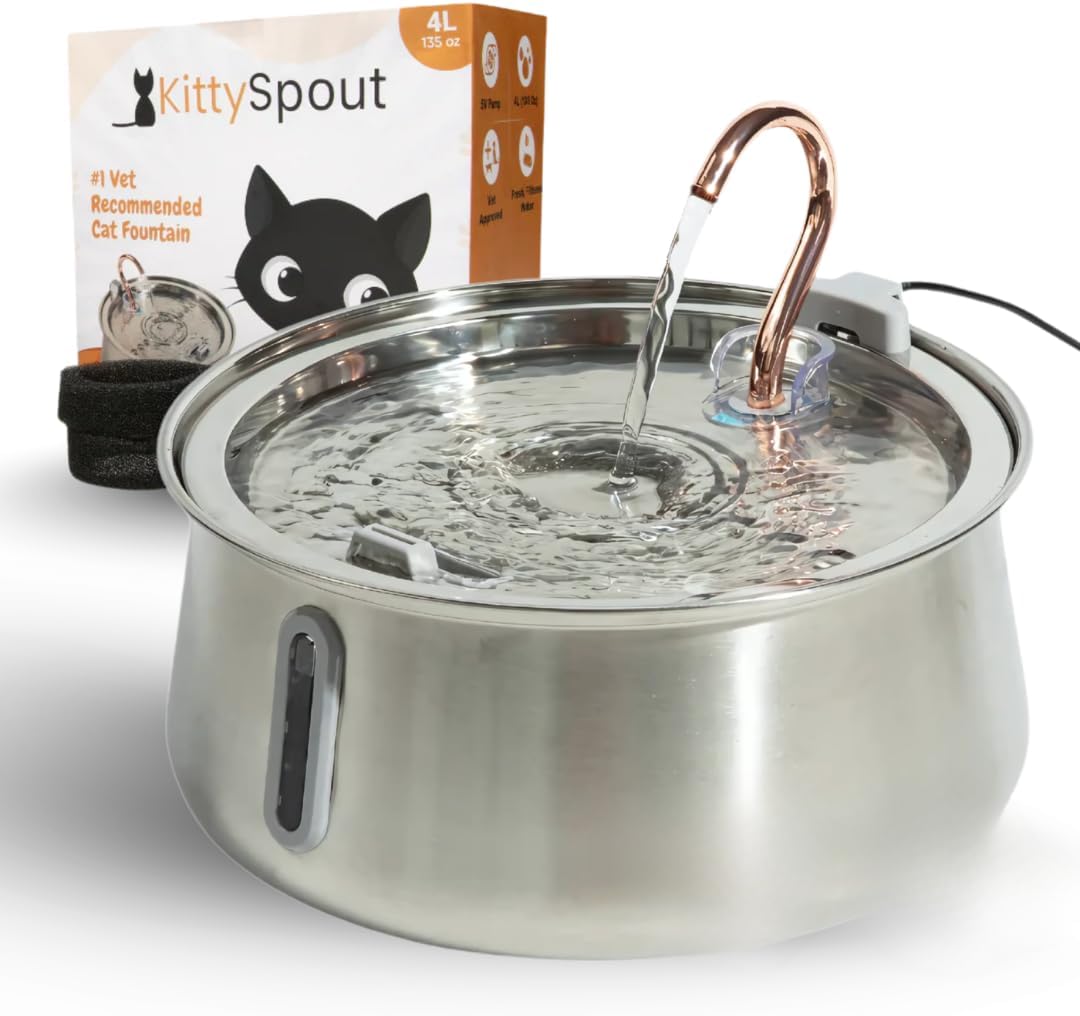
KittySpout Stainless Steel Cat Water Fountain Automatic Drinking Fountain, Quiet Circulating Water Bowl, Dishwasher Safe, Indoor Pet Fountain for Hydrated Healthy Cats (Stainless Steel, 4L Corded)
Check current Amazon price.
The KittySpout is the one I would buy if the leak you are fixing is really a noise and maintenance problem. It is a 4L corded unit, so the water capacity is big enough that a single cat will not drain it in a day, and the whole thing is dishwasher safe, which changes how often you actually deep clean. Pull the top off, run it through, and you are not scrubbing a seam with a bottle brush.
The listing calls it a quiet circulating fountain, and the covered pump housing is the part that does that work. Pump noise is what makes people unplug a fountain, and a fountain that sits unplugged for a week grows a film that clogs the intake when you finally switch it back on. The stainless drinking surface keeps water cleaner than plastic, and the bowl width gives a cat room to drink without its whiskers dragging the rim.
Flaws but not dealbreakers: Corded only, so it needs an outlet near the bowl. If your cat likes to splash, put a mat under it. No gasket seals a splash.
Anyone with one or two cats who wants a big, quiet, dishwasher safe basin should look here first.
The two job pick: Automatic Cat Feeder and Water Fountain Set, White – 3L Feeder & 2L Fountain, Stainless Steel Bowl, Locking Lid, Plug-in/Battery Powered, 4 Meals/Day, 10s Voice Recorder for Cats and Small Dogs
The two job pick
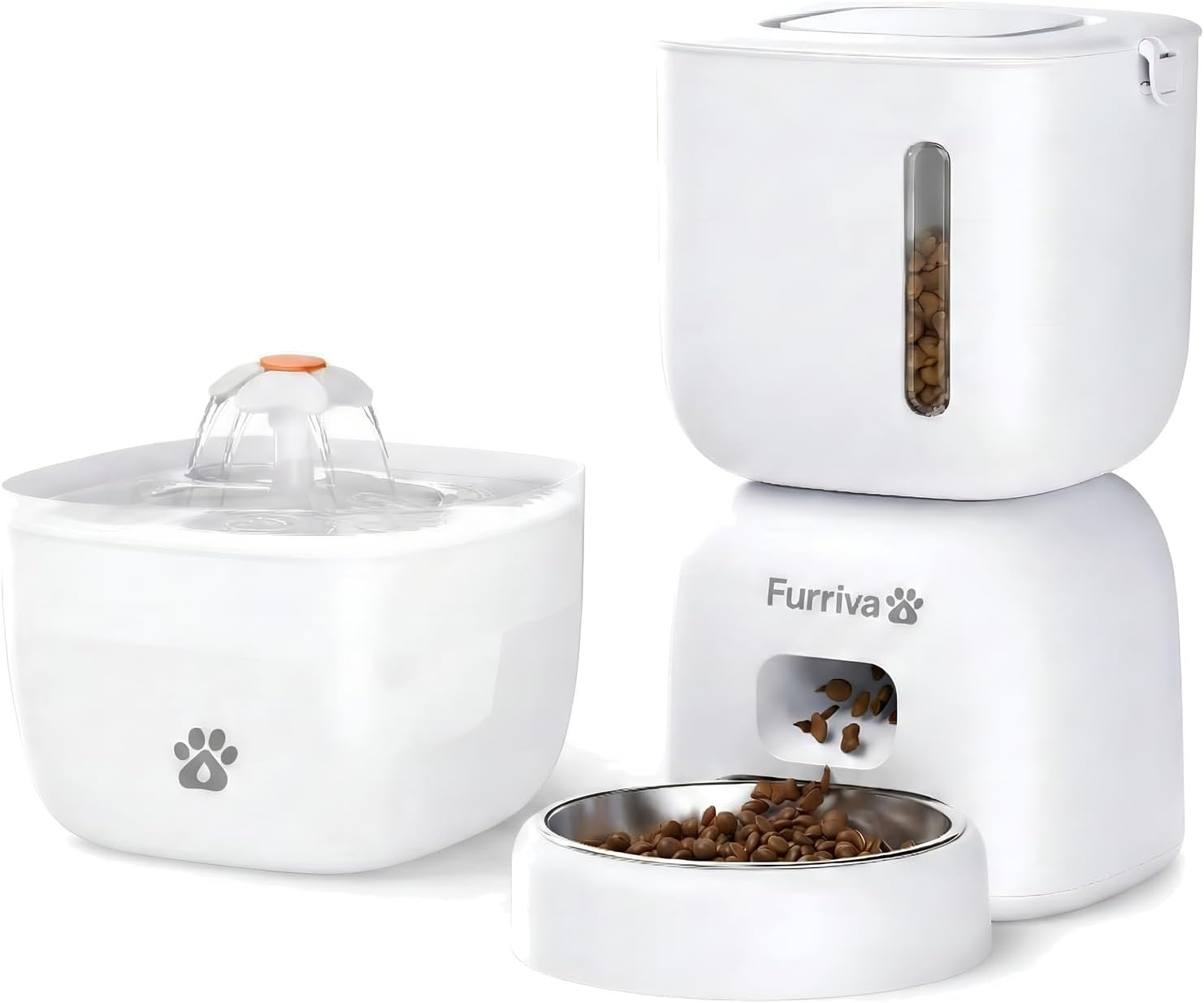
Automatic Cat Feeder and Water Fountain Set, White – 3L Feeder & 2L Fountain, Stainless Steel Bowl, Locking Lid, Plug-in/Battery Powered, 4 Meals/Day, 10s Voice Recorder for Cats and Small Dogs
Check current Amazon price.
This set does two jobs on one footprint: a 3L feeder and a 2L fountain, both with stainless steel bowls. It is the pick for a household where the water problem and the food problem overlap, like a cat that drinks a lot and a dog that eats whatever is left. The feeder runs four meals a day, the lid locks, and there is a 10 second voice recorder for calling them in.
For leak purposes, the useful part is the separate reservoir. The fountain side is its own 2L basin, so if the feeder half gets knocked, you are not draining the water half onto the floor. The locking lid matters more than people expect, because a cat that pries at a food bin is a cat that tips the whole unit.
Portion size is adjustable, and the bowls sit at a slight elevation angle, which is easier on a cat that bolts its food. It runs plug in or on batteries, so you can put it on the counter or on the floor.
Flaws but not dealbreakers: Two reservoirs mean two things to clean and two places to check for a slow seep. Battery mode is best for short trips, not for months of unattended use.
Anyone feeding a cat and a small dog from one corner, or anyone who wants the feeder and the fountain on the same power strip, will get the most from this set.
The actual repair workflow
Now the part you came for. This is the order I use to repair a leaking cat fountain, and it works on stainless and plastic units, corded or battery. Unplug the fountain before anything else, every single time.
Step one: Dry it, then find the wet line. Empty the fountain, dry the outside completely, and set it on a dry towel. Refill to the marked line and run it for half an hour. When you lift it, the dark patch on the towel tells you where the water is leaving. A wet spot under the base is a seam problem. A wet spot under the pump is a tube or gasket problem. A wet ring around the whole thing is usually a top plate that is not seated.
Step two: Reseat the top plate. This is the leak in most fountains I have opened. Press it down evenly with both hands, then run a finger around the rim and feel for a lip sitting high. Many plates only fit one way, and they will look right while sitting a few millimeters proud.
Step three: Inspect the gasket or O-ring. Take it out. A good gasket is soft and round. A tired one is flat, shiny, or stiff. Rinse it under warm water, check for hair stuck in the channel, and make sure the groove is clean before it goes back. A thin film of food grade silicone grease on a dry gasket helps it seat, but never stretch one back into shape. If it has gone hard, replace it.
Step four: Push the tube fully onto the pump outlet. Pull the tube off the pump, look at the end, and push it back on until it seats past the barb. If the end is stretched or split, cut a quarter inch off with scissors and reattach. A tube pushed on at an angle will leak at the outlet even when it feels tight.
Step five: Check the water level and the reservoir seating. Overfilling is a real cause. If the water sits above the max line, the pump pushes more than the return channel can handle and the surplus ends up on your floor. Pull the reservoir out, seat it flat, and fill only to the line.
Step six: Clean the impeller and the intake. Unplug it first. Open the pump cover, pull the impeller, and remove the fur wrapped around the shaft. Hair on the intake cuts flow, and low flow raises the water level in the basin, which is what pushes water past the plate. This is the fix that solves the leak you cannot see.
Step seven: Level the base and check the cord exit. Put a level on the rim, or just rock the unit with one finger. Uneven floors tilt the basin, and water pools in the low corner until it climbs the seam. The cord exit grommet is the other spot to check. If the cord is pulled tight, it can lift the grommet out of its seat.
Step eight: Pressure test overnight and make the call. Dry everything, refill, and leave it on a dry towel overnight. A dry towel in the morning means you fixed it. Water under the reservoir itself, not under the plate, usually means a cracked basin, and that is a replacement, not a repair.
If the checks above did not fix a leaking cat fountain, stop buying gaskets. That is a design problem or a crack, and the money is better spent on a unit with a proper gasket channel.
The competition and why it lost
The gravity waterer is the first thing people try, and it is not a fountain. It has no pump, no filter, and no moving water, so it solves nothing about a leak except by removing the parts that leak. It also gives you a reservoir that seals at one point and drips there forever once that seal goes bad.
Replacement pump kits are the other popular answer. A new pump fixes noise and low flow, and that is worth doing on a unit you otherwise like, but a pump is not where most fountains leak. If your towel is wet under the base, a new pump will not help.
Ceramic bowls solve whisker clearance and nothing else. They are the right call for a cat that refuses to drink from a fountain, not for a wet floor.
Microchip feeders sit in a different category entirely. If your problem is one cat eating another cat's food, you want a feeder with a set microchip range, and that is a feeding guide, not a leak guide. I cover that setup in the multi-cat feeding setup.
What this all costs
Nothing here is a big purchase, which is the point. The cheapest version of this repair is the one you already own: an hour with a towel, a bowl of warm water, and a pair of scissors for the tube end. If you need a gasket, that is the smallest line item in the whole article, and it is worth ordering two so you have one when the first goes flat again.
Filters are the real recurring cost on any fountain. A pack of six sounds like a lot until you change one every two to four weeks, and a fountain run without a filter is a fountain whose pump intake clogs faster. Check current Amazon price on the filter pack for whatever unit you own before you decide a new fountain is cheaper.
On the hardware side, the stainless budget unit is the lowest entry point, the KittySpout 4L corded model is the one to buy if you want the quietest and the easiest to clean, and the feeder and fountain set costs the most because you are buying two appliances in one footprint. Check current Amazon price on each before you commit, and remember that a fountain you actually clean is a fountain that does not leak.
The math is simple. A gasket and an hour beats a new fountain, and a new fountain with a real gasket channel beats a floor you have to refinish. Run the eight checks first. Most of the time, step two is the whole job, and the only thing you spent was an evening.