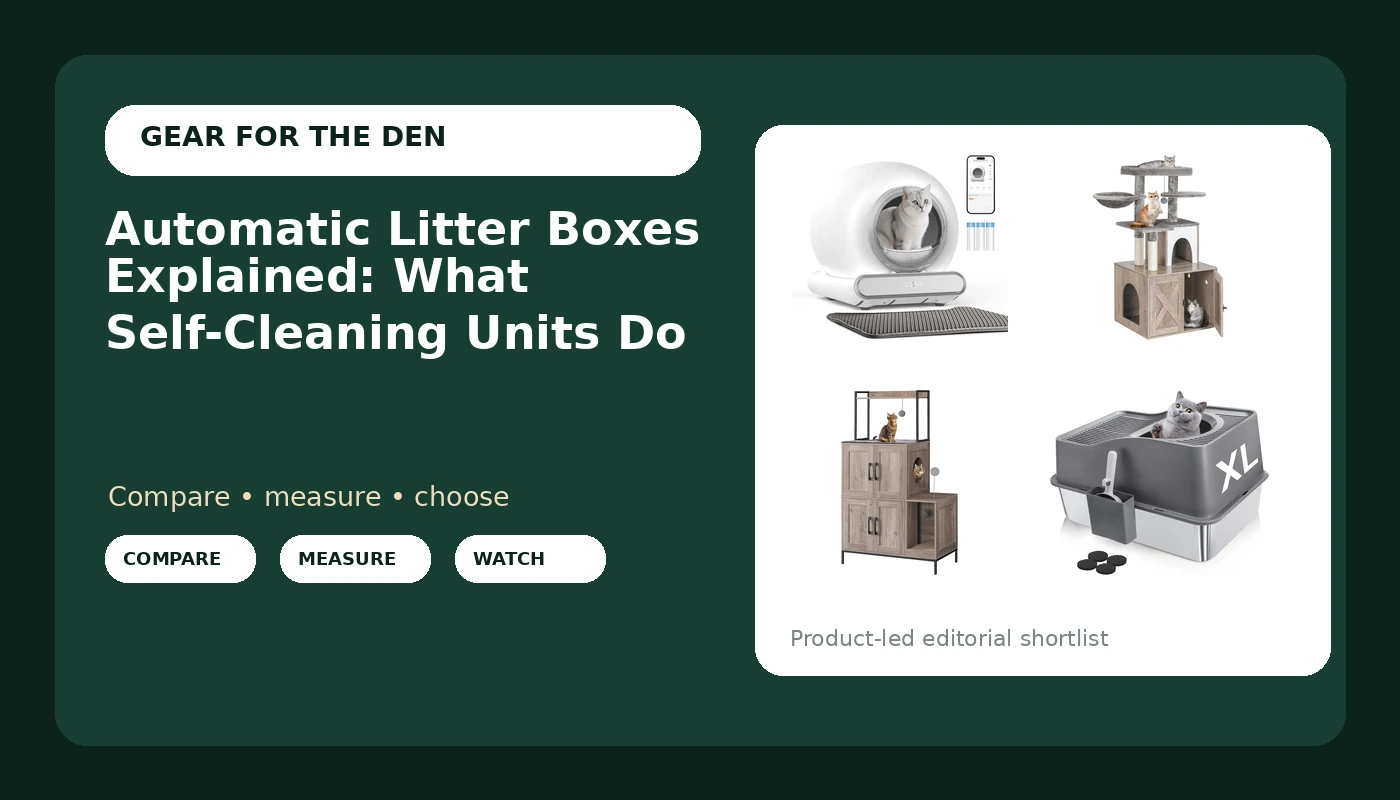
An automatic litter box is a box that scoops itself. A motor, a delay timer, and a set of sensors wait for the cat to leave, then a rake, a rotating drum, or a sifting screen pushes clumps into a sealed waste drawer. That is the entire idea behind automatic litter boxes explained in one sentence: you trade daily scooping for a machine that needs power, setup, and a cleaning routine of its own. The catch is that automation is not the only answer to a smelly bathroom corner. A hooded stainless pan, a wooden enclosure, and a decent mat change the same variables that matter most, box size, litter depth, odor control, and how much grit reaches your floor, with no motors, no cables, and nothing to reboot.
Quick answer
A self-cleaning unit suits a household that wants scooping handled and can accept a mains-powered appliance. The Self Cleaning Litter Box in this group is the only genuinely automatic model: it runs a cleaning cycle with app control, odor removal, a stated 65L plus 9L capacity aimed at multi-cat homes, and it arrives with a mat and three rolls of liners. The other three options are manual. Two are wooden enclosures that hide a pan and add cat furniture, and one is an extra large stainless top-entry box for big cats. If your cat is very young, very old, or easily startled by motors, start with a manual box and treat automation as a later upgrade. Search terms get mangled, so you may have arrived after typing autodesk matic litter boxes or autofloor matic litter boxes. Those are the same product category with autocorrect damage.
Four useful options
| Model | Best fit | What stands out |
|---|---|---|
| Self Cleaning Litter Box, 65L plus 9L | Homes that want the daily scoop handled | App control, odor removal, waste drawer, mat and three liner rolls included |
| Snughome Cat Litter Box Enclosure with Tree Tower and Condo | Small flats that need one piece of furniture to do two jobs | Hidden washroom plus sisal scratching post, plush perch, and multiple platforms |
| HOOBRO Cat Litter Box Enclosure Furniture, 2 in 1 | Two-cat homes that prefer a cabinet to a machine | Double litter cabinet with an upper shelf, plus two dangling plush balls and a toy ball |
| SOUJOY Stainless Steel Cat Litter Box with Lid | Large cats and owners happy to hand-scoop a metal pan | Extra large top entry, removable metal tub, scoop, and a high wall for anti-leakage |
The automatic pick: Self Cleaning Litter Box
An automatic box lives or dies on two details the listing rarely spells out. The first is sensor range, which decides how reliably the unit notices a cat has entered and, more importantly, that the cat has left before the rake moves. The second is clumping speed, because a fast-clumping litter sets before the cycle starts while a slow one smears across the drum. Litter depth matters too: too shallow and waste reaches the liner, too deep and the mechanism strains. Expect to run power to the box, expect some motor noise, and expect to empty a waste drawer rather than swing a scoop. Give a nervous cat a week with the old box still in place before you retire it.
The furniture option: Snughome Cat Litter Box Enclosure with Tree Tower and Condo
Nothing here cleans itself, so you are still scooping daily, and that is fine for plenty of homes. The trade is space and airflow. An enclosed cabinet concentrates odor unless air can move through it, and the pan inside has to fit with room for the cat to turn around. Check the internal opening against your cat's body length rather than the pan's outer size, because a big cat in a tight cabinet will start going on the floor beside it. On the plus side, a tall structure gives a multi-cat home vertical territory, which often does more for peace than any gadget. If odor is the main complaint, read our notes on litter box odor control before you buy furniture.
The double cabinet option: HOOBRO Cat Litter Box Enclosure Furniture, 2 in 1
Two boxes in one cabinet is the practical answer for a two-cat home that wants the litter out of sight, and it costs less than most automatic units. The compromise is maintenance: you scoop both pans, you wipe the interior, and you watch for the smell that builds when doors stay closed. Litter depth inside each compartment needs to stay deep enough for digging, which means more litter per change than a single open pan. Keep the cabinet away from food and water, and keep a mat at each opening so clay does not migrate under the shelf. If you would rather not scoop at all, this is the wrong category for you, and the automatic unit above is the one to compare against it.
The large-cat manual option: SOUJOY Stainless Steel Cat Litter Box with Lid
Stainless steel is the quiet advantage here. Plastic scratches, scratches trap odor, and trapped odor is the reason many people go looking for a machine in the first place. The counterweight is entry height: a top-entry box asks the cat to jump in and out, which a healthy adult manages and a senior with sore joints often does not. If your cat is older, pair this with a low step or choose a different pan. Mat texture matters as much as the box itself for this style, because litter clings to paws on the way out. A textured litter mat, or even a spare desk mat in a pinch, in front of the entry catches most of the grit before it reaches the rest of the floor.
Prices and availability may change. Product images, names, and retailer links are matched to verified listings. No current price, rating, stock status, or measured result is stated here without current evidence.
How automatic litter boxes work
Almost every automatic unit uses one of three mechanisms. A rake unit drags a comb through the litter and pushes clumps toward a chute. A rotating drum turns the whole barrel so waste falls through a screen into a drawer at the base. A sifting model lifts or drops a perforated tray and lets clean litter fall back through. All three depend on clumping litter, because loose non-clumping litter will not hold together long enough to be moved.
The cycle only starts when the machine is confident the cat has gone. Sensor range and placement decide that, along with a delay timer that usually runs several minutes after the last movement. Safety sensors stop the motor if a cat re-enters mid-cycle, which is the feature worth checking before you buy any brand.
Capacity figures such as 65L plus 9L describe the drum or pan volume and the waste compartment volume respectively. A larger waste drawer means fewer trips to the bin, which is the single biggest quality-of-life difference between models in a multi-cat home. Sealed drawers plus a carbon filter are what most odor control claims rest on, and they work until the drawer is overfull.
App control adds cycle logging, manual cycle triggers, and weight or visit tracking. It does not change how the box cleans, and it does not replace scooping entirely, because most owners still check the drawer and wipe surfaces. What automation removes is the daily pass with a scoop, not the maintenance.
Box size, entry height, and the rest of the checklist
Choosing between these options comes down to measurements rather than features. Box size should let the cat stand, turn, and dig without touching the walls. Entry height should match the cat's ability to step or jump in, and for a top-entry box that means a real jump. Litter depth of roughly two to three inches suits most clumping litters and most mechanisms.
Odor control comes from three things working together: a sealed or filtered waste container, prompt removal of solids, and a box material that does not absorb smell. Clumping speed determines whether waste holds together long enough for a rake or drum to move it cleanly. Mat texture decides how much litter travels through the house. The waste drawer and the sensor range are the two specs that separate a machine you tolerate from one you resent.
- Measure the floor space, then measure the cat, and buy for the cat first.
- Decide honestly who will scoop, because automation only pays off if everyone stops scooping.
- Match the litter to the mechanism, using a fast-clumping litter for any self-cleaning unit.
- Plan power and placement for an automatic box, keeping it away from food, water, and heavy foot traffic.
- Keep the old manual box in place during the switch so the cat is never left without a familiar option.
Practical setup and maintenance notes
- Place any box on a hard, level surface, since carpet hides vibration and traps tracked litter.
- Keep one more box than you have cats where space allows, even when one of them is automatic.
- Empty the waste drawer before it is full, because an overfull drawer defeats every odor claim.
- Wipe sensors and the entry lip regularly, since dust on a sensor is a common cause of stalled cycles.
- Watch the first week closely for stress signs, and be ready to return to the manual box you already own.
Which option should you choose?
Choose the Self Cleaning Litter Box when you want the daily scoop handled and your cats are confident around a motorised appliance. Choose the Snughome Cat Litter Box Enclosure with Tree Tower and Condo when floor space is tight and you would rather have climbing furniture than a machine. Choose the HOOBRO Cat Litter Box Enclosure Furniture, 2 in 1 when you have two cats, need two pans, and want them hidden behind cabinet doors. Choose the SOUJOY Stainless Steel Cat Litter Box with Lid when your cat is large, you are happy to scoop by hand, and you want a pan that will not hold onto odor.
One caveat applies to all four. Nothing here is a substitute for a vet visit if a cat stops using the box, strains, or urinates outside it, because those are medical signals rather than gear problems. And no listing tells you how a specific cat will react to a moving rake, so buy where you can return the unit if your cat refuses it.
The bottom line
Automatic litter boxes solve one problem well: they remove the daily scoop from your routine, provided the cat accepts the machine and you still empty the drawer and wipe the surfaces. Everything else about a litter setup, box size, entry height, litter depth, odor control, and mat texture, is unchanged by the motor. If scooping is not the part that bothers you, a stainless pan or a wooden enclosure will do the job for less money and less risk. If scooping is exactly the part that bothers you, the self-cleaning unit here is the one worth trying first, with a return window open and the old box kept in reserve.
</||DSML|| parameter>
</||DSML|| invoke>
</||DSML|| calls>