Ten gallons is the sweet spot for a rented apartment. It is big enough to hold a real nitrogen cycle and a small group of fish, and small enough to sit on a dresser you already own and to drain into a bucket in twenty minutes when the lease ends. Everything you need to know about how to set up a fish tank in a small apartment starts with that trade. You are not building a display. You are building something that fits a room you do not own.
The problem is that most tank advice assumes a utility sink, a floor drain, and a wall of outlets. A studio apartment has a bathroom sink, one overloaded circuit, and carpet. I have kept planted freshwater tanks in apartments for years, and every mistake I have made came from treating an apartment like a house.
The short version: pick the tank for the footprint you actually have, put the filter and heater on a circuit you trust, and let the tank cycle for three to six weeks before anything with a spine goes in. The three picks below are the gear I would buy again.
Why you should trust me
I have kept freshwater tanks in apartments since 2016: a five-gallon betta tank on a kitchen counter, a 10-gallon planted tank on a dresser, and a 20-gallon long that I sold before a move because it was more tank than the apartment could take. I have moved tanks through three leases without losing a fish, and I learned the rest the expensive way. A hang-on-back filter that soaked a carpet. A heater on a shared circuit that tripped a breaker at two in the morning. A particleboard dresser top that was never meant to hold water.
What I do not have is a lab bench. I am not going to hand you a leak-test curve or a flow-rate chart, and I am not going to quote a buyer review as if it were a measurement. What I have is a renter's checklist: what survives a move, what fits a small room, and what keeps a 10-gallon tank stable when the maintenance window is fifteen minutes between work and dinner.
How I picked and how I tested
Every tank and light in this guide had to pass four checks before it made the list.
Footprint. Tank volume is the easy number. Footprint is the number that decides whether the tank fits, and a tall 10-gallon takes less counter space than a long one, which is usually the right trade in an apartment.
Stand load. A 10-gallon setup gets heavy once you add water, substrate, and rock. That weight is why I put a board under every tank I own, and why I would never trust a hollow-core desk with it.
Hood fit and evaporation. An open rimless tank has no lid, so water leaves faster and a jumping fish can end up on the carpet. That is a choice, not a flaw, but you should make it on purpose.
Serviceability. Filter media you can rinse in a bucket, a light you can set and forget, a heater you can dial without moving the tank off its mark.
I ran the three picks below against those four points, then matched a light to them. It is the same checklist I run when a friend asks me to set up a fish tank in a small apartment before a move-in weekend, and it is the difference between a fish tank in a small apartment setup that lasts and one that gets drained and listed on a marketplace in six months.
The gear you need to set up a fish tank in a small apartment
The equipment list is short on purpose: one tank, one light, and the small parts you buy once. Both tanks here are 10-gallon class, which is the largest I would put in an apartment without a dedicated stand and a floor you can afford to damage. Check current Amazon price on each, because these move around.
Our pick: Vimvins 10 Gallon Glass Fish Tank, Easy to Maintain Small Aquarium for Betta/Shrimp and Aquatic Planting.
Our pick
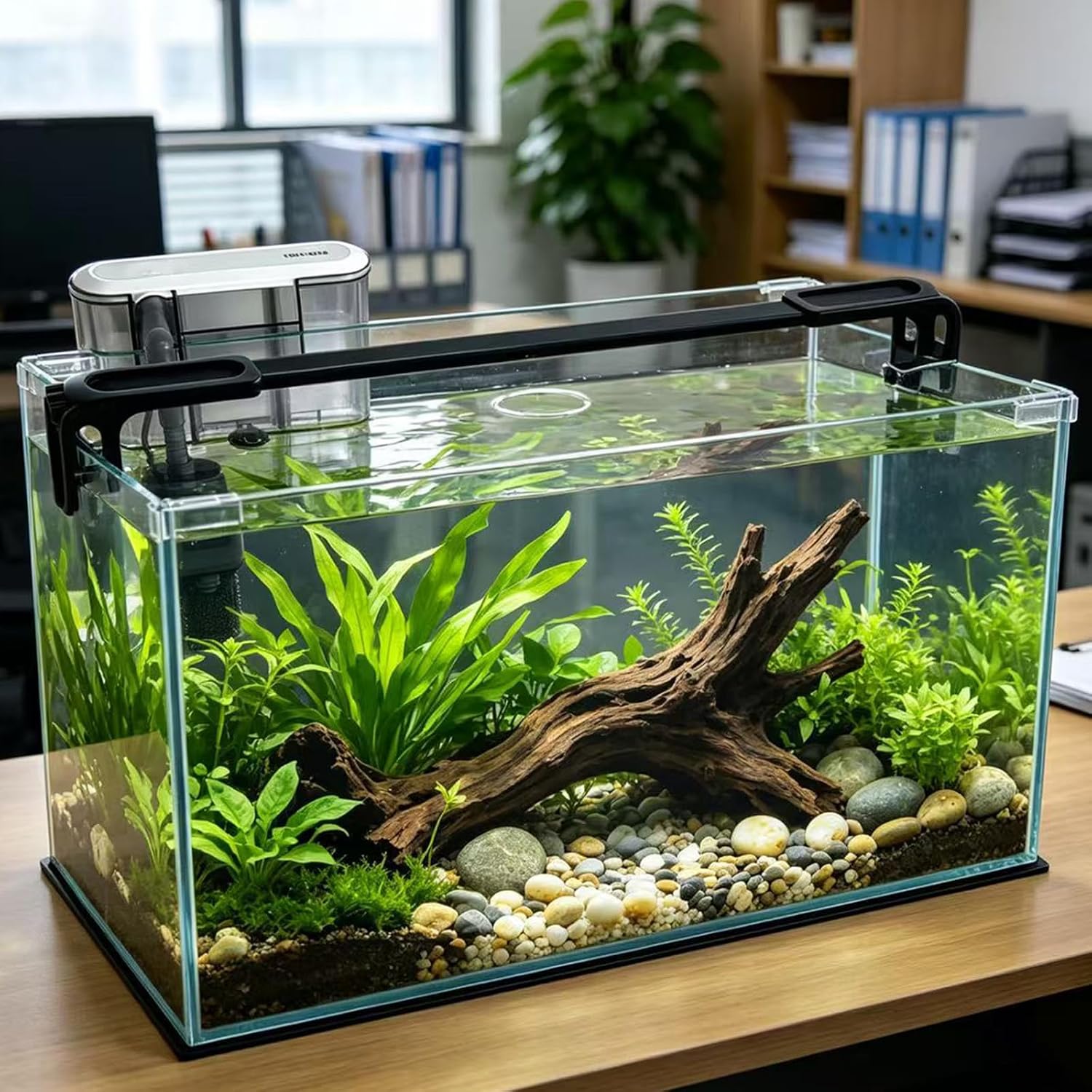
Vimvins 10 Gallon Glass Fish Tank, Easy to Maintain Small Aquarium for Betta/Shrimp and Aquatic Planting.
Check current Amazon price. This is the tank I would hand a first-time renter. Ten gallons is the volume where a betta or a group of shrimp has room to behave normally, and where plants have enough water above them to actually grow. The tank is positioned around easy maintenance and aquatic planting, and that matches the job: a plain glass box with no built-in filter to fail, no proprietary cartridge to hunt down, and no plastic hood to yellow in a sunny room.
The tradeoff is that everything is on you. You supply the filter, the heater, the lid or the lack of one, and the light. For a first setup that is a feature, because you buy one good filter and one good heater and you never replace a cartridge again.
Flaws but not dealbreakers: No lid and no light in the box, so budget for both. A bare 10-gallon also invites you to overstock it, so write your stocking list before you buy fish, not after.
Anyone who wants a straightforward 10-gallon planted tank for a betta, shrimp, or a small group of nano fish should start here.
Upgrade pick: LANDEN Aquarium Tall 10 Gallon Ultra Clear Glass Rimless Fish Tank 30T
Upgrade pick

LANDEN Aquarium Tall 10 Gallon Ultra Clear Glass Rimless Fish Tank 30T
Check current Amazon price. If you want the tank to read as furniture instead of a plastic box, this is the one. Ultra clear glass and a rimless top change how a small tank looks in a room, and the tall format is the apartment-friendly part: it stands up rather than out, which is what you want on a narrow console or a dresser top where every inch of depth is spoken for.
Rimless means no plastic trim to hide the water line, and it also means no included hood. Plan for evaporation and for a fish that can jump. Top-offs become part of your weekly routine, and a clip-on light is the natural match because it grabs the glass instead of needing a lid to sit on.
Flaws but not dealbreakers: Rimless glass wants a level surface more than a trimmed tank does, because an uneven stand puts stress on a joint with no frame to back it up. Check with a level before you fill, and use a mat under it.
Anyone who treats the tank as part of the room and does not mind topping off water every few days will get the most out of this one.
Lighting pick: fishkeeper Clip On Aquarium Light, 24/7 Mode Fish Tank Light with Timer
Lighting pick
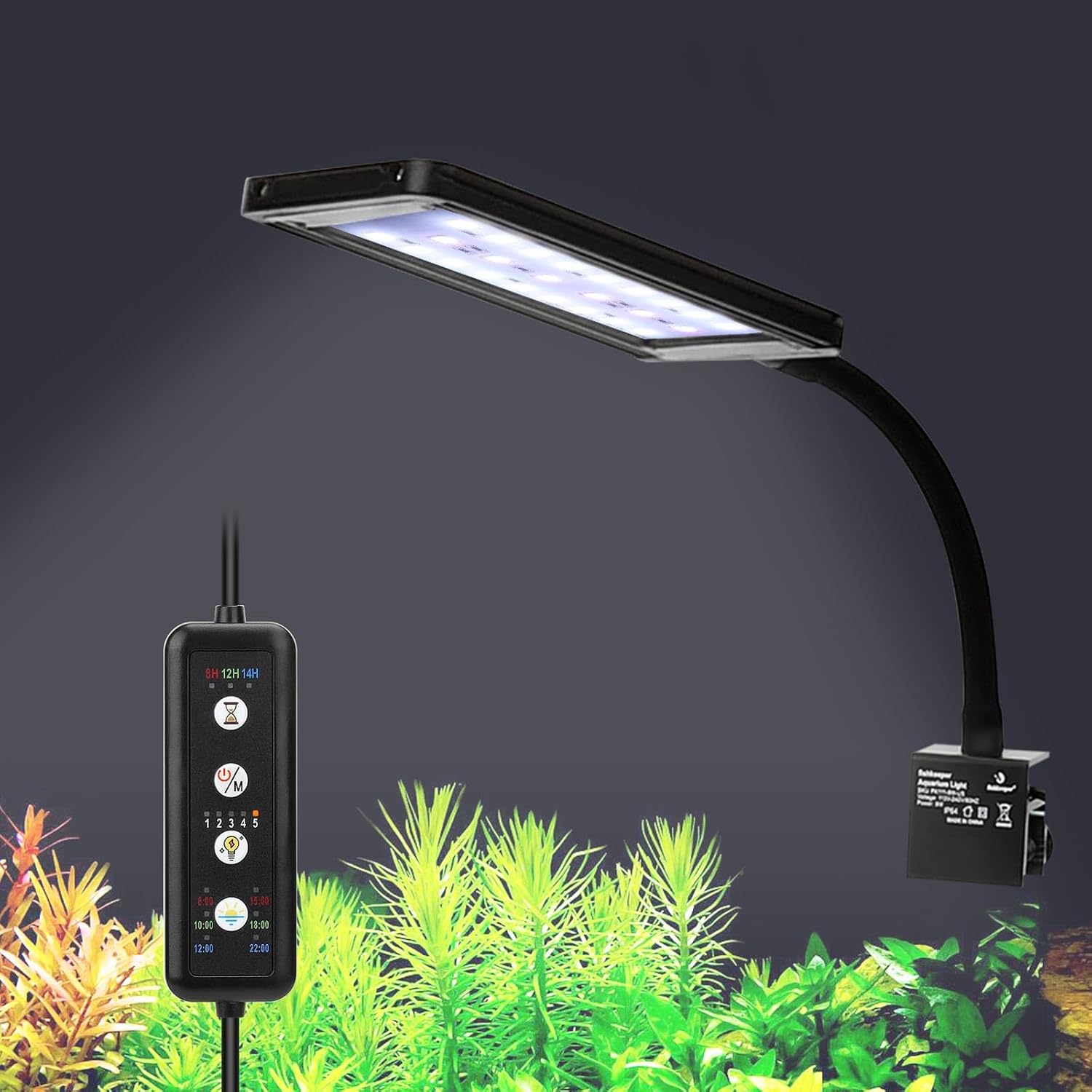
fishkeeper Clip On Aquarium Light, 24/7 Mode Fish Tank Light with Timer
Check current Amazon price. This is the cheapest thing in the build and the one that decides whether your plants live. It clips to the rim, so it works on the rimless tank above and on a tank with trim, and it does not need a hood to mount to. The 24/7 mode with a built-in timer is the part that matters in an apartment: you set the schedule once, and the light turns itself on and off while you are at work, which is the single most common reason small tanks grow algae.
Six to eight hours of light is the range most planted 10-gallons want. Start at six, watch the glass for green film, and add time only if the plants are stretching toward the light instead of filling in.
Flaws but not dealbreakers: A clip-on light sits close to the water, so keep the water level an inch or so below the rim to keep splash off the lens, and wipe it when you do a water change.
Anyone running low-to-medium light plants in a 10-gallon who does not want to think about a timer will be happy with this one.
The actual setup workflow
The order below is the order that saves carpets, and it is the order I follow every time I set up a fish tank in a small apartment. Do not skip ahead to buying fish.
Step one: Choose the spot and check the stand load. Level surface, out of direct sun, within reach of an outlet you trust, not behind a door, not next to the kitchen. Push on the furniture with one hand. If it racks or creaks, it is not a stand. A 10-gallon gets heavy fast, and in a rental the floor under it is not yours.
Step two: Leak test before you decorate. Fill the empty tank with room-temperature water, on towels or in a bathtub, and leave it for an hour. Watch the seams. A slow seep on day one is a wet carpet on month three, and that is your deposit.
Step three: Rinse the substrate and lay the bed. Rinse until the water runs clear, then build a bed about an inch and a half to two inches deep, deeper at the back if you plan to plant. Substrate depth is what roots hold on to, and it is also where a chunk of your bacteria will live.
Step four: Add hardscape and plants, then fill slowly. Set rock and wood before water, plant before water if you can, and pour onto a plate or a bowl so you do not dig a crater in the substrate. Treat the water with a dechlorinator before it goes in.
Step five: Install the filter and the heater. Put the filter where you can reach the media without moving the tank, and put the heater where water flows past it. Heater wattage is the number people get wrong: for 10 gallons, a 50-watt unit is the usual pick, and a 25-watt unit can fall behind in a cold apartment. Set tropical tanks near 78 degrees.
Step six: Mount the light and set the schedule. Clip it to the rim, aim it down, and set the timer to six to eight hours. Do not run it as a night light. Algae does not need much to get started.
Step seven: Cycle the tank, then wait. Cycle time on a 10-gallon runs three to six weeks. Feed the bacteria with a pinch of fish food or a bottled ammonia source, test ammonia and nitrite every couple of days, and do not add fish until both read zero and nitrate is climbing. When you rinse filter media, rinse it in old tank water, never under the tap, or you throw away the bacteria you just spent a month growing.
Step eight: Stock slowly, then plan for the move. Add fish a few at a time, drip acclimate them, and keep the first month light. After that, a 20 to 25 percent water change a week is the whole maintenance routine. When the lease ends, drain the tank down to an inch, keep the filter media wet in a bag of tank water, and move the tank last.
The competition and why it lost
A 20-gallon long is a better aquarium than anything on this list. It is also the wrong tank for a fourth-floor walk-up, because it weighs more full, needs a real stand, and takes a footprint most apartments do not have to spare. If you own the floor under it, buy the 20.
All-in-one nano cubes with built-in filtration are the other tempting option. They solve the equipment list problem in one box, and the trade is that you are locked into their cartridges and their light. When a pump dies two years in, you are buying their pump.
A sponge filter on an air pump is the cheapest filtration in the hobby and a genuinely good choice for a betta or a shrimp tank. It is also louder than a small internal filter, and in a studio apartment noise is the thing that makes people drain a tank.
The five-gallon kit you saw on sale is the third near miss. Five gallons is a fine betta tank and a hard beginner tank, because the smaller the water volume, the faster a mistake turns into a dead fish. Ten gallons is the smallest size I would hand a first-timer.
That is the ideal fish tank in a small apartment setup in one sentence: the largest volume that fits your footprint and your floor, with equipment you can service yourself. If you are still deciding between sizes, our notes on nano tank sizes walk through the footprint math.
What this all costs
Two tanks and one light are the only things here you have to buy from a specific listing. Check current Amazon price on each of them, because the two tanks sit in the same range and the light costs less than a decent dinner.
The rest of the equipment list is where the budget actually goes, and it is the part people forget: a small filter, a 50-watt heater, a thermometer, a freshwater test kit, a five-gallon bucket, a length of airline if you go with a sponge filter, and a towel you do not love. Add a lid or a top-off routine if you pick the rimless tank. If you are buying your test kit at the same time, the kits worth keeping on the shelf covers what actually needs to be in the box.
Then there is the part that does not show up on a receipt. Cycle time is three to six weeks, which means a month of looking at an empty tank. Count that as a cost and this hobby is expensive. Count it as the price of not killing fish and it is the cheapest month you will spend.
Divide any of it by the two or three years you will keep the tank and the daily number gets small. What matters more is that nothing on this list needs a plumber, a drill, or a landlord's permission, which is the whole point of a 10-gallon apartment tank.
That is the job. Fill it once, cycle it properly, and keep the towels close.