Most people try to stop dog hair on a sofa cover with a better vacuum. That is the wrong end of the problem. Hair lands where a dog rests, and a dog that naps on the sofa presses its undercoat down into the weave, where a vacuum can only skim the surface.
I learned this the slow way, with two shedding dogs and one cream-colored cover that went gray inside a week. The cover was never the problem. The sofa was the best bed in the house, the dogs had no better option, so they took it.
This is how to stop dog hair on a sofa cover in a way that survives past the first week: give the dog a better resting spot, put a cover on the sofa that lets go of hair, and build a wash rhythm you can keep. The gear below is the short list that made the difference in my house, and the steps at the end are the order I do them in.
Why you should trust me
I have been writing about pet gear for Gear for the Den since 2019, and I have lived with double-coated dogs for a lot longer than that. My living room is a two-dog, one-cat operation with a fabric sofa that has to survive all of them, plus a foster rotation that brings a new shedder through every few months.
I have run this routine through a full shedding season, rotating covers, watching which fabrics let go of hair in a cold wash and which hold it like felt, and paying attention to where the hair actually piles up versus where I assumed it did. The answer was never the seat cushion. It was the armrest and the back cushion, because that is where a dog leans while it watches the door.
I do not sell anything here. I recommend the gear that survived contact with my own dogs, and I tell you when the cheaper option is enough.
How I picked and how I tested
People ask me how to prevent dog hair on a sofa cover more than almost anything else, and the honest answer is that no single product does it. The three items below are the ones that change where the dog rests, which is the only lever that matters.
I picked them on boring criteria. Footprint in a normal living room. Whether a small dog can use the thing without being lifted. Whether the surfaces grab hair or release it. How easy the unit is to move when you vacuum. And whether it solves a problem on its own, without four accessories.
For the pens I looked at panel count first, because panel count decides whether the pen is a square box or a shape that actually fits around the sofa. I checked gate height, since a dog that can clear the gate makes the whole pen pointless. I looked for bar spacing, or the absence of it, because wire bars are a hair trap nobody wants to clean. And I compared each pen against a crate of the same footprint, since crate size is the number most people start with and it is rarely the number that fits.
For the stairs I cared about step depth, tread grip, and whether the top step sits flush against whatever the dog climbs onto. A stair set that rocks is a stair set a small dog stops using.
Everything below got used in the same house, on the same sofa, through the same shedding season.
Gear that helps you stop dog hair on a sofa cover
The logic is simple. A dog with a better place to sleep does not sleep on your cover. A dog with a boundary during the day does not wander onto it. The stairs and the pens below build those two things without turning your living room into a kennel.
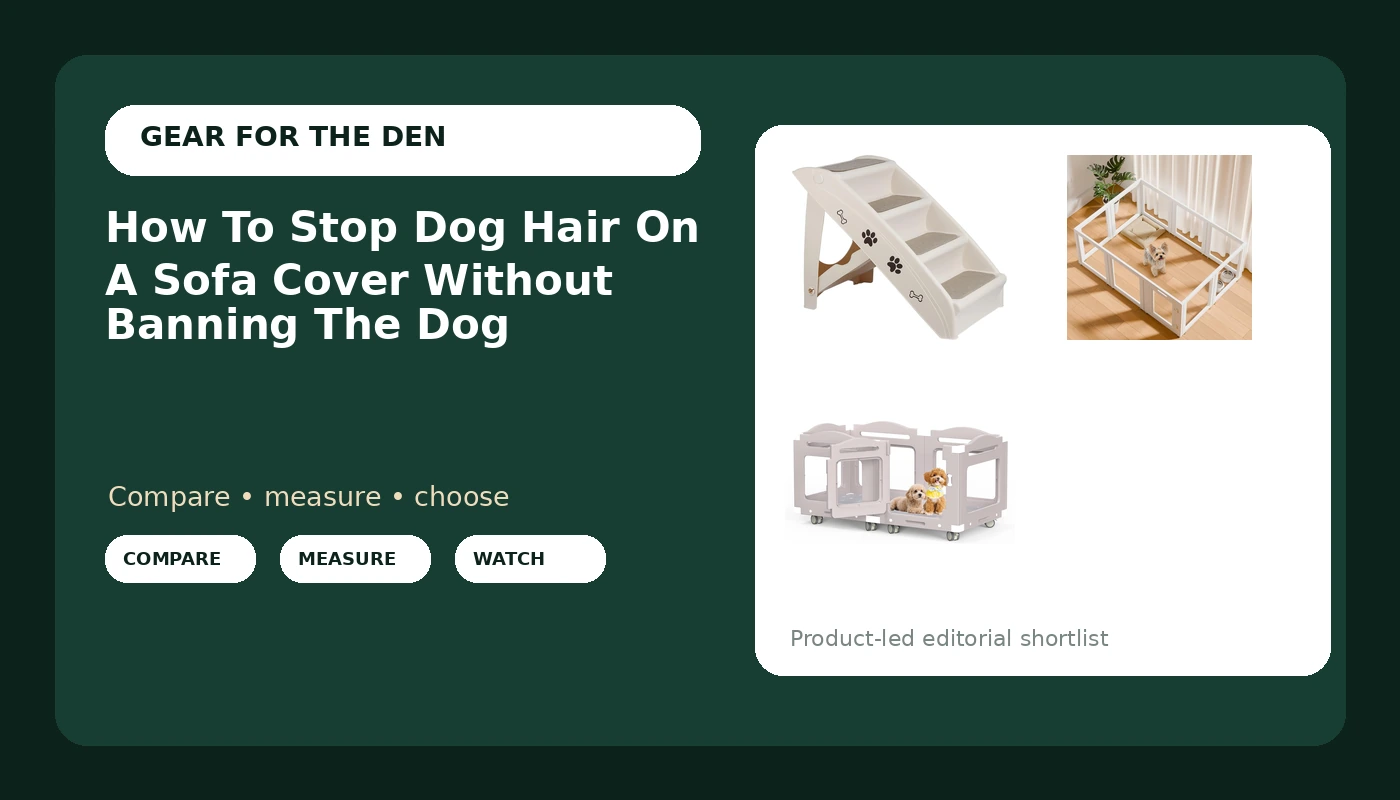
Budget pick: 20" H 4-Step Dog Stairs for Small Dogs and Cats, Non-Slip Dog Steps for High Beds, Couch, Sofa, Sturdy Pet Steps (Tan)
Budget pick
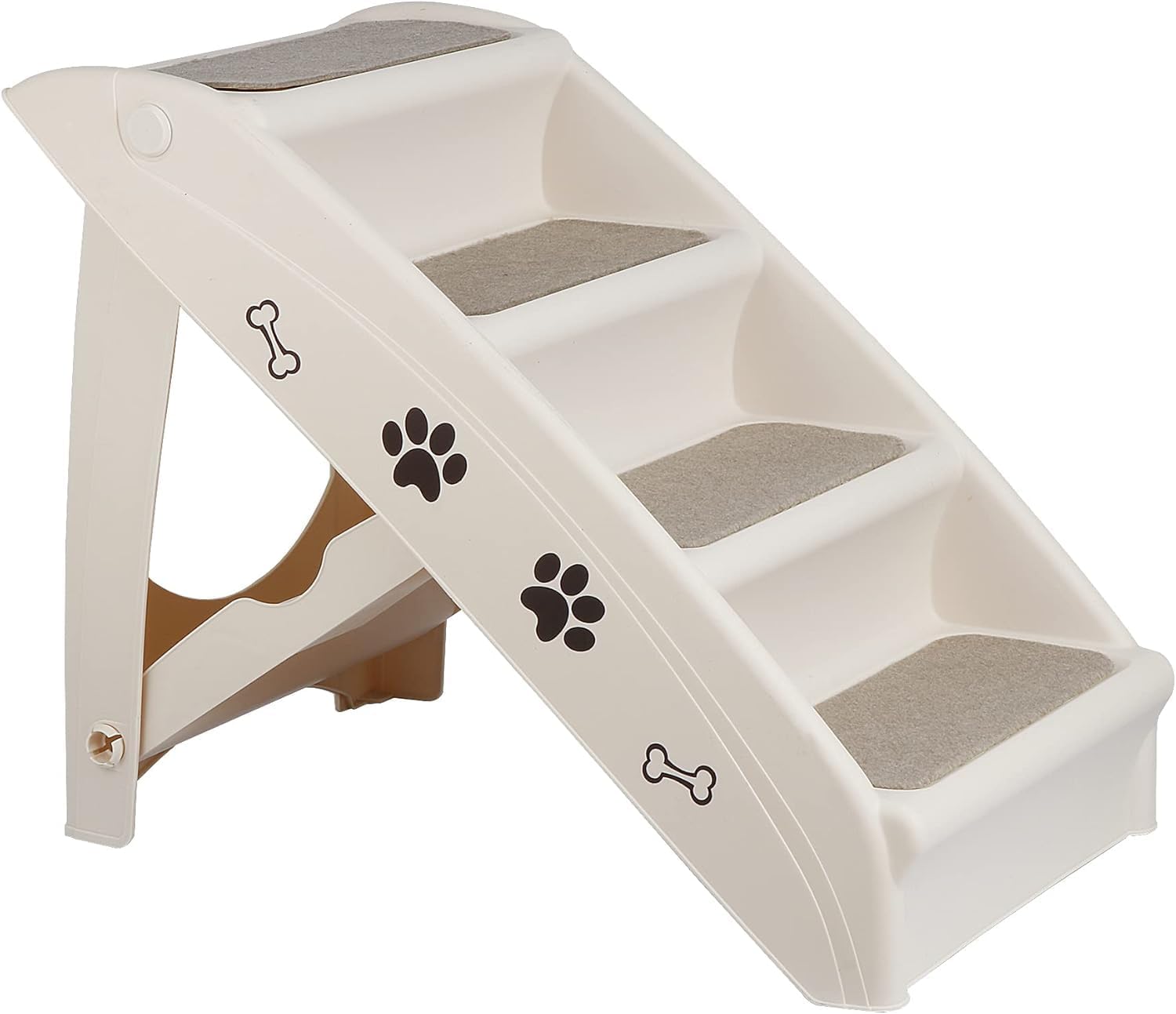
20" H 4-Step Dog Stairs for Small Dogs and Cats, Non-Slip Dog Steps for High Beds, Couch, Sofa, Sturdy Pet Steps (Tan)
The stairs are the cheapest of the three and the one I would buy first. Check current Amazon price. The idea is to give a small dog a way up to its own chair, its own bed, or the foot of your bed, so the sofa stops being the tallest, softest thing in the room.
Four steps at a twenty-inch height is the right size for a dachshund, a pug, or an aging terrier that should not be jumping. The tan fabric tread is the part that matters. A smooth step is a step a small dog slides off once and never trusts again. The frame is light enough to move with one hand when you vacuum, which sounds trivial until you own a stair set that weighs as much as the dog.
Hair does cling to the fabric treads, so this is not a zero-maintenance item. A rubber brush once a week handles it. What the stairs buy you is the dog's attention: once the stairs lead somewhere good, the couch is no longer the only high ground.
Flaws but not dealbreakers: The tread fabric is the weak point over years of washing, and the tan color shows dirt. If your dog is a mud monster, plan on a cover or a weekly brush out.
Anyone with a small or senior dog who wants the sofa to stop being the default perch should start here.
Our pick: EVERFRONT Clear Acrylic Dog Playpen Indoor Puppy Playpen, 24" H, 10 Panels
Our pick
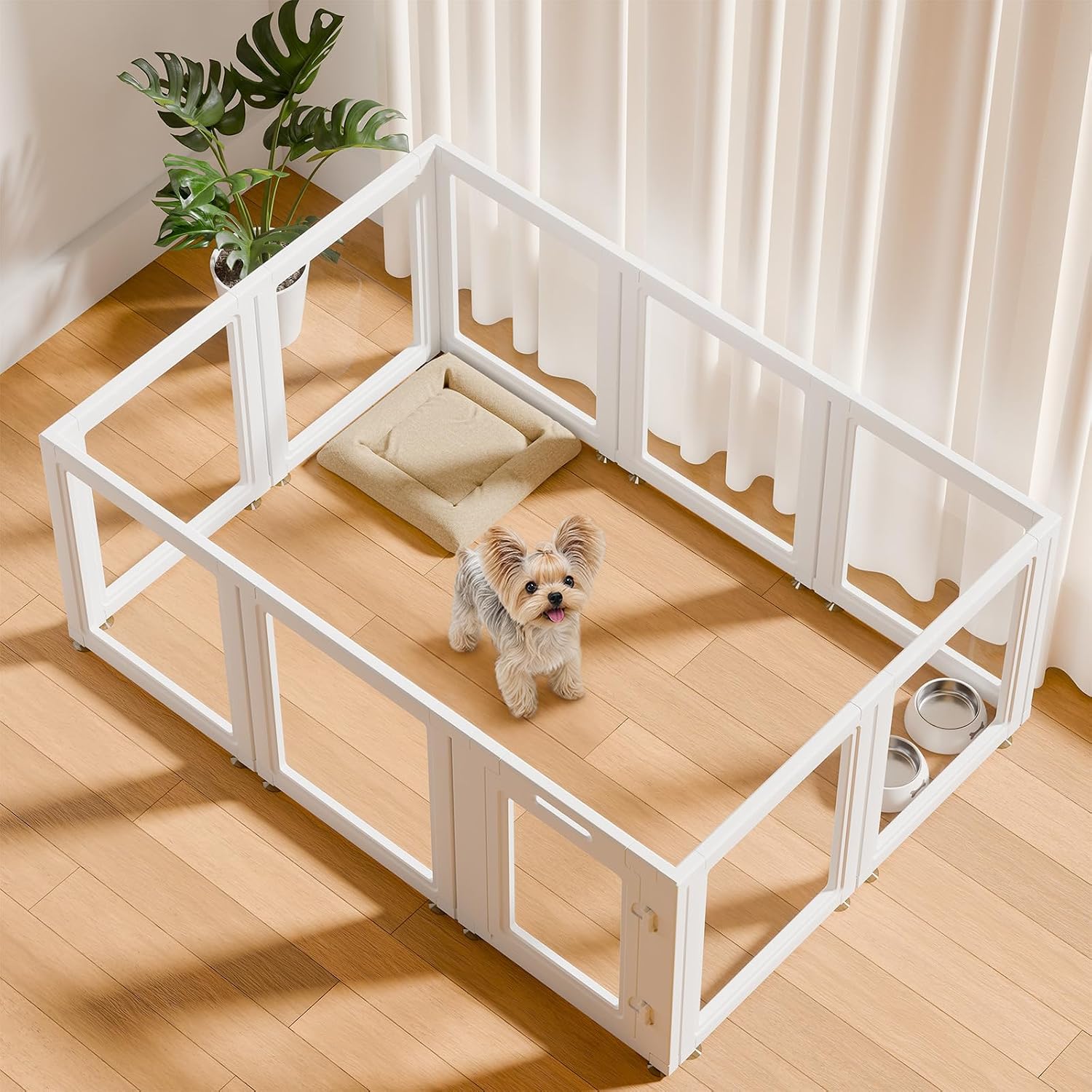
EVERFRONT Clear Acrylic Dog Playpen Indoor Puppy Playpen, 24" H, 10 Panels
This is the one to buy if the problem is not a single nap spot but a whole afternoon of unsupervised couch time. Check current Amazon price. Ten panels at twenty-four inches tall gives you enough panel count to build a real shape, not just a square: a rectangle along a wall, an L around a corner, or a box that keeps a puppy away from the sofa while you are out.
The clear acrylic is why it works in a living room. A dog in a solid-sided pen tends to bark at the wall in front of it. A dog in a clear pen can still see you, the door, and the cat, which keeps the whining down and keeps the pen from feeling like punishment.
Because the panels are solid acrylic, there is no bar spacing to trap hair and no bars for a determined puppy to climb. The gate is built into one panel, and the gate height matches the wall, so there is no low section for a jumper to aim at. Cleaning is a wipe with a damp cloth, which is faster than vacuuming a wire pen and far faster than laundering a fabric one.
Flaws but not dealbreakers: Acrylic shows nose prints and paw smudges, and it is heavier than a wire pen of the same footprint. You will not move it every day.
Anyone who wants a daytime boundary that does not look like a cage in the middle of the room should look here first.
Upgrade pick: Mobile Acrylic Dog Playpen with Stroller,Indoor Clear Small Puppy Pen 24" H
Upgrade pick
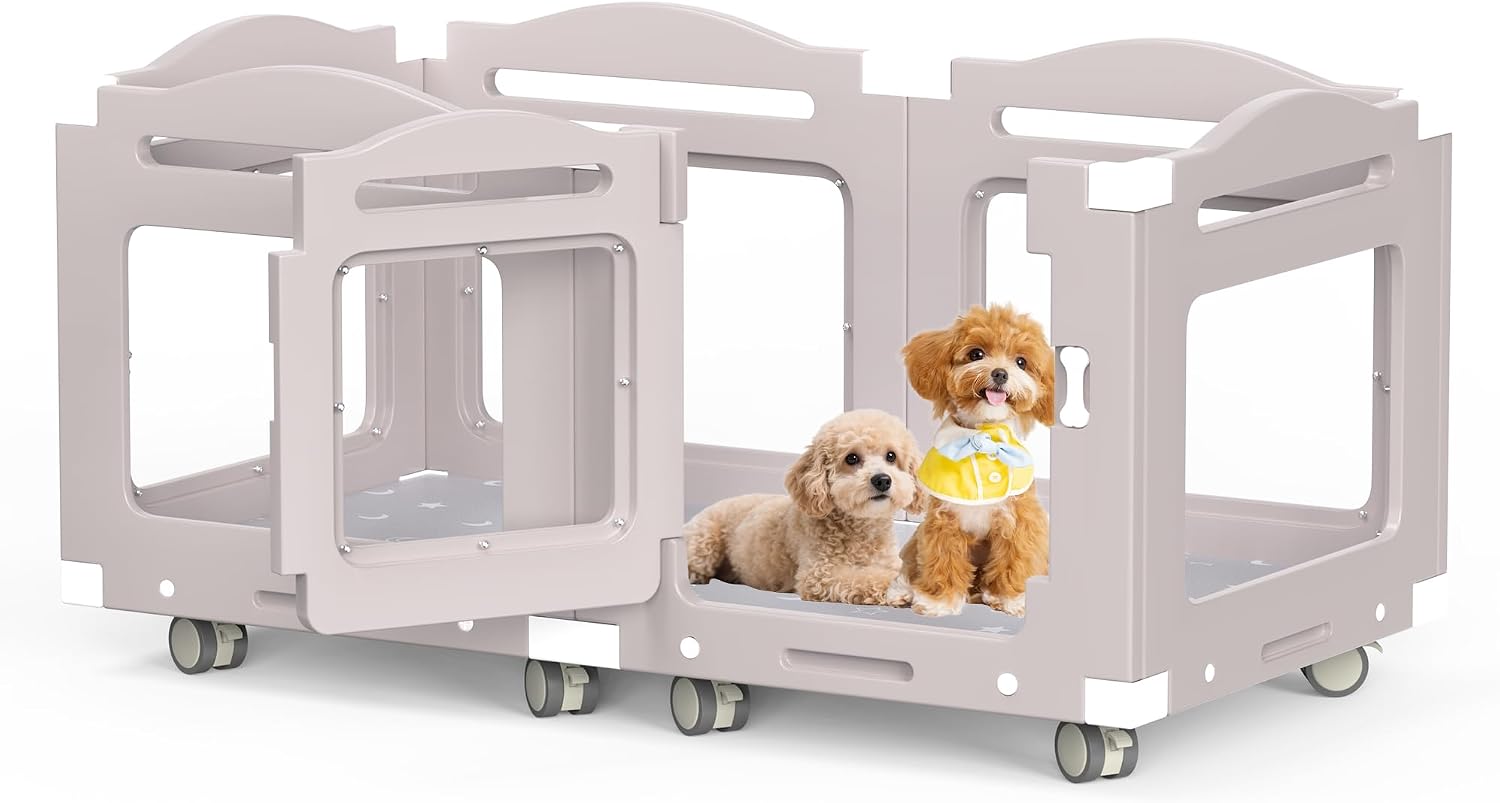
Mobile Acrylic Dog Playpen with Stroller,Indoor Clear Small Puppy Pen 24" H
This is the same idea with wheels and a stroller frame, and it costs the most of the three. Check current Amazon price. The point of the mobile version is that the boundary follows you: kitchen while you cook, office while you work, living room while you watch television, with the sofa cover out of reach the whole time.
If you have ever tried to drag a ten-panel pen across a rug by yourself, you understand why the wheels matter. The stroller frame keeps the panels rigid while you move it, so you are not reassembling the pen every time you change rooms. Twenty-four inches of height is the same working height as the fixed version, tall enough to stop a small dog from hopping out and low enough that you can step over it with an arm full of laundry.
For a puppy, this is the closest thing to a playpen that behaves like furniture. For an adult dog that has already learned the sofa is comfortable, it is the tool that makes the new rule stick, because the new spot is always nearby instead of in another room.
Flaws but not dealbreakers: Wheels and rugs are a mixed marriage, and the stroller frame adds bulk you have to store. Measure your doorway before you commit.
Anyone in an apartment or a small house who cannot sacrifice a room to a pen should look at this one.
The actual workflow
This is the sequence that worked, and it is the routine I would hand to anyone who wants to stop dog hair on a sofa cover without banning the dog from the room.
Step one: Find where the hair actually comes from. Look at the cover in daylight before you buy anything. Most of the hair sits in one or two zones: the armrest where the dog leans, the back cushion where it curls up, or one end of the seat where it naps. That map tells you whether you have a resting problem or a traffic problem. A dog that crosses the sofa on the way to the window needs a boundary. A dog that sleeps there needs a bed.
Step two: Give the dog a better bed than the sofa. Move or buy a bed and put it where the dog already likes to be, not in the corner where you want it. Height matters. If your dog likes the sofa because it is high, a low bed on the floor will not compete. This is where the stairs earn their place: they make the dog's own elevated spot reachable, so the sofa loses its monopoly on high ground.
Step three: Set a daytime boundary. For the hours you cannot watch the dog, close the loop. A pen with enough panel count to wrap around the sofa's approach beats a pen in a spare room, because the dog stays near the family and the habit holds. Check the gate height against your dog's actual jump, and skip wire pens with wide bar spacing unless you enjoy pulling hair out of bars.
Step four: Choose a cover that releases hair. Tight weaves release. Loose knits and chenille hold. A washable fabric with a flat surface gives up hair to a rubber brush or a damp cloth; a plush cover fights you for years. If you are shopping for the cover itself, look at my roundup of washable sofa covers that survive shedding and pick the weave you would expect on a good sheet, not on a fleece throw.
Step five: Layer a waterproof layer underneath. Hair is only half of what a dog leaves behind. A waterproof layer under the top cover keeps oils, drool, and accidents out of the cushions, which matters more than the hair for odor. Make sure the setup still allows cover ventilation, because a plastic sheet directly under a dog traps heat and turns a nap into a sweat, which makes the cover smell faster.
Step six: Get the hair off before it goes in the wash. Vacuum, then run a rubber squeegee or a damp rubber glove over the cover in one direction. That lifts the pressed-in undercoat instead of pushing it deeper. Do this dry. A wet cover holds hair like glue and you will be picking it out of the drum for a week.
Step seven: Wash cold and dry low. Hot water and high heat set the oils that make hair stick, and they shrink the cover. Cold wash, gentle cycle, low heat or line dry. If your machine has a second rinse, use it. Check mat thickness on the dog's own bed at the same time, because a thin mat that slides across the floor is a mat your dog will abandon for the sofa again.
Step eight: Reset the room on a schedule. Once a week: brush the cover, wipe the pen panels, check the stairs for loose treads, and rotate a spare cover on if you have one. The routine is boring and takes about ten minutes. Ten minutes a week is what separates a cover that lasts two years from one you replace every season.
The competition and why it lost
Some things I tried and set aside.
Wire exercise pens are cheaper than acrylic and they work, but the bar spacing is a hair trap. Every bar collects a ring of undercoat, and cleaning it takes longer than wiping a whole acrylic panel. Fabric playpens fold flat and travel well, but mesh collects hair the way a screen door does, and they sag after a few months with a determined puppy.
Lint rollers are a losing game on a sofa cover. They work on a jacket. On something the size of a couch you will burn a roll in one pass.
Furniture throws with a plush finish look great for a week and then hold hair so well that the hair survives the wash cycle. A loose knit cover is the same story, which is why the tight weave matters more than the color.
Robot vacuums help with the floor and do almost nothing for a cover, because the hair is pressed into the weave, not sitting on top of it. Air purifiers handle the airborne fraction, not the mat on the armrest, so they are a support act, not the solution.
Crates work for the boundary job, and if you already own one, use it. Crate size is the only number that matters there, and most people buy too big, which gives the dog room to pace and spread hair over more surface than it needs.
What this all costs
Three items, three tiers. Check current Amazon price on each before you decide, because these move.
The stairs are the cheapest piece and the one that changes the most for the least. If your dog is small or aging, that is where the money goes first.
The ten-panel acrylic pen costs more than the stairs, and it buys a daytime boundary that looks like furniture instead of a cage. It is the piece to buy if the couch problem happens while you are at work.
The mobile pen with the stroller frame is the most expensive of the three, and the premium buys one thing: the ability to move the boundary from room to room without rebuilding it. If you have a single room where the dog can stay, skip it. If your dog follows you from kitchen to office all day, the wheels earn their keep.
Add a washable cover and a waterproof layer underneath, and the whole setup lands in the range of a modest piece of furniture. Compare that with replacing a cushion cover every year, or paying for a professional upholstery clean, and the math is not close.
Nothing on this list by itself will stop dog hair on a sofa cover. The routine does. The gear is a one-time cost, and the part that actually works is the part where you decide, once, that the sofa is not the dog's bed, and then make the alternative better than the sofa.