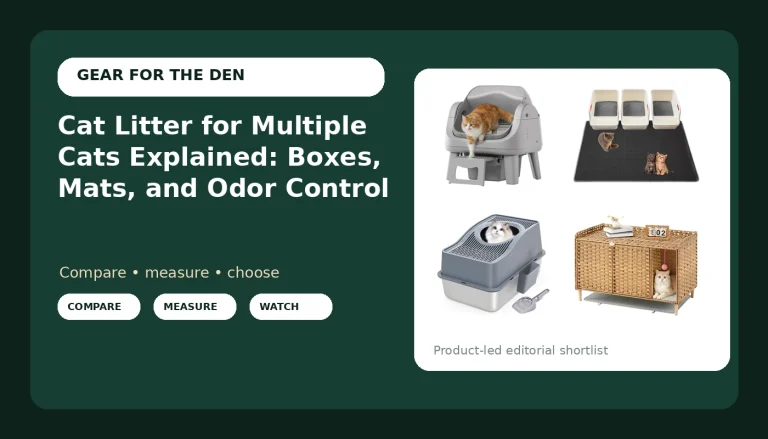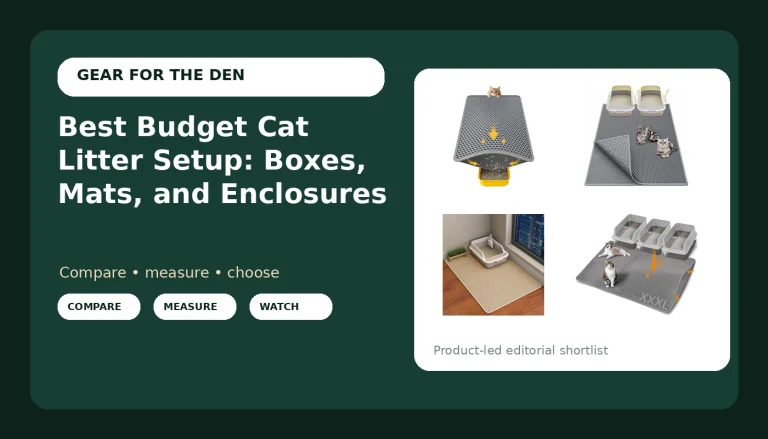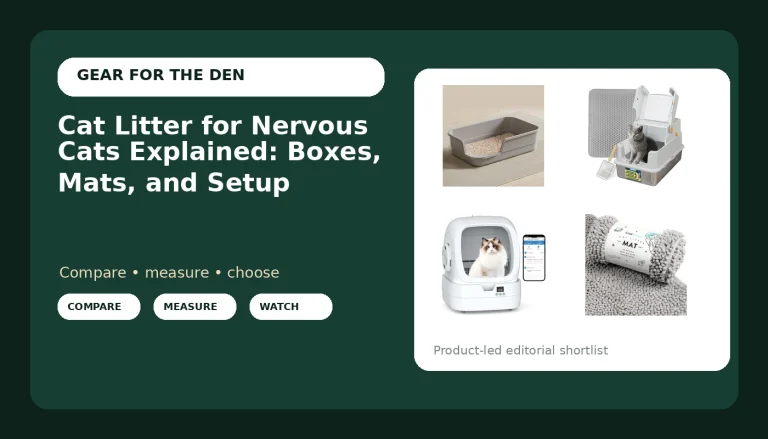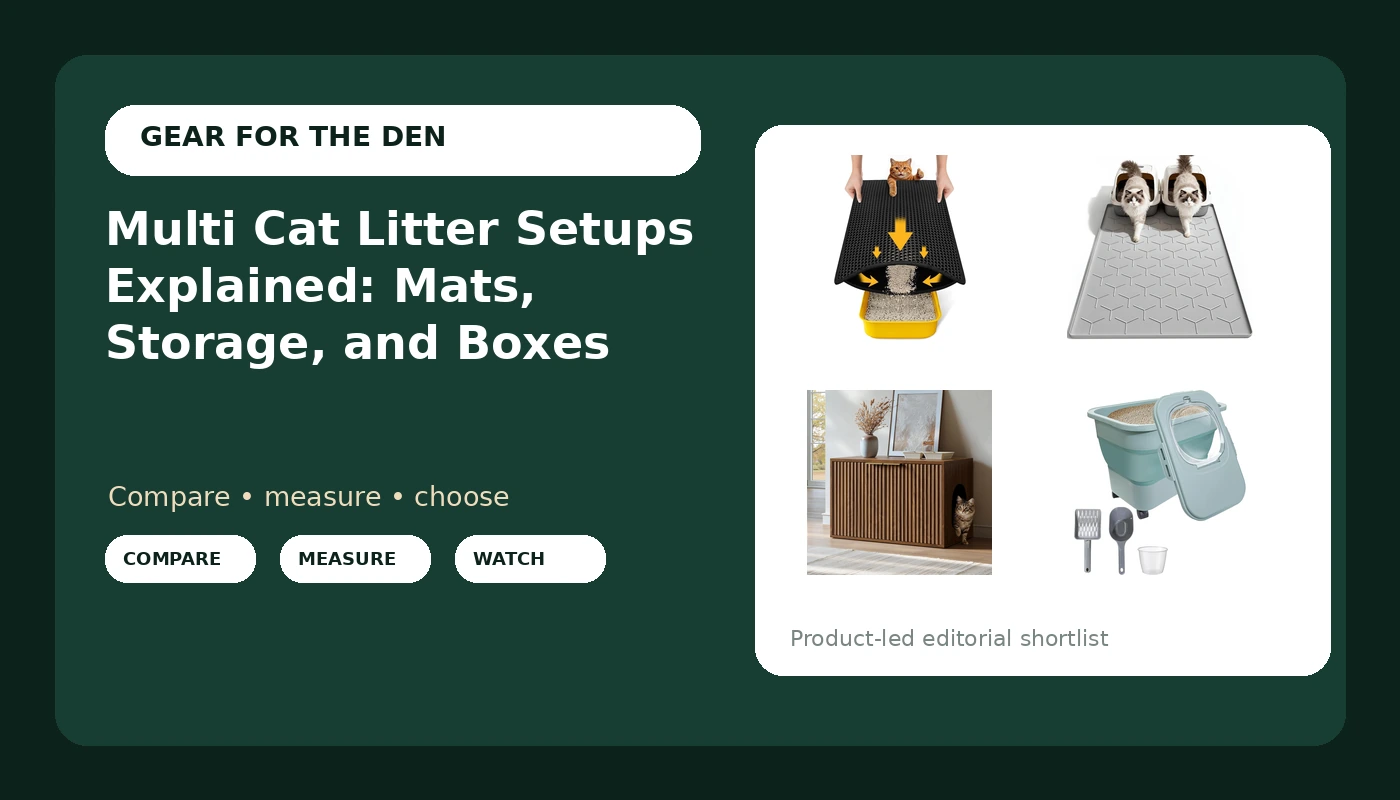
A second cat changes the litter routine more than most people expect. Two cats share boxes, double the daily waste volume, and often disagree about where they are willing to dig. Treating multi cat litter setups as one connected system, rather than a box in one corner and a mat in another, is what keeps the room usable and the daily routine short.
Quick answer
For most two and three cat homes, a workable setup begins with one box per cat plus one spare, spread across different rooms or at least different corners, each one large enough for the biggest cat in the house to turn around and dig. The accessories that earn their keep are the ones solving a specific problem: a mat that traps grit at the box exit, a sealed container that keeps spare litter dry and out of the way, and, when floor space is tight, an enclosure that hides the box without shrinking it. The four items below are support pieces, not substitutes for adequate boxes.
4 useful options
| Model | Best fit | What stands out |
|---|---|---|
| Cat Litter Mat Compact Size 23.6"x14.6" for Small Spaces, Upgrade Waterproof Leakproof Back Layer, Honeycomb Trapping Mat, Washable, Easy to Clean, Scatter Control Kitty Litter Matt, Black | Tight bathroom corners and narrow gaps beside a single box | Honeycomb trapping surface, waterproof back layer, washable |
| Garoopion Silicone Cat Litter Mat Large 40" X 28", Easy to Clean, Gray | Wide box exits and boxes placed side by side | Large silicone surface that wipes clean |
| Evermagin 31.5" Cat Litter Box Enclosure Furniture | Shared living space where the box has to disappear | Furniture-style enclosure sized at 31.5 inches |
| Collapsible Cat Litter Storage Container with Rolling Casters,20 Lbs Cat Litter Storage with Wheels,Airtight Lids,Cat Litter Shovel,Portable Cat Litter Storage Bin Container,BPA Free (Green) | Homes without closet space near the boxes | Rolls on casters, holds 20 lbs, airtight lid, scoop included |
Compact scatter control: Cat Litter Mat Compact Size 23.6"x14.6" for Small Spaces, Upgrade Waterproof Leakproof Back Layer, Honeycomb Trapping Mat, Washable, Easy to Clean, Scatter Control Kitty Litter Matt, Black
Tracking is usually the first problem that gets worse when a second cat arrives, because twice the digging means twice the grit leaving the box. A small mat suits the spots multi-cat homes actually have free: the strip beside a bathroom vanity, the gap between a box and a wall, the corner of a laundry room. Its job is not to cover the floor but to catch what leaves the box on the first step. Mat texture matters here, since a honeycomb surface holds loose granules while a flat or woven surface tends to pass them along to the next room. Place it flush against the box entrance and use one per box rather than carrying a single mat from room to room. Because it is washable, it can be rinsed and hung to dry during the weekly box cleaning, which keeps odor control from depending on a mat that has been sitting damp. The trade-off is coverage: a compact footprint fits tight spaces, but it will not catch everything a vigorous digger throws.
Wide coverage: Garoopion Silicone Cat Litter Mat Large 40" X 28", Easy to Clean, Gray
Where the compact mat solves tight space, this one solves spread. A large box, or two boxes placed side by side, throws litter farther than a small mat can catch, and a 40 by 28 inch surface gives you room to overlap the entry and the first step out. Silicone behaves differently from a honeycomb plastic mat: it sits flat, wipes down with a damp cloth or a quick rinse, and does not need the same shake-and-hang routine. That matters in a multi-cat home, where a mat may need attention more than once a week. The trade-offs are honest ones. A mat this size takes up floor space, so measure the area in front of the box before committing, and accept that a large gray mat is visible in a living room even when it is clean. It is also not a substitute for box placement: if the boxes sit in a high-traffic hallway, grit will travel past any mat, and a second mat at the doorway helps more than a bigger one under the box.
Hidden in plain sight: Evermagin 31.5" Cat Litter Box Enclosure Furniture
In a shared living space, the honest reason to buy an enclosure is that you do not want to look at a litter box, and there is nothing wrong with that. The risk in a multi-cat home is that the enclosure becomes the reason the box inside it is too small. Before buying, measure the box you plan to place inside and compare it against the enclosure's interior, not its outer footprint. Entry height matters as much as floor area, because a cat that has to duck through a low opening or jump up to get in may decide the spot is not worth the effort. For older cats and kittens, that calculation is even less forgiving, and a box with a lower entry is often the better answer than furniture. Ventilation and access for scooping matter too: an enclosure that is awkward to open will get cleaned less often, and in a two-cat home that shows up as odor within a day. Finally, one enclosure does not replace the other boxes. It hides one box well, and every cat still needs an exit route that does not pass another cat.
Prices and availability may change. Product images, names, and retailer links are matched to verified listings. No current price, rating, stock status, or measured result is stated here without current evidence.
Sealed and rolling: Collapsible Cat Litter Storage Container with Rolling Casters,20 Lbs Cat Litter Storage with Wheels,Airtight Lids,Cat Litter Shovel,Portable Cat Litter Storage Bin Container,BPA Free (Green)
Multi-cat homes go through litter quickly, so the half-open bag in the back of a closet becomes a daily annoyance: it tips, it spills, and it draws moisture every time the door opens. Clumping litter reacts to humidity, and a bin with airtight lids keeps that process from starting before the litter reaches the box, which in turn protects clumping speed once it is in use. Casters are a small feature with a large effect, because refilling several boxes means carrying or rolling the supply across the house, and a bin that moves easily gets refilled before it runs empty. The collapsible design earns its place in apartments where storage space disappears when guests visit, and having the cat litter shovel in the same container removes one more item to hunt for at scooping time. The trade-offs are space and surface: a full bin occupies floor area somewhere near the boxes, and wheels tend to roll more freely on hard flooring than on thick carpet.
What multi cat litter setups actually require
Start with arithmetic. The common guidance is one box per cat plus one extra, so two cats get three boxes. That extra box matters because it lets a cat choose a different location when one box is occupied, recently used, or simply in a spot another cat guards. Placement is part of the count: three boxes lined up in a row behave like one territory, while three boxes in separate rooms behave like three options.
Box size is the next constraint. A box should be long enough that the cat can enter, turn around, and dig without hanging over the edge. Many commercial boxes are smaller than that, which is one reason large storage totes get used as litter boxes. Litter depth works alongside size: most cats do best with enough loose litter to dig and cover, roughly a couple of inches, and topping up little and often keeps that depth steady rather than going from deep to bare.
Entry height deserves its own check. High sides reduce scatter but make the box harder to enter for kittens, senior cats, and cats with joint pain. A low entry with a high back is often the better compromise. If your household includes an older cat, an entry that is easy to step over will matter more than any accessory on this page.
Odor control is a function of removal frequency, litter type, and airflow, in that order. Scooping twice a day and replacing litter on a schedule does more than any additive. Covered boxes hold smell inside the box, which is good for the room and bad for the cat that has to breathe it. If you use a self-cleaning box, check that the waste drawer is large enough for the number of cats using it, and confirm the sensor range is suited to the box size, since a sensor that cannot see the whole interior will either cycle at the wrong time or miss the cat entirely.
Matching mats, storage, and space to the setup
The pieces on this page are not interchangeable, and the order you decide them in matters more than the brands. Work from the boxes outward:
- Count your cats, add one, and confirm you have that many boxes before buying anything else.
- Measure the floor around each box, then choose mat size: compact for narrow gaps, large for wide exits and side-by-side boxes.
- Decide where spare litter will live and how much you want to keep on hand; a sealed bin near the boxes beats a torn bag in a closet.
- Check box size and entry height against any enclosure before you commit to hiding a box inside furniture.
- Set a scooping and washing schedule you will actually keep, then buy only the accessories that support it.
Doing it in that order prevents the most common mistake in these setups, which is buying a mat or a bin to fix a problem that really comes from too few boxes or a box that is too small.
Practical guidance that holds up day to day
This is the part where correct multi cat litter setups are made or quietly lost. Gear helps, but routine decides.
- Scoop at least twice a day, and keep the scoop stored with the litter rather than in the box.
- Rinse washable mats weekly and dry them fully before they go back down, since a damp mat holds odor.
- Keep litter depth consistent instead of topping up only when the box looks empty.
- Replace boxes when the plastic is scratched and starts holding smell, even if the box still functions.
- Place a mat at every box, not just the busiest one, and shake mats outside rather than over a sink.
Which option should you choose?
There is no single template for ideal multi cat litter setups, because the right combination depends on how much floor space you have and where the boxes have to live. Taken together, the multi cat litter setups explained here come down to matching each piece to the job it is doing.
Choose the Cat Litter Mat Compact Size 23.6"x14.6" for Small Spaces, Upgrade Waterproof Leakproof Back Layer, Honeycomb Trapping Mat, Washable, Easy to Clean, Scatter Control Kitty Litter Matt, Black when boxes sit in narrow spots and you want a washable mat that fits a gap. Choose the Garoopion Silicone Cat Litter Mat Large 40" X 28", Easy to Clean, Gray when a large box or two side-by-side boxes throw litter across a wide area and you would rather wipe a silicone surface than shake out plastic. Choose the Evermagin 31.5" Cat Litter Box Enclosure Furniture when the box has to live in a shared room and hiding it matters more than instant access, provided your box still fits comfortably inside. Choose the Collapsible Cat Litter Storage Container with Rolling Casters,20 Lbs Cat Litter Storage with Wheels,Airtight Lids,Cat Litter Shovel,Portable Cat Litter Storage Bin Container,BPA Free (Green) when spare litter has no dedicated home and you want a sealed bin you can roll to each box.
Note that these are support items. None of them corrects a shortage of boxes, a box that is too small, or a scooping routine that slips to once every other day.
The bottom line
A multi-cat litter area works when the boxes come first: enough of them, big enough, in separate spots, with litter deep enough to dig. Mats, enclosures, and storage bins make that setup easier to live with by containing grit, hiding a box that has to sit in a shared room, and keeping spare litter sealed and mobile. Buy the accessories to fit the space you have, verify dimensions against your actual boxes before ordering, and check current Amazon price and availability for each item, since listings change. If the setup still smells or gets avoided, look at box count, box size, and cleaning frequency before adding anything else to the cart.