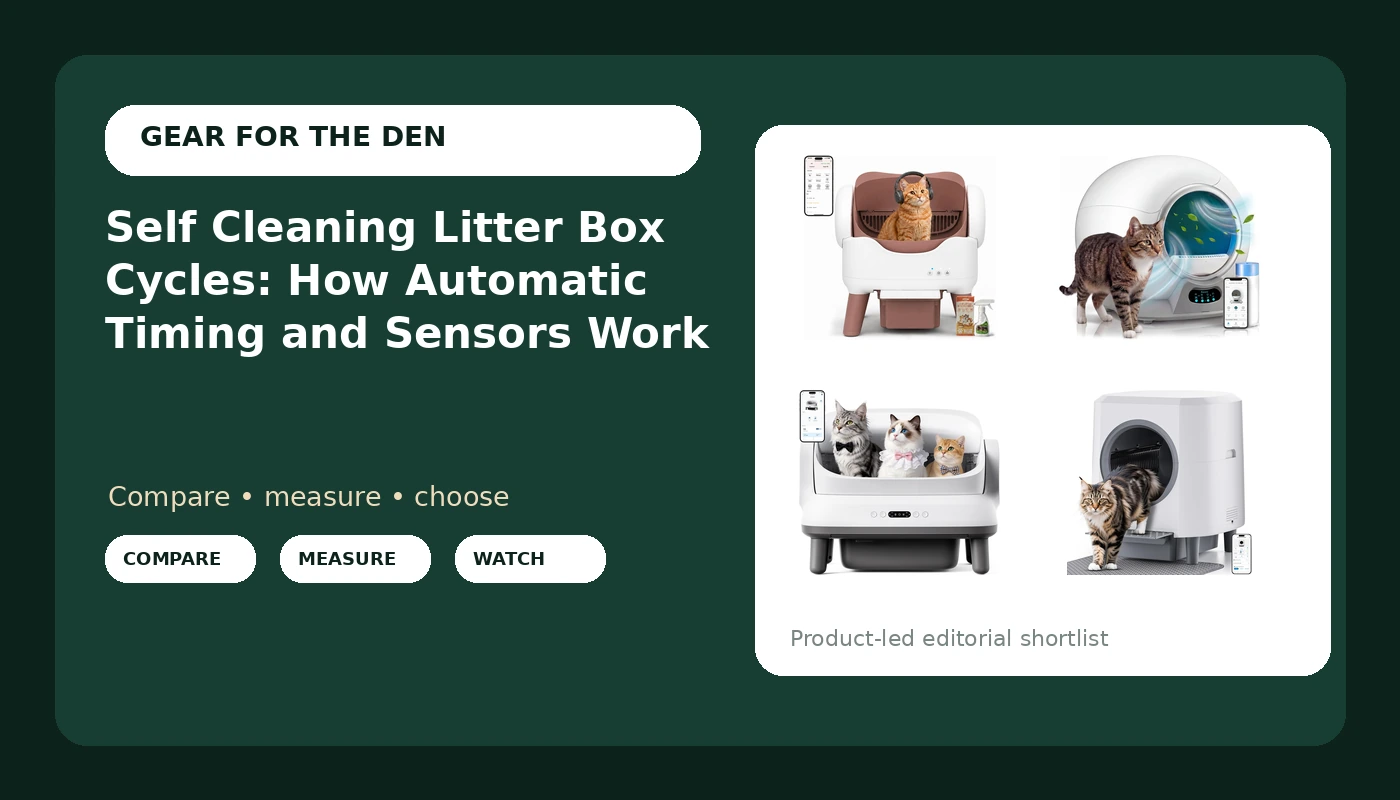
If you have ever watched an automatic box stop partway through a cycle, or come home to a clump still sitting in the tray hours after your cat walked away, the machine is usually not the problem. The settings are. Self cleaning litter box cycles are the repeating sequence of sensing, waiting, sifting, and resetting that an automatic box runs after every visit, and the details of that sequence decide whether the box stays ahead of odor or slowly becomes a jammed, smelly source of stress for you and your cat. This guide explains what triggers a cycle, which parts you can actually adjust, and how the four automatic boxes below differ in the features that shape a cycle: app pairing, Wi-Fi and signal range, capacity, odor control, and the litter they expect.
Quick answer
An automatic box starts a cycle when a sensor registers that a cat has entered and then left the unit. Most designs add a delay before the rake or drum moves, so a cat that steps back in is not caught by the mechanism. After the delay, the mechanism sifts clumps into a sealed waste compartment, returns to its parked position, and resets for the next visit. The short version of self cleaning litter box cycles explained is this: sense, delay, sift, reset. What you can usually change is the delay length, sometimes the cycle count or sensitivity, and on app-connected models the notifications you receive about waste drawer level or a stalled cycle. The variables that matter most in a real home are the sensor type, the delay range, the waste drawer size, and how reliably the box connects to your phone.
Four useful options
| Model | Best fit | What stands out |
|---|---|---|
| RPZ Self Cleaning Litter Box with APP, Automatic Litter Box for Cats Brown | Phone-based cycle control | Self cleaning cycle with app control and a brown finish |
| Petcove PurrTek Automatic Litter Box Self Cleaning 5GHz Wi-Fi, Odor Control | Crowded Wi-Fi environments | 5GHz Wi-Fi connection and odor control |
| Happypaw XXXL Open-Top Automatic Self Cleaning Litter Box for Multiple Cats | Multi-cat households | XXXL open-top design for multiple cats |
| Automatic Litter Box, Self Cleaning Litter Box, Odor Control, 90L Capacity | Large cats and higher capacity | 90L capacity and odor control |
App control: RPZ Self Cleaning Litter Box with APP, Automatic Litter Box for Cats Brown
App pairing is the first thing to test on any connected box. Pair it on the network you actually use, check the signal range at the far corner of the room where the box will sit, and decide whether you want notifications at all. A cycle alert that fires every time your cat visits is useful for the first week and irritating by the second. The other question worth answering before you buy is whether the app needs a subscription for the features you care about, because some brands gate history or remote control behind a paid tier while others include everything with the hardware. Power backup is the last piece: if the box loses power mid-cycle, a rake can be left parked in the middle of the tray, so read the manual reset procedure before you need it at eleven at night.
Wi-Fi: Petcove PurrTek Automatic Litter Box Self Cleaning 5GHz Wi-Fi, Odor Control
A 5GHz connection is not automatically better in every home. That band carries more data and suffers less interference, but it also travels a shorter distance through walls, so a box in a basement or a back bathroom may still prefer 2.4GHz. What matters is that the listing tells you which band the box uses, because that determines whether app pairing is a two-minute job or an afternoon of retries. Signal range is worth checking against where the box will actually live. If the router is at the front of the house and the litter box is at the back, a mesh node may matter more than any other feature on this list. Odor control named in a listing is a starting point rather than a measurement, since the waste drawer size and how often you empty it still do most of the work.
Multi-cat: Happypaw XXXL Open-Top Automatic Self Cleaning Litter Box for Multiple Cats
Open-top boxes trade odor containment for easier access and less hesitation from cats that dislike enclosed spaces. With several cats, that trade-off shows up in the cycle count. Every visit triggers a cycle, so a three-cat home can run many more cycles per day than a one-cat home, which means the waste drawer fills faster and the mechanism gets more chances to jam. An XXXL footprint helps because a larger tray gives cats room to turn around, but it also takes up floor space you may not have. If you go open-top, plan on a litter mat, a daily look at the drawer, and a delay long enough that a second cat does not step in while the rake is still moving. Placement guidance for shared boxes is worth reading alongside this section: multi-cat litter box placement.
High capacity: Automatic Litter Box, Self Cleaning Litter Box, Odor Control, 90L Capacity
Capacity is the quiet spec. A 90L box is aimed at large cats and at owners who want to empty a drawer less often, and a bigger interior reduces the chance that a cat ends up standing in a space that feels tight. The trade-off is footprint and litter volume: a larger box needs more litter to reach the depth the cycle depends on, and more litter means more weight when you change it out. Odor control named in the listing works alongside the capacity, because a large waste compartment holds more before it needs attention. If you have one big cat and a small apartment, measure the space before you commit to a large unit. If you have several cats, capacity is usually the first thing to get right.
Prices and availability may change. Product images, names, and retailer links are matched to verified listings. No current price, rating, stock status, or measured result is stated here without current evidence.
How self cleaning litter box cycles are triggered
Most automatic boxes use one or two sensors. A weight sensor in the base detects that something has stepped onto the tray, and an infrared or motion sensor at the entry detects movement across the opening. Some units use both, which reduces false triggers from a cat sitting on the edge of the tray or a vacuum bumping the base. When the sensor clears, the control board starts a timer.
That timer is the delay, and it is the single most useful setting on the box. A short delay cleans sooner but risks catching a cat that walks back in. A long delay is safer but leaves a clump sitting long enough to spread odor. After the delay, the mechanism runs its sequence: a rake drags through the litter and pushes clumps into a waste compartment, or a drum rotates the whole litter bed through a sieve. Then the rake returns to its parked position and the box resets.
Two safety systems matter. Most designs include a re-entry check that pauses the cycle if weight returns to the tray, and a jam detector that stops the motor and reports an error if the rake meets resistance. A waste drawer sensor is separate: it reports how full the compartment is, usually with a light on the unit or a notification in the app. None of these systems replaces looking at the box, but they explain most of the error codes you will see.
Delay, frequency, and the ideal self cleaning litter box cycles
Settings vary by brand, but the pattern is consistent. You choose a delay, you choose whether the box cycles after every visit or on a schedule, and on connected models you choose what the app tells you. There is no single ideal self cleaning litter box cycles setting that fits every household, because the right delay depends on your cat's habits, how many cats share the box, and how quickly odor builds in the room.
The correct self cleaning litter box cycles for your home are the ones that let the box finish before the next visit without leaving waste sitting long enough to smell. Start conservative, watch for a week, and adjust one variable at a time. Specs such as camera resolution or portion accuracy belong to pet cameras and feeders rather than litter boxes, so ignore them when you compare these listings.
- Read the delay range in the manual and start at the longest setting the box allows.
- Watch how your cat uses the box: if they leave and return within a minute or two, keep the longer delay.
- Match cycle frequency to the number of cats, and check the waste drawer daily until you know the fill rate.
- Test app pairing and notifications early, including signal range at the box's real location, then turn off alerts you will not act on.
- Confirm the fail-safes: behavior on a power cut, whether power backup exists, and how to reset a jammed rake by hand.
Practical guidance for the first two weeks
- Keep the old litter box in place until the new one has been used reliably for several days, and put the automatic box near it rather than in a new room.
- Use the litter type the manual specifies; clumping litter that is too fine or too coarse changes how well the rake sifts.
- Set the delay longer than feels necessary at first, then shorten it once you know your cat's pattern.
- Empty the waste drawer on a schedule rather than waiting for the sensor, and wipe the rake and tray with a damp cloth; check which parts are water resistant before you rinse anything.
- Keep a manual scoop and a spare tray on hand, and check battery life or power backup before you rely on the box during a trip.
Which option should you choose?
Choose the RPZ Self Cleaning Litter Box with APP, Automatic Litter Box for Cats Brown when you want cycle control from your phone and a finish that blends into a living room. Choose the Petcove PurrTek Automatic Litter Box Self Cleaning 5GHz Wi-Fi, Odor Control when your Wi-Fi is crowded and you want the box on the less congested band with odor control named in the listing. Choose the Happypaw XXXL Open-Top Automatic Self Cleaning Litter Box for Multiple Cats when several cats share one box and you would rather not have a lid in the way. Choose the Automatic Litter Box, Self Cleaning Litter Box, Odor Control, 90L Capacity when you have a large cat or want the biggest stated capacity in this group.
Those are feature-based fits, not rankings. The listings do not give cycle time, decibel level, or measured waste volume, so nothing here should be read as a claim that one box is faster, quieter, or safer than another. Sensor design, delay range, and drawer volume are the specs to compare on the product pages, and your cat's reaction in the first week will tell you more than any spec sheet.
The bottom line
Self cleaning litter box cycles are a simple loop dressed up in sensors: detect, wait, sift, reset. The parts you control are the delay, the frequency, and the notifications, and the parts the manufacturer controls are the sensor type, the mechanism, and the size of the waste drawer. Get the delay long enough that your cat is never surprised, keep the drawer empty enough that odor never gets ahead of you, and test app pairing, signal range, and power backup before you depend on the box. Any of the four options here can run that loop; the differences come down to capacity, connectivity, and whether the design is open or enclosed.