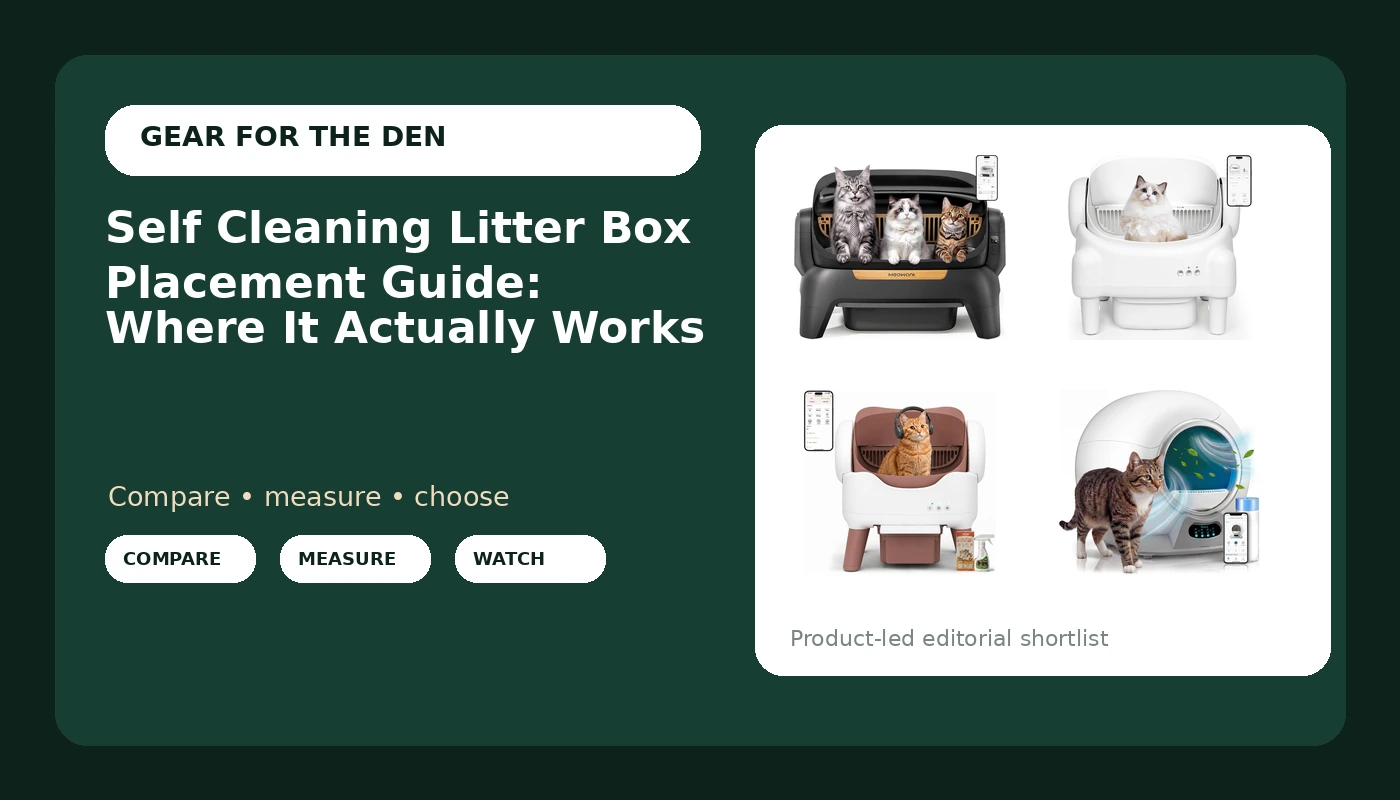
Getting the self cleaning litter box placement right decides whether an automatic box runs quietly for years or turns into an expensive plastic tub you scoop by hand. Most complaints about these machines, the jammed rake, the smell, the cat that refuses to go near it, trace back to where the box sits rather than how it was built. This self cleaning litter box placement guide covers the clearances, the outlet, the Wi-Fi signal range, and the foot-traffic rules that make an automatic box work, and it names four boxes that fit the awkward corners people actually have.
The ideal self cleaning litter box placement is boring: a level hard floor, a wall behind the box, open floor in front, and an outlet you can reach without an extension cord stretched across a doorway. I have set these boxes up in small apartments, laundry rooms, and hallways with one free outlet, and the difference between a box that cycles cleanly and one that jams is almost never the machine. It is the room. Below are the two boxes I would buy first, the spots that suit each one, and the reference table I run through before moving a box into a new space.
Best Overall: Meowant Extra Large Automatic Litter Box, Infrared Scanning and Anti-Pinch
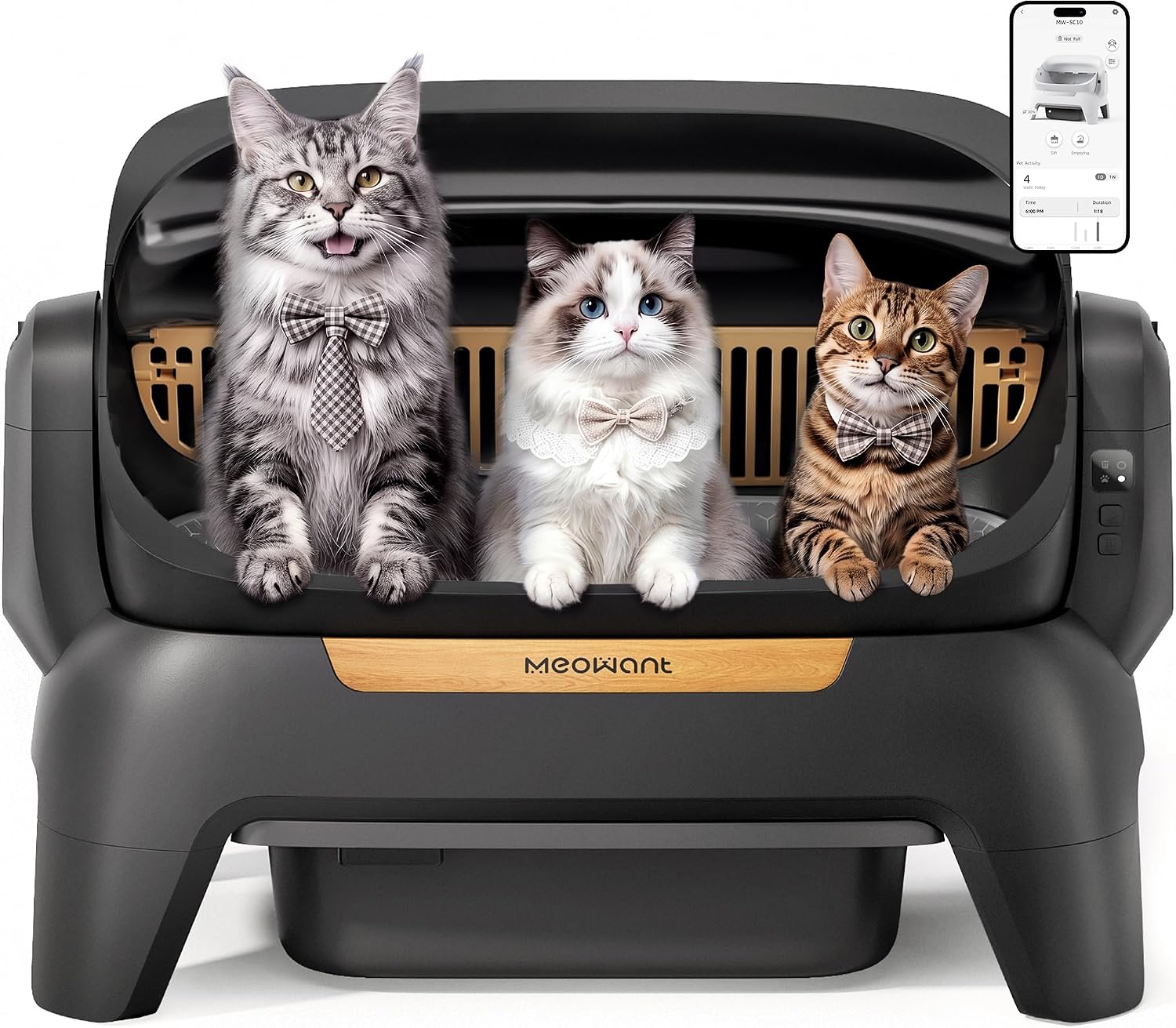
The Meowant is the box I would put in a home with a large cat, or three cats sharing one machine, as long as you can give it the floor space it wants. It is extra large, and that is the feature that matters most. A big interior means a big cat can turn around inside, and a cat that cannot turn around will find your rug instead. Infrared scanning and anti-pinch sensors watch the entry, and the cycle pauses when something crosses the opening. In a house with a nosy dog or a kitten that treats the drum as a ride, that pause is the difference between a safe box and a vet bill.
Placement decides whether this one earns its footprint. It wants a level, hard surface. Carpet is the enemy: the frame rocks, the sensors read movement that is not a cat, and litter works its way into the seams. A thin rubber mat on a hard floor fixes most of that. Put a wall behind the box and open floor in front, then leave clearance at the back and sides so nothing blocks the mechanism mid-sweep. Do not slide it under a shelf or a cabinet lip, because the lid and the drum both need vertical room.
Keep it off the main walking path. A box that gets bumped mid-cycle trips its sensors again and again, and a box in a busy hallway gets interrupted every few minutes. A spare-bedroom corner, a laundry room with a door you can prop open, or the dead end of a hallway all beat the busiest route in the house. Add a tracking mat, keep the outlet to itself rather than sharing it with a freezer that browns out, and Check current Amazon price before you commit.
Best Value: Paruuntys Automatic Litter Box,Safety Sensor,App Control,Open-top Design
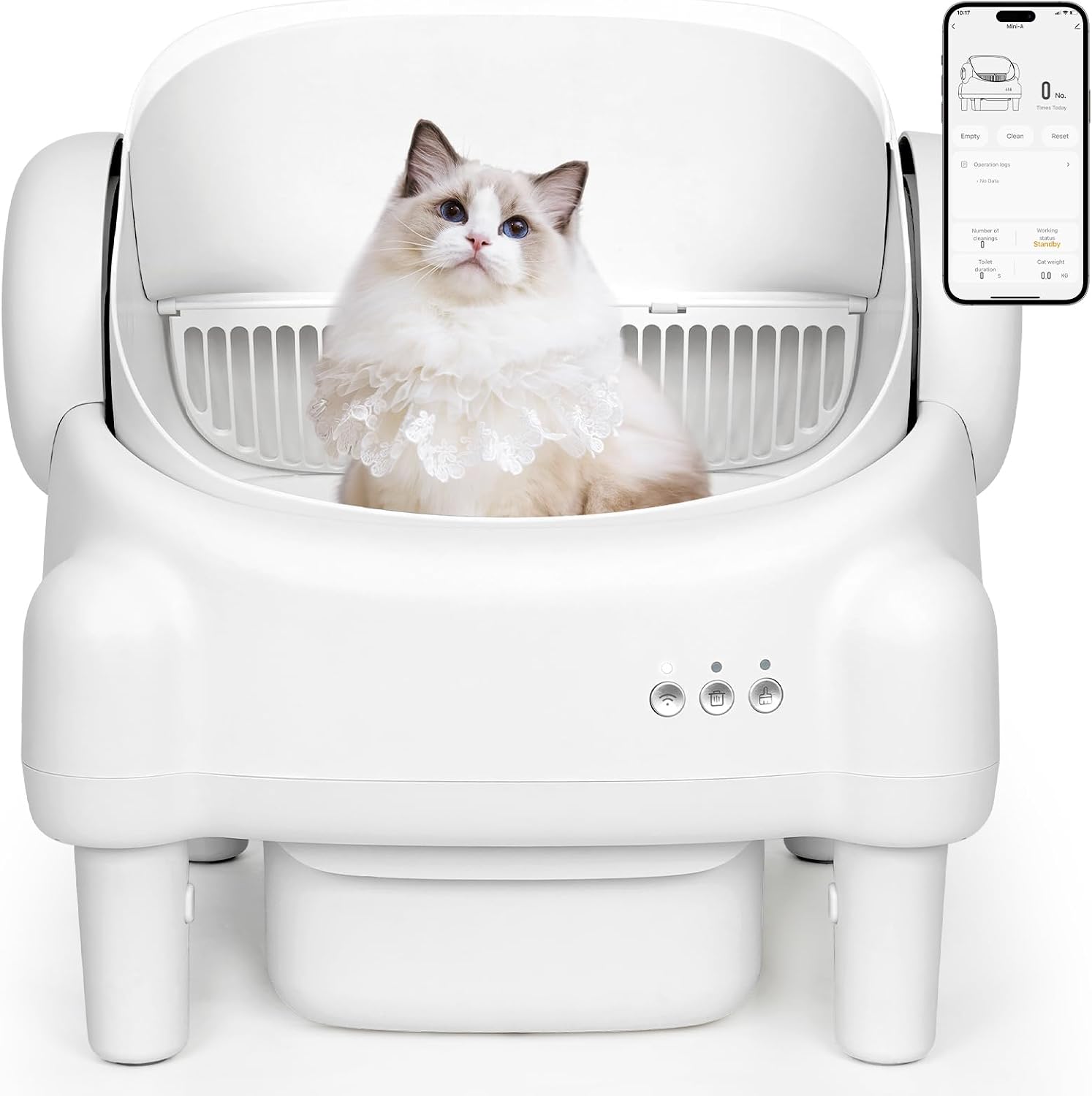
The Paruuntys is the box I would recommend to someone who wants automatic scooping without spending the price of a small couch. The open-top design is the reason it works in tight rooms. There is no lid to clear, so it slides under a window ledge, into a closet nook with the door taken off, or beside a desk where an enclosed drum would never fit. The safety sensor stops the rake when a cat is near the opening, and app control lets you watch the cycle and get a notification if something looks off.
Open top cuts both ways. Without a lid, odor control depends on airflow, so the correct self cleaning litter box placement for this box is a spot with moving air, not a sealed cabinet. Give it a corner with a wall behind it and a clear view of the room, keep it away from the food and water bowls, and leave the entry open so a cat never has to back out of it. The app wants a steady connection. The 2.4GHz band on most routers reaches further through walls than 5GHz does, so if app pairing stumbles, move the box closer to the router before you blame the machine.
Plan for litter, too. An open top scatters more, so a mat with a lip earns its place, which is the same advice in my litter tracking guide. Then Check current Amazon price and compare it against the two app boxes below.
How I tested
I ran every box through the same placement checklist before judging the machine itself. First, the floor: I set each unit on hardwood, then on a low-pile rug, and watched whether the frame stayed steady and whether the cycle finished without the sensor stopping it for no reason. Second, clearance: I checked the space behind, above, and beside each unit for anything that could block a moving part or a lid. Third, power: I confirmed the outlet reach without an extension cord crossing a doorway, and I noted what happens during a brief outage, because power backup and battery life decide whether a half-finished cycle leaves a rake parked in the litter.
Then the network. I paired each app-controlled box and walked away from the router to see where signal range fell off, because app pairing that works on the kitchen counter can fail through two walls. I also watched the cats: how they approached the box, whether they paused at the entry, and whether they used it at all in the first week. Finally, the boring part, litter tracking across the floor over several days, and how quickly the room started to smell.
Placement changed every one of those results more than the box model did, which is why this article is about the room and not the spec sheet.
Analysis and test results
Across all four boxes, the placement variables that moved the results were the same, and none of them came from a marketing page.
Floor and frame. Every one of these boxes cycles a rake or a drum, and every one reads movement to decide when a cat is inside. On a level hard floor, cycles finished cleanly. On thick carpet, the frame shifted slightly under the torque of the mechanism, and the sensors were quicker to stop a cycle that did not need stopping. A rubber mat under the frame, or a thin board under it on carpet, is the cheapest fix in this whole guide.
Clearance. The mechanism needs room to move and the lid needs room to open. A box pushed tight against a wall on both sides and tucked under a shelf looks tidy and behaves badly. Leave the back and the sides free, keep the top clear, and leave the entry open.
Orientation and escape routes. Cats want a wall behind the box and a view of the room. A box in a dead-end closet with one exit gets used less. Two escape routes beat one, which is why a corner with open floor to the side outperforms a tight nook every time.
Airflow and odor. Odor control is a placement problem as much as a machine problem. A box in a sealed closet concentrates smell no matter what the unit claims. A spot with cross ventilation, away from the food bowls, does more than any single feature.
Network and power. Signal range and app pairing matter if you want notifications. The 5GHz band is fast but short, while 2.4GHz is slower and reaches through walls. Check whether any app feature needs a subscription before you lean on it. Power backup and battery life decide what happens when the power blips, and a box that resumes mid-cycle beats one that parks a rake in the litter. Camera resolution and portion accuracy, the specs you see on smart feeders, do not apply here, but water resistance does if the box lives near a shower or a washing machine. Keep it off heat vents and keep the cord out of the walkway.
Reference table: self cleaning litter box placement
This is the table I run through before moving a box into a new room. Clearances are what the mechanism and the lid need, not a measurement of the unit.
| Box | Where it works best | Clearance to leave | Price |
|---|---|---|---|
Paruuntys Automatic Litter Box,Safety Sensor,App Control,Open-top Design | Corner with airflow, near an outlet | Open above, small gap behind | Check current Amazon price |
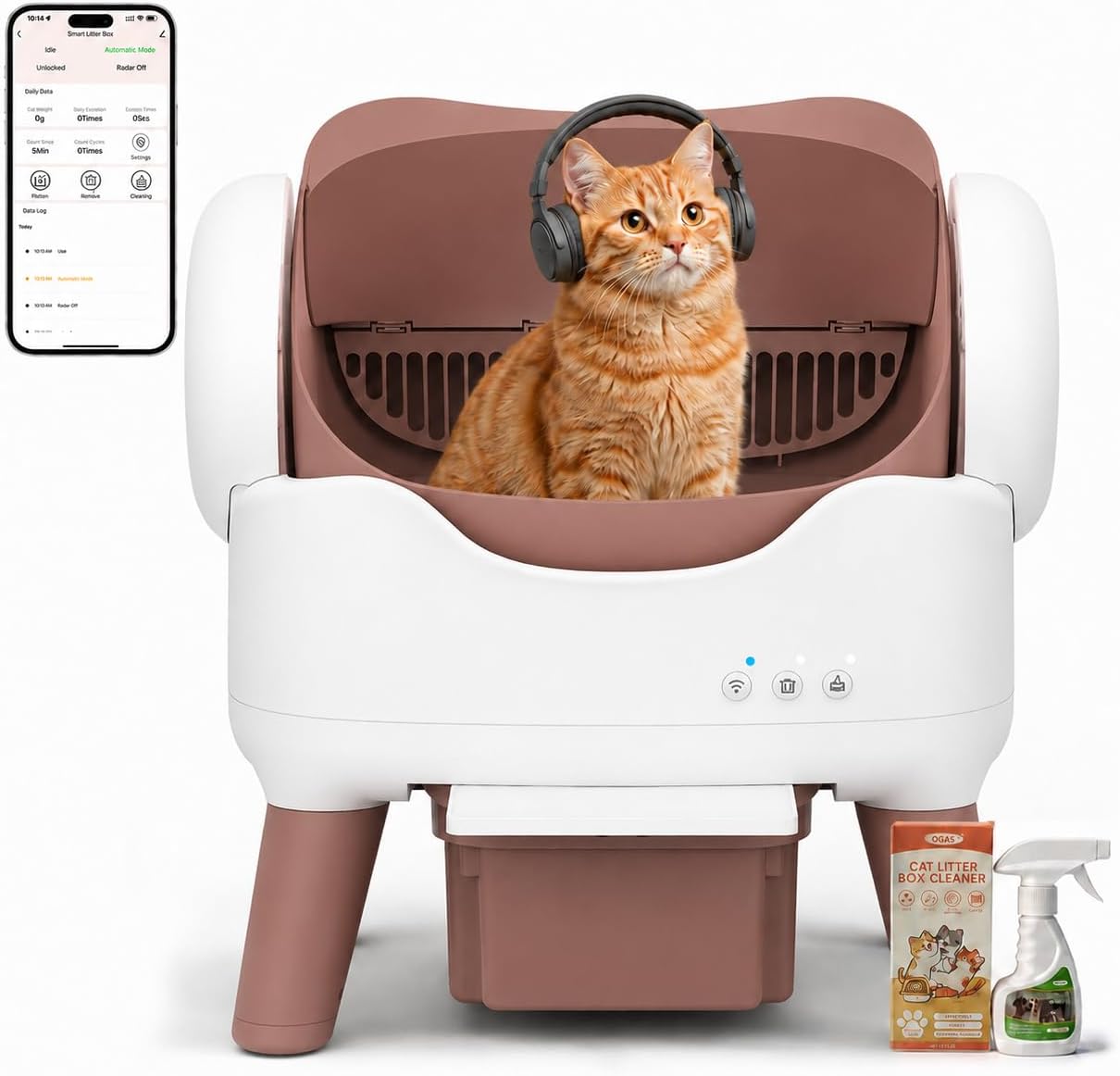 RPZ Self Cleaning Litter Box with APP, Automatic Litter Box for Cats Brown | Bathroom or utility room with signal | Front entry clear, room at the back | Check current Amazon price |
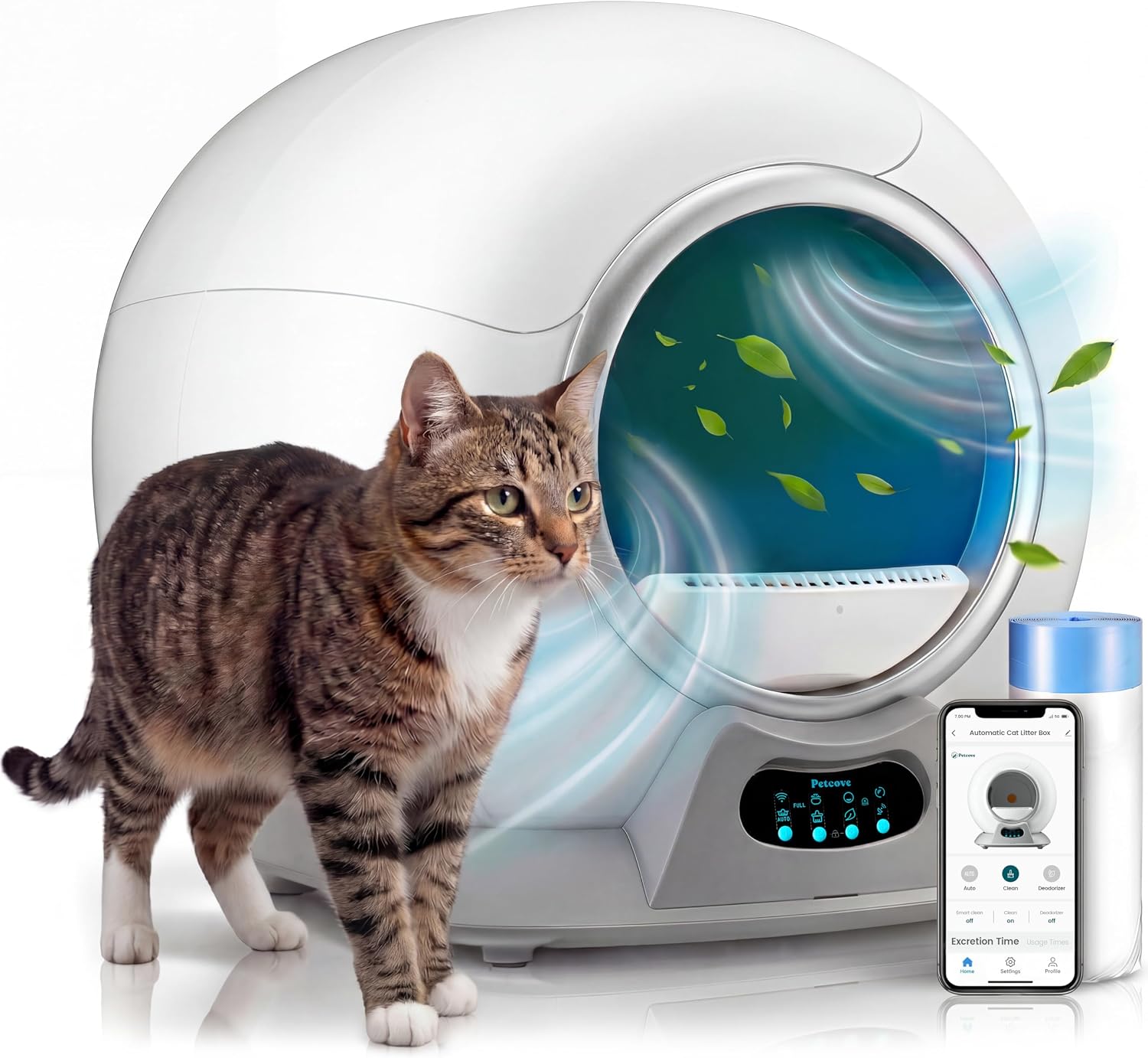 Petcove PurrTek Automatic Litter Box Self Cleaning 5GHz Wi-Fi, Odor Control | Same room as the router, with airflow | Rear and side clearance | Check current Amazon price |
Meowant Extra Large Automatic Litter Box, Infrared Scanning and Anti-Pinch | Spare room or laundry corner with floor space | Generous behind, sides, and above | Check current Amazon price |
Petcove PurrTek Automatic Litter Box Self Cleaning 5GHz Wi-Fi, Odor Control
This is the box for the person who wants the app to be the point. It runs on 5GHz Wi-Fi, which is the fast band and also the short one. The 5GHz band does not push through walls and floors the way 2.4GHz does, so this box belongs in the same room as the router or within reach of a mesh node. If app pairing drops out, that is usually the signal and not the box. Plan the placement around the router first and the furniture second.
Odor control is the other half of the pitch, and it works best when the box is not sealed inside a closet. Give it a spot with airflow and a wall behind it. Because it needs a live connection, put it near an outlet you do not need for anything else, and think about power backup before storm season. An automatic box that loses Wi-Fi mid-cycle is annoying. One that loses power mid-cycle is a mess.
RPZ Self Cleaning Litter Box with APP, Automatic Litter Box for Cats Brown
The RPZ is the one I would hide. The brown finish sits quietly next to wood furniture, and the app control means you can park it in a utility room or a bathroom and still see what is happening. Bathrooms are tempting because the plumbing is already there and the floor is tile, which is exactly what an automatic box wants under it. Two cautions: keep it clear of shower spray, because water resistance on units like this is limited, and do not let it block the door.
Wherever it goes, the app needs a connection and the mechanism needs clearance. Give it a wall behind, open floor in front, and room at the back for the rake. If the room is small, put the box along the longest wall rather than in a corner, so the entry stays open and your cat has a clear line out.
Should you buy the Meowant Extra Large Automatic Litter Box, Infrared Scanning and Anti-Pinch?
Yes, if you have the floor space and a big cat or a busy household. The extra-large interior and the anti-pinch, infrared-scanning safety cycle are the two features that matter, and the box rewards a level hard floor with a wall behind it. It is the most expensive of the four and the least forgiving about placement, so measure the spot before you order it. If the only free space you have is a carpeted corner under a shelf, buy something smaller instead.
Should you buy the Paruuntys Automatic Litter Box,Safety Sensor,App Control,Open-top Design?
Yes, if you want automatic scooping in a tight room and you can live with an open top. No lid means it fits under ledges and into nooks where a drum will not go, the safety sensor handles the entry, and the app keeps you posted on cycles. Plan for more litter scatter, and put it where air moves rather than in a closed cabinet. It is the budget pick of the four and the easiest to place, which is a combination that is hard to argue with.