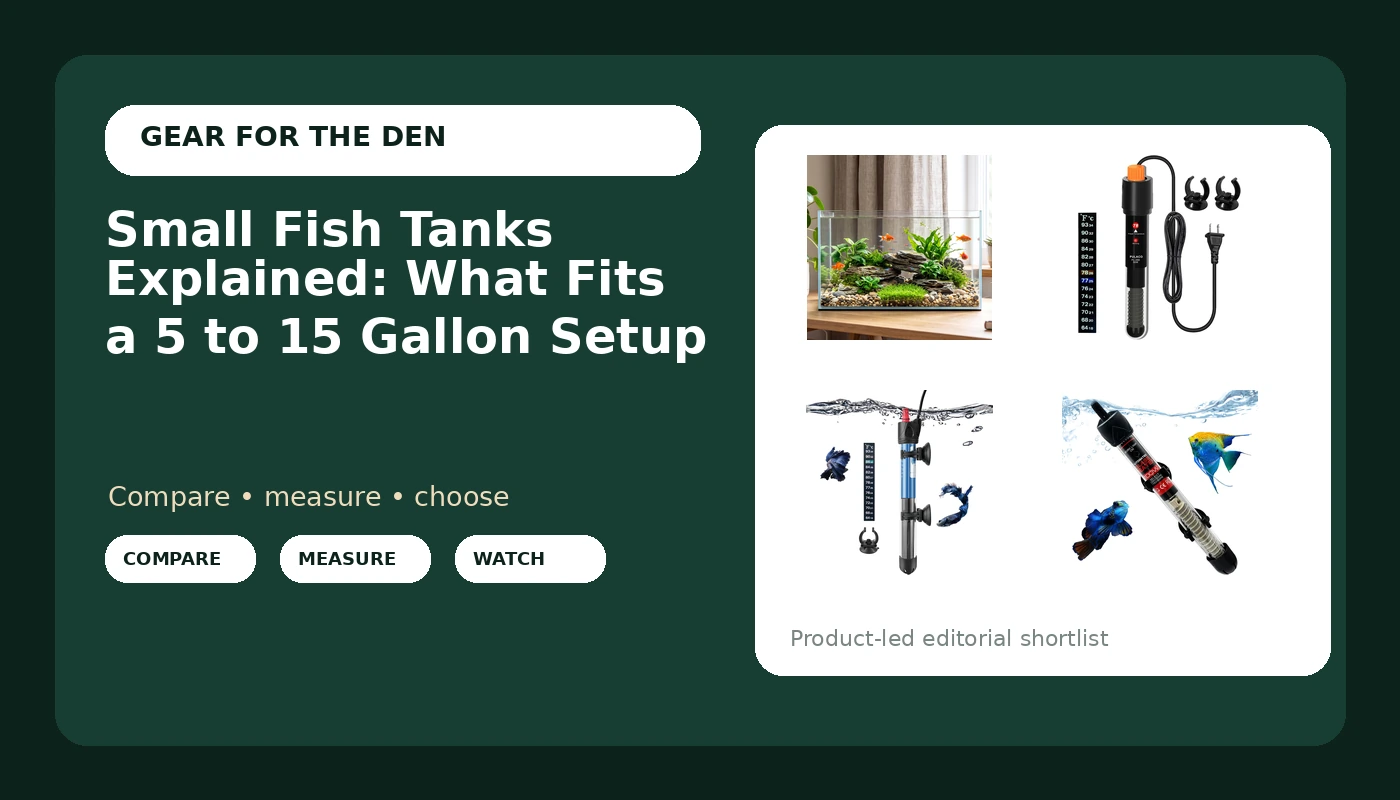
Aquarium advice is usually written for 55-gallon show tanks, which is why so many first-time keepers get lost the moment they start shopping for small fish tanks. The rules shift once tank volume drops below about 20 gallons. A few degrees of room temperature, one missed water change, or a filter that turns the water over too aggressively can move water chemistry quickly, and the less water there is, the less buffer you have. This article keeps small fish tanks explained in plain terms: what the numbers on a heater box actually mean, how cycle time behaves in a small filter, and which parts of a standard equipment list you can honestly postpone at this size.
Quick answer
For a first freshwater setup between 5 and 15 gallons, the core purchase is a tank with enough footprint to hold a filter and a heater without crowding, a 50W adjustable heater, and a separate thermometer so you can confirm the setting instead of trusting a dial. Heater wattage is generally sized at roughly three to five watts per gallon for a tank kept near normal room temperature, which puts a 10-gallon tank squarely in 50W territory. Tank volume drives everything else: the filter you can run, the substrate depth you can build, and how often you change water. Buy the tank, heater, filter, and test kit first, then add light, plants, and decor once the tank has cycled.
Four useful options
| Model | Best fit | What stands out |
|---|---|---|
| Cirrsondy 10 Gallon Ultra Clear Glass Fish Tank, Easy to Maintain Small Rimless Aquarium for Betta/Goldfish/Snails/Shrimp and Aquatic Planting | A first rimless 10-gallon setup | 10-gallon rimless glass with an open top, listed for betta, snails, shrimp, and planting |
| PULACO 50Watt Aquarium Heater for 6-15 Gallon Fish Tank, Adjustable Submersible Heater Thermostat with Thermometer Strip and Suction Cup | Tanks from 6 to 15 gallons | Adjustable thermostat with a thermometer strip and suction cup included |
| Hitop 25W/50W/100W/300W Adjustable Aquarium Heater, Submersible Glass Water Heater for 5-70 Gallon Fish Tank (50W) | Buyers who want a glass heater across a wide gallon range | Adjustable submersible glass heater sold in four wattages; this listing is the 50W |
| Fish Tank Aquarium Heater – Adjustable Temperature Submersible Thermostat Heater,25W/50W/100W/150W/200W/300W | Buyers who want the widest wattage choice in one listing | Six wattage options from 25W to 300W |
The tank: Cirrsondy 10 Gallon Ultra Clear Glass Fish Tank, Easy to Maintain Small Rimless Aquarium for Betta/Goldfish/Snails/Shrimp and Aquatic Planting
A rimless tank is the part of the hobby where the trade-off is visible before you buy. There is no hood fit included, so evaporation is faster than on a covered tank and the water line will show on the glass between top-offs. If you have cats, a curious toddler, or a room with dry winter air, price a lid that matches the exact rim dimensions before the tank arrives. The upside is footprint and light: a 10-gallon rimless tank takes up about the same counter length as a large microwave, and an open top makes it far easier to plant, siphon, and net without removing a cover every time.
One note on the species list: the listing mentions goldfish, but goldfish grow large and produce a heavy waste load, and most of them are not a good long-term match for a 10-gallon tank volume. Treat the mention as a starting point and check adult size for anything you plan to keep.
The heater with a thermometer: PULACO 50Watt Aquarium Heater for 6-15 Gallon Fish Tank, Adjustable Submersible Heater Thermostat with Thermometer Strip and Suction Cup
Heater wattage is the number that causes the most confusion, and the included thermometer strip is the reason this listing is worth a look for a 10-gallon build. Adjustable heater dials are approximate, so the honest workflow is to set the dial, wait a day, and read a separate thermometer rather than assuming the dial matches the water. Mount the heater low and near a spot with water movement so heat spreads instead of pooling, and leave it fully submerged to the marked line.
The wider-range glass heater: Hitop 25W/50W/100W/300W Adjustable Aquarium Heater, Submersible Glass Water Heater for 5-70 Gallon Fish Tank (50W)
The appeal here is continuity. If you start with a 5-gallon and later move to a 20-gallon long, the same heater family covers both ends of that jump, which keeps your settings and mounting habits familiar. Glass bodies are also easy to wipe clean during a water change, which matters in small tanks where a film of algae or mineral scale on a heater is more noticeable. As with any glass heater, unplug it before you lift it out of the water and let it cool, since a hot glass tube that hits air can crack.
The wattage-choice heater: Fish Tank Aquarium Heater – Adjustable Temperature Submersible Thermostat Heater,25W/50W/100W/150W/200W/300W
Because this listing spans so many wattages, the risk is ordering the wrong one rather than finding the right one. Do the arithmetic first: three to five watts per gallon for a tank in a normally heated room, then round toward the higher end if the room runs cold or the tank sits near a window. Unlike the PULACO listing, this one does not name a thermometer in its title, so plan on buying a separate thermometer to verify the setting.
Prices and availability may change. Product images, names, and retailer links are matched to verified listings. No current price, rating, stock status, or measured result is stated here without current evidence.
Tank volume, stand load, and hood fit
Tank volume is the number that decides almost everything downstream. It sets your stocking ceiling, your water change volume, and your heater wattage. It also sets how forgiving the tank is: a 10-gallon tank holds roughly twice the water of a 5-gallon, which means a small mistake is diluted twice as much. If you are choosing between two sizes and both fit your space, the larger one is usually the easier tank to keep stable.
Stand load is the part beginners underestimate. Water weighs a little over eight pounds per gallon, before you add glass, substrate, and rock, so a filled 10-gallon setup can land near or above 100 pounds. A dresser, a shelf, or a thin tabletop may not be rated for that, and a rimless tank needs a surface that is flat and level so the base is fully supported rather than resting on one corner.
Hood fit matters more on small tanks than on large ones because the surface area to volume ratio is higher, so evaporation moves the water line faster. Rimless tanks are sold without a hood, which means either accepting top-offs every few days or buying a lid cut to your exact rim dimensions. Measure the outside rim, not the glass panels, before you order anything.
What small fish tanks demand from a beginner
Your equipment list can stay short. Tank, heater, filter, thermometer, test kit, and a siphon are the working core. Filter media is worth thinking about at this size: a cartridge that gets thrown away monthly is convenient, while sponge or ceramic media that you rinse in tank water lasts far longer and keeps the bacteria you spent weeks growing. Heater wattage is the one number you should get right before checkout.
Cycle time is the other thing small fish tanks do differently. Because there is less water and less surface area for bacteria to colonize, a small filter carries a smaller bacterial population, and that population is easier to disturb. Feed lightly at first, avoid deep filter cleanings, and test rather than guess.
A practical order of operations:
- Choose the spot first, then confirm the surface is level and rated for the loaded weight of the filled tank.
- Set the tank in place, add substrate to your planned depth, and fill with dechlorinated water.
- Install the filter and heater, set the heater dial, and confirm the reading with a separate thermometer.
- Run the tank through its full cycle, testing until ammonia and nitrite read zero before adding livestock.
- Stock slowly, and add fish in small groups rather than all at once.
Practical guidance for a first small tank
- Keep substrate depth modest, roughly one to two inches, so waste does not collect in a deep bed you cannot reach with a siphon.
- Confirm hood fit and lid dimensions against the actual rim measurement before ordering, especially on a rimless tank.
- Check stand load with the filled weight in mind, not the empty tank weight.
- Set heater wattage from tank volume, then verify with a thermometer rather than trusting the dial.
- Change a smaller volume of water more often instead of one large change, which is gentler on a small bacterial colony.
- Rinse filter media in removed tank water, never under the tap, so you keep the bacteria that run your cycle.
Which option should you choose?
Choose the Cirrsondy 10 Gallon Ultra Clear Glass Fish Tank, Easy to Maintain Small Rimless Aquarium for Betta/Goldfish/Snails/Shrimp and Aquatic Planting when you want a rimless 10-gallon display and are ready to plan a lid separately. Choose the PULACO 50Watt Aquarium Heater for 6-15 Gallon Fish Tank, Adjustable Submersible Heater Thermostat with Thermometer Strip and Suction Cup when your tank falls between 6 and 15 gallons and you want the thermometer included from day one. Choose the Hitop 25W/50W/100W/300W Adjustable Aquarium Heater, Submersible Glass Water Heater for 5-70 Gallon Fish Tank (50W) when you expect to move up in tank size and would rather stay inside one heater line. Choose the Fish Tank Aquarium Heater – Adjustable Temperature Submersible Thermostat Heater,25W/50W/100W/150W/200W/300W when you already know your gallon rating and want the widest wattage spread to match it.
There is no single set of ideal small fish tanks, and no universal answer to what makes correct small fish tanks, because volume, room temperature, and livestock all pull the decision in different directions. The wattage ranges, gallon ratings, and species lists above come from the manufacturer listings, not from testing on this site, so treat them as the starting point for your own measurements.
The bottom line
Start with tank volume and let it set everything else. A 10-gallon rimless glass tank with a 50W adjustable heater, a filter suited to the water volume, and a separate thermometer covers the needs of most first freshwater setups in this size range. Confirm your stand can carry the loaded weight, decide how you will handle evaporation and hood fit before the tank arrives, and spend the first few weeks on cycle time instead of stocking. Do that and a small tank is not harder than a large one, just less forgiving of shortcuts.