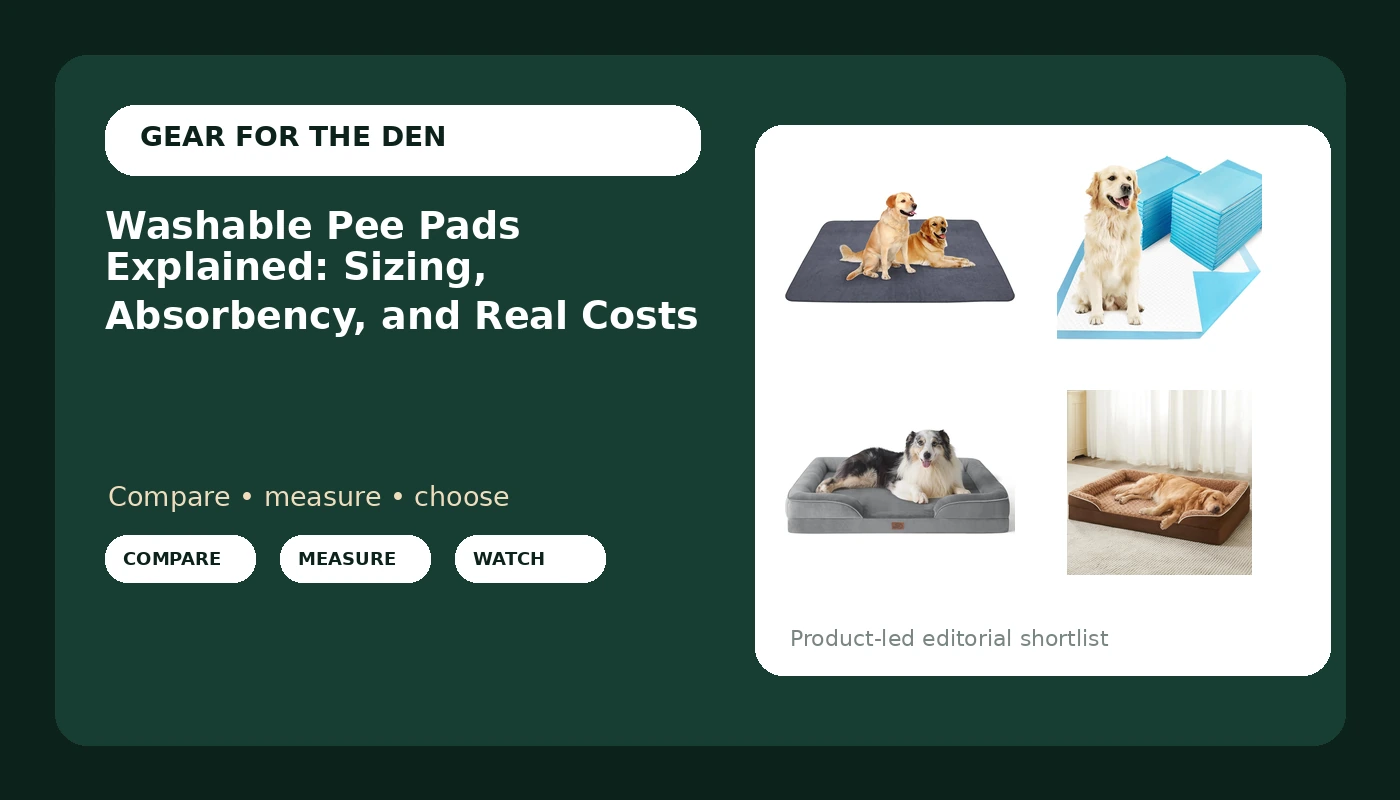
If you have been searching for washable pee pads explained in plain language, what you actually want is a straight answer: will a reusable pad survive a puppy, a senior dog with leaks, or a whelping box, and which one fits your floor? Washable pee pads are fabric pads with an absorbent top layer and a waterproof backing that get laundered and reused instead of thrown away. Four things decide whether a pad works in your home: pad size, pad absorbency, liner waterproofing, and how the pad behaves in a washing machine. Get those right and the rest is mostly about where the pad lives and who is standing on it.
Quick answer
Reusable pads make the most sense when the pee happens in a predictable place: a whelping box, a crate, a playpen, or the floor beside an older dog's bed. Disposable pads make sense when you need to throw the mess away, including travel, vet visits, and the first weeks with a puppy who is still being carried between spots. Neither replaces a supportive bed. The pad deals with liquid; the bed deals with pressure and sleep quality. Most homes that get this right run both.
Four useful options
| Model | Best fit | What stands out |
|---|---|---|
| Peepeego Non-Slip Dog Pad 72"x72", Washable Pee Pad Waterproof for Training, Whelping | Whelping boxes, pens, and open floor areas | A 72 by 72 inch square footprint with a non-slip backing |
| Dogcator Dog Pee Pads Extra Large 30"x36", 30 Count Super Absorbent Pee Pads for Dogs, Disposable Urine Bed Pads for Doggie, Thicken XXL Puppy Pads, Piddle Pads X-Large for Indoor, Outdoor Use | Travel, crates, and messes you want to bin | 30 disposable pads at 30 by 36 inches each |
| Bedsure Orthopedic XL Dog Bed Extra Large Washable Original Design | Large dogs that need a washable sleeping surface | An orthopedic XL bed with a washable design |
| WNPETHOME Orthopedic Washable XL Dog Bed for Senior Dog Cozy Sleep | Senior dogs that need joint support | An orthopedic XL bed built around senior comfort |
Full-floor coverage: Peepeego Non-Slip Dog Pad 72"x72", Washable Pee Pad Waterproof for Training, Whelping
One large pad concentrates the laundry rather than spreading it. A 72 inch square pad is a bulky item in a home washer, so plan on one pad in the drum at a time and a second pad on standby. The trade-off is coverage against handling: you get more protected floor per pad, but each wash cycle costs you more drum space and more drying time. If your dog only ever eliminates inside a crate, a large floor pad is more fabric than you need, and a crate sized pad or a disposable pad will be easier to manage day to day. If you are whelping or penning a litter, the larger footprint is the whole point. This is also the pad shape to think about if you are working through dog-proofing a rental floor and want one layer that can be pulled up and washed.
Throwaway coverage: Dogcator Dog Pee Pads Extra Large 30"x36", 30 Count Super Absorbent Pee Pads for Dogs, Disposable Urine Bed Pads for Doggie, Thicken XXL Puppy Pads, Piddle Pads X-Large for Indoor, Outdoor Use
The honest argument for disposables is convenience, and the honest argument against them is volume. Every pad you use is a pad you buy again and a pad that goes to landfill, so the cost per use matters more than the shelf price over a year. In practice, many owners keep both: a reusable pad as the base layer in a pen or beside a bed, and disposables for travel, vet visits, and the first messy weeks with a puppy who is not yet predictable. That combination keeps laundry manageable without leaving you without a backup at 2 a.m. If your dog is a small breed, the sizing logic changes, and a small breed pad size list is worth a separate look.
Washable sleeping surface: Bedsure Orthopedic XL Dog Bed Extra Large Washable Original Design
Think about where your dog actually leaks. A dog that soaks a bed overnight needs a washable bed before it needs a bigger pad, because the pad under the bed is doing nothing for the foam. Check how the cover comes off and how the inner bed dries before you commit, since a bed that takes two days to dry in a humid room is a bed your dog cannot use. If you pair a bed with a reusable pad, put the pad between the dog and the bed only if the dog tolerates it. Many dogs push a pad aside, and in that case the bed's washable design is the part that saves you.
Senior dog comfort: WNPETHOME Orthopedic Washable XL Dog Bed for Senior Dog Cozy Sleep
The senior dog case is a little different. Leaks often arrive alongside stiffness, so the dog may not want to stand up and step off a pad, and may not want to walk to the door at 3 a.m. Placing a reusable pad in front of the bed, rather than under the dog, keeps the sleeping surface dry without asking an arthritic dog to relocate. If the dog does soak the bed, a washable design is the difference between one load of laundry and buying a new bed. Keep a spare pad and a spare cover in rotation so one is always dry.
Prices and availability may change. Product images, names, and retailer links are matched to verified listings. No current price, rating, stock status, or measured result is stated here without current evidence.
What an ideal washable pee pads setup actually needs
A reusable pad is a three layer sandwich. The top layer touches the dog, the middle layer holds the liquid, and the back layer is the liner that keeps it off the floor. When a pad fails, it usually fails at one of those three layers, not because the idea is wrong.
Top layer and wicking. The surface needs to pull liquid away from the coat quickly. A pad that puddles on top leaves the dog wet, and a wet dog leaves a trail across the room. This is where absorbency claims get tested in real use, and thick is not automatically better. A dense pad that releases liquid slowly can be harder to launder than a thinner pad that wicks fast.
Core and pad absorbency. The core is where the volume goes. Absorbency is often quoted in cups or milliliters, but the number that matters to you is how much your dog produces between washes. A puppy in a pen can produce several times what a senior dog with a small leak produces. Match the core to the dog, not to the largest figure printed on a listing.
Liner waterproofing. A pad with a weak backer lets moisture through to the floor or carpet. Look for a backing described as waterproof, and consider whether it is a coating that might crack after repeated hot washes. This layer decides whether the pad is genuinely carpet safe in your home, and it is the first thing to inspect on an older pad.
Odor and enzymes. Urine odor comes from uric acid crystals that stay in fabric after the water evaporates. An odor neutralizer in the wash helps, but the more reliable approach is an enzyme based cleaner used at the dilution the label calls for. Enzyme concentration matters: a diluted enzyme cleaner leaves crystals behind, and the smell returns in a humid room even though the pad looked clean. Never mix enzyme cleaners with bleach, since bleach destroys the enzymes.
Laundry reality. A pad is only reusable if it survives the wash. Hot water and high heat drying shorten the life of the waterproof backing, so most pads do better on a warm wash with a low or air dry. Skip fabric softener and dryer sheets, since both coat fibers and reduce absorbency. Look for pads described as machine washable and check the care instructions before you buy, and keep an oxygen based booster on hand because it is generally fabric safe where chlorine bleach is not.
Size and placement. Pad size should match the zone, not the dog. A pad smaller than the dog's standing footprint gets missed at the edges. A pad much larger than the zone wastes drum space. Measure the crate, the pen, or the floor area first.
How to build the correct washable pee pads routine
The correct washable pee pads setup is less about the pad and more about the rotation around it. Work through these steps in order.
- Measure the zone: crate, pen, whelping box, or the floor beside the bed. Write down length and width.
- Decide reusable or disposable for each zone. Fixed spots get reusable pads; travel and unpredictable spots get disposables.
- Buy at least two pads in the size you chose, so one can be in the wash while the other is in use.
- Set a wash schedule that keeps pace with your dog. Twice a week is common for a puppy; once a week suits a small senior leak.
- Inspect the floor and the bed after each cycle. A pad that has started letting moisture through at the corners needs replacing, not another wash.
Practical rules for living with reusable pads
- Rinse a soiled pad in cool water before it goes in the drum if you cannot wash it the same day. Dried urine sets into fabric and is harder to remove.
- Wash warm and dry low or air dry. High heat is the fastest way to ruin liner waterproofing.
- Never use fabric softener or dryer sheets on a pad or on a washable bed cover.
- Keep an enzyme cleaner on hand and follow the dilution on the bottle. Enzyme concentration is the variable people get wrong most often.
- Rotate pads and check the backing every few weeks, especially on a pad that sits on carpet.
Which option should you choose?
Choose the Peepeego Non-Slip Dog Pad 72"x72", Washable Pee Pad Waterproof for Training, Whelping when you need to cover a whelping box, a pen, or a large floor area with a pad that stays put. Choose the Dogcator Dog Pee Pads Extra Large 30"x36", 30 Count Super Absorbent Pee Pads for Dogs, Disposable Urine Bed Pads for Doggie, Thicken XXL Puppy Pads, Piddle Pads X-Large for Indoor, Outdoor Use when the mess is going in the bin, including travel, crates, and the messy first weeks of puppy raising. Choose the Bedsure Orthopedic XL Dog Bed Extra Large Washable Original Design when the accident is landing on the dog's sleeping surface and you need a large bed that can be washed. Choose the WNPETHOME Orthopedic Washable XL Dog Bed for Senior Dog Cozy Sleep when you have an older dog who needs joint support and a washable surface close to the floor.
None of this tells you which pad lasts longest, because longevity depends on your machine, your water, your detergent, and how often you wash. Treat absorbency claims as starting points rather than measurements, and read current reviews for the specific listing. If your dog is urinating more often than usual, talk to your vet before you spend money on gear.
The bottom line
The short version of washable pee pads explained: a reusable pad is a laundry habit, not a one time purchase. Absorbency and waterproofing decide whether a pad works, pad size decides whether it covers the zone, and your wash routine decides how long it lasts. Buy two pads so one is always dry, keep disposables for travel and vet visits, and put a washable orthopedic bed under the dog that needs support. Match the gear to the dog in front of you and the whole system gets quieter.