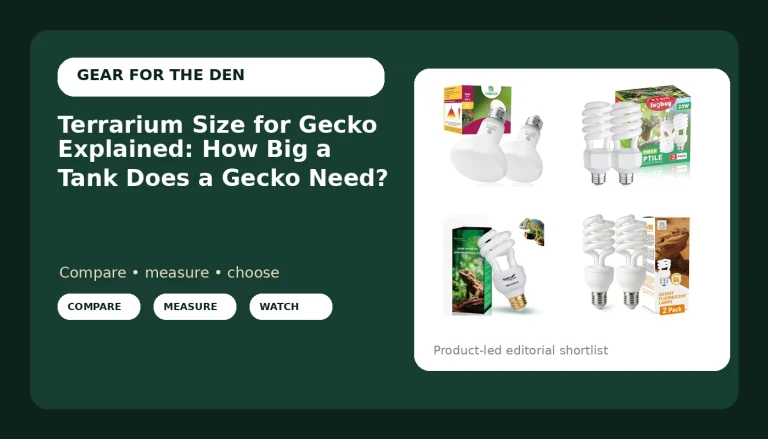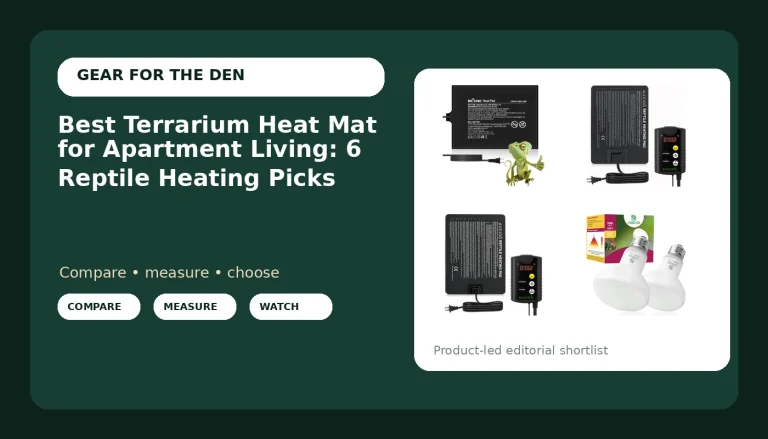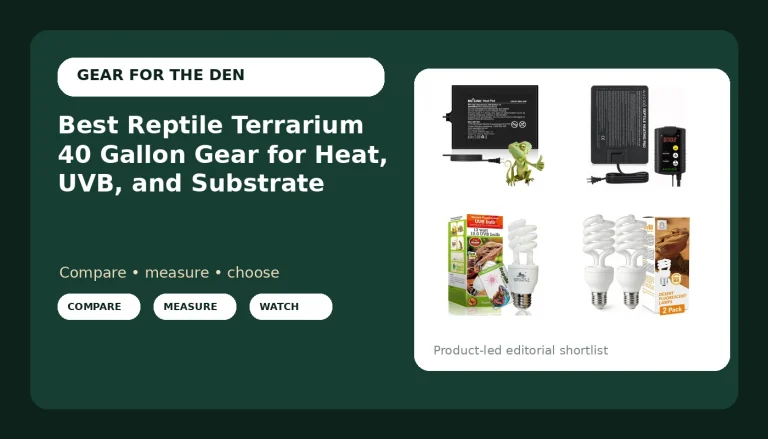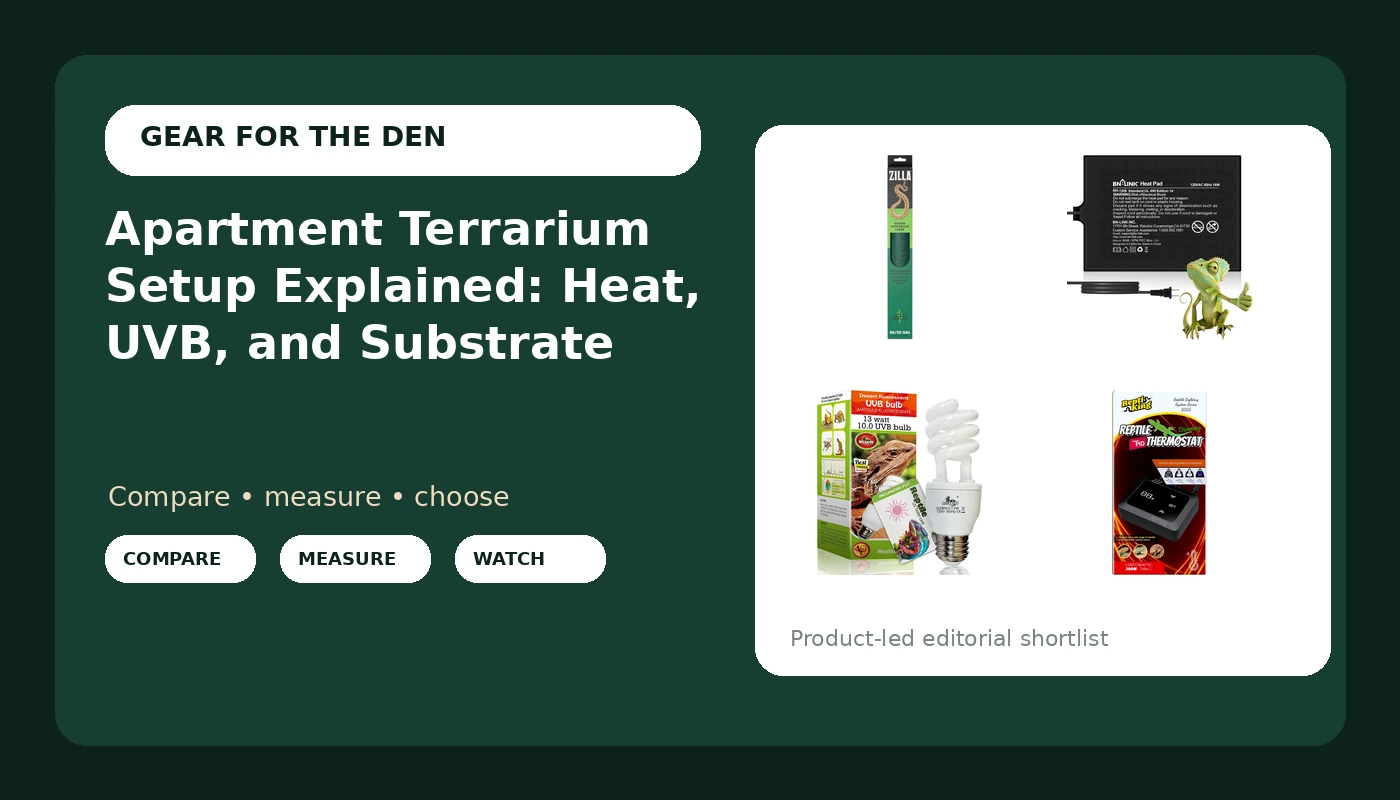
An apartment terrarium setup is a space problem before it is a reptile problem. You are fitting a glass box, a heat source, a light, and the cords that run them into a room you also live in, and you are doing it under a lease that may not allow drilling, wall mounting, or a heavy tank on a particleboard shelf. The apartment terrarium setup explained below works from the equipment outward: a base layer that does not need scooping, an under-tank heat mat, a compact UVB bulb, and a thermostat that holds the whole thing steady. None of it needs a dedicated room or a permanent installation, and every piece can move with you when the lease ends.
Quick answer
Four pieces cover the working parts of a small enclosure: a floor liner for the base, an under-tank heat mat for belly warmth, a compact UVB bulb for light, and a dimming thermostat to hold the basking spot steady. Tank size decides which of these fit, and the animal decides the numbers. Set the enclosure up, run it empty for a day, and measure the basking temperature, the cool end, and the humidity range before anything living goes in. Skipping the thermostat is a common way a small setup goes wrong, because an uncontrolled heat source keeps warming until something in the chain gives out.
4 useful options
| Model | Best fit | What stands out |
|---|---|---|
| Zilla Reptile Terrarium Bedding Substrate Floor Liner, Green, 40BR/50G | Renters who want a wipeable base and no loose bedding | Cut for 40 breeder and 50 gallon footprints; green liner sits flat |
| BN-LINK Reptile Heat Pad 8"X12" 16W | A warm hide or belly-heat spot in a 30 to 40 gallon tank | 8 by 12 inch footprint at 16W, waterproof, under-tank use |
| MCLANZOO UVA UVB Light Reptile Bulb 10.0 13W | Desert species that need a compact UVB source | 10.0 UVB designation, 13W compact fluorescent, tester card included |
| ReptiKing Reptile Dimming Thermostat | Holding a basking spot steady with a bulb or ceramic emitter | Dimming PID control instead of simple on/off switching |
Base layer: Zilla Reptile Terrarium Bedding Substrate Floor Liner, Green, 40BR/50G
A liner is a trade-off rather than a free upgrade. Burrowing species that dig need substrate depth, and a flat liner gives them none, which is why loose bedding still belongs in the plan for sand dwellers and soil diggers. Where the liner earns its place is in a rental: nothing spills over the rim during a move, nothing tracks through a hallway, and there is no half-used bag of bedding in the closet. Pair it with hides that sit flush against the floor so the animal still has somewhere enclosed to retreat to, and plan on wiping the surface at the same time you clean the water bowl.
Under-tank heat: BN-LINK Reptile Heat Pad 8"X12" 16W for 30-40gal Under Tank Terrarium Heating Mat Waterproof for Turtle, Lizard, Frogs, Snake, Hermit Crab
Under-tank heat does a different job than a basking bulb. A mat warms the surface above it, so it is useful for a warm hide or a digestion spot, and less useful for raising the air temperature of a tall tank. Heat mat wattage matters more than mat size: 16W is a modest draw, and in a warm apartment it may be all the supplemental heat you need, while in a cold room it may not be enough on its own. Whatever the room does, the mat should run through a controller rather than straight into a wall socket, and it should never be sandwiched between the glass and a solid shelf that traps the heat.
UVB lighting: MCLANZOO UVA UVB Light Reptile Bulb 10.0 13W Desert Compact Fluorescent Terrarium Lamp for Bearded Dragon, Turtle, Snake, Gecko, Lizard With UV Tester Card
UVB output is the part of a terrarium that renters most often underestimate, because a bulb that looks bright is not the same as a bulb that produces useful UVB. The 10.0 figure describes a desert-strength spectrum, which suits basking desert species and is stronger than what a forest gecko living under leaves would want. Compact fluorescents have a smaller effective footprint than long tubes, so the useful zone is narrower and placement matters more: the lamp needs to sit over the basking area, not at the far end of the tank. UVB output also falls off over months of use while the lamp still glows, which is why the included tester card is worth keeping instead of throwing away with the packaging. For a wider look at how heat and light work together, see reptile heat and lighting basics.
Temperature control: ReptiKing Reptile Dimming Thermostat, Heat Lamp Temperature Controller, Reptile Terrarium PID Digital Thermostat, Heating Controller for Basking Spot Heat Bulbs and Ceramic Heat Emitter
A thermostat is what turns a heat source into a controlled system, and the difference between dimming and on-off control shows up at the basking temperature. An on-off controller lets the surface swing between too warm and too cool as the bulb cycles, while a dimming controller reduces power and holds closer to the setpoint, which is the reason PID control is used for basking spots. The catch is that this kind of controller is designed for a resistive heat load, so it pairs with bulbs and ceramic emitters rather than with a heat mat, which is usually run on a simpler probe thermostat. Set the thermostat range from the basking temperature your species needs, not from what feels warm to your hand.
Prices and availability may change. Product images, names, and retailer links are matched to verified listings. No current price, rating, stock status, or measured result is stated here without current evidence.
What an apartment terrarium setup has to solve
There is no single ideal apartment terrarium setup, because three constraints pull against each other. The first is floor space: a 40 gallon breeder is a common first enclosure, but it is roughly three feet long, and in a studio that is a piece of furniture rather than a corner decoration. The second is where the power goes. An enclosure needs an outlet within reach of the heat mat cord, the lamp cord, and the thermostat probe, and an extension cord running across a doorway is how cords get kicked loose at night. The third is the room itself. Apartments hold heat differently than basements, they dry out in winter, and a small room with the door closed runs warmer and more humid than the rest of the flat.
Tank size drives everything downstream. A larger tank is easier to keep a gradient in, because there is more distance between the basking spot and the cool end, but it is also heavier, harder to move, and more expensive to light. A smaller tank is easy to place but swings faster when the room changes. Decide the tank size first, then choose a heat source that can actually move the temperature of that volume, and check the lease before committing to anything that needs mounting.
Matching heat, light, and control to the animal
The numbers in a terrarium are set by species, not by preference. Basking temperature is the first one: a bearded dragon wants a hot spot well above room temperature, while a crested gecko wants nothing close to that. UVB output follows the same logic, which is why a 10.0 desert lamp suits a basking desert species and is too strong for a forest gecko that spends its day under leaves. Read the species profile first, then buy equipment that can reach those numbers without running at its limit.
The rest of the setup is about giving the animal a choice. Hide size should let the animal turn around inside, and you want at least one hide on the warm side and one on the cool side. Substrate depth matters if the species digs and is mostly irrelevant if it does not, which is the whole argument for a liner in a rental. Humidity range is the hardest thing to hold in a small apartment room, because a closed room with a heat lamp running dries out faster than a larger space. Heat mat wattage should be matched to the tank footprint, and every heat source should sit on a controller so the thermostat range you set is the range you get.
- Pick the species, then look up its basking temperature, UVB output requirement, and humidity range.
- Choose tank size from the adult animal, not the juvenile you are buying today.
- Decide how heat will be delivered: an under-tank mat, a basking bulb, or both.
- Add a thermostat or dimmer so the heat source has a setpoint instead of a wall socket.
- Run the empty enclosure for a day and measure the basking spot, the cool end, and the humidity before the animal arrives.
Practical setup notes for small rooms
- Put the enclosure against an interior wall, away from a radiator, a heater vent, and direct afternoon sun, all three of which push temperatures around.
- Leave an air gap under the tank when you use an under-tank mat, and never trap the mat between the glass and a solid shelf.
- Keep the thermostat probe at the basking surface rather than taped to the glass, or you are measuring the room instead of the hot spot.
- Plan on a switched power strip so you can cut heat and light in one motion during a move or a power event.
- Replace UVB on a schedule rather than when the bulb stops glowing, since UVB output fades while the lamp still looks bright.
Which option should you choose?
Choose the Zilla Reptile Terrarium Bedding Substrate Floor Liner when you want a base you can wipe down in a rental and your animal does not need to dig. Choose the BN-LINK Reptile Heat Pad when your enclosure is in the 30 to 40 gallon range and you need a warm surface under a hide rather than more air heat. Choose the MCLANZOO UVA UVB Light Reptile Bulb when you keep a desert species and need a compact UVB source that fits a single fixture. Choose the ReptiKing Reptile Dimming Thermostat when your heat comes from a basking bulb or a ceramic emitter and you want the basking temperature held close rather than switched on and off.
None of these four pieces is a complete habitat on its own. A correct apartment terrarium setup also needs hides sized to the animal, a water dish, a gradient from the basking spot to the cool end, and a species-appropriate humidity range. Care sheets and a thermometer you trust should set your numbers; this equipment list only decides how well you can hold them.
The bottom line
An apartment terrarium setup is mostly a question of control. A floor liner removes the substrate variable, an under-tank mat gives you a warm surface in a 30 to 40 gallon enclosure, a compact 10.0 UVB lamp gives a desert species its light from a single fixture, and a dimming thermostat turns a bulb or ceramic emitter into a heat source with a setpoint. Buy the controller with the heat source rather than after it, measure the enclosure empty before you add an animal, and let the species profile set the basking temperature, the humidity range, and the hide size. The room you rent can change the equipment you choose, but it does not change what the animal needs.