Automatic cat feeders solve one narrow problem: getting dry food into a bowl at set times when you are at work, asleep, or away for a night. They are not a substitute for noticing whether your cat actually eats, and they are not interchangeable. Some run on a timer alone, some add app control, and some carry a battery backup so a short power cut does not become a missed meal. What follows is automatic cat feeders explained in practical terms: how the mechanisms differ, which numbers on a listing actually change your day, and how to match a unit to your cat's portion size and your own routine.
Quick answer
An automatic feeder earns its place when your cat eats dry food, your schedule is irregular, and you can measure one portion once and trust a machine to repeat it. The features that separate models are the power design (corded, battery, or rechargeable), how many meals you can program, hopper capacity, and how easily the bowl and chute come apart for cleaning. App control and a second hopper are conveniences rather than necessities. The practical test is simpler than the feature list: does the feeder hold the portion size you already feed, keep kibble dry between meals, and keep running when the power does not?
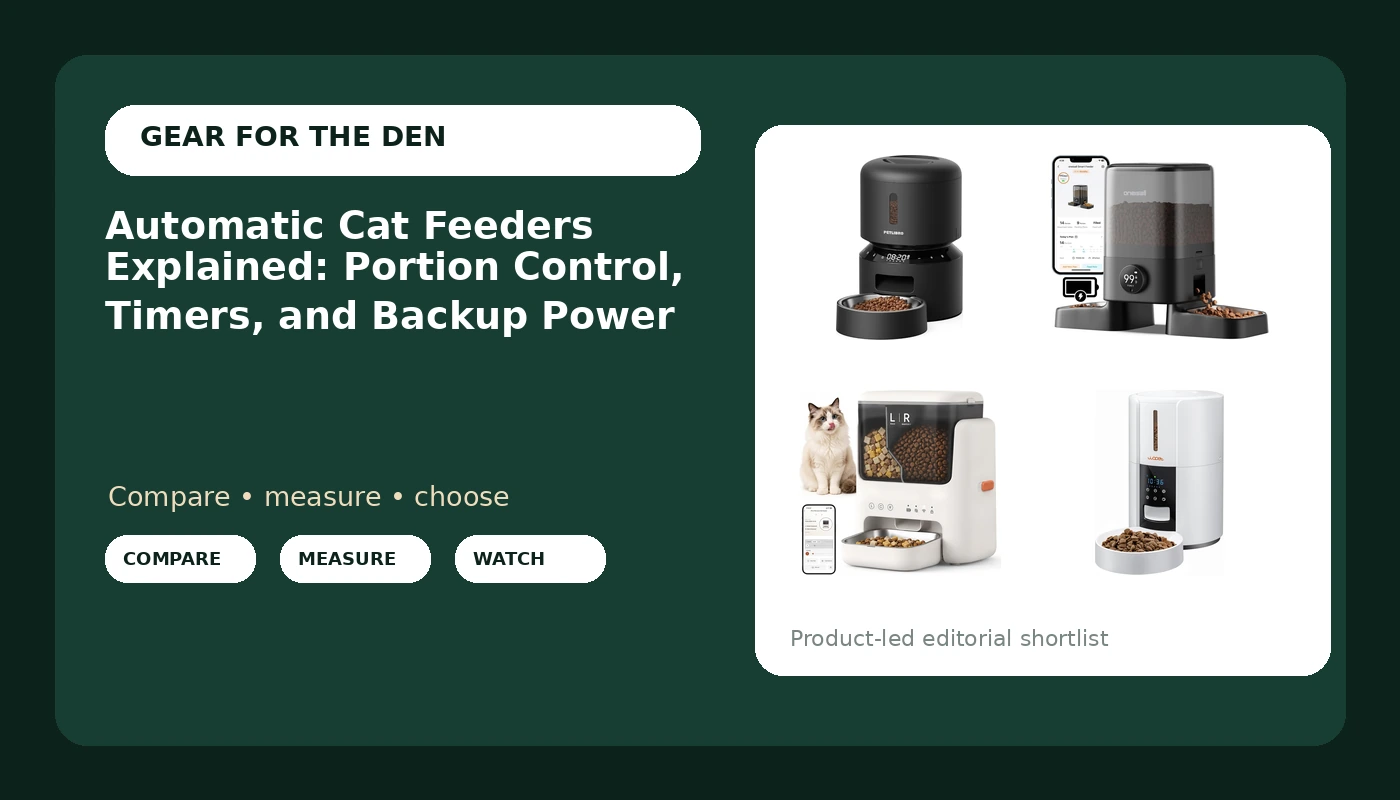
Four useful options
| Model | Best fit | What stands out |
|---|---|---|
| PETLIBRO Automatic Cat Feeder, Timed Dry Food Dispenser for Cat & Small Dog | One cat on a fixed daily schedule | Timed dry food dispensing sized for cats and small dogs |
| oneisall 2.4G Cordless Automatic Cat Feeder, Rechargeable, 20 Cups/5L | Feeding spots with no nearby outlet | Cordless rechargeable body with a 20 cup / 5L hopper |
| Automatic Cat Feeder, Dual Hopper for Meals & Treats, App Control | Households that want treats on their own schedule | Two hoppers plus phone based scheduling |
| WOPET Automatic Cat Feeder, 3L Pet Dry Food Dispenser, Timed Portion Control with 6 Meals, Voice Recorder, Battery Backup | Homes that want backup power and a familiar call | Six meal settings, a voice recorder, and battery backup |
Timed simplicity: PETLIBRO Automatic Cat Feeder, Timed Dry Food Dispenser for Cat & Small Dog
This is the feeder for someone who wants the job done without a phone in the loop. You fill one hopper with dry food, set the meal times, and let the machine repeat them. The trade off is flexibility: a single hopper means one food and one schedule, so if you also free feed a second cat or hand out treats on a different rhythm, you will be working around the unit rather than with it. Check the bowl width against your cat's whisker clearance before you commit, since a narrow bowl can put pressure on whiskers and some cats eat less willingly from it.
Cordless placement: oneisall 2.4G Cordless Automatic Cat Feeder, Rechargeable, 20 Cups/5L
Cordless design is about placement, not gadgetry. If the only sensible feeding spot in your home is a hallway corner with no outlet, a rechargeable feeder removes the extension cord problem entirely. The 20 cup / 5L hopper is on the large side for a single cat, which mostly means fewer refills and a longer gap between top ups. The trade off is that you now own a battery to manage. A rechargeable unit still needs charging on some cadence, and a feeder that runs flat mid week is worse than a corded one you never think about, so keep the charger somewhere you will actually see it.
Meals and treats: Automatic Cat Feeder, Dual Hopper for Meals & Treats, App Control
Two hoppers change what a feeder can do. One side holds meals, the other holds treats, and app control lets you put those on separate schedules without standing at the machine. That suits a household where one person does most of the feeding, or where a cat gets a small reward at a predictable hour and you would rather not be the one delivering it. The cost is upkeep. Two hoppers mean two chambers to keep dry, two chutes to check for jams, and two foods to restock. App control also only helps if your home network reaches the feeding spot.
Backup power: WOPET Automatic Cat Feeder, 3L Pet Dry Food Dispenser, Timed Portion Control with 6 Meals, Voice Recorder, Battery Backup
This unit covers the failure mode people worry about most: power loss. Battery backup keeps the schedule alive when the outlet does not, and six meal settings cover a normal day with room to spare. The voice recorder lets you attach a short clip to mealtimes, which some cats respond to the way they respond to a can opener. The 3L hopper is a middle of the road size, enough for a cat eating standard dry food for a stretch of days rather than weeks. Note that the listing does not spell out which battery type the backup takes, so read the manual before you depend on it.
Prices and availability may change. Product images, names, and retailer links are matched to verified listings. No current price, rating, stock status, or measured result is stated here without current evidence.
How automatic cat feeders measure a portion
Every timed feeder in this group works the same way at the mechanical level: a hopper holds kibble, a rotating mechanism or auger moves it into a chute, and the chute drops it into a bowl. The portion size you program is a count of those drops, not a weight in grams. That distinction matters more than most listings admit, because kibble density varies. A scoop of a large, airy kibble weighs less than the same volume of a small, dense one, so switching foods can quietly change how many calories your cat gets per meal.
Kibble geometry is the other variable. Very small kibble can slip through a chute faster than the mechanism expects, and very large or oddly shaped pieces can bridge across the opening and stall the flow. Before you trust any feeder with a full day, run it with the exact food you plan to use and watch two or three cycles land in the bowl.
Then there is the bowl itself. Bowl width and whisker clearance are the two dimensions that decide whether a cat eats comfortably from a machine. Some cats will eat from a narrow bowl without complaint; others will hook kibble onto the floor rather than let their whiskers touch the sides. If your cat is already a messy eater, a wider bowl and a tray underneath will save you daily sweeping.
Finally, remember what a feeder is not. It does not hold water, and the specs that matter for a fountain are different: water capacity, pump noise, and filter type. If you are shopping for both, treat them as two separate decisions. And if you are considering a microchip activated feeder that opens only for a registered cat, microchip range is the number to check, since a chip that reads poorly at the lid is a feeder your cat cannot open. A corded model with a fixed base also locks in its elevation angle, so a raised bowl has to come from a stand rather than the unit.
What to check before you buy
If you have been searching under garbled strings like autodesk matic cat feeders or autofloor matic cat feeders, you are after the same object: a hopper, a chute, and a timer. The buying process is short if you answer five questions in order.
- Measure what your cat eats now. Weigh or scoop a normal meal so you know the target portion size before you compare programmable ranges.
- Check your kibble against the chute. Small pieces and very large pieces are the two ends that cause jams, and your own food is the only reliable test.
- Decide how you want to power it. A cord is the least maintenance, a rechargeable unit is the most flexible, and battery backup is insurance rather than a primary source.
- Count the meals you actually need. Six settings cover most routines, but split meals for a kitten or a cat on a vet designed plan may need more.
- Plan for failure. Know what happens at hour twelve if the mechanism jams, and keep a bowl you can fill by hand.
Living with an automatic feeder day to day
- Run the feeder for a week before you rely on it for a trip, including one cycle while you are out of the house.
- Keep the hopper dry. Kibble that sits in a humid kitchen clumps, and clumps are what stall a chute.
- Put something under the bowl. A cheap desk mat or a shallow boot tray catches the kibble that misses, and it is far easier to shake out than to sweep a corner.
- Wash the bowl and the chute on a schedule you will keep, since dried food residue and oils build up on surfaces a cat licks.
- Watch the first meals after any change, whether that is new food, a new schedule, or a new position in the room.
- Keep the manual feeding routine in reserve. A feeder is a convenience, not a medical device, and a cat that stops eating needs a person.
- Think about placement. Keep the unit out of reach of a dog and away from a tight wall, and if you also run a cat water fountain, give the two machines enough space that neither gets splashed.
Which option should you choose?
Choose the PETLIBRO Automatic Cat Feeder, Timed Dry Food Dispenser for Cat & Small Dog when you want one food on one predictable schedule with no app involved. Choose the oneisall 2.4G Cordless Automatic Cat Feeder, Rechargeable, 20 Cups/5L when the best feeding spot in your home has no outlet and you are willing to keep a rechargeable unit topped up. Choose the Automatic Cat Feeder, Dual Hopper for Meals & Treats, App Control when treats need their own schedule and phone control is a feature you will genuinely use. Choose the WOPET Automatic Cat Feeder, 3L Pet Dry Food Dispenser, Timed Portion Control with 6 Meals, Voice Recorder, Battery Backup when backup power matters more than hopper size and you want a voice cue at mealtimes.
None of these listings publishes a measured portion accuracy figure, and none of the four is described here as the quietest, fastest, or best. Treat the specs on the box as a starting point, and test the machine with your own kibble before you trust it with a weekend away.
The bottom line
An automatic feeder is a scheduling tool, and it works best when you keep the job small. Pick a unit whose power design matches your home, whose hopper holds the food you already buy, and whose bowl your cat will actually eat from. Test it for a week, clean it on a routine, and keep a hand feeding plan for the days when something jams or the power stays off. The four options here split along clear lines: timed simplicity, cordless placement, meals plus treats, and backup power. Match the line that describes your household, then let the machine handle the clock.