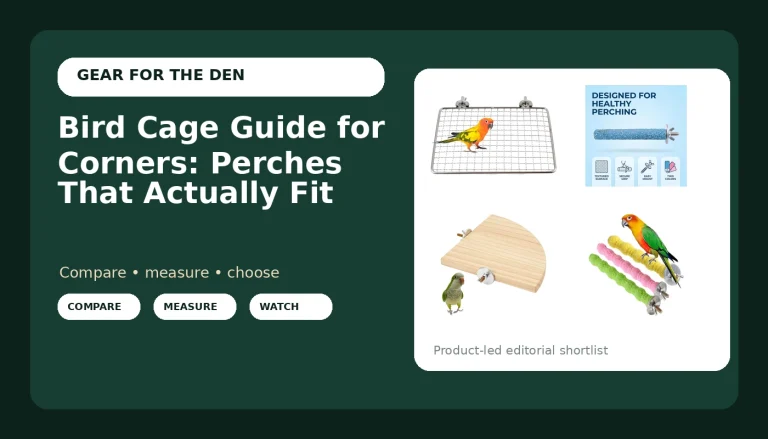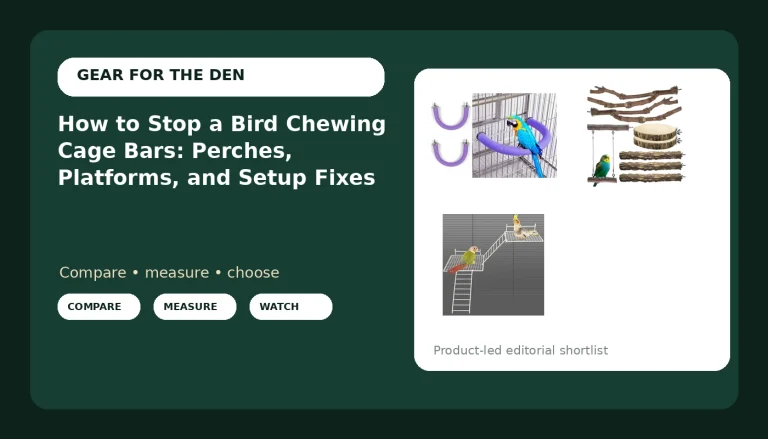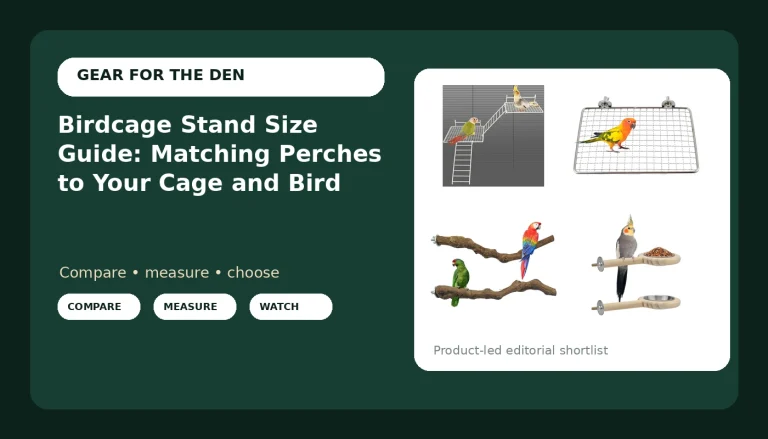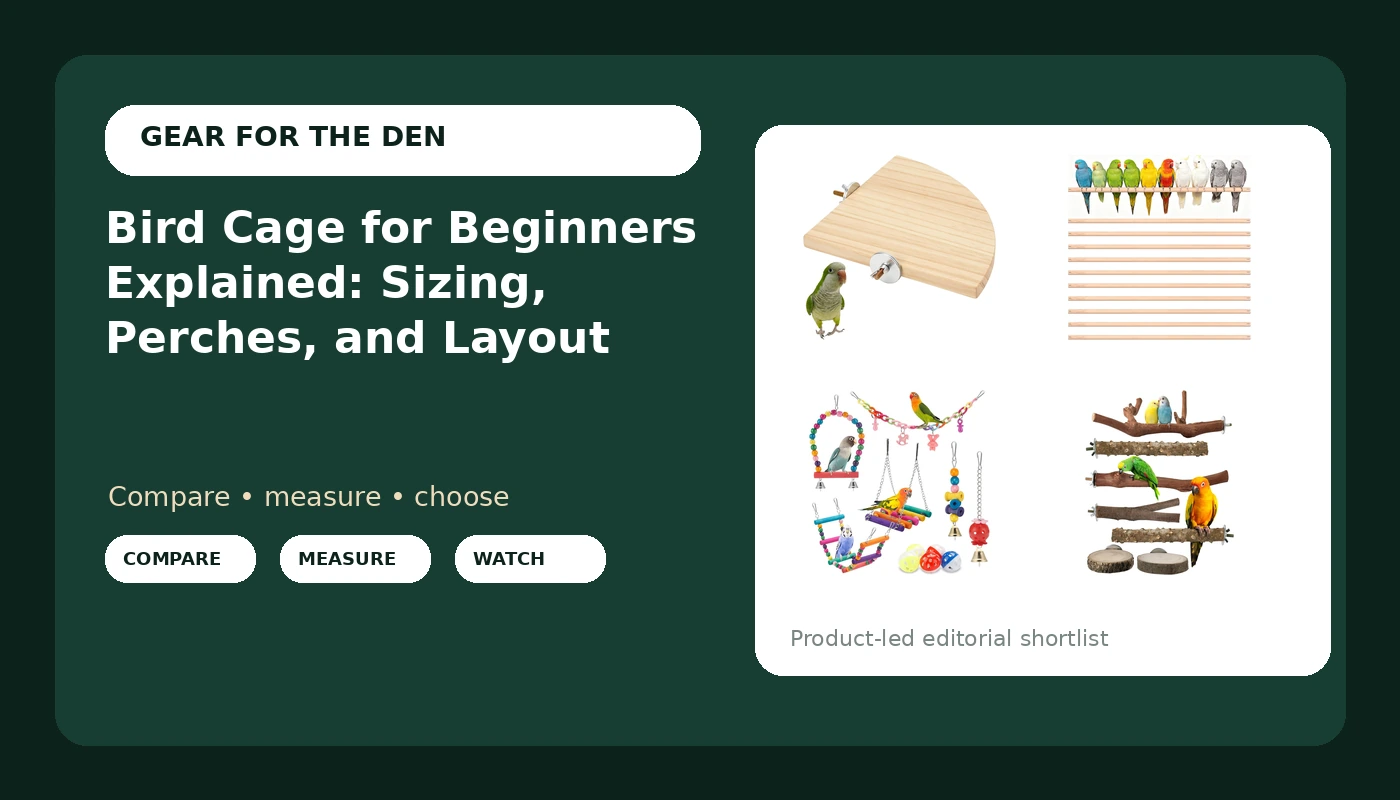
Buying a first cage is where a lot of new bird owners spend money on the wrong parts. The enclosure sets the limits, but what happens inside it decides whether a bird actually settles: perch heights, the gap between the bars, where the food cups sit, and how much of the day the bird has something to do. This guide walks through the bird cage for beginners decision in the order that matters, from the enclosure itself down to the small accessories that make a starter setup workable. Every item below is described by what it is, not by a promise about what it will do for your bird.
Quick answer
Match bar spacing to the species first, then set cage height, perch diameter, and food cup size around that choice. A budgie or finch needs narrow spacing so it cannot squeeze through the gap or trap a leg; a cockatiel or small conure needs a wider footprint and sturdier perches. Once the cage is right, the accessories that matter most are perches in more than one diameter, one flat resting surface, and something to chew, climb, or swing on. The four options below cover those jobs without overlapping each other, and none of them replaces the cage itself.
Four useful options
| Model | Best fit | What stands out |
|---|---|---|
| 6.7 Inch Fan-Shaped Bird Perch Platform, Natural Wood Flat Bird Perches for Cage, Parrot Perch Corner Stand, Small Parrot Stand Animal Cage Accessories for Hamsters Gerbils | Corner resting spot | Flat fan-shaped wood platform that mounts into a cage corner |
| Wopgrty 10 Pcs 24 x 0.6 Inches Wooden Bird Perches for Cage Accessories Natural Parrot Rods with Double Head Slots Grinding Stick for Budgies Parakeet Cockatiel Conures Macaw Cockatoo | Replacing thin dowels | Ten rods with double head slots sized for standard cage bars |
| Bird Parakeet Toys – Swing Hanging Standing Chewing Hammock Climbing Ladder Bird Cage Colorful Toys Suitable for , Parakeet, Conure, Cockatiel, Mynah, Love Birds, Finches | Enrichment starter | Swing, hammock, ladder, and chew pieces in a single pack |
| Bissap Bird Perch Stand 7PCS, Natural Grape Wood Pole Standing Parrot Cage Branch Paw Grinding Fork Parakeet Platform Hammock for Conures Budgies Finches Cockatiels Small Birds Exercise Training | Natural perch variety | Grape wood branches in assorted shapes and thicknesses |
Corner resting platform: 6.7 Inch Fan-Shaped Bird Perch Platform, Natural Wood Flat Bird Perches for Cage, Parrot Perch Corner Stand, Small Parrot Stand Animal Cage Accessories for Hamsters Gerbils
Round perches ask a bird to grip the same way all day, and a flat surface gives the feet a break from that constant curl. A corner platform also solves a layout problem: the corners of a rectangular cage are the hardest spots to use, and a fan shape fits into them without blocking the middle of the cage where the bird needs to move. This is the piece to add when a starter cage has three identical dowels and no variation at all.
Standard dowel replacement: Wopgrty 10 Pcs 24 x 0.6 Inches Wooden Bird Perches for Cage Accessories Natural Parrot Rods with Double Head Slots Grinding Stick for Budgies Parakeet Cockatiel Conures Macaw Cockatoo
Most starter cages ship with two or three thin dowels, and those dowels are usually all the same thickness, which is the real problem. Feet that grip one diameter all day can develop pressure spots over time, so the practical fix is to swap in rods of a different size and place them at different heights. A ten-pack like this one gives you enough length to run perches across the cage at two or three levels, and enough spare material that a chewed or soiled rod can be replaced instead of scrubbed.
Enrichment starter: Bird Parakeet Toys – Swing Hanging Standing Chewing Hammock Climbing Ladder Bird Cage Colorful Toys Suitable for , Parakeet, Conure, Cockatiel, Mynah, Love Birds, Finches
A cage with nothing but perches and a food cup is a cage where a bird has no outlet for normal behavior. Chewing wears down the beak, climbing uses the vertical space, and a swing mount gives a bird a moving surface to master. The trade-off with a mixed pack is that not every piece will suit every bird: a finch and a cockatiel have different ideas about what is worth climbing on. Start with two or three pieces, watch which ones get used, and rotate the rest rather than hanging everything at once.
Natural perch variety: Bissap Bird Perch Stand 7PCS, Natural Grape Wood Pole Standing Parrot Cage Branch Paw Grinding Fork Parakeet Platform Hammock for Conures Budgies Finches Cockatiels Small Birds Exercise Training
Natural wood branches vary in thickness along their length, so a bird shifts its grip as it walks instead of holding one position. That variation is the whole argument for this kind of perch, and it is the reason a mixed set beats buying four identical rods. The practical caveat is fit: irregular branches take up more room than a straight dowel and can be awkward in a small cage, so measure the inside of the enclosure before you commit to the larger pieces in a set like this.
Prices and availability may change. Product images, names, and retailer links are matched to verified listings. No current price, rating, stock status, or measured result is stated here without current evidence.
How to size a bird cage for beginners
The enclosure comes first because everything else has to fit inside it. Bar spacing is the single most important measurement, and it is species-specific. If the gaps are too wide, a small bird can push its head through and then struggle to pull back, which is a genuine injury risk. If the gaps are much too narrow, the cage is usually built for a smaller bird than the one you have, and the whole structure will be too light.
Cage height matters more than floor area for most small birds, because birds move up when they feel unsafe. A tall cage with a modest footprint suits a budgie or a cockatiel better than a wide, short one, provided the perches are placed so the bird can use the upper third of the space. Horizontal room still counts, especially for wing exercise, so look for a cage that is taller than it is wide but not a narrow column.
Perch diameter should let the bird's foot wrap most of the way around the rod without the toes overlapping or meeting underneath. That is a rough test, not a measurement, and it is the reason a single-diameter cage is a problem: one size cannot be right for every bird and every perch position. Food cup size follows the same logic. Cups that are too deep hide food and make a bird dig; cups that are too shallow get scattered across the tray liner within an hour.
Bar spacing, layout, and the parts that wear out
Bar spacing and perch diameter get most of the attention, but the parts that decide whether a first cage is pleasant to live with are the ones you touch every day. A tray liner or removable tray that slides out without dismantling anything turns a ten-minute cleaning job into a two-minute one, and cages that are hard to clean get cleaned less often. Look at how the tray comes out before you look at the color.
Layout inside the cage follows a few simple rules. Keep perches out of the direct line above the food and water cups so droppings do not land in them. Leave the middle of the cage open for movement rather than filling it with branches. Put the highest perch at a spot where the bird can see the room, since that is where a nervous bird will spend its first days. If you travel with the bird, a carrier size that lets it stand upright without its head touching the top is the minimum, and it should be a separate piece of equipment from the cage.
Foraging difficulty is the last piece most beginners skip. A bird that gets its food in an open bowl in thirty seconds has hours left in the day, and that is where feather problems and repetitive behavior start. Simple foraging, such as food scattered among safe chew items or wrapped in paper, adds time to the meal without requiring special equipment.
- Confirm the species and its correct bar spacing before shopping for anything else.
- Measure the space where the cage will live, including clearance above it.
- Check the cage height and decide where the highest perch will sit.
- Match perch diameter to the bird, then buy at least two different thicknesses.
- Add one enrichment item and one flat resting surface, then stop and observe.
Daily and weekly habits that keep the setup working
- Change the tray liner on a fixed schedule rather than when it looks bad.
- Wash food and water cups daily, since seed hulls and pellets both spoil in water.
- Rotate toys and chew items every week or two instead of leaving everything in place.
- Check every perch and swing mount for looseness each time you clean the cage.
- Replace any wood perch that has been chewed down to a sharp edge or a thin point.
A starter cage rarely fails because of one bad purchase. It fails because the bird spends all day on one dowel at one height with one bowl of food and nothing to do. The accessories above are the cheapest way to fix that, and they are also the easiest to get wrong by buying four versions of the same thing.
Which option should you choose?
Choose the 6.7 Inch Fan-Shaped Bird Perch Platform, Natural Wood Flat Bird Perches for Cage, Parrot Perch Corner Stand, Small Parrot Stand Animal Cage Accessories for Hamsters Gerbils when your cage has open corners and the bird needs a flat surface to rest on. Choose the Wopgrty 10 Pcs 24 x 0.6 Inches Wooden Bird Perches for Cage Accessories Natural Parrot Rods with Double Head Slots Grinding Stick for Budgies Parakeet Cockatiel Conures Macaw Cockatoo when you are refitting a cage that came with thin matching dowels. Choose the Bird Parakeet Toys – Swing Hanging Standing Chewing Hammock Climbing Ladder Bird Cage Colorful Toys Suitable for , Parakeet, Conure, Cockatiel, Mynah, Love Birds, Finches when the bird has perches but nothing to do. Choose the Bissap Bird Perch Stand 7PCS, Natural Grape Wood Pole Standing Parrot Cage Branch Paw Grinding Fork Parakeet Platform Hammock for Conures Budgies Finches Cockatiels Small Birds Exercise Training when you want natural, uneven surfaces and your cage is large enough for irregular branches.
The one thing none of these items can do is correct a cage with the wrong bar spacing. If the gaps do not suit your species, fix the cage first and treat the accessories as a second step. It is also worth remembering that the ideal bird cage for beginners is not the largest one available, but the one that fits the bird, fits the room, and can be cleaned without a struggle. Getting that part right makes the rest of the setup much easier to judge.
The bottom line
The correct bird cage for beginners setup starts with bar spacing and cage height, moves to perch diameter and food cup size, and finishes with a few accessories that give the bird something to do. Perch variety, a flat resting surface, and one or two enrichment pieces cover the gaps that starter cages leave, and they cost far less than replacing the cage later. Work through the sizing decisions first, add the accessories that fit your bird, and adjust from what you actually see rather than from what the packaging promises.
For a fuller walkthrough of the equipment side of the same topic, see the small bird cage setup checklist, which covers the rest of the bird cage for beginners explained ground in more detail.