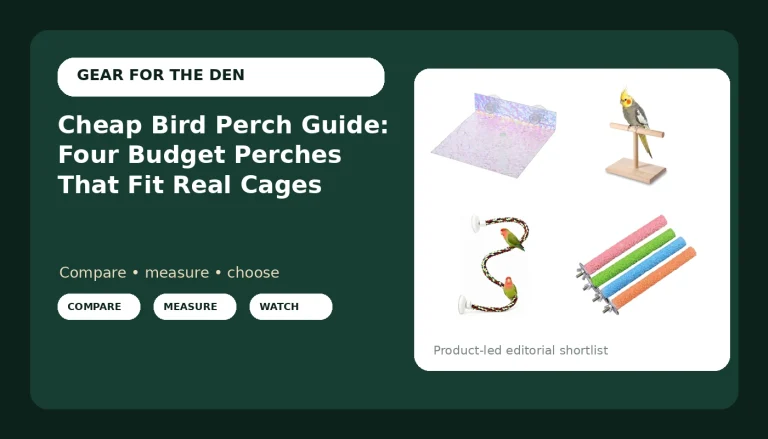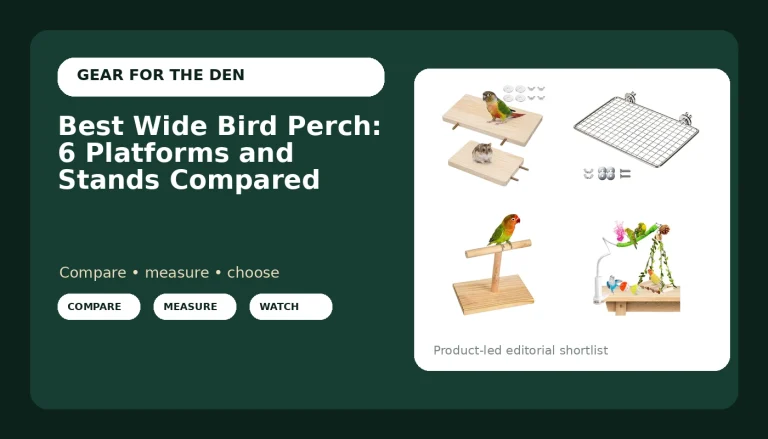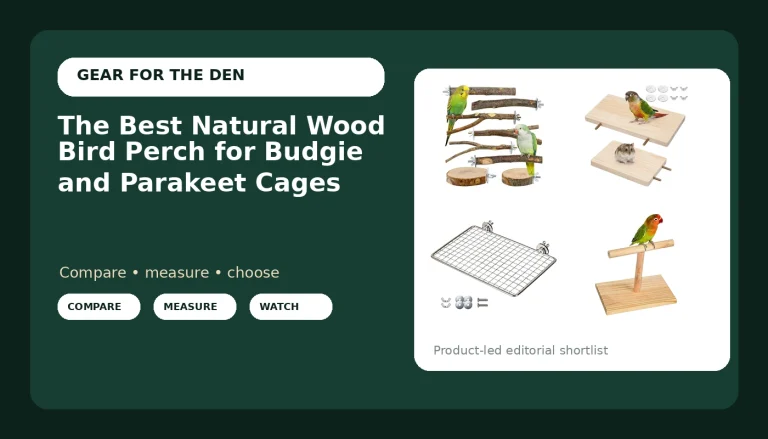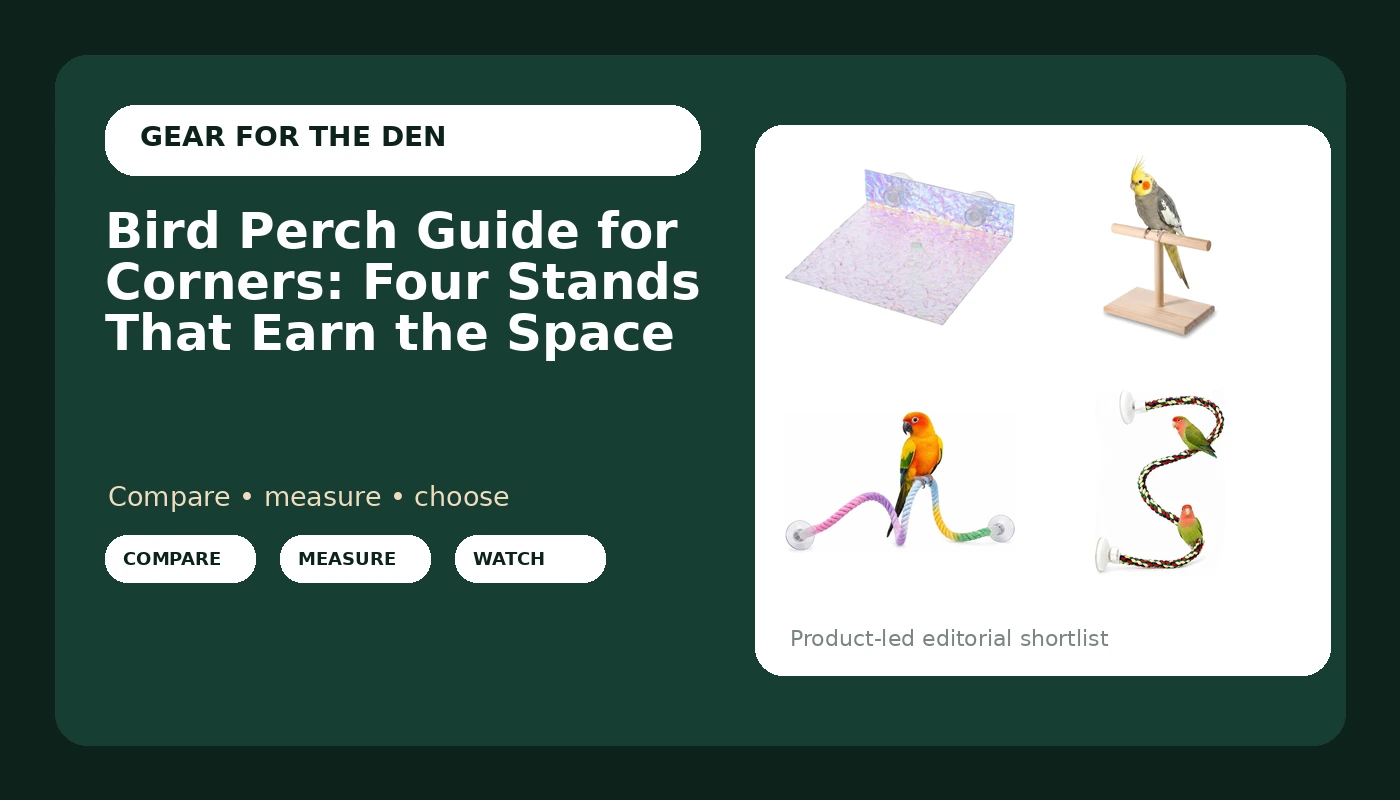
This bird perch guide for corners starts with a boring fact of floor plans: cages go in corners. That is where the wall already exists, where the outlet is, and where a cage stays out of the walking path. Perches, meanwhile, are designed for flat walls. Put the two together and you get a bird that shuffles along the back bars, because the comfortable standing room is a triangle and nothing you own is built to use a triangle.
A corner is not a wall. It is two walls, and the usable air in front of them is a wedge. Anything you add has to either reach across that wedge, which is what suction cups and rope perches do, or stand in the dead floor space in front of it, which is what tabletop stands do. That is the whole decision, and it is why this comparison comes down to mount type rather than brand.
I looked at four stands that solve the corner problem in different ways: two suction cup rope perches that turn a window or a glass panel into usable space, and two freestanding tabletop stands that sit on a desk, a shelf, or the floor beside the cage. I compared them on mount security, perch diameter, how much of the corner they actually occupy, and how easy they are to clean.
Best Overall: Portable Bird Perch Stand, Adjustable Height Acrylic Platform
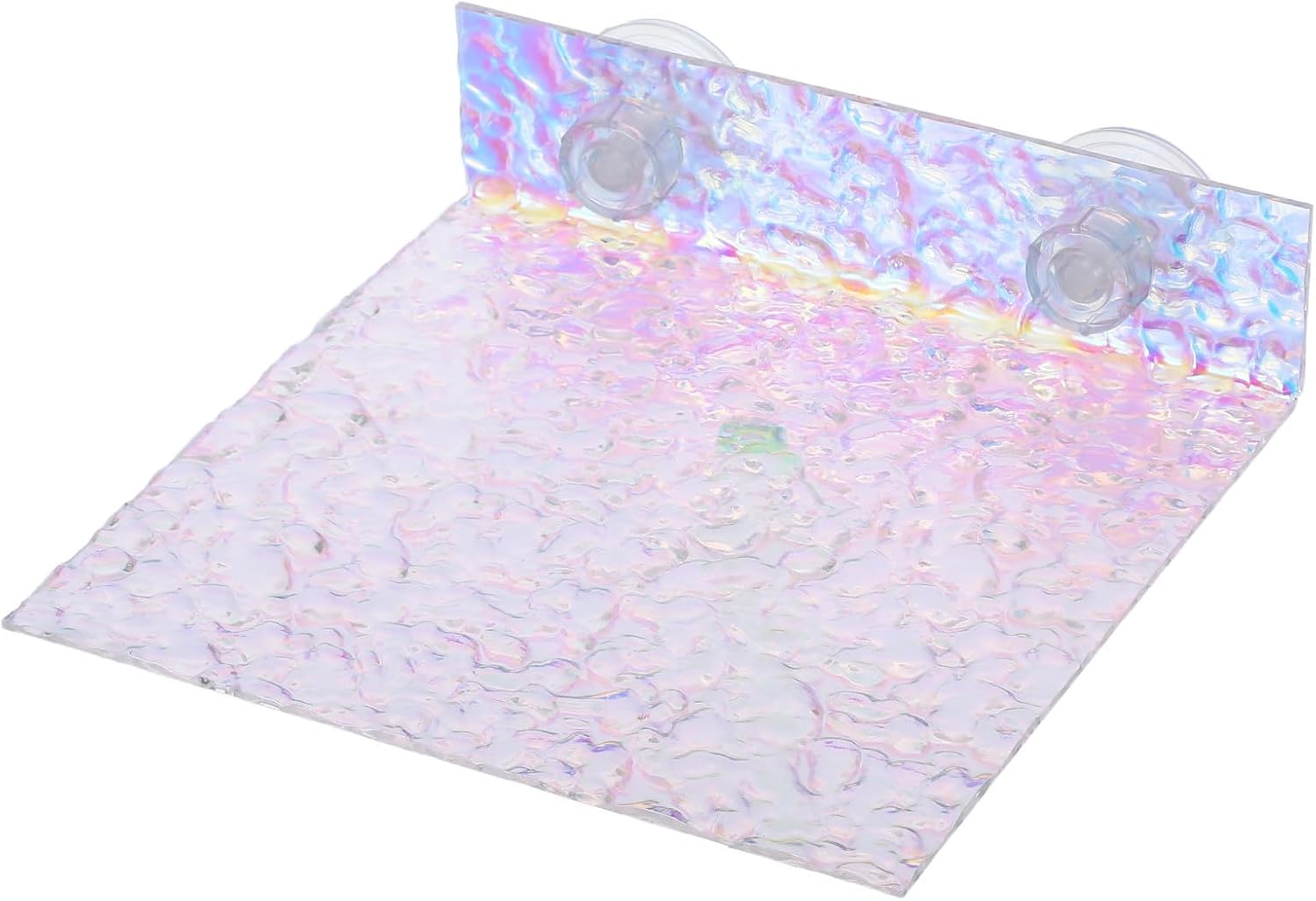
This is the one I would hand most people first. It is a freestanding stand with an acrylic platform and an adjustable height, which sounds like a small feature until you try to line a perch up with the door of a cage that sits in a corner. Because the height moves, you can match the perch to the cage opening instead of matching the cage to the perch.
A corner is awkward for a stand because the base has to fit in the dead space behind the cage door, and a flat platform base does that better than legs that splay outward. The acrylic surface is also the easiest thing here to wipe down, which matters more than you expect once a bird has eaten fruit over it.
Adjustable height fixes the cage height problem directly. If the cage door sits at chest level, a fixed tabletop stand puts the perch too low, and the bird has to climb down to use it. Most parrots will not bother. Raise the platform and the perch lines up with where the bird already is.
Visit on Amazon – Check current Amazon price
Where it gives ground is portability. It is a stand, not a travel perch, so it stays where you put it. If you want something you can carry from room to room, the tabletop training stand below is the better fit.
Best Value: Bird Perch Stand, Bird Training Portable Tabletop Parrot Stand
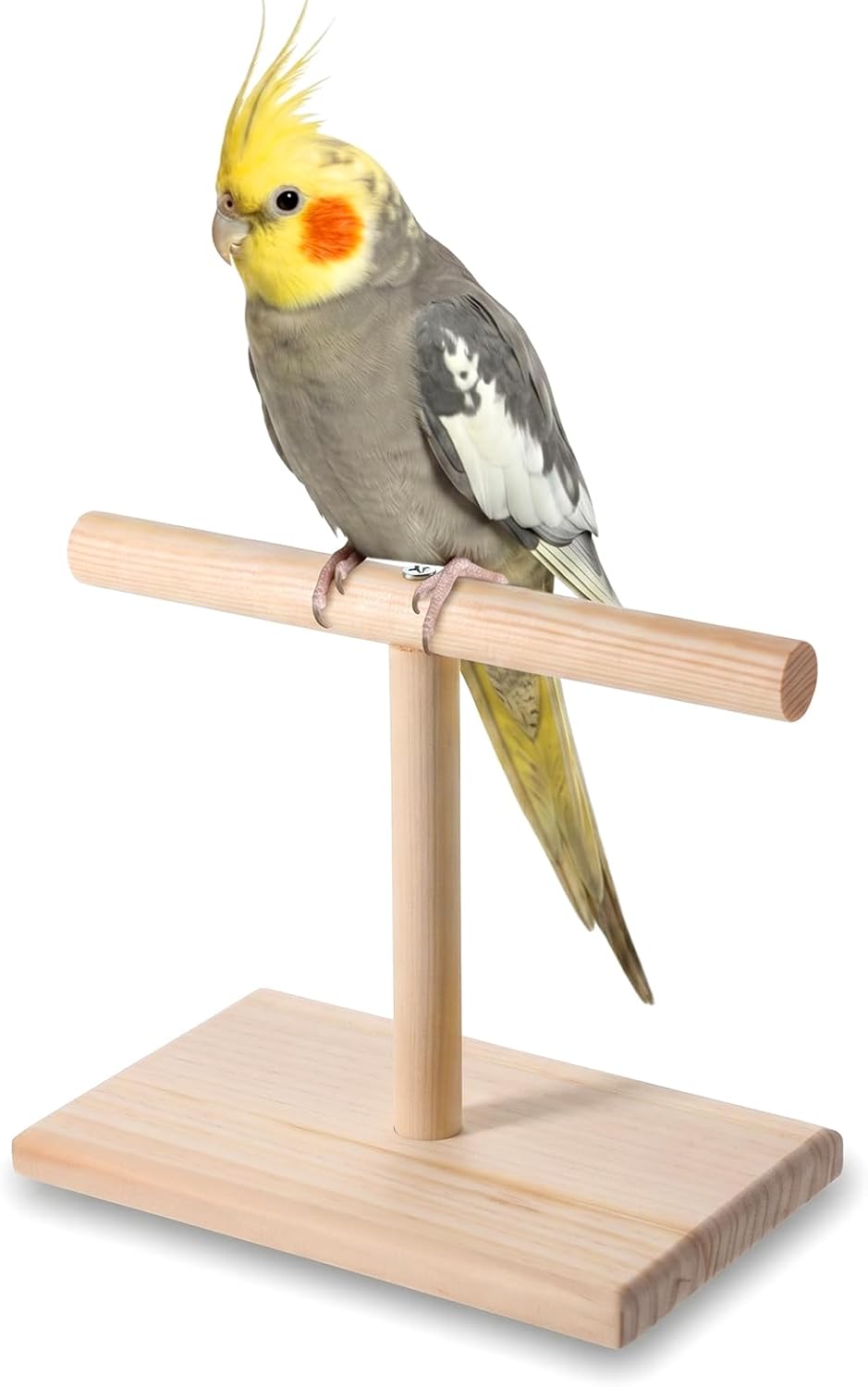
This is the simple one, and simple is the point. It is a tabletop parrot stand built for training, which means it is meant to be moved, wiped, and put away. If you are working on step up, target training, or you just want a landing spot outside the cage, a small stand that lives on a desk does more for you than an elaborate mount.
In a corner setup it earns its place as the secondary station. Corner cages usually sit in rooms where the corner is the only free floor, so a compact stand on the same table as the cage keeps the bird with you without taking up another footprint. It also gives you a neutral spot to work on recall, because the bird is on the stand rather than on you.
Perch diameter is the part to look at on any training stand. A perch that is too thick for the feet means the bird cannot wrap its toes, and it will shift its weight constantly instead of settling. A perch that is slightly thin is the safer error, especially for smaller birds.
Visit on Amazon – Check current Amazon price
It is not a climbing frame and it is not a cage perch. It is a training station that happens to fit a corner room better than a full size stand.
How I tested
I mounted all four the same way, in the same corner of the same room, and I lived with each of them for a stretch rather than judging them out of the box.
First, the surface. Suction cups go on glass, mirrors, or glazed tile. They go nowhere useful on painted drywall or textured wallpaper, no matter how hard you press. I checked whether each cup held with weight on the rope, then wiped the glass and re-set it, because a cup that only holds on the first try is a cup that will drop a bird.
Second, the corner itself. I set each stand beside a cage door and looked at three things: whether the perch lined up with the cage opening, whether the base stayed out of the walking path, and whether the whole thing could be moved without taking the cage apart.
Third, cleaning. Perches get soiled. A rope perch can be scrubbed and rinsed. An acrylic platform wipes in one pass. Anything with a fabric cover or a deep crevice collects dust and seed hulls, and that is the part that decides whether you keep using it.
I did not measure grip strength in pounds, because that number would be meaningless across different glass, different humidity, and different temperatures. What matters is whether the cup holds after a re-set and whether the stand stays put when a bird lands hard.
Analysis and test results
A bird perch guide for angled corners has to start with the mounting surface, not the perch. The four stands split cleanly into two families: two rely on suction cups, two are freestanding.
Suction cups win on space, because they use vertical glass that the cage cannot use. They lose on surfaces, because painted drywall, textured wallpaper, and unfinished wood will not hold a seal. If your corner is drywall, a suction cup perch is not a corner perch at all. It is a window perch that will not work until you find glass.
Freestanding stands win on reliability and lose on floor space. In a small room the corner is often the only free floor, so a stand with a footprint is competing with the cage for the same real estate.
Anyone hunting a bird perch guide for corner spaces will find the same two answers repeated, and the ideal bird perch guide for corners would rank surface first, perch diameter second, and everything else after that. Perch diameter decides whether the bird can wrap its toes, and a perch that is too thick is worse than one that is slightly too thin, because the bird cannot settle its grip and ends up on one foot all day.
Cage height is the number people skip. Inside the cage, a perch should sit high, because most parrots want the highest point in the room. Outside the cage, on a stand, the perch should line up with the door so the bird can step across without climbing down. Bar spacing matters for a related reason: if you hang anything inside the cage, from a swing mount to a foraging toy, the spacing decides what fits and what rattles.
Foraging difficulty is worth thinking about in a corner too, because two walls give a puzzle feeder something to work against, and the mess lands in one place instead of across the floor. Two smaller details decide whether you keep using a stand: food cup size and a tray liner. A cup a cockatiel can perch on the rim of ends up on the floor, and a tray without a liner is a tray you scrub twice a week.
And if the bird travels, carrier size and perch diameter have to agree. A perch that fits the cage may be too long for the carrier you own.
The bird perch guide for corners reference table
This is the table I keep, sorted by how the perch attaches rather than by brand. Match the mount to your surface first, then look at the perch itself.
| Product | Mount type | Best corner placement | What to check |
|---|---|---|---|
Portable Bird Perch Stand, Adjustable Height Acrylic Platform | Freestanding platform | Floor or shelf beside the cage door | Perch height lines up with the opening |
Bird Perch Stand, Bird Training Portable Tabletop Parrot Stand | Freestanding tabletop | Desk or table in the corner, training station | Perch diameter and wipe down ease |
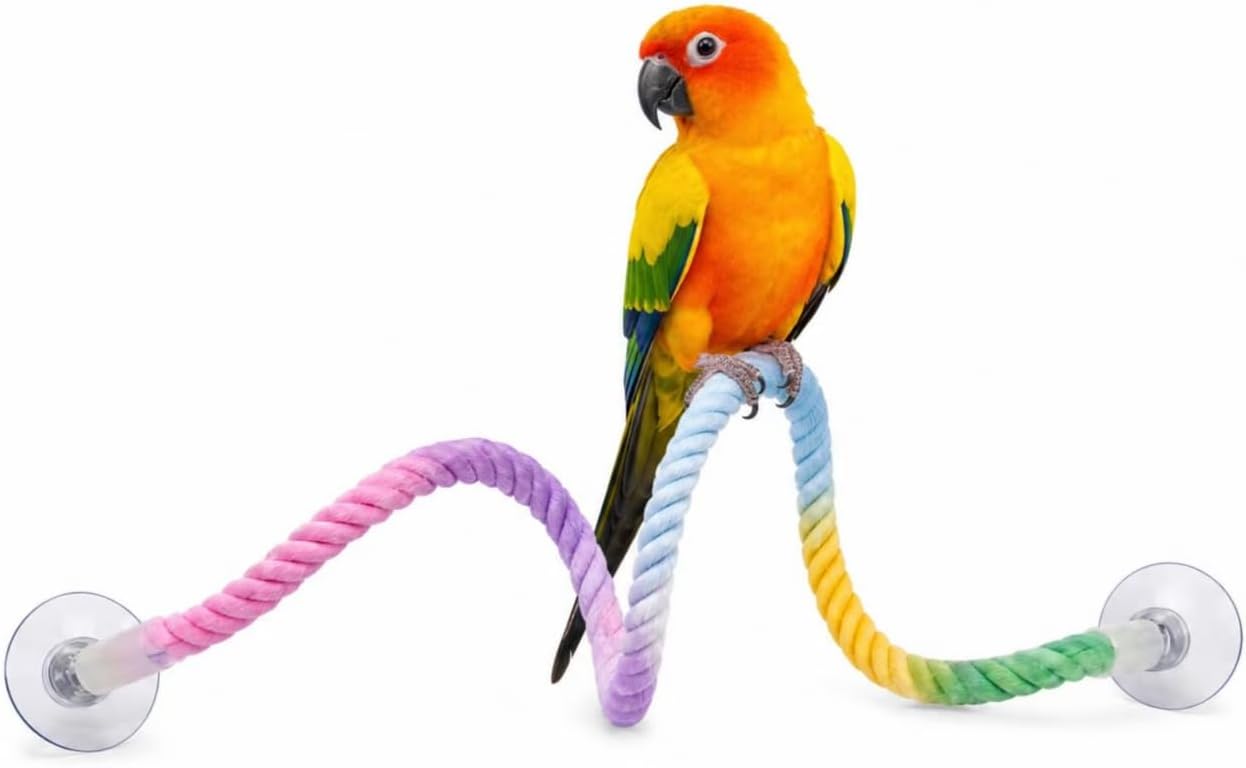 View on Amazon → Xorabuddy Window Bird Perch Parrot Climing Rope with Suction Cups, 80cm | Suction cup rope | Glass corner, window, or shower wall | Cups on clean glass, never on drywall |
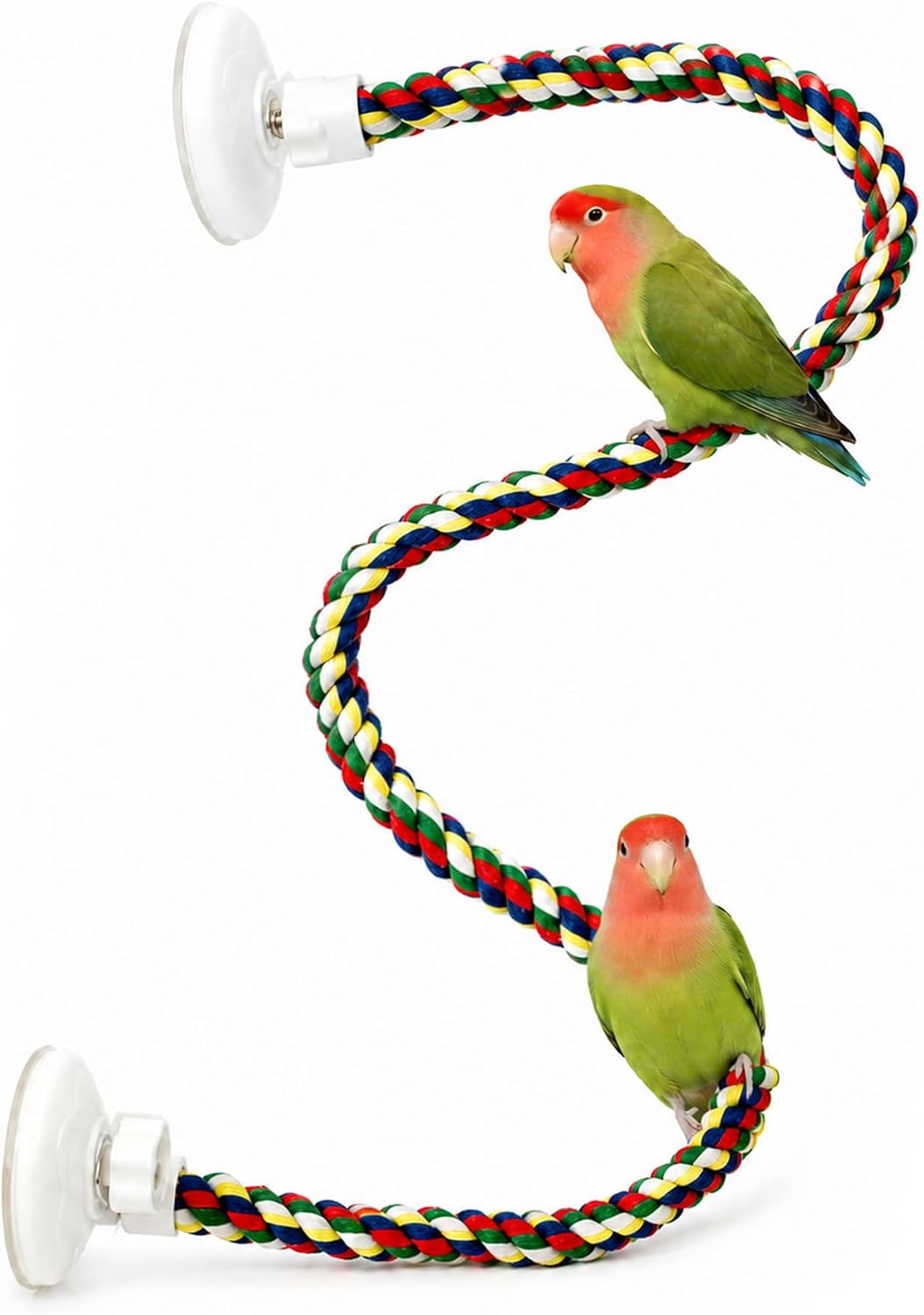 View on Amazon → OOXYG Bird Rope Perch Stand with Strong Suction Cups for Window/Bath | Suction cup rope | Window or bath wall with a clear sightline | Cup seal and how much the rope sags |
Check current Amazon price on each before you commit, because these four sit close enough together that the right answer is the one that fits your surface.
Suction cup mounts for glass corners
The Xorabuddy rope perch is the long one, and length is the reason it works in a corner. An eighty centimeter rope can be run along a window frame and turned into the corner, which gives a bird somewhere to climb rather than somewhere to sit. That is a different job than a cage perch, and it is the job corners are worst at, because the wedge of space behind a cage door is unusable for anything that needs a flat mount.
The OOXYG rope perch is the same idea built around a window or a bath wall. The strength of this design is that it moves between rooms: glass in the kitchen, glass in the bathroom, glass in a bedroom, all with the same two cups.
Both of these depend on the cup seal, and both fail the same way. Wash the glass, press the cup from the center out, and re-set it whenever it starts to feel loose. A suction perch that has been up for months without a re-set is a perch that is about to fall.
Tabletop stands and perch diameter
The two freestanding stands do the work suction cups cannot, which is stand on a surface that is not glass. The adjustable platform is the one for a permanent corner station, because height adjustment is the only way to make a stand meet a cage door where it already is. The training stand is the one to carry into the kitchen while you cook.
On both, look at perch diameter before anything else. A bird's toes should wrap roughly two thirds of the way around the perch. If the toes meet or overlap, the perch is too thin. If the bird cannot touch its own toes together underneath, the perch is too thick and the bird will keep shifting.
Should you buy the Portable Bird Perch Stand, Adjustable Height Acrylic Platform?
Yes, if your cage lives in a corner and you want a station outside the door. A bird perch guide for corners is only useful if it answers the height question, and this is the one of the four that does, because the platform moves. The acrylic surface wipes clean in one pass, which is the difference between a perch you use daily and a perch you avoid.
It is not a travel perch and it is not cheap plastic you can fold into a bag. It is furniture for a corner, and in a small room that is exactly what you need. Check current Amazon price and measure your cage door height first.
Should you buy the Bird Perch Stand, Bird Training Portable Tabletop Parrot Stand?
Yes, if you want the simplest possible station and you want to be able to move it. It is the lightest job of the four, and it does that job without fuss. For step up practice, for a bird that is new to the room, or for a landing spot on the desk while you work, it is the one that gets used.
If you need the perch to reach a cage door at chest height, spend the extra on the adjustable platform instead. If you need a perch on glass, neither tabletop stand helps you and the rope perches are the answer. Everything else is preference.