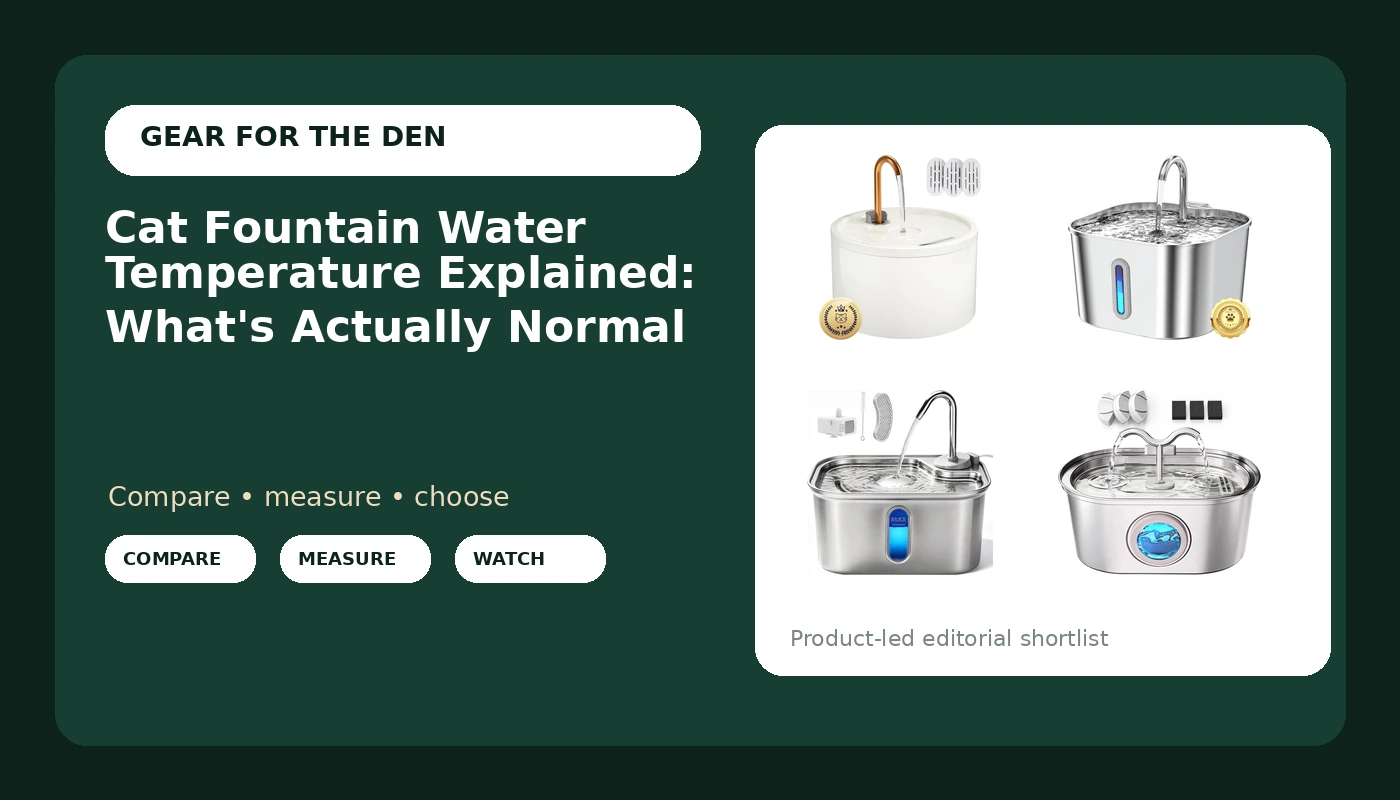
Most people buy a fountain for circulation and filtration, then notice something else a few hours later: the water is not cold. That surprise is the reason this cat fountain water temperature explained guide exists. A fountain has no chiller and no heater, so the water drifts toward the temperature of the room around it, nudged upward slightly by the pump motor and downward slightly by evaporation at the surface. Nothing is broken when the bowl reads close to your kitchen air. The useful questions are how far the water drifts, how quickly it gets there, and whether your setup makes the drift worse. Answer those and you can choose gear with confidence instead of guessing at a number that was never real.
Quick answer
There is no universal target number. Water in a fountain settles near the ambient air temperature, typically a degree or two above it once the pump has been running for a while, because the motor sheds heat into the reservoir. In a home held at 68 to 72 degrees Fahrenheit, expect the water to land in that same band. The ideal cat fountain water temperature is therefore room temperature, not chilled and not warmed. If the water reads noticeably warmer than the room, check placement first: direct sun, a heat vent, or a pump running hot because the reservoir is low. If it reads noticeably colder, the room is cold, and a cat that avoids the fountain may simply be avoiding cold water. The practical test is comparison. Measure the air and the water with the same thermometer, and the correct cat fountain water temperature for your home is the one that tracks that room.
Four useful options
These four fountains differ in body material, water capacity, and filter design, which are the variables that shape how water temperature behaves in a real room.
| Model | Best fit | What stands out |
|---|---|---|
| MISFANS Ceramic Cat Water Fountain, All-Ceramic Body, Pure Copper Spout | Cats in rooms with wide day-to-night swings | All-ceramic body with a pure copper spout |
| Stainless Steel Cat Water Fountain – 74oz/2.2L Cat Drinking Fountain | Small kitchens and daily refillers | 74oz/2.2L stainless reservoir |
| Cat Water Fountain Stainless Steel for Cats Indoor 2.5L 85oz by BPA-Free SUS304, Effective 6-Layer Filter Cat Fountain for Drinking 15dB Ultra Quiet Metal Pet Water Fountain (Fountain+1 Filter) | Owners who want a stated filter stack | 2.5L/85oz SUS304 body, six-layer filter, one filter included |
| SohoTeco 3.2L/108oz Stainless Steel Cat Water Fountain Pet Fountain | Multi-cat homes and busy weeks | 3.2L/108oz stainless reservoir |
The ceramic option: MISFANS Ceramic Cat Water Fountain, All-Ceramic Body, Pure Copper Spout
The trade-off with ceramic is weight and handling. A ceramic reservoir is heavier to lift for a full refill, and it will not survive a drop onto a tile floor the way a steel or plastic body might. In exchange you get a body that does not taste or smell like anything, does not flex under a cat's paw, and buffers the small swings that happen when a window is open in the morning and shut by noon. Ceramic does not make water colder. It makes the water's temperature less jumpy, which is the part most owners actually notice.
The compact stainless option: Stainless Steel Cat Water Fountain – 74oz/2.2L Cat Drinking Fountain
Stainless steel is a good conductor, so water in a steel fountain reaches room temperature faster than water in ceramic. In a stable, air-conditioned room that difference is minor. In a room with wide swings, this fountain will follow the room more closely and more quickly. Capacity is the bigger factor: less water means a thinner buffer, so a 74oz fill warms or cools faster than a 108oz fill in the same spot. If you refill daily and your home holds a steady temperature, that behavior is fine. If you want to fill once and forget it for several days, the reservoir size works against you.
The filtered stainless option: Cat Water Fountain Stainless Steel for Cats Indoor 2.5L 85oz by BPA-Free SUS304, Effective 6-Layer Filter Cat Fountain for Drinking 15dB Ultra Quiet Metal Pet Water Fountain (Fountain+1 Filter)
Filter type is worth thinking about before you buy, because filters are the recurring cost and the part that decides how often you open the pump housing. A six-layer stack generally means more material to rinse and replace, and a proprietary cartridge means you stay tied to that seller's refills. None of that changes the water's temperature. What it changes is how long the water stays appealing enough that your cat keeps drinking, and how often you top the reservoir off with fresh water from the tap. A fountain that is easy to clean gets cleaned, and a clean fountain holds a stable, fresh supply far better than a neglected one.
The large-capacity option: SohoTeco 3.2L/108oz Stainless Steel Cat Water Fountain Pet Fountain
Capacity is the quiet variable in every water temperature conversation. Doubling the volume does not halve the temperature change, but it slows it, and it spreads the pump's heat through more water. The cost is countertop space and the weight of a full reservoir on the walk to the sink. A 108oz fountain is also more water to dump and rinse during a weekly clean, which is the routine that keeps any fountain pleasant to drink from. With one cat and a small kitchen, the extra volume may be more hassle than benefit. With three cats and a busy week, it is the difference between a fresh fountain and a dry one.
Prices and availability may change. Product images, names, and retailer links are matched to verified listings. No current price, rating, stock status, or measured result is stated here without current evidence.
How cat fountain water temperature is actually set
Three inputs decide the cat fountain water temperature you measure. The first is room air. Water in an open reservoir moves toward the temperature of the air around it, and in a normal home that is the dominant factor by a wide margin. The second is the pump. A submersible pump turns electricity into motion and sheds some of that energy as heat directly into the water, which is why a fountain that has run all day often reads a degree or two above the room. The third is evaporation. Water leaving the surface as vapor carries heat with it, so a fountain in a dry room loses a little heat continuously, while a fountain in a humid room loses less.
Body material and volume sit on top of those three inputs rather than replacing them. Ceramic conducts heat slowly, so a ceramic body resists quick changes. Stainless steel conducts quickly, so a steel body follows the room more closely. A larger water capacity adds thermal mass and slows every change, while a smaller reservoir responds faster to both the room and the pump. Surface area matters too: a wide bowl with a lot of exposed water exchanges heat with the air more readily than a narrow one.
Placement is the input owners control most easily. A fountain in direct afternoon sun, beside an oven, on top of a refrigerator, or under a heating vent runs warmer than the same fountain across the room. A reservoir filled halfway runs warmer than a full one, because there is less water to absorb the pump's heat. No single factor produces a dramatic swing, but stacked together they explain why two identical fountains in two homes can read differently on the same afternoon.
What the ideal cat fountain water temperature looks like in practice
Because there is no dial to turn, the useful skill is comparison rather than recall. Run this check once and you will know whether your fountain is behaving normally or whether something about the setup needs to move.
- Fill the reservoir to the marked line and let the pump run for at least an hour before you judge anything.
- Measure the air a few feet from the fountain with an ordinary household thermometer.
- Measure the water in the bowl with the same thermometer and compare the two readings.
- Note the surroundings: sun, vents, appliances, and how full the reservoir is at that moment.
- If the water runs more than a few degrees above the room, fix placement and water level before you consider replacing the fountain.
A fountain that tracks the room is doing its job. A fountain that runs well above the room is telling you something about where it sits or how full it is, and those are the two things you can change today at no cost. Chasing a colder number is not the goal. Steady, fresh, and easy for your cat to reach is the goal.
Practical guidance for a fountain your cat actually drinks from
- Match water capacity to your refill habits rather than to a spec sheet. A reservoir you top off every day stays fresher than a large one you leave for a week.
- Give the drinking point room to work. A bowl width that lets a cat lap without pressing its whiskers against the rim matters more than a fractional temperature difference, and whisker clearance is the reason some cats refuse a narrow spout.
- Choose a filter type you can buy repeatedly, and rinse the pump intake at every refill, because a clogged pump runs hotter and pushes more heat into the water.
- Place the fountain out of direct sun and away from vents, and listen to the pump noise at night. A noisy fountain in a bedroom usually ends up unplugged, and an unplugged fountain has no temperature story at all.
- Watch the elevation angle of the spout and the drinking surface. A cat that has to crane its neck will drink less, and less drinking is a bigger health concern than a two-degree difference.
One more note on specs: features such as portion size and microchip range describe automatic feeders, not fountains. If a fountain listing leans on them, it is not telling you anything about water.
Which option should you choose?
Choose the MISFANS Ceramic Cat Water Fountain, All-Ceramic Body, Pure Copper Spout when you want a heavy, non-plastic body that changes temperature slowly and you are comfortable carrying a ceramic reservoir to the sink. Choose the Stainless Steel Cat Water Fountain – 74oz/2.2L Cat Drinking Fountain when counter space is tight and you refill daily, so a small, fast-turning reservoir is an advantage rather than a chore. Choose the Cat Water Fountain Stainless Steel for Cats Indoor 2.5L 85oz by BPA-Free SUS304, Effective 6-Layer Filter Cat Fountain for Drinking 15dB Ultra Quiet Metal Pet Water Fountain (Fountain+1 Filter) when you want a mid-size stainless body with a stated six-layer filter and you are prepared to keep buying that filter. Choose the SohoTeco 3.2L/108oz Stainless Steel Cat Water Fountain Pet Fountain when you have several cats, you move through busy weeks, and you want the largest reservoir here to slow temperature swings and stretch the time between refills.
One caveat applies to all four. The listings describe body material, capacity, filter design, and in one case a noise figure. None of them promises a water temperature, because no fountain can. A claim that a fountain keeps water cold is really a claim about circulation and freshness, not refrigeration.
The bottom line
Cat fountain water temperature is not a setting you tune, it is an outcome you manage. Water lands near room temperature, rises slightly from pump heat, and cools slightly through evaporation, while body material and reservoir size decide how fast it moves when the room changes. Measure your air and your water with the same thermometer, keep the reservoir full, keep the fountain out of the sun, and clean the pump on a schedule. Do those four things and the reading takes care of itself. If your cat still avoids the fountain, the cause is more likely to be pump noise, whisker clearance, or an awkward spout angle than a degree or two of water temperature.