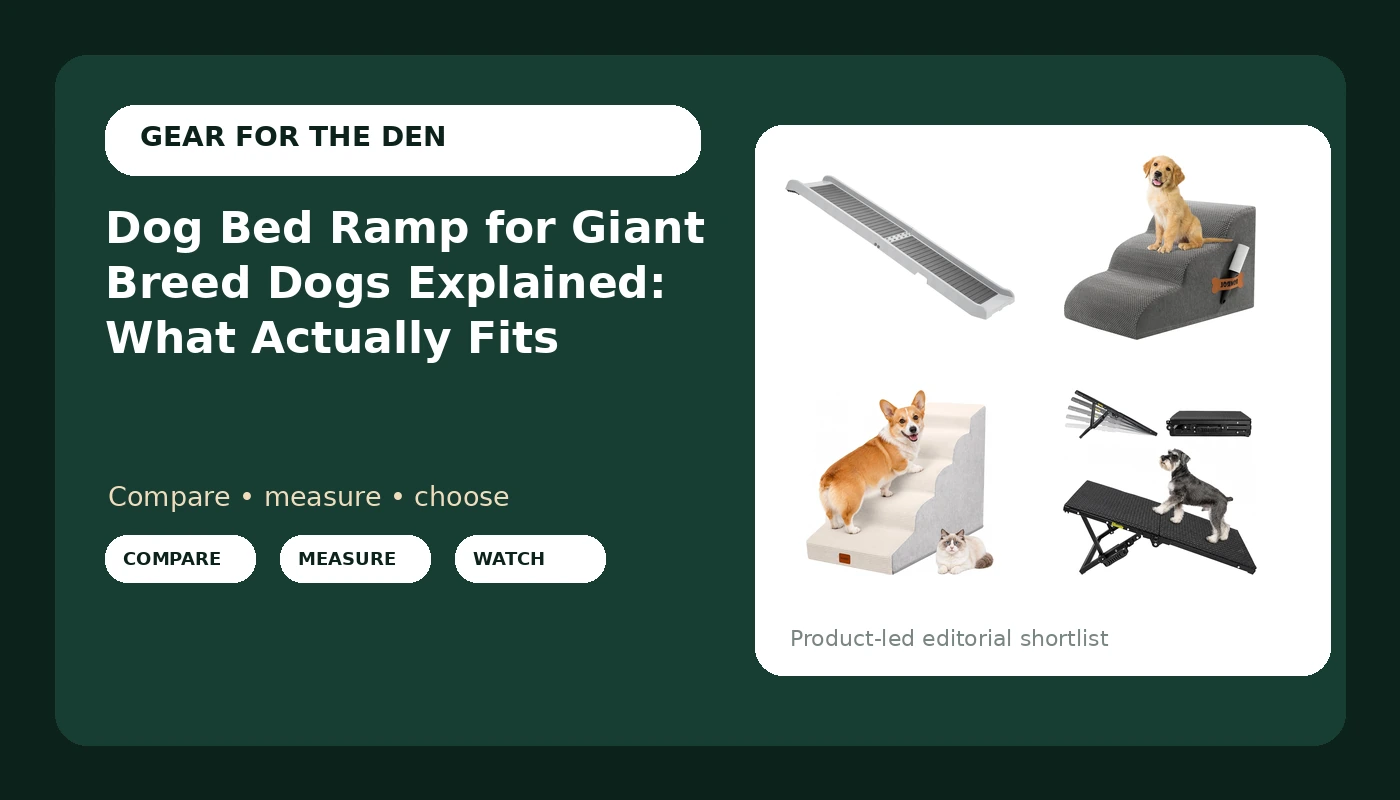
Getting a 150 pound dog onto a bed is a different problem from getting a 15 pound dog onto a couch, and the gear that solves it is different too. A dog bed ramp for giant breed dogs has to carry real mass, span a taller rise, and offer a surface wide enough for a paw the size of a saucer. Most ramps sold for beds are designed around small dogs and cats, which is why so many listings look right at a glance and then turn out to be rated well below what a Mastiff, a Great Dane, or a Newfoundland needs. Think of this as the dog bed ramp for giant breed dogs explained in plain terms: measure the bed, weigh the dog, then match the gear to both.
Quick answer
Giant breed bed access comes down to three numbers: the bed height you are bridging, your dog's weight, and the length and width of the walking surface. Of the options here, the WeatherTech PetRamp is the one built around very large dogs, with a 67 inch length, a 15 inch width, and a listing that describes capacity for dogs up to 300 pounds. The step sets and the short ramp in this group are sized for small dogs, cats, and lower furniture, so they answer a different question. Before you buy anything, check the listed weight capacity against your dog and think about the ramp angle the product will create at your bed height. The correct dog bed ramp for giant breed dogs is the one whose capacity, run, and surface all match your dog and your furniture.
Four useful options
| Model | Best fit | What stands out |
|---|---|---|
| WeatherTech PetRamp | Giant breeds and high beds | 67 inch length, 15 inch width, traction grip surface, described for dogs to 300 pounds |
| Romrol Dog Stairs Ramp for High Bed | Small dogs, cats, and lower beds | Three steps with a 15.7 inch rise and a waterproof fabric cover |
| NAPWAYS Dog Stairs for Large Dog | Large dogs and senior joints | Five steps at 22.6 inches, high density foam, washable cover |
| VKWJYOS Dog Ramp for Bed Couch | Small dogs at low furniture | 33.2 inch length and 12.8 inch width |
The full-length ramp: WeatherTech PetRamp
Length matters more than almost anything else on a ramp because of geometry. A bed that sits high off the floor demands a longer run if the ramp angle is going to stay gentle enough for a heavy dog to walk up rather than haul itself forward with the front legs. A 67 inch ramp provides that run, and the 15 inch width gives a giant breed room to place a paw without stepping off the edge. The trade-off is footprint and handling: a ramp this long occupies real floor space in a bedroom and is more awkward to move than a short step set. If your bed sits high and your dog is heavy, that is usually a trade worth making. If you are also sorting out what the dog sleeps on, our guide to orthopedic dog beds for large breeds covers support surfaces.
The compact step option: Romrol Dog Stairs Ramp for High Bed
This one is here as a reference point rather than a giant breed solution. The listing describes a 15.7 inch rise and a three step design aimed at small dogs, cats, and pets with joint concerns, with a waterproof fabric cover that is easy to wipe down. For a giant breed the problem is not the concept, it is the scale, because a short product with small pet intent is not sized for 150 pounds of dog. Where it fits is a multi pet home, a smaller dog that shares the bed, or a low platform. Steps also shorten the footprint compared with a long ramp, which matters in a tight room, but every step asks the dog to lift its own weight instead of walking a slope.
The foam step option for large dogs: NAPWAYS Dog Stairs for Large Dog
Foam density is the number most buyers never see, and it is the one that decides whether a step set holds firm under a heavy dog or slowly compresses into a soft wedge. This set uses high density foam with a washable cover and reaches 22.6 inches across five steps, and the listing describes it for injured and senior pets. That combination suits a large dog that needs hip support and a shorter climb than a full length ramp, and the cover matters in a house where a senior dog occasionally has an accident on the way up. The catch is that five steps at 22.6 inches still means repeated lifting, which is harder on joint mobility than a gentle slope. A dog with a diagnosed condition should be assessed by a veterinarian before you settle on steps.
The short bed and couch ramp: VKWJYOS Dog Ramp for Bed Couch
A 33.2 inch ramp is short, and short means steep once you add height. That is not a flaw, it is a design choice: this ramp is described for small dogs at a bed or couch, where the drop is low enough that a shallow run still works. For a giant breed it would be the wrong tool on two counts, the run and the listed intent. It is still worth understanding, because the same logic runs in reverse for the WeatherTech ramp: the taller the furniture, the more length you need. If a small dog shares the house, this is the category to look at, and our guide to dog ramps and stairs for small dogs goes deeper on that end of the market.
Prices and availability may change. Product images, names, and retailer links are matched to verified listings. No current price, rating, stock status, or measured result is stated here without current evidence.
What a dog bed ramp for giant breed dogs has to solve
Ramp angle is the first constraint. Every ramp converts a vertical rise into a slope, and the longer the run, the shallower that slope becomes. A giant breed carries enough mass that a steep climb loads the shoulders and wrists heavily, so the practical goal is a ramp long enough that the dog can walk rather than scramble. Bed height is the input you control least, which makes ramp length the variable you adjust.
Weight capacity is the second. Listings describe capacity in different ways, some as a maximum dog weight, some as a structural rating, and the wording matters. A ramp described for dogs to 300 pounds is telling you something specific about its intended load. A step set described for small dogs is telling you the opposite, no matter how sturdy it looks in a photograph.
Surface and stability are the third. A non-slip backing keeps the base from sliding when a heavy dog pushes off, and a traction walking surface keeps paws from slipping on the way up. Width matters more for giant breeds than most buyers expect, because a narrow ramp forces the dog to walk a line rather than place its feet naturally.
Then there is the senior dog layer. Hip support and joint mobility change the calculus, because a dog with arthritis may do better with a shallow ramp than with steps that require a lift and a landing on every rise. Foam density determines whether a step set stays firm under that weight or bottoms out. None of this is exotic, but all of it has to line up at once, and that is why there is no single ideal dog bed ramp for giant breed dogs.
Matching the gear to your dog and your bed
Work through these in order before you add anything to a cart.
- Measure the bed height from the floor to the top of the mattress, including any topper, because that number sets the rise the ramp has to cover.
- Weigh your dog on a scale you trust rather than guessing, and add margin if the dog is young and still filling out.
- Compare that weight with the listed weight capacity on the product page, and treat vague capacity language as a reason to keep looking.
- Check the run and the ramp angle it produces, remembering that a longer ramp over the same rise is always the gentler option.
- Check the landing and the base: a non-slip backing, a top edge that meets the mattress, and enough width for the dog to stand naturally.
Practical setup and safety notes
- Position the ramp or steps so the top edge sits level with the mattress and cannot slide away from the bed frame under load.
- Keep the walking surface clean and dry, since grit and damp reduce grip on any traction surface.
- Give a giant breed a wide approach lane, because a narrow landing zone makes the climb harder than it needs to be.
- Watch how your dog uses the product for the first week and adjust the placement rather than pushing the dog to adapt.
- If your dog is a senior with diagnosed joint disease, treat the ramp as one part of a plan that includes your veterinarian's advice.
Which option should you choose?
Choose the WeatherTech PetRamp when you have a giant breed, a high bed, and the floor space for a 67 inch run. Choose the NAPWAYS Dog Stairs for Large Dog when your dog is large rather than giant, the bed sits high, and you want a foam step set with a washable cover and a 22.6 inch climb. Choose the Romrol Dog Stairs Ramp for High Bed when the pet on the bed is a small dog or cat, or a pet with joint concerns, and the rise is short enough for a 15.7 inch product. Choose the VKWJYOS Dog Ramp for Bed Couch when the drop is low and the dog is small.
One caveat worth stating plainly: the listings in this group do not publish every number that matters. Foam density is often described in words rather than figures, and capacity claims vary in how they are worded. If your dog sits at the top of a product's described range, or if a veterinarian has diagnosed joint disease, treat the listing as a starting point and confirm the details before you commit.
The bottom line
For a giant breed, length and listed capacity do most of the work. A long ramp lowers the ramp angle, a wide surface lets a big dog place its feet, and a traction top with a non-slip backing keeps the whole setup steady under load. The WeatherTech PetRamp is the option in this group built around that set of requirements. The step sets and the short ramp are honest tools for smaller dogs and lower furniture, and they are worth knowing about if you share the bed with more than one pet. Measure the bed, weigh the dog, and let those two numbers pick the product rather than the other way around.