A large dog holds far more water than a small one, and that water sits in places a towel cannot easily reach: deep in the undercoat along the spine, behind the ears, under the belly, and around the tail base. Towels handle the surface. Everything below it is a tool question. This guide is about choosing a dog dryer for large dogs, which comes down to airflow, control, and coat type long before it comes down to brand names.
Quick answer
Match the dryer to the coat before you match it to the dog's weight. A high-velocity blower that pushes a strong, adjustable stream of air drives water out of a dense undercoat faster than heat alone, and heat is the part most likely to bother a dog. Prioritize stepless or multi-speed control, a nozzle set that can reach skin level, and a hose long enough that the machine is not fighting you. That is dog dryer for large dogs explained in one line: buy airflow and control first, then decide whether you also want vacuuming, a simpler kit, or a wider spread of nozzles.
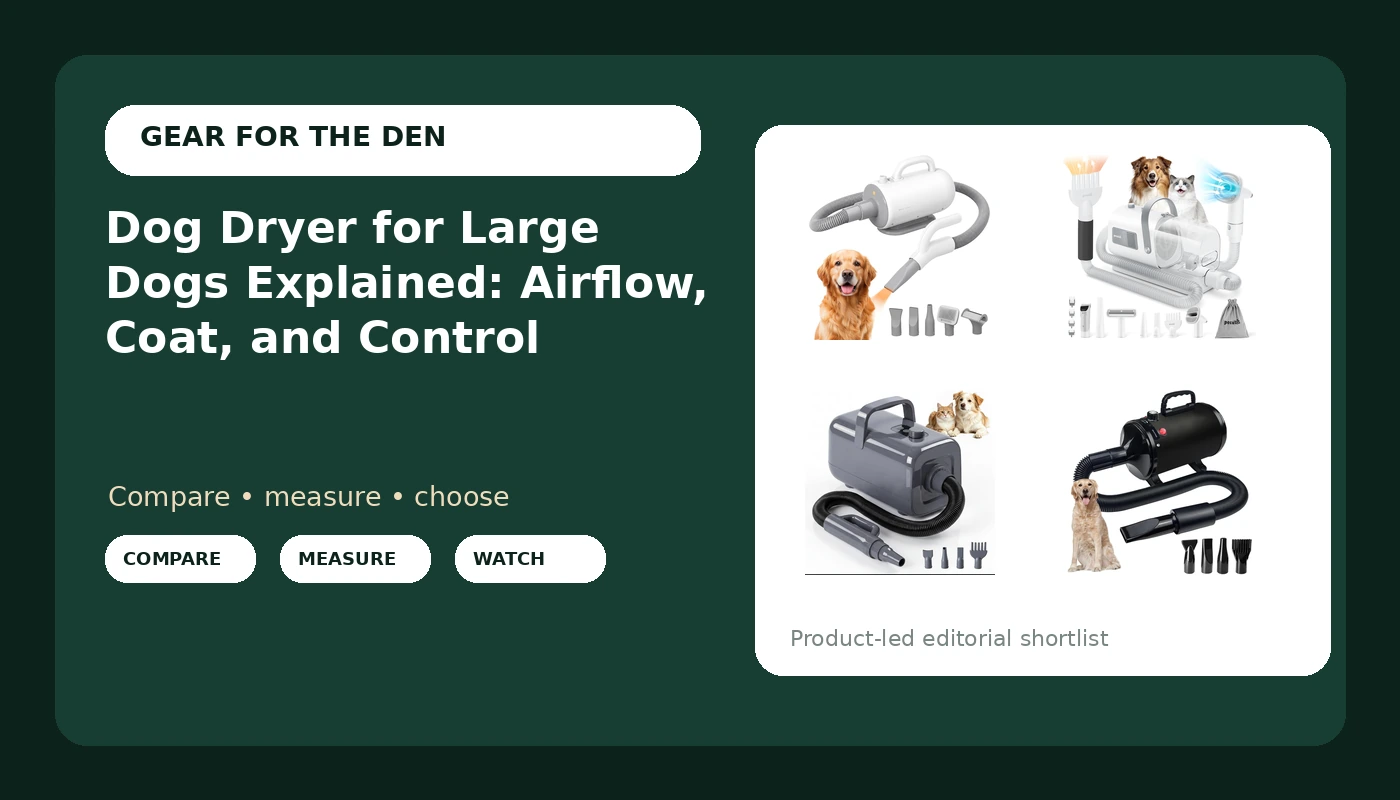
Four useful options
| Model | Best fit | What stands out |
|---|---|---|
| Sevy Whoosh Dog Dryer | Homes that need one dryer to cover different coats and body zones | Stepless speed, 4 temperature settings, 5 nozzles, negative ion design |
| Pecute 7-in-1 Dog Grooming Vacuum & Dryer for Heavy Shedding | Dogs whose shedding is as much of a problem as wet coat | Combines a grooming vacuum with a dryer in a 7-in-1 kit |
| DUMOS Dog Dryer for Pet Grooming Kit, Dog Blow Dryer with 4 Nozzles | Short and moderate coats, and simple routines | Compact kit with a blow dryer body and 4 nozzles |
| Dog Dryer for Pet Grooming, High-Velocity Force Blow Dryer | Bulk water removal on a big coat before detail work | High-velocity force blower format |
Adjustable control: Sevy Whoosh Dog Dryer
Stepless speed is the feature that separates a dryer you can use on a nervous first-timer from one you cannot. With this one you can start low, let the dog settle, and open the airflow as the coat sheds water, and the four temperature settings let you work warm without pushing hot air straight at skin. Five nozzles cover the range a large dog needs: a wide tip for the back and flanks, a narrow tip for paws and the space behind the ears. As with any high-velocity blower, motor noise is part of the deal, so introduce the sound from a distance before you point it at the dog.
Dry and vacuum: Pecute 7-in-1 Dog Grooming Vacuum & Dryer for Heavy Shedding
Heavy shedding is a grooming problem before it is a drying problem. Pulling loose hair out of the undercoat before the bath means less of it loosens into the air while you dry, which is the appeal of a combo tool. The trade-off is complexity: a 7-in-1 machine has more parts, more attachments to store, and a canister or filter to empty on a schedule. If your routine is already a full groom rather than a quick rinse, that trade is usually worth it. If you only ever need moving air, it is not.
Simple kit: DUMOS Dog Dryer for Pet Grooming Kit
For a large dog with a short or moderate coat, a simple kit is often enough, and a tool that is easy to set up gets used more often than one that needs assembly. The limitation is adjustment. Four nozzle shapes and a simpler control set mean more of the work falls to your hands, your angle, and your patience, and a very dense undercoat will take longer to clear than it would with a wider spread of tips. That is a fair trade for a dog that dries quickly anyway.
High velocity: Dog Dryer for Pet Grooming, High-Velocity Force Blow Dryer
Used well, the first pass does most of the drying and the finishing pass with a narrower tip does the rest. The trade-off is that a single-purpose blower gives you nothing for the shedding side of grooming, and the emphasis on force means you should keep the nozzle moving rather than holding it against the skin. Force is only useful when the air can escape past the coat.
Prices and availability may change. Product images, names, and retailer links are matched to verified listings. No current price, rating, stock status, or measured result is stated here without current evidence.
What makes a dog dryer for large dogs different
Three things separate a large-dog drying job from a small one, and none of them is the size of the motor alone.
The first is volume of coat. A large dog with a double coat has an undercoat that traps water against the skin, and warm air alone will not lift it out. What moves that water is airflow: a strong, focused stream that pushes between the hairs and drives water toward the tips, where a towel or the floor can take it. This is why there is no single ideal dog dryer for large dogs. The coat in front of you sets the requirement.
The second is surface area. More dog means more drying time, and drying time is where patience runs out, which is why control matters as much as raw power. Being able to dial airflow down for the face and up for the body keeps a long session tolerable for both of you.
The third is noise. High-velocity blowers are loud by design, and motor noise is the most common reason a dog refuses to stand still. Distance, a low starting speed, and a steady supply of treats do more for cooperation than any specification on a box.
Matching airflow and nozzles to coat type
Coat type decides which nozzle you reach for, and it decides how much of the job the dryer can do on its own.
A short, single coat on a large dog dries quickly with a wide nozzle and moderate airflow. Water sits near the surface and moves easily.
A double coat with a dense undercoat is the hard case. Start with a wide nozzle to break up the coat and clear the bulk, then switch to a narrower tip to work along the spine and down the sides in the direction the hair grows. Keep the tip moving at all times.
A curly or woolly coat holds water in clumps. Work in sections, and expect to come back over the legs, chest, and tail more than once.
Whatever the coat, the order is the same: back and flanks first, then legs, belly, and tail, and the head and ears last on the lowest airflow you can manage.
Two related tools are worth keeping straight. A brush with the right bristle type helps lift and separate a coat before drying, and if your routine includes clipping, blade guard sizes belong to the clipper rather than the dryer. Neither replaces airflow. They just make airflow work better.
- Towel the dog thoroughly before the dryer comes out, because a large dog can shed a surprising amount of water into a towel.
- Set the dryer to its lowest speed and let the dog hear it from a few feet away before you point it anywhere.
- Dry the body first, following the direction of hair growth, and keep the nozzle several inches off the skin.
- Switch to a narrow nozzle for the legs, paws, belly, and the space behind the ears.
- Finish with the head and face on the lowest setting, then check the skin under the collar and around the tail base for damp patches.
Practical guidance for drying a large dog at home
- Bath first, then dry. Shampoo choice is a separate decision, and if you use an oatmeal-based product, oatmeal concentration matters for itchy skin but not for drying time.
- Work in a contained space. A bathroom or a garage corner with a non-slip mat keeps a wet large dog from shaking water across the house. A bathing routine for large dogs is worth sorting out before you buy a dryer at all.
- Use the grip handle rather than the body of the machine, and loop the hose over your forearm so you can change angle without fighting the weight.
- Dry in short sessions with breaks if your dog is anxious, and never hold a nozzle in one spot against the skin.
- Clean or replace filters as the manual directs, since reduced airflow is often a maintenance problem rather than a motor problem.
Which option should you choose?
Choose the Sevy Whoosh Dog Dryer when you want the widest range of adjustment and you plan to dry one large dog at home or in a small grooming setup. Choose the Pecute 7-in-1 Dog Grooming Vacuum & Dryer for Heavy Shedding when shedding is as much of a problem as wet coat and you would rather run one tool than three. Choose the DUMOS Dog Dryer for Pet Grooming Kit when your dog's coat is short or moderate and you want a simple blower with a few nozzle options. Choose the Dog Dryer for Pet Grooming, High-Velocity Force Blow Dryer when the job is bulk water removal on a big coat and you want a single-purpose blower for it. The correct dog dryer for large dogs is the one that matches your dog's coat and your tolerance for noise, not the one with the longest feature list.
None of these listings is claimed here as the quietest or the fastest, and no measured drying time is stated for any of them. Motor noise, actual airflow, and drying time vary with the coat in front of you, the room you work in, and how the tool is used. Treat the specifications as a starting point and the fit with your dog as the deciding factor.
The bottom line
For a large dog, the dryer that works is the one that gives you airflow you can control and nozzles that reach the skin, because that combination is what actually removes water from an undercoat. The Sevy Whoosh covers the widest range of adjustments, the Pecute folds drying and shedding cleanup into one machine, the DUMOS keeps the kit simple, and the high-velocity force blower does the first pass on a big coat with nothing extra attached. Start with coat type, decide how much control you want in your hand, and let that narrow the field.