Dog food storage is usually framed as a container problem, and the container is part of it. But the bag, the scoop, the bowl, and the feeder all sit between the kibble and the dog, and each one decides how long that food stays exposed to air, moisture, and heat. A large bag of kibble starts losing aroma the moment it is opened, and a bowl that sits out all afternoon does the same thing on a smaller scale. Get the storage basics right and the feeding gear becomes much easier to judge. This guide covers what actually matters in dog food storage, then looks at four pieces of feeding gear that handle food in different ways.
Quick answer
Dog food storage explained in one line: keep kibble in the bag it came in, put that bag inside a container with an airtight seal, store it somewhere cool and dry, and never leave more food in a bowl than the dog will finish in a day or two. The gear matters because that is where the food waits between the bag and the dog. A gravity feeder holds a reserve and releases it as the tray empties, a slow feeder spreads one meal across slow feed ridges so it takes longer to eat, and a puzzle toy turns part of a meal into work. None of these replaces a sealed container, but each one changes how long food stays exposed.
Four useful options
| Model | Best fit | What stands out |
|---|---|---|
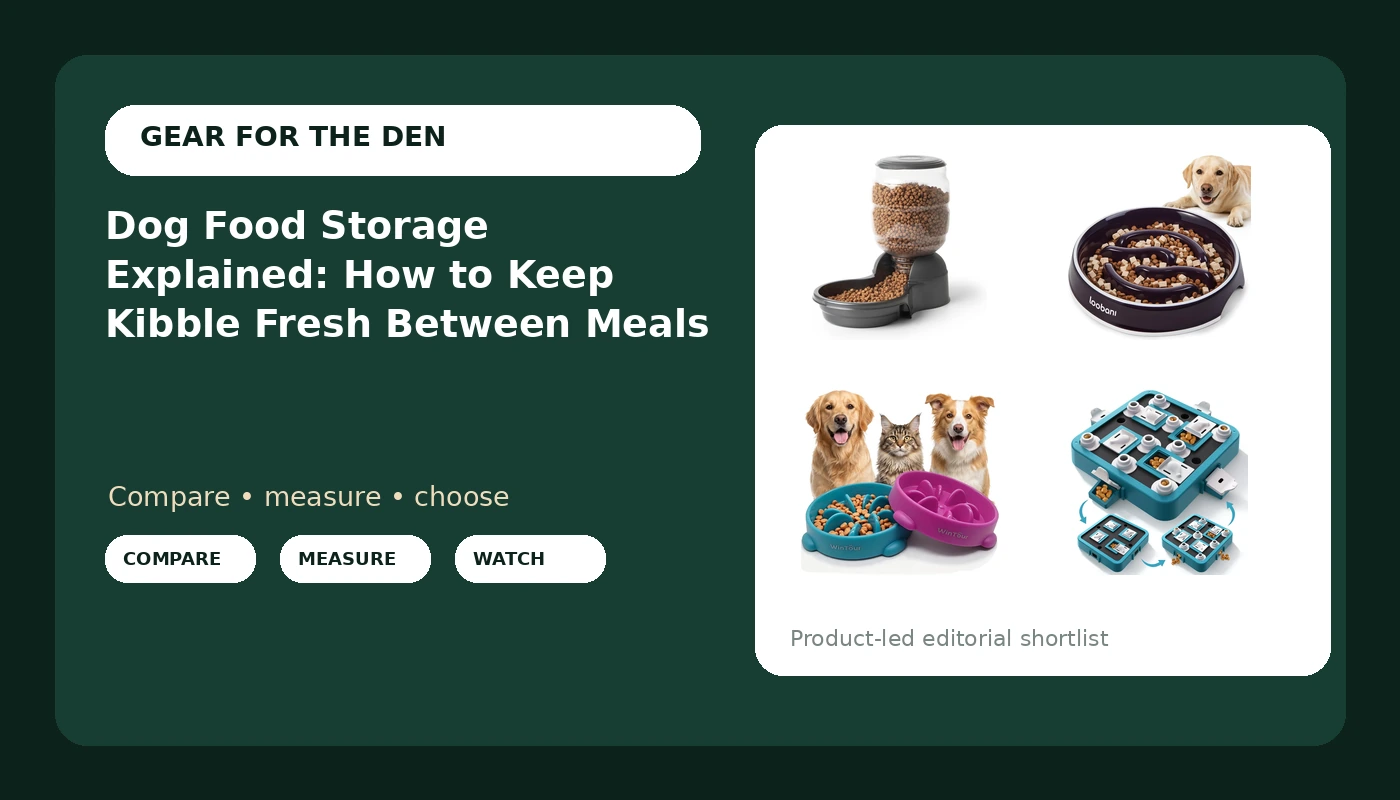
| Petmate Replendish Gravity Dog Feeder, 5lbs, Microban Antimicrobial Base | Households that want a standing reserve of kibble | A 5 lb gravity reservoir on a Microban antimicrobial base |
| LOOBANI 3.5 Cups Ceramic Slow Feeder Dog Bowls Large Dogs with Grip Handles | Large dogs that finish a meal in seconds | A 3.5 cup ceramic bowl with grip handles |
| WinTour 2 Pack Slow Feeder Dog Bowls, BPA Free, Medium & Small Dog Bowls | Two-dog homes and smaller breeds | Two BPA free slow feeder bowls in one pack |
| Aluckmao Dog Puzzle Toy Large Size – Adjustable Levels Food & Treat Game | Dogs that need mealtime to take longer | Adjustable difficulty levels for food and treats |
The bulk-hold option: Petmate Replendish Gravity Dog Feeder, 5lbs, Microban Antimicrobial Base
The appeal here is a steady supply. A dog that grazes can walk up whenever it wants, and you refill the reservoir instead of scooping twice a day. That is also the trade-off. Food sitting in an open tray is exposed to air continuously, so a 5 lb reservoir suits a household that will work through it quickly better than a single small dog that eats half a cup a day. A gravity feeder is not a fountain: there is no pump and no filter cartridge to replace, and food rather than water is what moves through the mechanism. Clean the tray and the reservoir on a schedule, because a feeder that is topped up without ever being washed is a storage problem rather than a storage solution.
The ceramic option for large dogs: LOOBANI 3.5 Cups Ceramic Slow Feeder Dog Bowls Large Dogs with Grip Handles
Slow feeders work by geometry rather than by tricking the dog. The food is spread across a maze of ridges, so the dog has to work around the obstacles to reach each mouthful. That does not change what is in the bowl, only how quickly it disappears. Bowl capacity is the first number to check, because a 3.5 cup bowl is a large-dog size, and a small dog will struggle to reach food at the bottom of a deep design. Feeding height matters too: a bowl this size sits low, so a very tall dog eats with its neck angled down unless it is raised on a stand. Ceramic is often listed as dishwasher safe, but confirm it on the listing before you assume.
The two-bowl set for smaller dogs: WinTour 2 Pack Slow Feeder Dog Bowls, BPA Free, Medium & Small Dog Bowls
If you have two dogs of different sizes, matching the bowl to the dog matters more than matching the bowls to each other. A medium-and-small set suits a pair of similar dogs. A large dog paired with a small one usually needs two different bowls, which is where a set like this stops being the right answer. Look for a non slip base on smooth floors, since a slow feeder that slides across the kitchen defeats its own purpose. Two bowls also make rotation easier: wash one while the other is in use, and food never sits in a dirty bowl for days.
The enrichment option: Aluckmao Dog Puzzle Toy Large Size – Adjustable Levels Food & Treat Game
Puzzles sit at the edge of this topic because they change how food is delivered without changing how it is stored. A dog eating from a puzzle is still eating from the same bag, but the meal takes longer and the food is handled more. Use dry kibble or treats, keep track of how much goes in so the daily ration stays accurate, and wash the toy when it gets greasy. Residue left in the crevices is exactly the kind of thing a sealed container in the cupboard cannot protect against.
Prices and availability may change. Product images, names, and retailer links are matched to verified listings. No current price, rating, stock status, or measured result is stated here without current evidence.
What dog food storage actually involves
The bag is the best container you already own. Kibble bags are built with a barrier layer that resists oxygen and grease, and most decorative bins are not. If you pour food into a bin, keep the bag inside it: the bag carries the lot code and the date guidance, and it does more to slow staling than the plastic around it.
An airtight seal means a gasket or a screw-on lid, not a lid that merely sits flat. Press-fit lids on storage bins keep a dog out, which is a different job, and they let air in every time the bin is opened. If the container has no seal, the bag inside it is doing the work.
Do not top off. Empty the container, wash it, dry it completely, and refill. Kibble leaves oil and fine crumbs behind, and those crumbs are the first thing to go stale. Topping up a bin with fresh food means the oldest particles stay at the bottom indefinitely, and every scoop carries some of them back to the bowl.
Heat, light, and moisture do more damage than air alone. A garage shelf in summer or a spot beside a dishwasher swings in temperature, and condensation can form inside a sealed bin when that happens. A cool, dark cupboard is the default answer for a reason.
Use one scoop, and keep it out of the bin. A scoop stored in the food transfers moisture and oils from your hands into the kibble every time you reach for it. Keep it beside the container and wash it when you wash the bin.
Finally, check the bag for the manufacturer's guidance on how long the food stays at its best after opening, and write the opening date on the container. That single habit tells you more than any feature printed on a bin.
How to judge ideal dog food storage for your kitchen
Ideal dog food storage is a fit question: fit for the bag, fit for the dog, and fit for the space you actually have. Work through these five decisions before buying anything.
- Measure the bag you buy most often, then choose a container that holds it with the bag still inside.
- Check the lid. A gasket or screw top is the feature that matters, not the size printed on the side.
- Pick the location first: cool, dark, dry, and out of the dog's reach between meals.
- Set the daily ration with one consistent scoop or scale, then match bowl capacity to that portion so nothing is left sitting out.
- Build a cleaning routine around refills, and treat every refill as a chance to wash the bin, the scoop, and the bowls.
Practical guidance for correct dog food storage
Correct dog food storage comes down to a short routine rather than a special container.
- Keep the original bag inside the sealed bin, and never pour kibble straight into an unlined plastic tote.
- Wash the bin, the scoop, and the bowls on a schedule, not when they look dirty.
- Match the feeder to the eating style: a gravity feeder for a grazer, a slow feeder for a dog that finishes in seconds, a puzzle for a dog that needs the meal to last.
- Watch the food itself. If kibble smells rancid or feels damp, the storage setup failed somewhere, and the bowls need washing too.
- Keep water separate from food storage. A water bowl or gravity waterer has its own water capacity to plan for, and a splash into a food bin is a problem you do not want.
Which option should you choose?
Choose the Petmate Replendish Gravity Dog Feeder, 5lbs, Microban Antimicrobial Base when you want a standing reserve and have a dog that eats steadily through the day. Choose the LOOBANI 3.5 Cups Ceramic Slow Feeder Dog Bowls Large Dogs with Grip Handles when you have a large dog that eats too fast and you want a heavier bowl that stays where you put it. Choose the WinTour 2 Pack Slow Feeder Dog Bowls, BPA Free, Medium & Small Dog Bowls when you have two smaller dogs eating at once, or you want a spare bowl in rotation. Choose the Aluckmao Dog Puzzle Toy Large Size – Adjustable Levels Food & Treat Game when the goal is a longer mealtime rather than a slower bowl.
None of these products stores food for you, and none of them is a substitute for a sealed container in a cool cupboard. Treat the feeder as the last step in the chain: sealed storage first, portion control second, delivery third. Confirm current specifications on each listing, since materials, capacity, and care instructions can change between production runs.
The bottom line
Dog food storage is mostly about limiting exposure: keep kibble in its bag, seal the bag inside a container, keep that container cool and dark, and put out only what the dog will eat in a day or two. The feeding gear decides what happens after that. A gravity feeder keeps a reserve available but leaves food in an open tray, so it fits households that go through kibble quickly. A slow feeder spreads a meal across ridges and slows a fast eater without changing the food. A puzzle toy stretches a portion into an activity. Pick the one that matches how your dog eats, then wash it often enough that the gear never becomes the weak link in the storage chain.