Few things in dog ownership generate more laundry than the coat cycle, and dog shedding is the part of that cycle owners actually see. Hair grows, holds in a growth phase for weeks or months, dies, and falls out, while a new hair pushes through behind it. That turnover never fully stops. What changes with the season, the breed, the indoor lighting, and the dog's general health is how much of it ends up on your floor. Double-coated breeds tend to blow coat hard twice a year, while single-coated breeds shed at a steadier, lower rate all year. Knowing which pattern your dog follows is the difference between a grooming problem, a nutrition question, and something a veterinarian should look at. This guide covers the mechanics, the labels, and the buying decisions that follow from both.
Quick answer
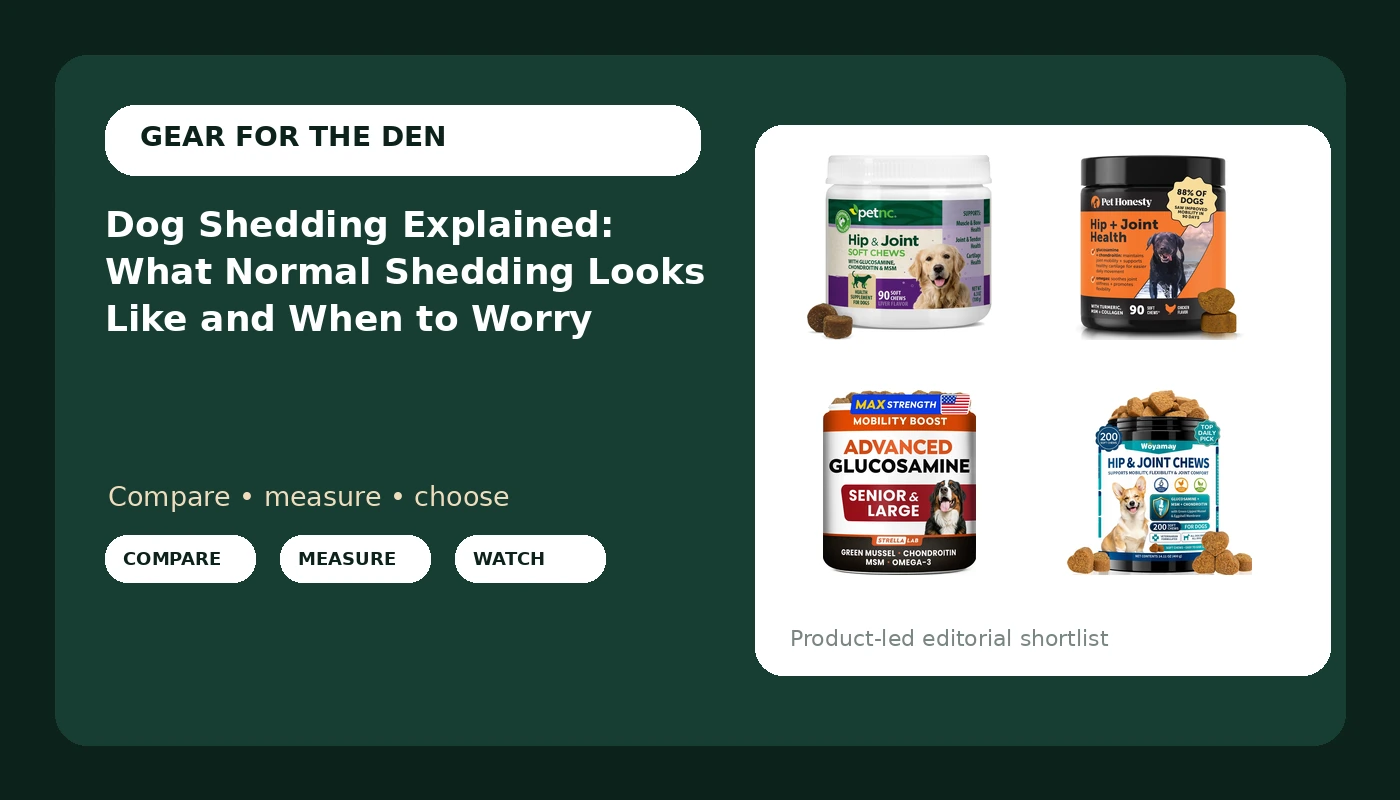
Most shedding is normal and is managed with brushing, bathing, and a complete diet. It deserves a veterinary look when it starts suddenly, turns patchy, or arrives with itching, bald spots, or skin changes. There is no universal ideal dog shedding rate, because coat type, season, and how much time a dog spends indoors under artificial light all move the baseline. What reads as correct dog shedding on a husky would be a red flag on a poodle. The four supplements below are joint and mobility products, not shedding treatments. They appear here because readers working through the skin and coat category often need to keep a senior or large dog moving comfortably at the same time, and because their ingredient lists are a useful place to practice label reading.
Four useful options
| Model | Best fit | What stands out |
|---|---|---|
| PetNC Natural Care Hip and Joint Soft Chews for Dogs, 90 Count – 27591 | A first soft chew routine | 90-count bottle in a soft chew format |
| Pet Honesty Vet Recommended Hip and Joint Supplement for Dogs, 90 Count | Shoppers who weigh vet positioning | 90-count bottle; vet-recommended positioning in the product name |
| STRELLALAB Advanced Glucosamine for Dogs, Collagen&Green Lipped Mussel | Collagen and mussel on the label | Names collagen and green lipped mussel alongside glucosamine |
| Woyamay Joint Supplement for Dogs, Glucosamine for Dogs, 200 Soft Chews | Multi-dog homes and long routines | 200 soft chews in one bottle |
Entry-level soft chews: PetNC Natural Care Hip and Joint Soft Chews for Dogs, 90 Count – 27591
The trade-off with any soft chew is compliance. A supplement only helps if the dog eats it, and a chew that gets sniffed and abandoned is money on the floor. Start with one and watch. Chews also carry calories, so if your dog is on a measured ration, subtract them rather than adding them on top; extra weight is one of the few things that reliably makes joint discomfort worse. Keep expectations calibrated as well: this is a hip and joint product, and nothing on its label claims to change how much hair your dog drops.
Vet-positioned label: Pet Honesty Vet Recommended Hip and Joint Supplement for Dogs, 90 Count
Vet recommended is one of the most common phrases on a supplement label, and it is worth knowing what it does and does not tell you. It does not say which veterinarian, how many, or what they reviewed. Treat it as positioning and go straight to the ingredient list and the guaranteed analysis. If your own vet has a preference, that opinion is worth more than a phrase printed above the logo. The 90-count bottle is a practical size, so the real decision between this option and the entry-level chew comes down to the formula and the price you see at checkout.
Collagen and mussel formula: STRELLALAB Advanced Glucosamine for Dogs, Collagen&Green Lipped Mussel
Collagen and green lipped mussel show up in joint products partly because mussel is a shellfish ingredient that also carries omega 3 fatty acids, which is where joint and coat shopping overlap. That overlap is real but narrow. A joint chew is not a coat supplement, and it is not a substitute for a complete diet or for a fish oil product with a stated EPA DHA figure on the label. What the front of this label does give you is transparency about headline ingredients, which makes it a good candidate for a side by side comparison against the other bottles here.
Large-count bottle: Woyamay Joint Supplement for Dogs, Glucosamine for Dogs, 200 Soft Chews
Bottle size is the quiet variable in supplement shopping. A 200-count bottle means fewer reorders and a lower cost per chew if the product suits your dog, but it also means a longer stretch of storage. Chews can dry out once opened, so keep the lid tight and store the bottle away from heat. If your dog has never taken a soft chew before, buying the biggest bottle first is a gamble. A smaller bottle is the cheaper way to find out whether the routine survives week two.
Prices and availability may change. Product images, names, and retailer links are matched to verified listings. No current price, rating, stock status, or measured result is stated here without current evidence.
What actually drives dog shedding
Dog shedding explained in one line: it is a light and hormone driven hair cycle, not a skin disease. Each follicle moves through growth, transition, and rest. During rest the old hair is dead but still anchored; when the next growth phase begins, a new hair pushes the old one out. Because follicles do not cycle in sync, most dogs drop a little hair every day. Seasonal blowouts happen when day length shifts and a large share of follicles change phase at once, which is why spring and autumn produce the worst weeks. Dogs kept under long artificial light often shed more evenly across the year and less dramatically in any single month.
Coat type shapes the pattern more than breed size does. Double-coated dogs carry a soft undercoat plus a longer guard coat, and they dump the undercoat in concentrated bursts. Single-coated dogs shed continuously at a lower volume. Curly and continuously growing coats, like a poodle's, tend to trap shed hair inside the coat instead of releasing it onto the floor, which trades loose hair for matting risk. Hairless breeds shed very little but need skin care instead.
Health and nutrition sit underneath all of it. Parasites, allergies, yeast overgrowth, hormonal conditions, stress, pregnancy, and some medications can all push a coat into a heavier or patchier shed. Sudden changes, bald spots, itching, redness, or scabs are veterinary questions, not shopping questions. On the nutrition side, hair is mostly protein, and a diet short on protein or fat shows up as a dull, brittle coat. Omega 3 fatty acids, listed on labels as EPA DHA, are the usual supplement lever for skin and coat condition, and they support general inflammation control as well.
How to read a skin and coat label
The supplement aisle mixes joint, skin, calming, and digestive products, and the front of the bottle is written to sell rather than to inform. Work from the back forward.
- Read the ingredient list before the front panel. Ingredient order reflects relative amount, and a proprietary blend that hides individual amounts tells you less than a label that lists them.
- Find the omega 3 line. A product that states omega 3 as EPA DHA in milligrams is more useful than one that lists fish oil as a single lump.
- Match the format and the bottle size to your dog. Soft chews, powders, capsules, and oils suit different dogs; divide the count in the bottle by the chews per day to see how long it actually lasts.
- Count the calories. Chews are food, so subtract them from the daily ration instead of adding them, because extra weight is hard on joints.
- Change one thing at a time and give it weeks, not days. If nothing changes over six to eight weeks, or your dog gets worse, stop and call your vet.
Living with a heavy shedder
- Brush to coat type. An undercoat rake suits a double coat in blowout season, while a rubber curry or a soft bristle brush suits a short single coat.
- Bathe on a schedule, and judge a shampoo by its oatmeal concentration rather than by the word oatmeal on the front of the bottle.
- Wash bedding weekly and use a washable cover on the dog's usual spot, because loose hair concentrates where the dog rests.
- If you use a topical coat or flea product, confirm it is lick safe before the dog grooms itself, and keep the dog separated from other pets until it dries.
- Store chews and supplements as directed, keep the lid tight, and note the bottle size against your dog's daily dose so you are not caught short mid-routine.
Which option should you choose?
Choose the PetNC Natural Care Hip and Joint Soft Chews for Dogs, 90 Count – 27591 when you want a low-commitment soft chew and your dog already takes treats by hand. Choose the Pet Honesty Vet Recommended Hip and Joint Supplement for Dogs, 90 Count when a vet-positioned name matters to you, while remembering that the claim lives in the product title and the ingredient list is the real evidence. Choose the STRELLALAB Advanced Glucosamine for Dogs, Collagen&Green Lipped Mussel when you specifically want collagen and green lipped mussel named in the formula. Choose the Woyamay Joint Supplement for Dogs, Glucosamine for Dogs, 200 Soft Chews when a 200-count bottle suits a multi-dog home or a dog already on a daily chew routine.
None of these four products is a shedding treatment, and none of them should be bought to fix a coat problem. If you suspect a food sensitivity, a limited ingredient diet trial is a conversation with your vet rather than a shelf decision. If the coat is greasy, smelly, or inflamed, a medicated shampoo from a veterinarian will do more than any chew. Supplement names and formulas change, so re-read the label each time you reorder.
The bottom line
Dog shedding is a normal hair cycle driven by light, hormones, coat type, and general health, and most of it is managed with a brush, a bath schedule, and a complete diet. Sudden, patchy, or itchy hair loss belongs with your veterinarian. If you are shopping the skin and coat category and also want to keep an older or larger dog moving comfortably, the four joint supplements here cover the practical range: a soft chew starter bottle, a vet-positioned label, a formula that names collagen and mussel, and a large 200-count bottle for households that go through chews quickly. Check the ingredient list, count the calories, and give any change several weeks before you judge it.