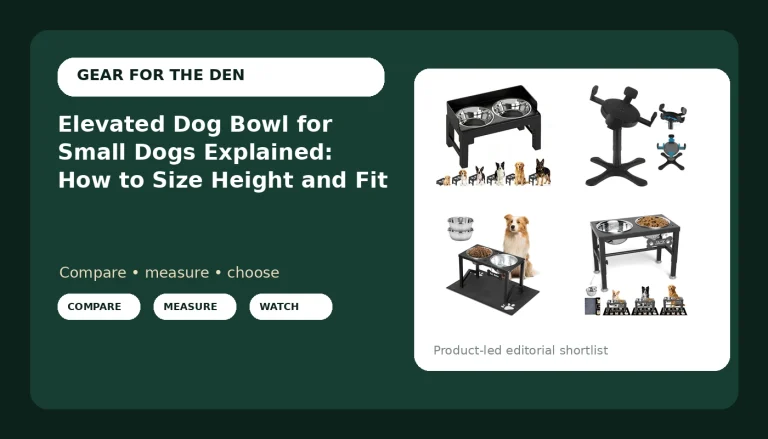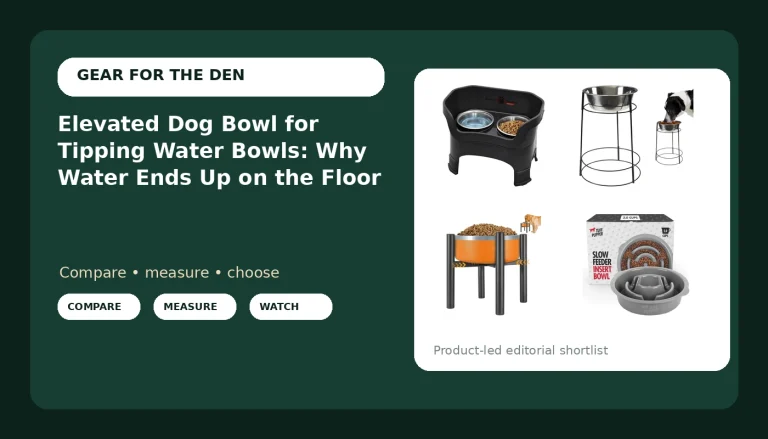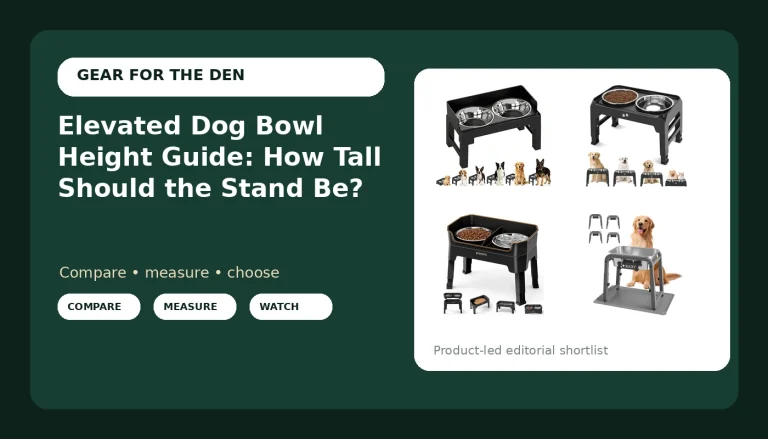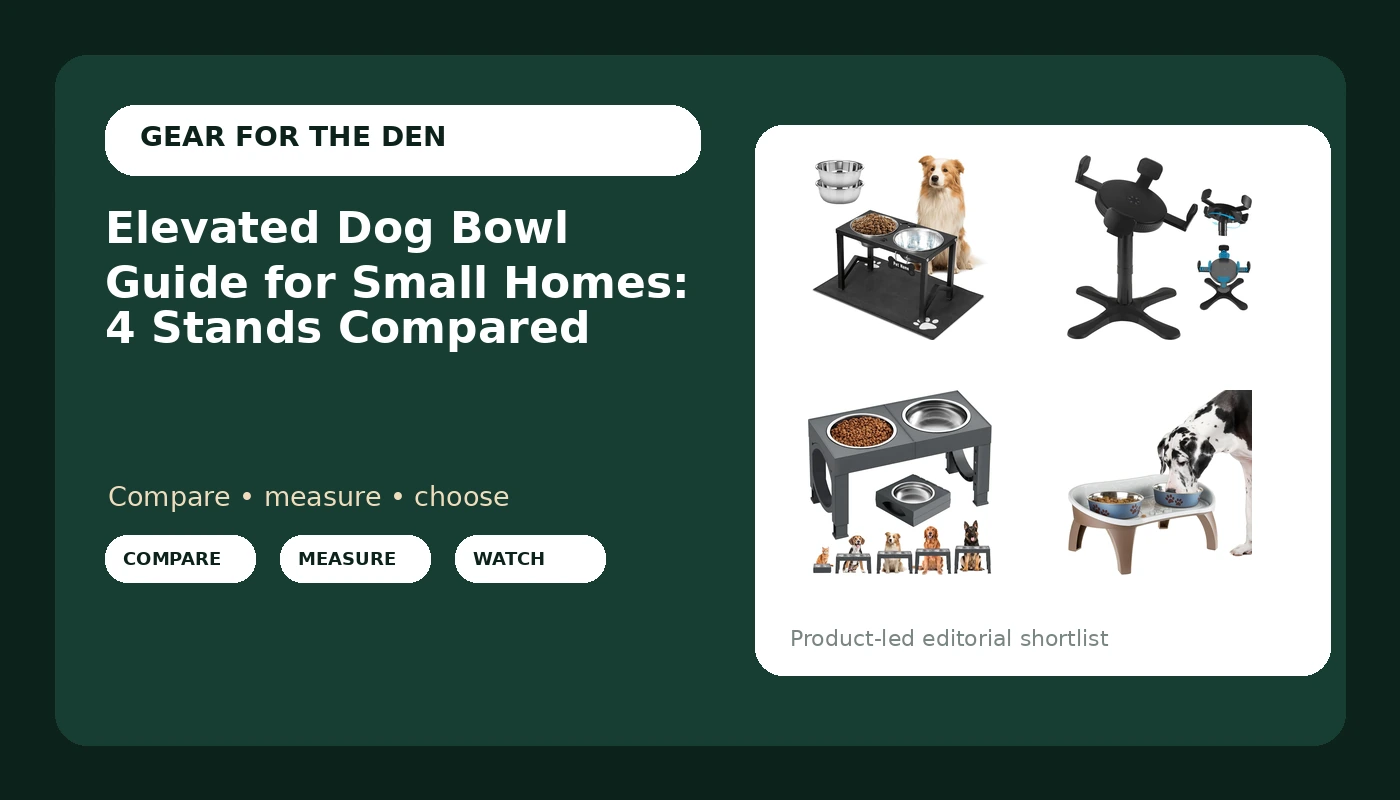
A real elevated dog bowl guide for small homes starts with a tape measure, not a shopping cart. Floor space runs out first in a small place, and a raised feeder is one of the few pieces of dog gear that gives some back: a single stand holds two bowls in a footprint smaller than the pair of bowls currently sliding around your kitchen floor. Get the feeding height wrong and you have added a shin-height trip hazard. Get it right and your dog eats with a level neck while you stop mopping under the bowls.
I have set up raised feeders in apartments, in a hallway that doubled as a dining room, and in a kitchen whose only free wall sat behind a door. The four stands below are the ones I would shortlist for a small home, and each solves the problem differently: a two-bowl station, an adjustable tilting stand, a five-height tower, and a wide splash-guarded tray.
Best Overall: Flodomix Elevated Dog Bowls, Metal Raised Dog Bowl Stand with 2 Thick 58oz Stainless Steel Food Bowls & Non-Slip Mat – 11.8" Tall for Medium/Large Breeds
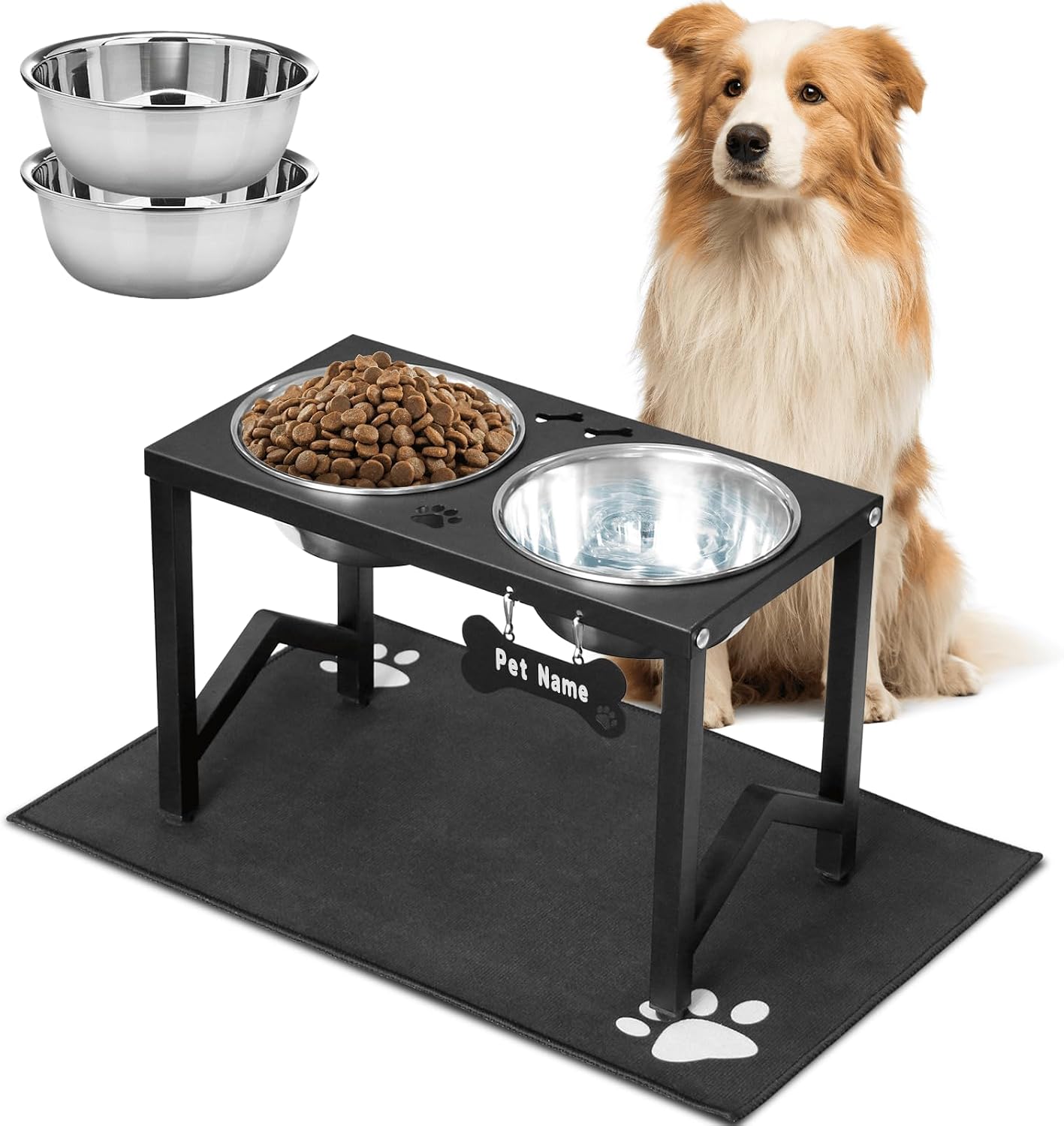
This is the stand I would buy first for an apartment with a medium or large dog, because it answers the two questions a small home asks at the same time: where does the water go, and where does the food go. One metal stand, 11.8 inches tall, two 58-ounce stainless steel bowls, and a non-slip mat underneath to catch the splash. Two bowls in one footprint is the whole trick. You are not hunting for a second spot along the wall, and you are not stepping over a water bowl parked in the middle of the kitchen.
Bowl capacity is the number people skip. Fifty-eight ounces per bowl is enough water capacity that you are not refilling at lunch, and enough food capacity that a large dog's dinner fits without a second scoop and a second trip to the bin. Stainless steel is the right material for both jobs, since it does not hold odors and it is dishwasher safe, which matters more in a small kitchen where the sink is usually full.
The 11.8-inch height suits most medium and large breeds, and the non slip base keeps the station planted on tile and vinyl, the two floors that make bowls skate. The mat is the quiet hero. It contains the drips that would otherwise turn into a slick patch under your feet.
Where you put it matters as much as what you buy. In a small home, the station belongs against a wall the dog can approach head-on, not in a corner where the dog has to eat sideways with its shoulder pressed into a cabinet. Leave room behind the stand for a tail to wag without knocking the bowls. If the only flat wall is beside the fridge, check that the bowls still clear the door swing.
The trade-off is that 11.8 inches is the height, full stop. There is no adjustment, so it is wrong for a small dog and marginal for a very tall one. It is also wider than a single bowl, which matters if you are tucking it into a narrow gap.
Best Value: Dog Bowls Elevated Adjustable Stand, Raised Bowl with 3 Heights & Tilted Feeding Stand, Compatible with Various Bowls, for Medium & Large Breeds (1 Pack) Black
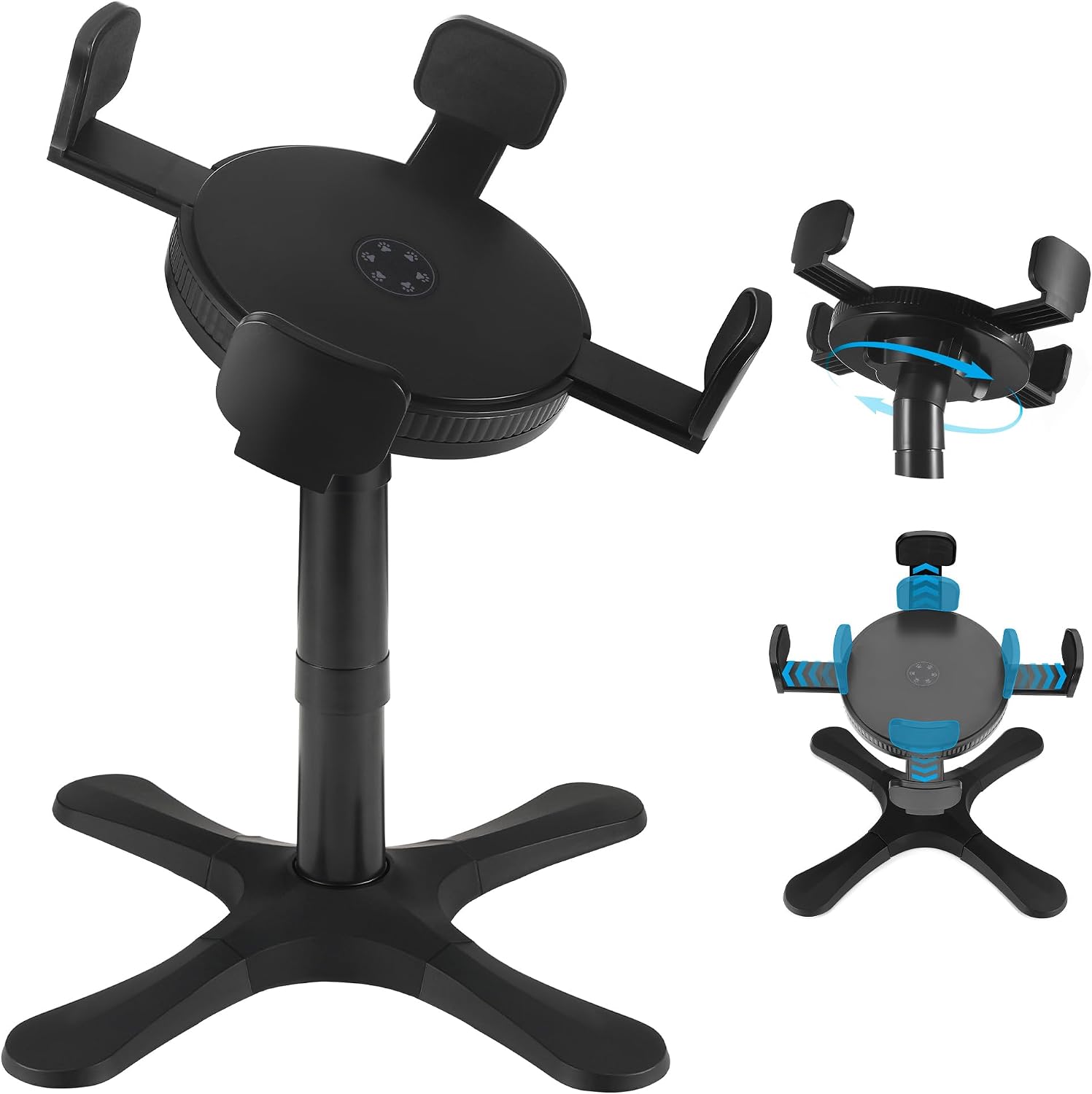
If you already own bowls you like, start here. This is the stand only, one pack, no bowls in the box, and that is the point: three heights and a tilted platform that accepts various bowls, so you can drop in the stainless bowl you already have, a slow feed bowl with ridges for a dog who inhales dinner, or a wide water bowl for a heavy drinker.
Three heights is more useful than it sounds in a small home. The same stand serves a growing puppy and the adult dog it becomes, and you can fine-tune the feeding height instead of accepting whatever a fixed stand gives you. The tilt is the second feature worth paying for. A tilted bowl lets a dog eat with the neck lower and the shoulders more open, which is why senior dogs and deep-chested dogs tend to do better with one.
The compromises are real. No bowls in the box means the total cost depends on what you already own, and the tilt is not for every dog. Some dogs push a tilted bowl across the platform, and a messy drinker can send water over the front edge. Three heights is also fewer than the tallest adjustable stands offer, so measure your dog before you commit.
How I tested
I test raised feeders the same way every time, and every check is something you can repeat in your own kitchen in an afternoon.
The tape measure comes first. I measure the dog at the shoulder, then check where the bowl rim lands at each height setting. The goal is a rim that sits near the lower chest, so the dog eats with a straight, level neck instead of reaching down or craning up. Then I measure the floor: the footprint of the stand, the clearance to the wall, and whether a door can still open past it.
Then the live tests. I set the stand on tile and on vinyl, load both bowls to a realistic level, and watch whether the non slip base holds when a dog eats with enthusiasm. I check the splash zone, because in a small home a splash guard or a mat is the difference between a quick wipe and a full mop. I check bowl capacity against the dog's daily water capacity. I check whether the bowls are dishwasher safe, and whether the stand accepts bowls you already own.
I also swap bowls to see how the stand behaves with something other than what came in the box. A slow feed bowl with ridges is heavier and wider than a standard stainless bowl, and a fountain bowl holds more water capacity than one you refill twice a day. If a stand only works with its own bowls, that is worth knowing before you buy.
Then I live with it for a week: filled, emptied, washed, refilled, and tripped over. A stand that is awkward to refill is a stand you stop using, no matter how good the listing looks. The ideal elevated dog bowl guide for small homes is boring on purpose: measure the dog, measure the floor, load the bowls, and watch what happens.
Analysis and test results
The four stands split into two families: fixed-height stations that arrive with bowls, and adjustable stands that expect you to bring your own. That single difference decides most of the buying decision.
Adjustability is worth more in a small home than it looks. A fixed stand is a bet that your dog's feeding height today is the feeding height you want in two years. With a puppy, a dog recovering from surgery, or a household with two very different dogs, an adjustable stand is the only one that keeps working. The XIAZ stand covers the widest range, the tilted stand covers the middle, and the Flodomix and the PETMAKER tray are fixed by design.
Bowls included is the other half of the equation. A station that arrives with two stainless bowls is a finished purchase: unbox, fill, done. A stand that arrives without bowls costs less up front, but you need bowls that fit, and "fits" is not universal. The upside is that you choose the bowl, which is the only way to get slow feed ridges or a specific water capacity.
Footprint is where small homes get surprised. A two-bowl station takes roughly the floor space of a small chair, and it does not fold away. That is still less space than two separate bowls drifting apart, but it is more than a single bowl. The PETMAKER tray is the widest of the four and the most forgiving, because the tray and splash guard keep the mess inside the footprint instead of spreading it across the floor.
Cleaning is the part nobody photographs. Two stainless bowls and a mat take three minutes at the sink and then go in the dishwasher. A stand that arrives without bowls means you are washing whatever you own, which is fine until a bowl does not fit the ring. In a small kitchen with one sink, fewer parts to wash is a genuine advantage, and it is the reason the two-bowl station wins on cleanup even though it is the least adjustable.
The small stuff decides the rest. A non slip base on tile is not a luxury, it is the difference between a feeder and a hockey puck. Dishwasher safe bowls save you the hand wash. And in a small kitchen, an airtight seal on the food bin and a fresh filter cartridge in the water fountain matter as much as the stand does, because both are the reason you are not storing a second bucket of gear.
The correct elevated dog bowl guide for small homes is decided by adjustability and bowl capacity more than by looks. Everything else is preference.
The elevated dog bowl guide for small homes: sizing and height chart
Every height and capacity below comes from the product listing. The small-home notes are the things I check first.
| Stand | Heights | Bowls included | Small-home notes |
|---|---|---|---|
Flodomix Elevated Dog Bowls | 11.8 in, fixed | Two 58 oz stainless steel | One footprint for food and water; non slip mat catches the splash |
Dog Bowls Elevated Adjustable Stand | 3 heights, tilted platform | None; accepts various bowls | Best if you already own bowls; the tilt suits seniors and gulpers |
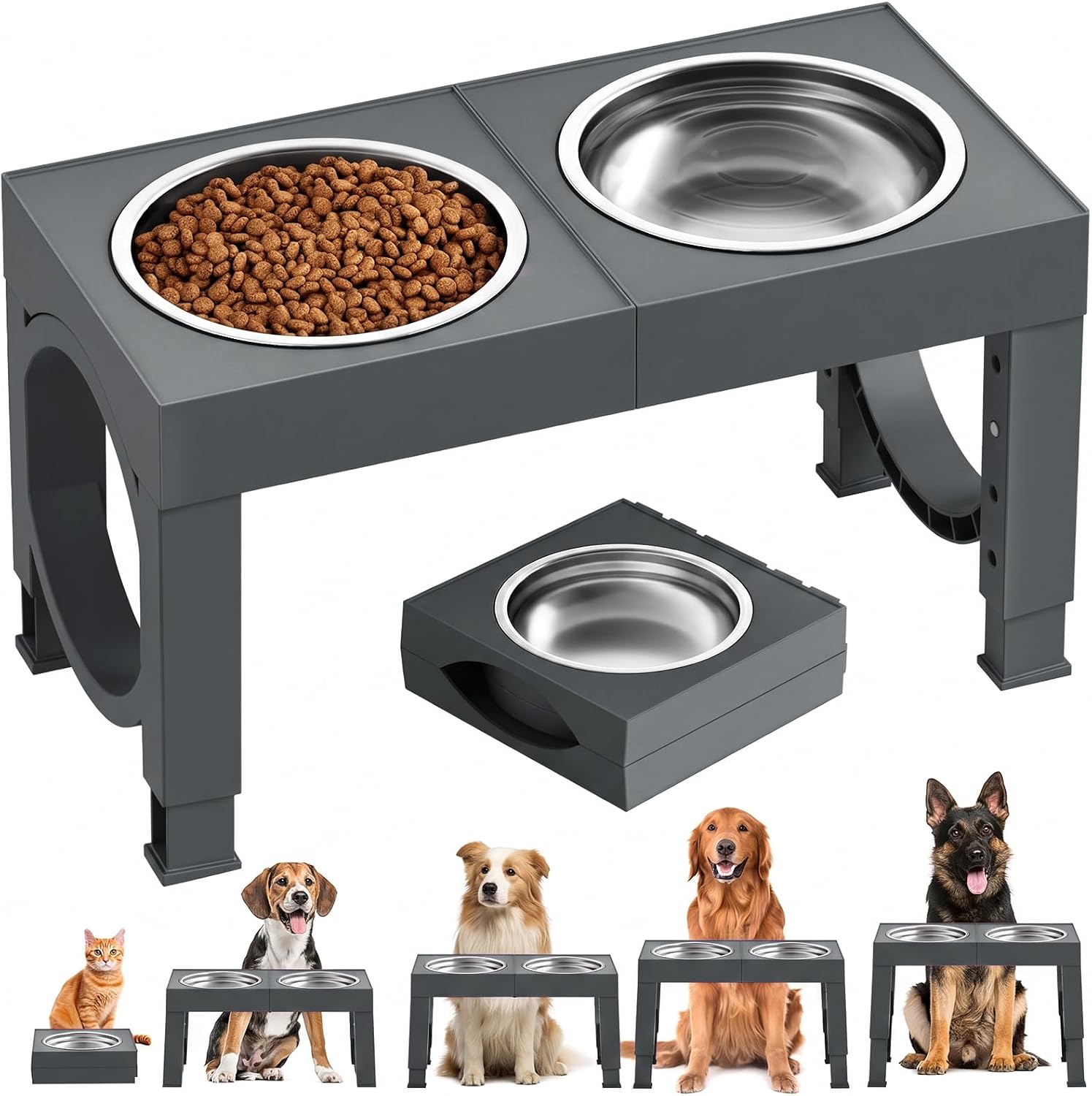 XIAZ Elevated Dog Bowls Large Breed | 5 heights, 9/11/12/14 in | Stainless steel food and water bowls | Widest height range; grows with a puppy and a large adult |
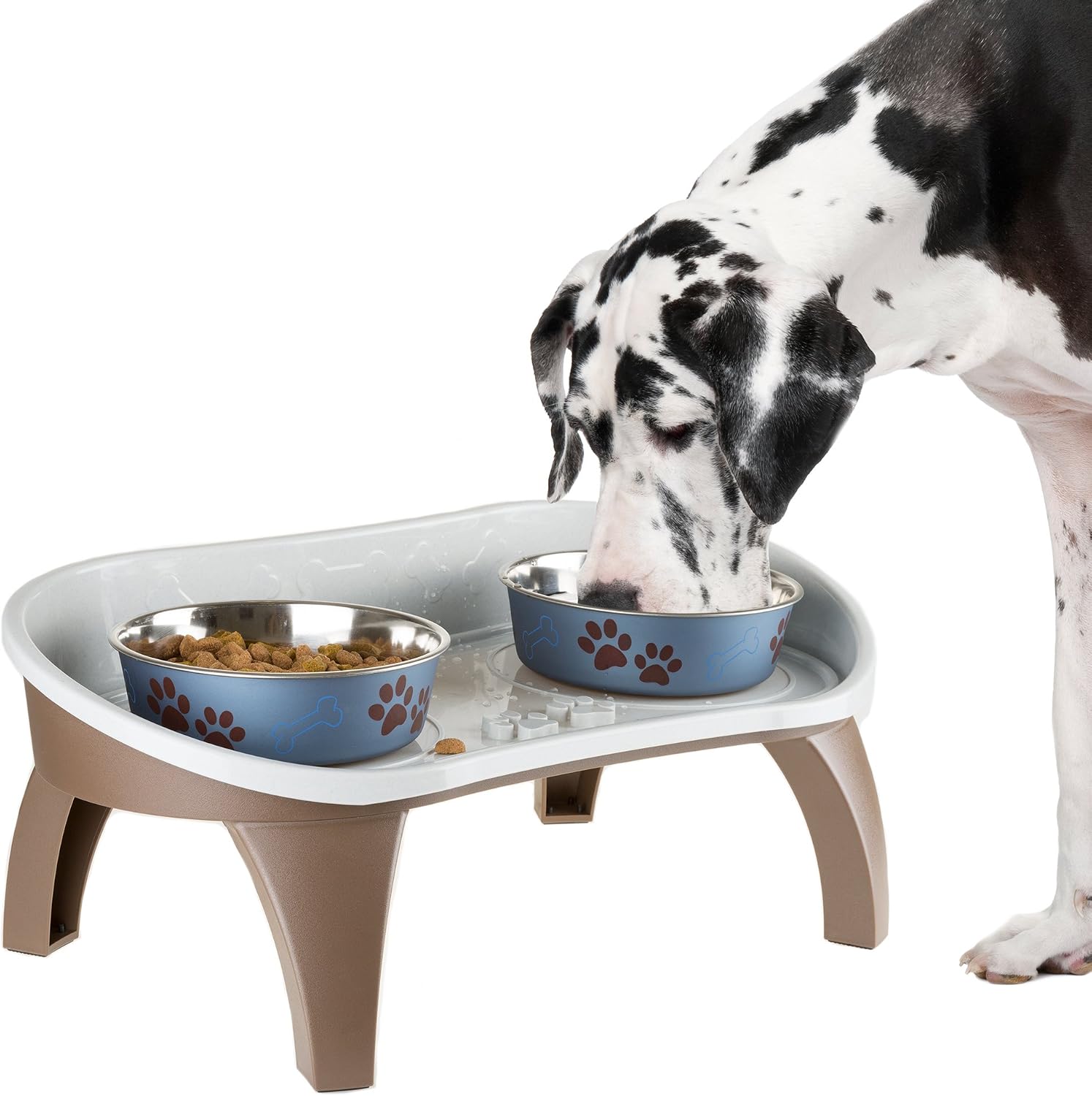 PETMAKER Elevated Pet Feeding Tray | 8.5 in, fixed | No bowls listed | 21 x 11 in tray with splash guard and non-skid feet; dogs and cats |
XIAZ Elevated Dog Bowls Large Breed: five heights in one station
The XIAZ is the one to buy if the dog is not finished growing, or if two dogs of different sizes share the kitchen. Five height settings, with the tallest at 14 inches, cover small, medium, and large dogs, and the stand arrives as a station with stainless steel food and water bowls rather than a bare frame. In a small home that range is insurance: you buy once, adjust as the dog grows, and you do not replace the stand when the puppy turns into a ninety-pound adult. The taller settings are the reason this one works for large breeds, and the reason it is a poor fit for a cat or a toy breed, where the bowl ends up at chest height.
PETMAKER Elevated Pet Feeding Tray: the tray that holds the mess
The PETMAKER is the low, wide option: a 21 by 11 inch tray, 8.5 inches tall, with a splash guard and non-skid feet. That 8.5-inch feeding height suits small and medium dogs, and it is the one stand here that the listing describes for cats as well as dogs, which is the useful part in a small apartment with both. The tray and splash guard are what sell it. Water lands in the tray instead of on the floor, and the raised lip keeps kibble from scattering into the corners. The trade-off is the footprint. This is the largest of the four across the floor, and 8.5 inches is too low for a large dog. A proper elevated dog bowl guide for small homes has to account for the water bowl, not just dinner, and this tray is the one that treats the water bowl as the main event.
Should you buy the Flodomix Elevated Dog Bowls?
Yes, if you have a medium or large dog and you want the feeding station settled in one purchase. Two 58-ounce stainless bowls, a metal stand at 11.8 inches, and a non-slip mat cover food, water, splash, and sliding in a single footprint, which is exactly what a small home needs. It is the least fussy option of the four.
Skip it if your dog is small, if you are still guessing at the right feeding height, or if you need the stand to fit a gap narrower than its two-bowl frame. There is no adjustment here, and no bowl choice either.
Should you buy the Dog Bowls Elevated Adjustable Stand?
Yes, if you already own bowls, if your dog is a gulper or a senior, or if you want a feeding height you can change. Three heights and a tilted platform that accepts various bowls make it the most flexible stand for the money, and the tilt is a genuine comfort feature rather than a gimmick.
Skip it if you want everything in one box, if your dog pushes bowls around, or if you need the tallest setting for a large breed. In that case, pay a little more for the XIAZ, or take the Flodomix if a fixed height suits your dog.