Most aquarium kits stop at the tank, so the lid is the piece people buy last, in a hurry, and often wrong. A hood is not a generic accessory. It has to match the footprint of the tank, clear the rim, leave room for a filter and a heater, and pass enough light for whatever you plan to keep. Buy the wrong one and you either fight it every time you feed the fish or you leave the tank open, which raises evaporation, dust, and the odds of a fish on the floor. This guide covers fish tank hoods in plain terms: what they actually do, how hood fit works on standard and rimless tanks, and which of the four products below makes sense for a given setup.
Quick answer
A hood is a lid sized to your tank's footprint, and it only works when the opening it covers matches. There is no single set of ideal fish tank hoods, because the right cover depends on the tank in front of you. On a standard 10 gallon glass tank with a molded rim, a cover sized 20 inches by 10 inches fits the opening. On a rimless tank there is usually no rim for a resting hood to grip, so a mesh lid or an open top is the common answer. Check the footprint first, then the rim, then the light.
4 useful options
| Model | Best fit | What stands out |
|---|---|---|
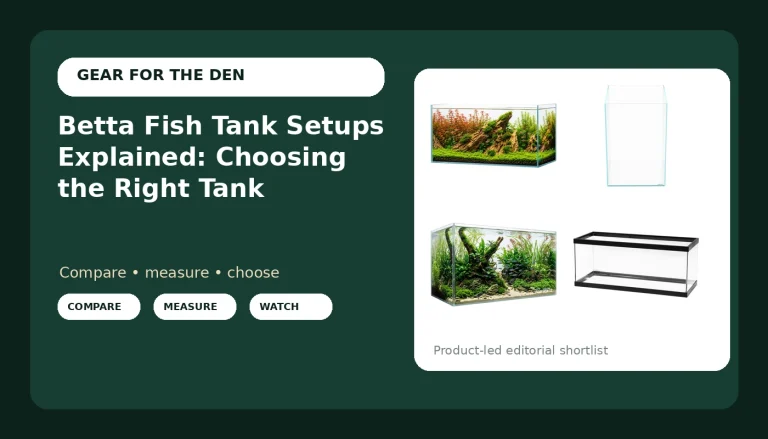
| Tetra LED Aquarium Hood 20 in x 10 in, Low-Profile Fish Tank Cover | Rimmed tanks with a 20 in x 10 in opening | Low-profile cover with an LED built into the lid |
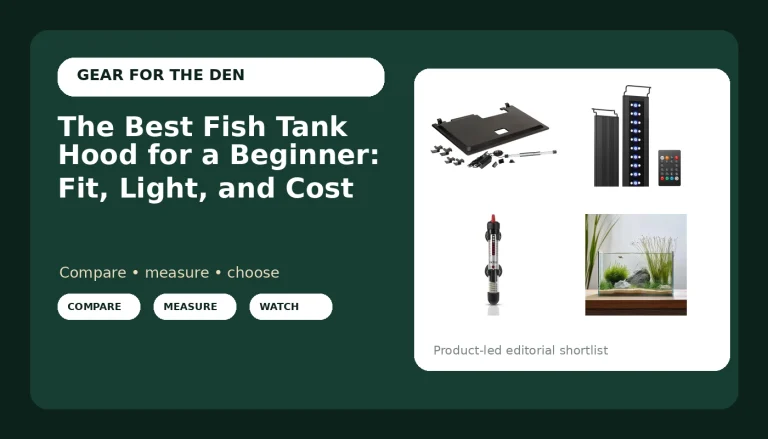
| Aquarium Tank, Glass, 10 Gal | A first freshwater tank that takes standard covers | Standard rectangular 10 gallon glass footprint |
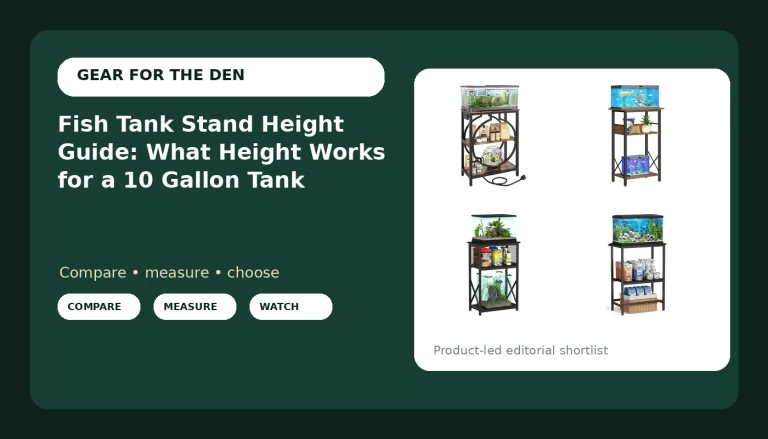
| Hjarta 10 Gallons Fish Tank, Ultra-Clear Rimless Aquarium | Open-top, view-first setups | Rimless ultra-clear glass with a bare top edge |
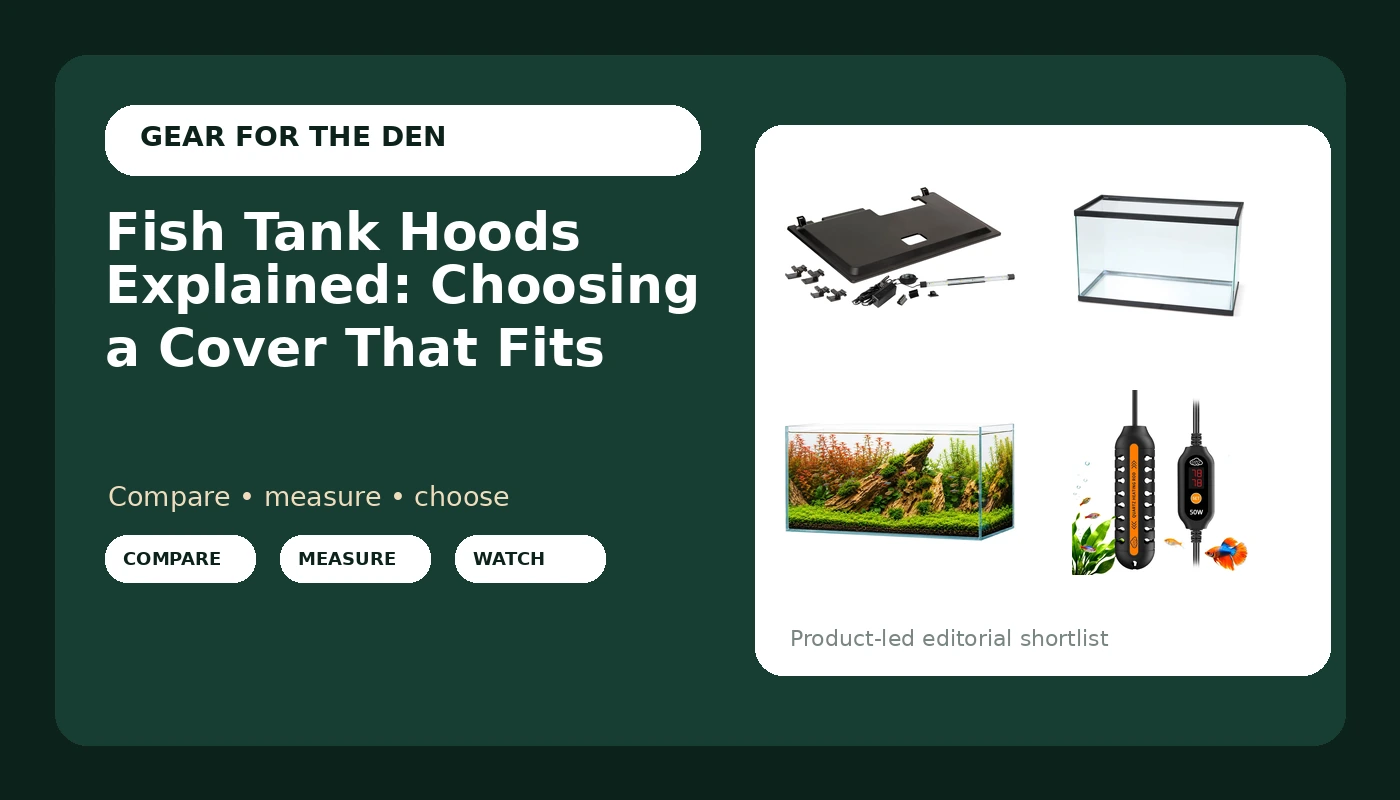
| QZQ Aquarium Heater, 50W Adjustable Fish Tank Heater with Digital Display | Small tanks that need a steady set point | Adjustable 50W heater with a digital display |
The hood: Tetra LED Aquarium Hood 20 in x 10 in, Low-Profile Fish Tank Cover
This hood answers the most common version of the question: a rimmed 10 gallon tank with a bare top. Its 20 in x 10 in size matches the standard 10 gallon footprint, so it drops onto the rim and closes the opening. The trade-off is flexibility. A molded hood is built for one footprint and one rim style, so it will not adapt to a rimless tank, a longer tank, or a tank with an unusually thick frame. Treat the built-in light as general viewing light for the room and for undemanding plants. If you plan to grow plants that need more intensity, check the light output before you commit, because the fixture is part of the lid.
The standard tank: Aquarium Tank, Glass, 10 Gal
This is the tank shape the whole cover market is built around. That matters for the equipment list more than it sounds. A standard footprint means hoods, glass lids, and mesh tops are all cut to fit it, and it also means you can estimate the stand load before you fill it. Tank volume is only the start of the weight question, because substrate depth, rock, and water all add to what the stand carries. Expect the first weeks to run long on maintenance while the cycle time finishes, and expect to have the lid off a lot during that stretch, which is one more reason to want a cover that lifts easily.
The rimless tank: Hjarta 10 Gallons Fish Tank, Ultra-Clear Rimless Aquarium
A rimless tank changes the cover question completely. With no rim along the top, a standard hood has nothing to sit on and nothing to grip. The top edge is bare glass, which is exactly why these tanks look the way they do and exactly why the cover options are narrower. Most rimless keepers run an open top with a light that clips to the glass, or they add a mesh lid that mounts on clips. Open tops look clean, but they evaporate faster, collect dust, and give a jumping fish a clear path out. If a closed top is non-negotiable for you, a rimmed tank is the easier starting point.
The heater: QZQ Aquarium Heater, 50W Adjustable Fish Tank Heater with Digital Display
A heater is the piece that most often conflicts with a hood. Heater wattage is chosen for the tank volume and for how much cooler the room runs than your target temperature, and a 50W adjustable unit is aimed at small tanks. The practical issue is placement: the heater needs water moving around it and a cord that leaves the tank without pinching under a lid. If you buy a hood, look at where its cutouts sit before you decide where the heater goes. A digital display helps because you can read the set point without lifting anything. For more on picking a size, see our guide to sizing a heater for a small tank.
Prices and availability may change. Product images, names, and retailer links are matched to verified listings. No current price, rating, stock status, or measured result is stated here without current evidence.
What fish tank hoods actually do
A hood does four jobs, and most buying mistakes come from caring about only one of them.
The first job is covering. A lid slows evaporation, keeps dust and pet hair out of the water, and keeps fish in. On a small tank, evaporation shows up fast as a dropping water line and as mineral rings on the glass.
The second job is light. Many hoods include an LED strip, which is the simplest way to light a tank because the light and the cover arrive as one part. For low-demand plants that is often enough. For plants that need more intensity, the built-in fixture can become the limiting factor in the whole setup.
The third job is access. You will open this thing every day, sometimes twice. A hinged section, a lift-off lid, or a feeding door all work. A cover that needs two hands and a cleared surface does not.
The fourth job is routing. Filters, heaters, and air lines all have to leave the tank. A hood with molded cutouts handles that cleanly. A flat glass lid usually means a notch or a gap instead.
What a hood does not do is filter water, hold temperature, or replace the filter media in your filter. It is a cover and a light, and it should be judged on fit.
Matching hood fit to tank volume and rim style
Hood fit comes down to two numbers and one shape. The numbers are the length and width of the opening. The shape is the rim.
Measure the outside of the tank and the inside of the opening, because they are not the same. A rimmed 10 gallon tank has a plastic frame that adds a little to the outside dimensions and narrows the opening a little. A cover sold as 20 in x 10 in is describing the footprint it was built for, not a universal size.
Tank volume matters mostly as a proxy for footprint. A 10 gallon tank in the standard rectangular shape is a known quantity, which is why so much equipment is made for it. Larger tanks often come with their own hood or canopy, and small tanks are frequently sold as kits with a lid included.
Rim style is the part people skip. A molded rim gives a hood something to sit on and gives a clip light something to grab. A rimless tank gives you neither, so the correct fish tank hoods for that tank are usually mesh lids, clip-on lights, or nothing at all.
- Measure the tank opening, inside and out, before you order anything.
- Identify the rim: molded plastic, thin trim, or bare glass.
- Decide what the light has to grow, then check whether the hood's fixture can do it.
- Plan the cutouts for the filter, the heater, and every cord that leaves the tank.
- Confirm you can open the lid one-handed, because you will do it daily.
Practical guidance before you buy
- Measure twice. The length and width of the opening, plus the height of the rim, decide whether a cover fits at all.
- Buy for the tank you have, not the tank you might upgrade to. A hood built for a 20 inch footprint is useless on a 24 inch tank.
- Leave room for cords. A hood that traps a heater cord against the rim will wear the insulation over time.
- Expect evaporation. An open or loosely covered tank needs top-offs more often, and the water you add should be treated the same way as water used for a change.
- Put the light on a timer and clean the cover with the glass. A tank that never gets a dark period grows algae faster, and mineral film on a lid cuts the light reaching the water.
Which option should you choose?
Choose the Tetra LED Aquarium Hood 20 in x 10 in, Low-Profile Fish Tank Cover when you have a standard 10 gallon rimmed tank and want the cover and the light handled in one purchase. Choose the Aquarium Tank, Glass, 10 Gal when you want a plain standard tank that accepts off-the-shelf hoods, glass lids, and mesh tops. Choose the Hjarta 10 Gallons Fish Tank, Ultra-Clear Rimless Aquarium when you want an open, clear view and are willing to run a clip light or a mesh lid instead of a molded hood. Choose the QZQ Aquarium Heater, 50W Adjustable Fish Tank Heater with Digital Display when your room runs cool and you need to hold a steady temperature in a small tank.
The honest limit here is that fit is specific. A hood that suits one 10 gallon tank can be wrong for another if the rim or the footprint differs, and no listing can tell you how a cover will sit on your particular tank. Check the measurements against your own tank before ordering, and treat these four items as a starting point rather than a matched set.
The bottom line
If you want fish tank hoods explained in a single sentence, it is this: match the cover to the opening, then match the light to what you plan to grow. A standard 10 gallon glass tank with a rim is the easy case, and a hood sized 20 in x 10 in covers it with a light built in. A rimless tank is the hard case, because there is no rim to sit on, so the answer is usually a clip light with a mesh lid or an open top. Sort out the footprint and the cord routing before you buy, and the rest of the setup gets simpler.