Most apartment cat trees fail for reasons that have nothing to do with the cat. The box arrives, the thing wobbles on a hardwood floor, it eats the only corner where the litter box could go, and by month three it is in the hallway with a free sign taped to it. Learning how to choose a cat tree for an apartment is mostly learning to measure first and shop second.
I write the cat gear guides here at Gear for the Den, and the emails I get are always the same shape. The cat ignores the tower. The tower tips when the cat jumps off. The tower will not fit through the door of the next apartment. None of those are cat problems. They are floor plan problems and hardware problems, and both are fixable before you spend anything.
This is the checklist I run before I recommend a tree to anyone in a rental, plus the three that pass it at three different budgets.
Why you should trust me
I have set up cat furniture in carpeted rentals, in apartments with 1970s vinyl glued over concrete, and in one studio where the only usable wall was a shared closet door. The lessons repeat. A tree with a small base and a tall platform is a lever, and a lever on a smooth floor goes over. A tree with a huge base and a low platform stays upright and gets ignored, and an ignored cat scratches the couch instead.
What I bring to this is not brand loyalty. It is a tape measure, a stud finder, and the habit of reading the spec sheet for the numbers the marketing photos leave out: post diameter, shelf depth, weight limit, and what the base actually measures. I also have a strong opinion about hammock fabric, because a hammock cover you cannot wash is a hammock cover you will throw away.
Where I cannot verify a claim, I say so. Where a tree only makes sense for one specific floor plan, I say that too. This article is about fit, not about which brand has the prettiest catalog.
How I picked and how I tested
Before anything gets recommended for a rental, I check how to pick a cat tree for an apartment against the same short list of constraints. It is not a long list, but it eliminates most of the catalog.
The method starts with the base footprint, because that number decides whether the tree fits at all, and it is the number most listings bury under glamour shots. Then platform height, measured from the floor to the highest surface a cat can actually stand on, not to the top of a decorative finial.
Post diameter comes next. A sisal post under about three inches is a post an adult cat wraps a paw around and then gives up on. Diameter is what lets a cat stretch to full length, which is the entire point of a scratching post. Shelf depth and perch width decide whether the top level is a bed or a launching pad. The weight limit tells you what the structure is rated to hold, and the anchor type tells you whether the tree is meant to stand free or be strapped to a wall.
I also look at how the thing breaks down. If it does not come apart into flat panels or a stack of cubes, moving day is going to be miserable, and renters move. The same tape measure is worth using for carrier size before a vet trip, since a cat that will not go into the carrier is a cat that will not go to the vet.
I ran the three trees below through that list against their published specs, then compared them against each other for small-space use. No lab, no sensors, no pretending a living room is a test facility. Just the numbers that decide whether the thing stays upright.
What to measure before you choose a cat tree for an apartment
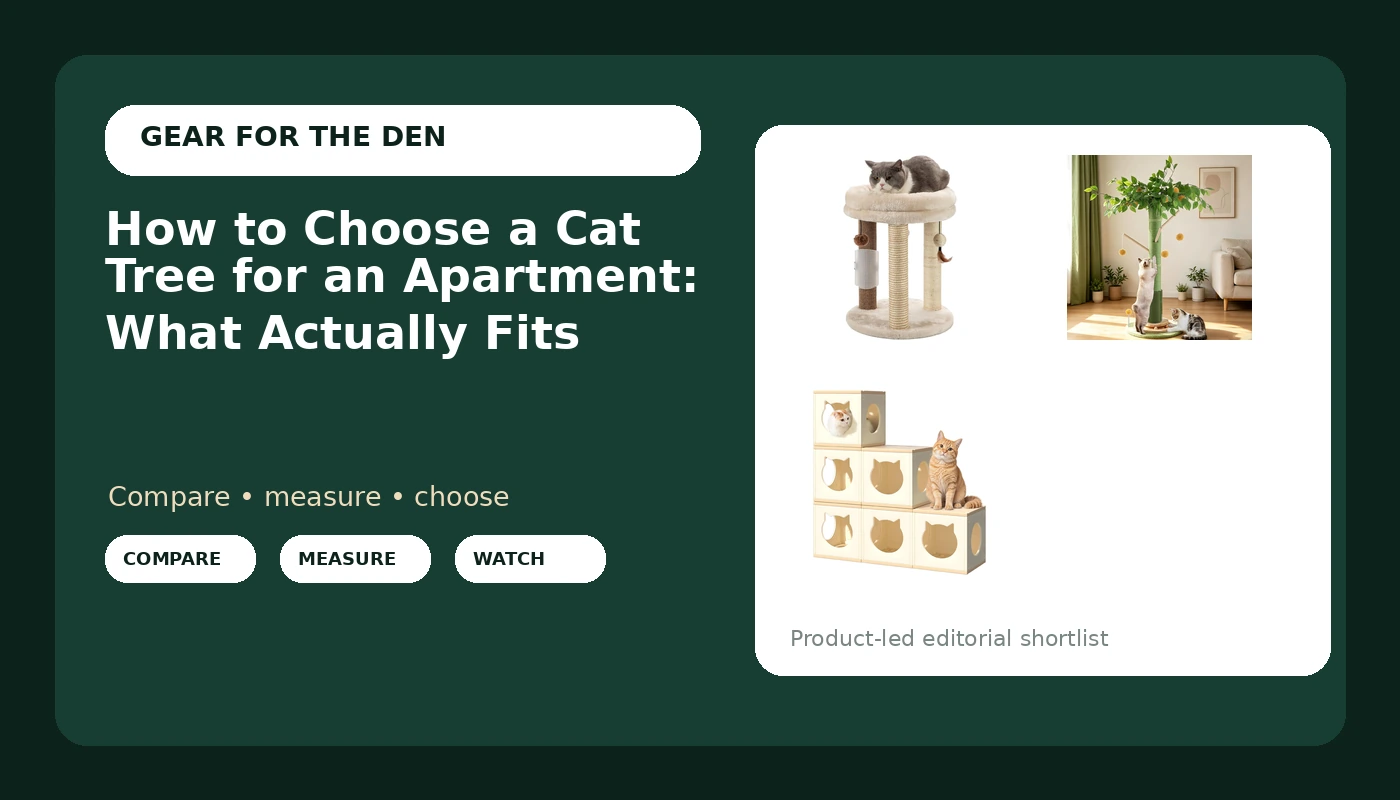
Three trees made the cut, and they are three different answers rather than three versions of one answer. One is for the corner of a studio. One is for a cat that wants height and nothing else. One is for a two-cat household that likes to rearrange the furniture. All three assume you have measured the space first, because the tree that does not fit is the only tree guaranteed to fail.
Budget pick: MECOOL 4in1 Small Cat Tree,Scratching Post with Tower Soft Bed, Sisal Carpet Jute Posts with Three Hanging Ball Toys and Massage Brush for Indoor Cats
Budget pick
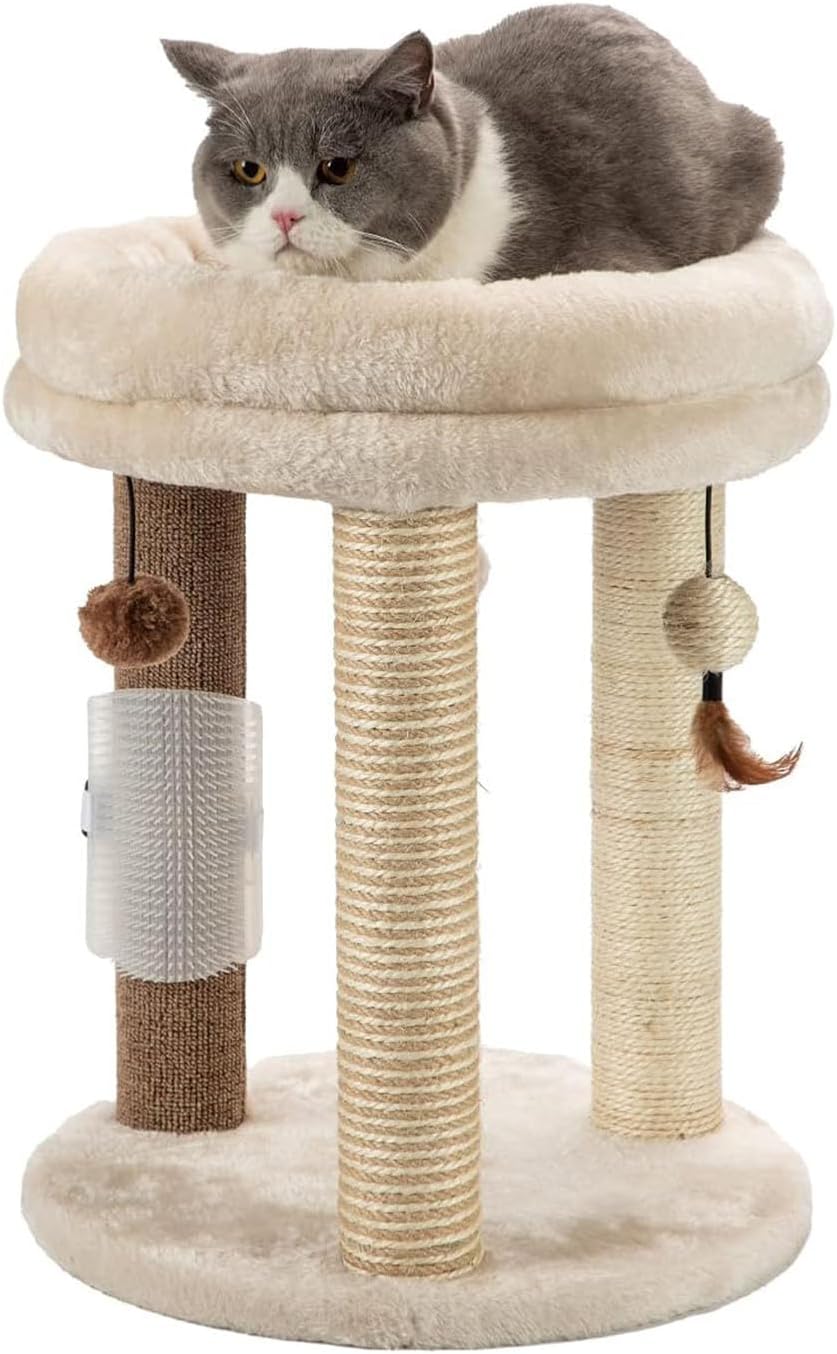
MECOOL 4in1 Small Cat Tree,Scratching Post with Tower Soft Bed, Sisal Carpet Jute Posts with Three Hanging Ball Toys and Massage Brush for Indoor Cats
This is the tree for the apartment with a spare corner of floor and a cat that has never had furniture of its own. The jute and sisal posts give a real scratching surface rather than the thin carpet wrap you see on cheap towers, the soft bed sits low, and the three hanging ball toys plus the massage brush are the kind of extras that keep a kitten busy while you unpack. Low platform height is the safety feature here: there is not enough leverage in the thing to tip it when a cat launches off the top.
Check current Amazon price.
Flaws but not dealbreakers: The bed is sized for a small to average cat, so a very large breed will hang over the edges. The hanging toys are the first part to disappear under the couch. The massage brush only works on a cat that already likes being brushed, and not every cat does.
Anyone in a studio or a small one-bedroom with one cat, or anyone buying a first tree for a kitten, will get their money's worth here.
Our pick: 46" Tall Cat Scratching Post, Natural Sisal Cat Tree for Indoor Adult Cats
Our pick
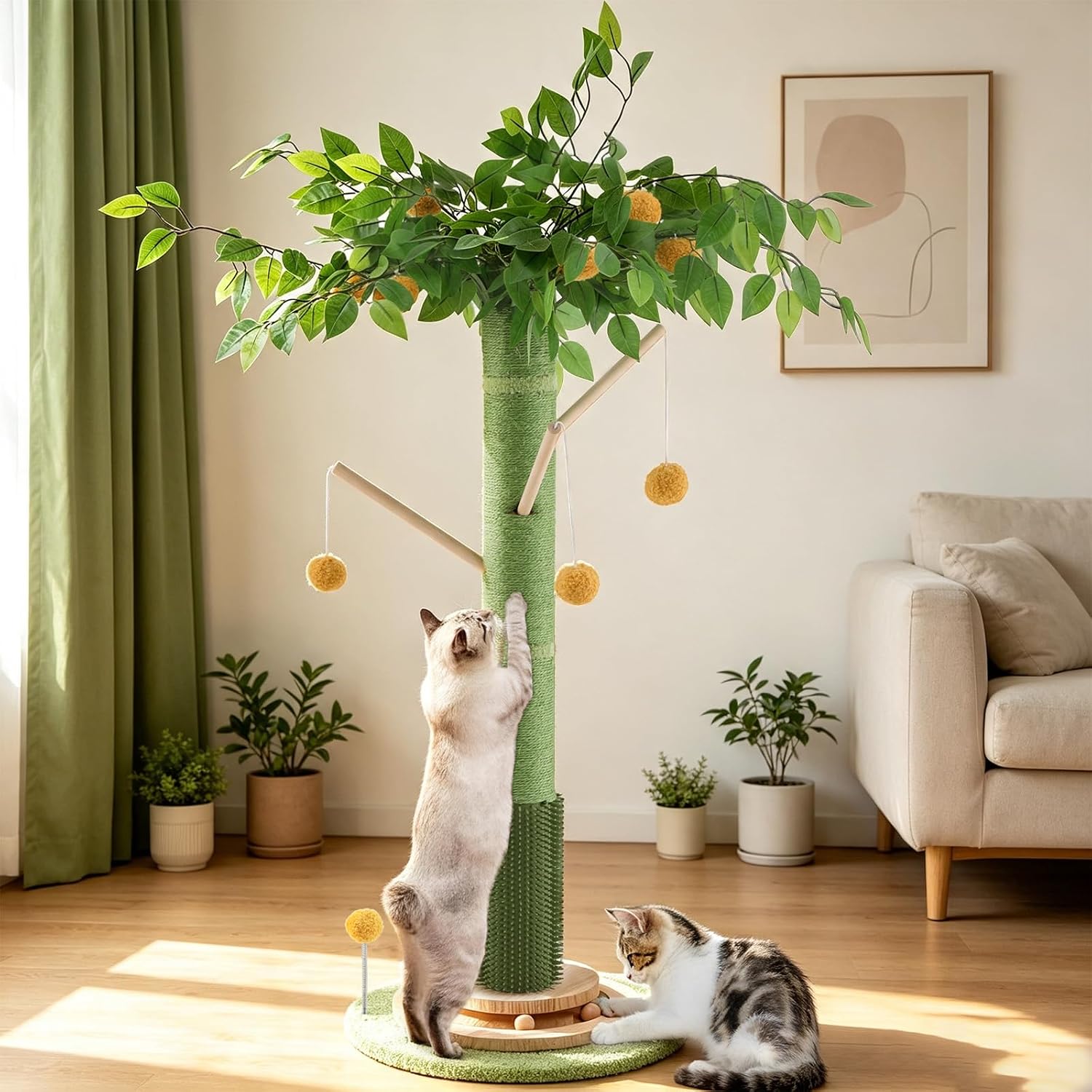
46" Tall Cat Scratching Post, Natural Sisal Cat Tree for Indoor Adult Cats
If your cat uses the couch as a scratching post, this is the fix, and it is the tree I would buy first for most apartments. The post is tall enough for an adult cat to stretch all the way up, and the footprint is small enough to slide between a bookcase and a wall. Natural sisal on a full-height post is a better scratching surface than any carpeted platform, and a single post has nothing to knock sideways.
Check current Amazon price.
Flaws but not dealbreakers: There is no perch, so a cat that wants to sleep up high still needs a window bed or a shelf. Tall, narrow posts need a wall strap if your cat climbs rather than scratches, and this one is no exception. Sisal sheds a little at first, which is normal and stops after a few weeks.
Anyone with an adult cat and a tight floor plan should start here, then add a sleeping platform later if the cat wants one.
Upgrade pick: 6-Cube Stackable Cat Tree Tower, Plastic Cat Tunnel for Indoor Cats
Upgrade pick
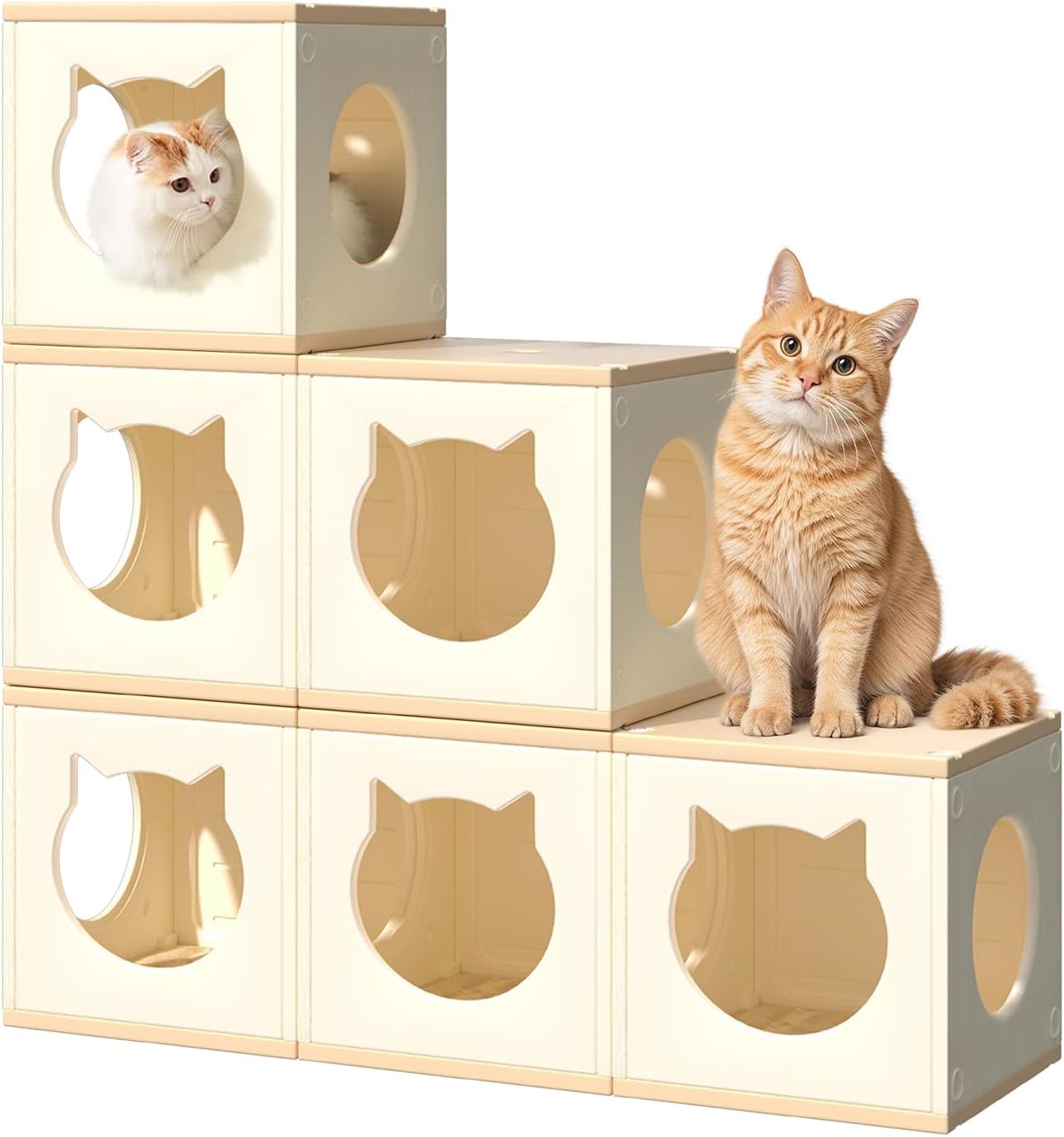
6-Cube Stackable Cat Tree Tower, Plastic Cat Tunnel for Indoor Cats
This is the one for a household with two cats and a landlord who does not want holes in the wall. The six cubes stack into different shapes, so you can build a stair for an older cat, an L for a corner, or two towers on opposite sides of a room, and you can rebuild it after a move without buying anything new. The plastic tunnel adds a chase route, which matters in a small apartment where two cats need somewhere to run.
Check current Amazon price.
Flaws but not dealbreakers: It takes up more floor than either pick above, and the plastic tunnel is not a scratching surface, so you still want a sisal post standing next to it. Cubes without a fabric lining are not a bed, so plan on a cushion or two.
Anyone with two cats, or one cat that has destroyed every plush tower it has met, will get the most out of this.
The actual setup workflow
Now the part that decides whether any of the three works. This applies to every tree, in every apartment.
Step one: Measure the floor. Everything about how to choose a cat tree for an apartment starts on the floor. Tape out the footprint where the tree will live, then check the door swing, the closet door, and the path to the litter box. If you only do one thing to pick a cat tree for an apartment, make it this, because a tree that blocks the litter box or the bathroom door will be resented by everyone in the household, including you. Our litter box setup guide covers the clearance those boxes need.
Step two: Check what you can anchor to. Look at the anchor type the tree ships with and be honest about your walls. Drywall with a stud behind it will take a strap. Plaster and lath is a different job. Tension poles need a solid, flat ceiling, so they are a bad idea under a drop ceiling or a textured finish. If you are not allowed to drill, plan on a wide base instead of a wall strap, and put the tree in a corner.
Step three: Match platform height to the cat. Kittens, seniors, and heavy cats do better with a low platform height and several short steps. Young adults want height. Around forty inches or more of platform height gives a cat a real vantage point, and a perch near a window is worth more than a perch in a corner, because the cat gets something to watch.
Step four: Check post diameter before anything else on the spec sheet. Three inches is the floor for an adult cat. A thicker post lets the cat stretch fully and lasts longer before it needs replacing. Sisal and jute wear better than thin carpet, and a post wrapped in carpet fibers is the surface that ends up shredded across your floor.
Step five: Check shelf depth and perch width. A perch narrower than the cat is a launching pad, not a bed. Deep shelves and wide perches are what let a cat sleep up high without sliding off. While you are in that part of the listing, check the hammock fabric: if the cover does not come off for washing, the hammock has a short life.
Step six: Check the weight limit and the base area together. A weight limit means little if the base is narrow, because the tree will tip long before it breaks. In a two-cat apartment, assume both cats will end up on the top level at once and size the base accordingly.
Step seven: Check how it breaks down. Stackable cubes, flat panels, and screw-together posts all move well. One-piece towers do not. If you plan to move within a year, this matters more than color, and the same measuring habit helps with carrier size when it is time for the vet.
Step eight: Anchor it, place it, then leave the cat alone. Put the tree where the cat already scratches or already sleeps, strap it if it needs strapping, and then do not fuss over it for a week. Cats claim furniture on their own schedule, and a tree that gets moved three times in three days never gets claimed at all.
The competition and why it lost
A few alternatives came up often enough to deserve an explanation.
Floor-to-ceiling tension pole trees solve the footprint problem and lose on ceilings. In an apartment with a solid, flat ceiling they are excellent. In one with a textured finish or a drop panel they slip, which is the last thing you want under a climbing cat.
The big carpeted condos with two or three plush levels are the classic cat tree, and they lose on floor space and on moving day. They are heavy, they do not break down flat, and carpeted platforms hold hair and dander in a way a removable cover does not. In a small apartment, that is a lot of furniture for one cat.
Wall-mounted cat shelves are the space-saving answer most renters cannot use. They need anchors, they need permission, and they do not give the cat a scratching surface, so you end up buying a post anyway. If you own the place, shelves plus a tall post is a great combination. If you rent, it is a deposit conversation.
Small starter trees with thin posts and a low platform lost for the opposite reason: they are cheap in every sense. A cat outgrows them in a few months, and then the couch pays for it. A two-cube version of the stackable tower also lost to the six-cube, because you cannot build a stair or a corner run out of two cubes, and the whole advantage of the modular system is the shapes.
What this all costs
The three picks sit in three price tiers, and the tier you should buy depends less on your budget than on how long you plan to stay put.
The budget tree is the one to buy when you are not sure your cat will use a tree at all. It costs the least of the three, it fits almost anywhere, and if the cat ignores it you have not lost much. The trade is size: it is a small cat tree, and a large cat will outgrow the bed even if the posts hold up.
The tall sisal post is the best value of the three for most apartments. It is a single-purpose object, it takes almost no floor space, and it solves the one problem that actually damages your home, which is scratching. Everything it does, it does without a platform to dust or a hammock to wash.
The stackable cube tower is the one to buy when you have two cats or when you expect to move. You are paying for flexibility and for floor area, and you should go in knowing that you will probably add a cushion, a sisal post, and maybe a wall strap on top of the purchase.
Prices move constantly on all three, and any number written into an article would be stale by the time you read it. Check current Amazon price on each listing before you commit.
Add-ons worth planning for: a wall strap or anchor kit if your cat climbs, a replacement sisal wrap for the post when the original wears through, a washable cushion for cube systems, and a carrier that actually fits your cat for the vet trip. None of those come close to the cost of replacing a couch, which is the real comparison. A cat with a post it likes leaves the furniture alone, and in a rental that is the whole return on investment.
Measure the corner first. The rest of this is easy.