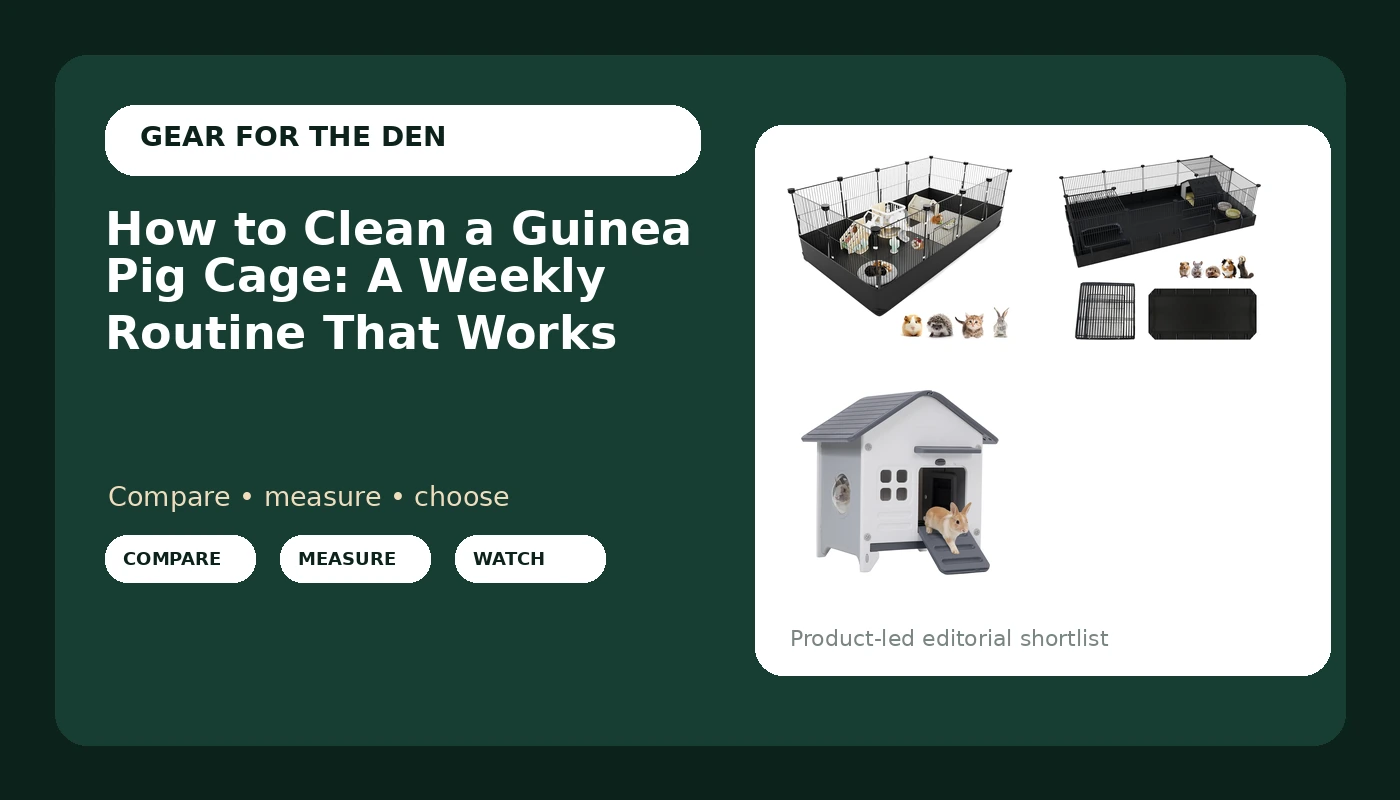
If you want to know how to clean a guinea pig cage without turning it into an afternoon project, stop scrubbing harder and start paying attention to where the mess lands. Guinea pigs poop constantly, they dribble water from the bottle into the bedding underneath it, and they drag hay out of the hay rack into every corner of the floor area. A cage that fights you on those three things is always a chore. A cage that cooperates turns the weekly change into about twenty minutes.
Most of the frustration I hear about is not really a cleaning problem. It is a setup problem. Bar spacing wide enough that bedding dust sifts through onto the shelf below, a hideout size that traps soiled bedding in a corner you cannot reach, a base that soaks instead of wiping clean. Every one of those adds minutes to a job you already do every week.
So this is two guides in one: a repeatable routine for how to clean a guinea pig cage, and a look at three cage designs that make that routine shorter. Get the base and the access right, and cleaning stops being a battle.
Why you should trust me
I write the small-pet gear coverage for this site, and I have read more cage listings than any one person should have to. What I care about is boring and specific: floor area, bar spacing, base material, how the door opens, and whether the thing can be wiped instead of scrubbed. I do not care how many colors the panels come in.
My bias runs toward cages that survive a weekly reset. I have watched people give up on a perfectly good guinea pig because the cage was miserable to clean, and I have watched a plain cage with a sealed base make the whole thing easy again. That is the standard I hold these three to.
How I picked and how I tested
Testing a cage is mostly a matter of asking the same questions in the same order and seeing which design answers them without excuses.
The checklist: How much floor area do you actually get, taken from the listed dimensions rather than the marketing? (The Tresbro lists 48 by 24 inches, which works out to roughly eight square feet.) How wide is the bar spacing, and can a young guinea pig's head pass through it? Is the bottom a sealed liner, a canvas, or an open tray? Can you open the cage one-handed while holding a guinea pig in the other? And how many pieces do you have to move to reach the far corner, where wet bedding always ends up?
I also weighed the small things that show up in a weekly reset: whether bedding dust falls through the bars onto the floor, whether the hay rack drops hay straight into the sleeping corner, and whether the hideout size leaves room for a tunnel.
Everything here is judged on how it changes the twenty minutes it takes to clean a guinea pig cage. If you are still working out how much space a pair needs, our guinea pig cage size guide breaks down the math.
What I did not do is pretend that every cage here is the same object. They are not. The least expensive one asks you to do more of the work yourself, and that is the trade you are making.
Cages that make it easier to clean a guinea pig cage
Three cages, three different answers to the same question: how do you get soiled bedding out fast?
Budget pick: Tresbro Guinea Pig Cage with Waterproof PVC Bottom Liner & One-Hand Release Hook, Triple Fixing C&C Cage for Guinea Pigs, Bunny, Rabbit, Hedgehog, Small Animal Indoor Playpen 48''L x 24''W x 16''H
Budget pick
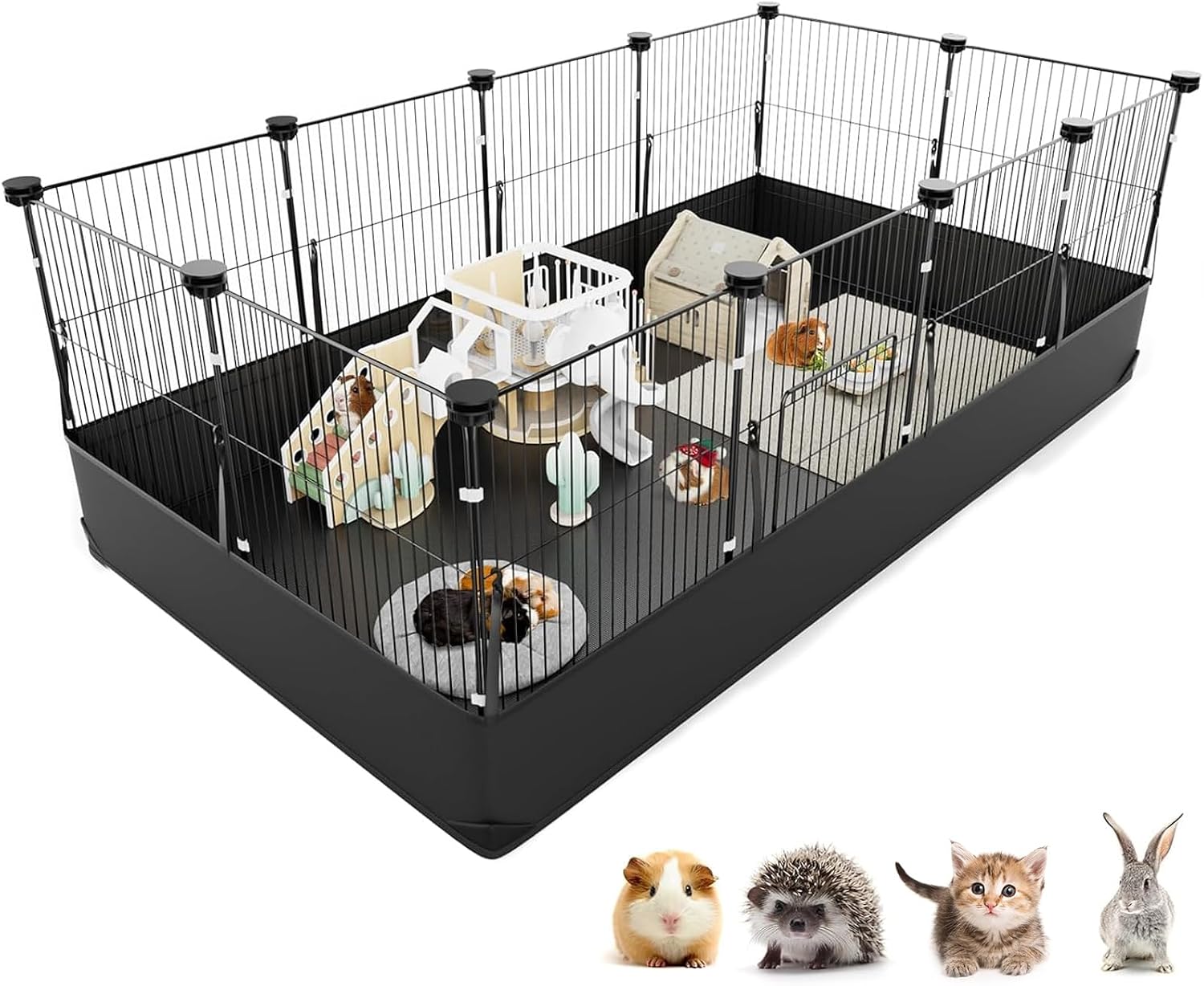
Tresbro Guinea Pig Cage with Waterproof PVC Bottom Liner & One-Hand Release Hook, Triple Fixing C&C Cage for Guinea Pigs, Bunny, Rabbit, Hedgehog, Small Animal Indoor Playpen 48''L x 24''W x 16''H
This is the least expensive of the three, and for most first-time owners it is where I would start. The waterproof PVC bottom liner is the part that matters for cleaning: urine and spilled water stay on the surface instead of soaking into a coroplast tray or a wooden base, so a vinegar wipe gets you back to clean in under a minute. The one-hand release hook sounds like a small detail until you are holding a guinea pig and trying to open the door with your elbow. Triple fixing means the panels are held at more than one point, which matters when you lean over the front wall to reach the back corner where wet bedding collects.
At 48 by 24 inches you are working with about eight square feet of floor area, which is a workable floor for a pair once a hideout, a hay rack, and a bottle are in there. Check current Amazon price.
Flaws but not dealbreakers: The liner has to be dried fully before fresh bedding goes down, and the panel spacing deserves a look if you have a young pig. Anyone who wants a sealed base without building one should start here.
Our pick: Xymoso DIY Guinea Pig Cages with Waterproof Canvas Bottom,16 Panels Small Animal Cage Pet Playpen with Door for Bunny Turtle Hedgehog,Indoor Metal Wire Yard Fence Outdoor
Our pick
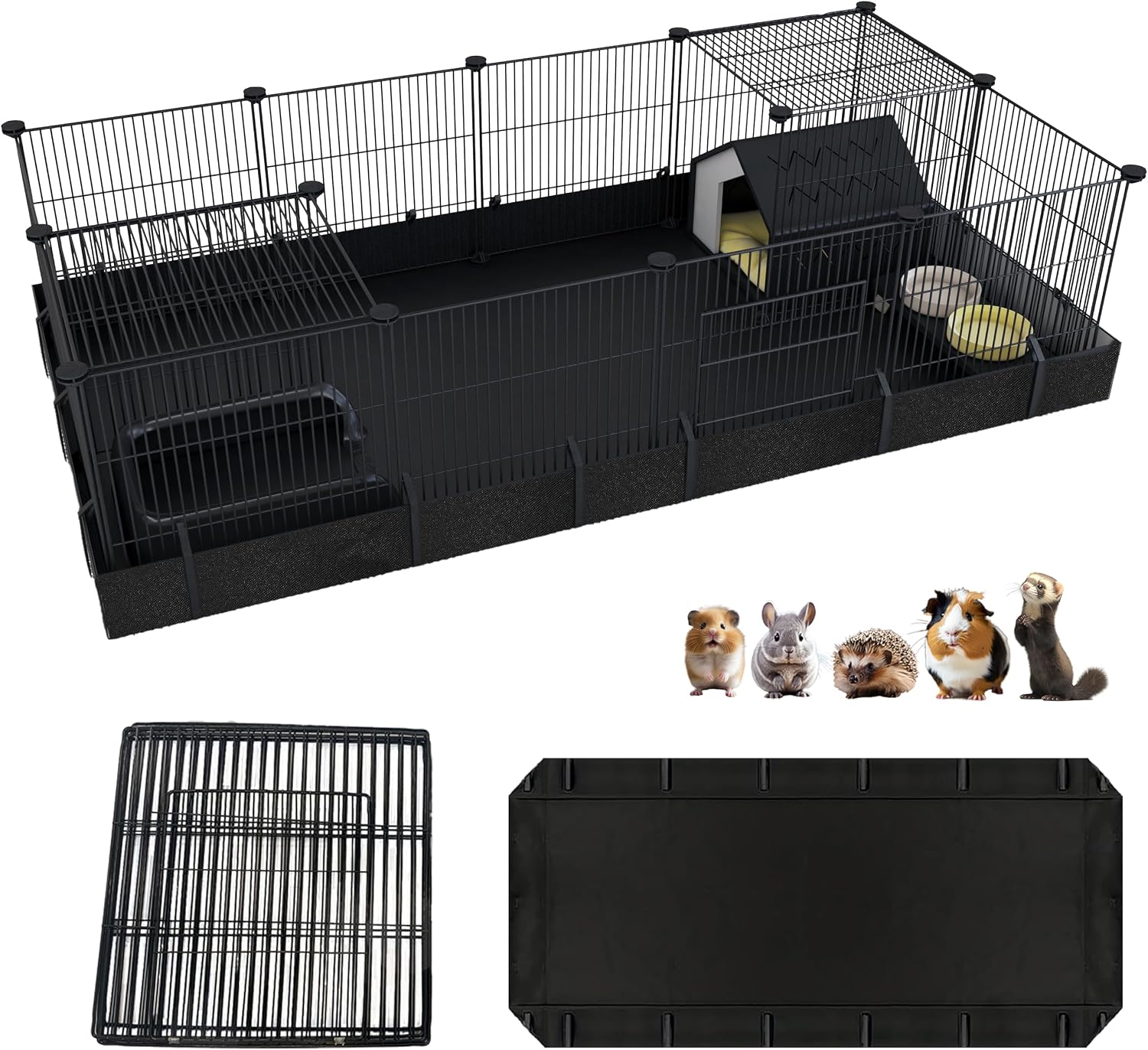
Xymoso DIY Guinea Pig Cages with Waterproof Canvas Bottom,16 Panels Small Animal Cage Pet Playpen with Door for Bunny Turtle Hedgehog,Indoor Metal Wire Yard Fence Outdoor
Sixteen panels means you are not locked into one footprint. You can build a 4×2, add a loft, or expand the floor area later when a second guinea pig arrives, and that flexibility is worth more than it sounds, because cage size is the thing most owners get wrong first. The waterproof canvas bottom is the cleaning story here: it is a soft liner, so you can lift the whole thing out, shake it, hose it, and let it dry in the sun, which is the fastest reset of the three cages in this guide. The door panel means you do not have to unclip half the cage to reach the back corner. Check current Amazon price.
Flaws but not dealbreakers: Canvas takes longer to dry than a rigid liner, so keep a spare liner or a fleece pad on top, and check the connectors after every reset because panels shift. Anyone who wants a cage that grows with the pig should look here first.
Upgrade pick: Plastic Rabbit Cage Outdoor Indoor, Bunny Cage Guinea Pig Cages Enclosure
Upgrade pick
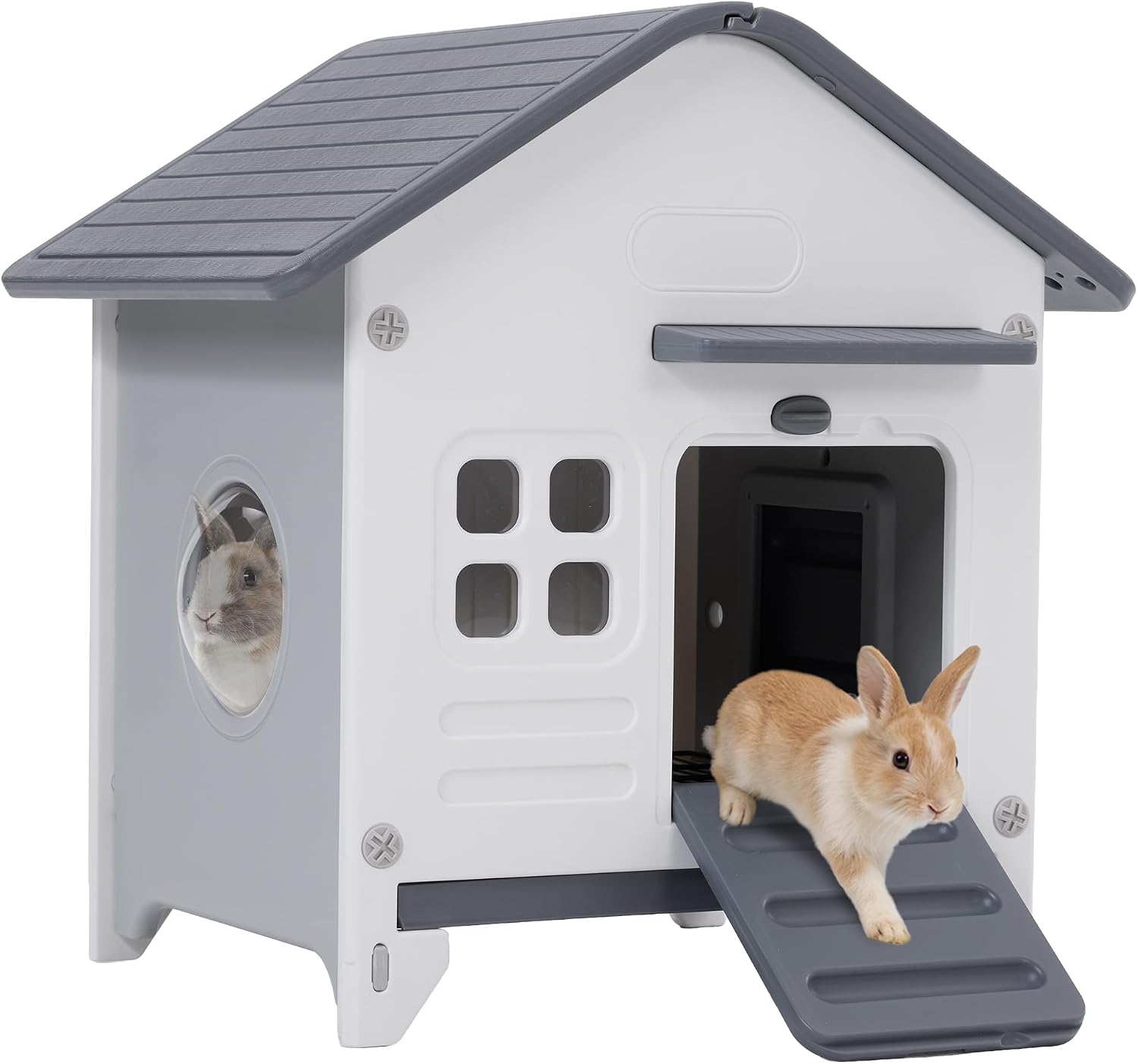
Plastic Rabbit Cage Outdoor Indoor, Bunny Cage Guinea Pig Cages Enclosure
This is the biggest single spend on the list, and what it buys is plastic. The cleaning surface is molded material you can hose, spray, and wipe without worrying about seams soaking up urine, which is exactly what you want if the cage lives in a garage, a shed, or on a covered porch and gets a full wash-down instead of a spot clean. There is no fabric to dry and no panel grid to re-tension after a reset. Check current Amazon price.
Flaws but not dealbreakers: A molded enclosure can hold less airflow than an open wire panel cage, so ammonia builds faster and you have to stay on the daily spot clean. It is also heavier, so a full reset means working around the cage rather than lifting it. Anyone who wants to hose the whole thing down outdoors, or who keeps pigs somewhere with a drain nearby, will get the most out of this one.
The actual cleaning workflow
Now the routine itself. It works whether you are running a panel cage with a canvas liner or a molded plastic enclosure. The steps do not change; the tools do.
Step one: Set up before the pig comes out. Move the guinea pigs to a carrier or a playpen with hay, a hideout, and water. Then put everything within arm's reach of the cage: a trash bag, a spray bottle of half white vinegar and half water, rags, fresh bedding, a spare fleece liner, and a bottle brush. Half the time people lose on a cage change is spent walking to the kitchen for something they forgot.
Step two: Pull everything out. Hay rack, bottle, bowls, hideouts, tunnels, all of it. Put the washable items in a bin or the sink. Anything wooden that has soaked up urine gets a sniff test after washing; if it still smells, it is done. Wood does not give that smell back.
Step three: Strip from the clean end to the dirty end. Work toward the corner the pig uses as a bathroom so you are not dragging soiled bedding across clean floor. Roll fleece or a canvas liner inward on itself, bag disposable bedding, and take it straight outside. Shake fleece outdoors, never over a sink or a bathtub.
Step four: Wipe the base. A 50/50 mix of white vinegar and water is enough for a routine clean. Spray it, let it sit for a minute, wipe it dry. Skip bleach, skip pine-scented sprays, and skip anything that leaves a residue, because guinea pigs put their mouths on every surface. Dry the base completely before bedding goes back in; a damp base grows the smell right back within a day. If you have ever wondered how to wash a guinea pig cage without wrecking the finish on the base, this is the whole answer.
Step five: Wash the hard items. Bottle, bowls, hideouts, hay rack, tunnel. Hot water and a bottle brush handle most of it. You do not have to wash a guinea pig cage in a bathtub to get these clean, and you should not soak wooden items. Check bottle capacity against how much your pigs actually drink in a day; a bottle that runs dry by evening means either a bigger bottle or a second one. Rinse everything and let it air dry.
Step six: Reset the layout. Put the hideout at the opposite end from the water bottle, because a bottle always drips a little and you do not want wet bedding in the sleeping corner. Hang the hay rack over the easiest part of the floor area to sweep. Keep a tunnel with a diameter wide enough that a full-grown guinea pig walks through without squeezing. Leave the middle open for running, and keep the floor area as clear as you can, because a cluttered cage hides soiled bedding.
Step seven: Bedding depth and dust. Enough bedding to absorb a day of urine, not so much that it buries the bottom of the hideout. If dust rises when you pour bedding in, that is bedding dust you and the pig are both breathing; pour it outside the room, or switch to a lower-dust option. Check the cage size against the number of pigs one more time while you are in there. A cage that is too small gets dirty twice as fast.
Step eight: The two-minute daily reset. Twice a day, pick out soiled bedding and stray hay, wipe under the bottle, and check the hay rack. Every two or three days, swap the fleece liner or spot-change the bedding. If you want to clean a guinea pig cage faster, the win is here, not in a better scrub brush. Do that and the weekly deep clean stays a twenty-minute job. Skip it and you will be back to scrubbing a cage that smells like a barn.
The competition and why it lost
None of the cages that lost here lost on price. They lost on access, base material, or the amount of work they hand back to you.
The glass aquarium with a screen top is the classic mistake. It looks tidy, but it holds humidity, it is heavy, and you reach in over a wall to get at the back corner. Ammonia builds fast in a glass box with a lid.
The deep plastic starter tub with a wire lid has a decent base but a lid you have to lift off entirely, which means you cannot reach the far corner without dismantling the top. That is two extra minutes on every single clean.
The cheapest zip-tied grid kits have panels that are fine and a base that is not. A folded coroplast tray or a shower curtain is not sealed, and neither wipes clean the way a molded liner does, so you end up replacing the base every few months.
And the oversized wooden hutch looks wonderful in a garden and smells like a barn by August. Urine soaks into the wood, and no amount of vinegar pulls it out of a seam.
What this all costs
The one-time cost is the cage. The Tresbro is the least expensive of the three, the Xymoso sits just above it, and the molded plastic enclosure is the biggest single spend. Check current Amazon price on each, because listings move.
The recurring cost is where the money actually goes, and it has nothing to do with which cage you pick. Bedding, hay, and liners add up faster than the cage ever will. Fleece liners cost more up front and then get washed instead of replaced, which is cheaper over a year and much cheaper over five. Vinegar is the cheapest cleaning supply in the house. Hay is the sleeper expense, because half of it ends up on the floor no matter which hay rack you use.
The honest math: a cage with a sealed base and a door that opens one-handed saves ten or fifteen minutes a week and saves you the cost of replacing a soaked base or a wooden hutch every year or so. Over the life of a guinea pig, the setup matters more than the sticker.
Pick a cage you can wipe, keep a spare liner, and run the routine until it is boring. That is how to clean a guinea pig cage in twenty minutes, and it is the version of the job you will actually keep doing.