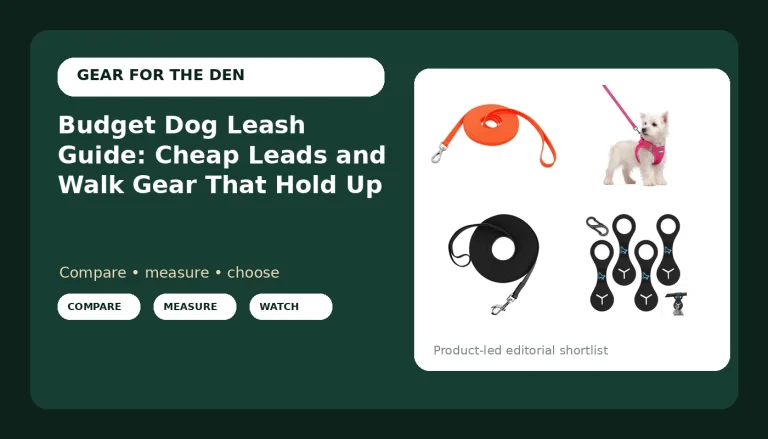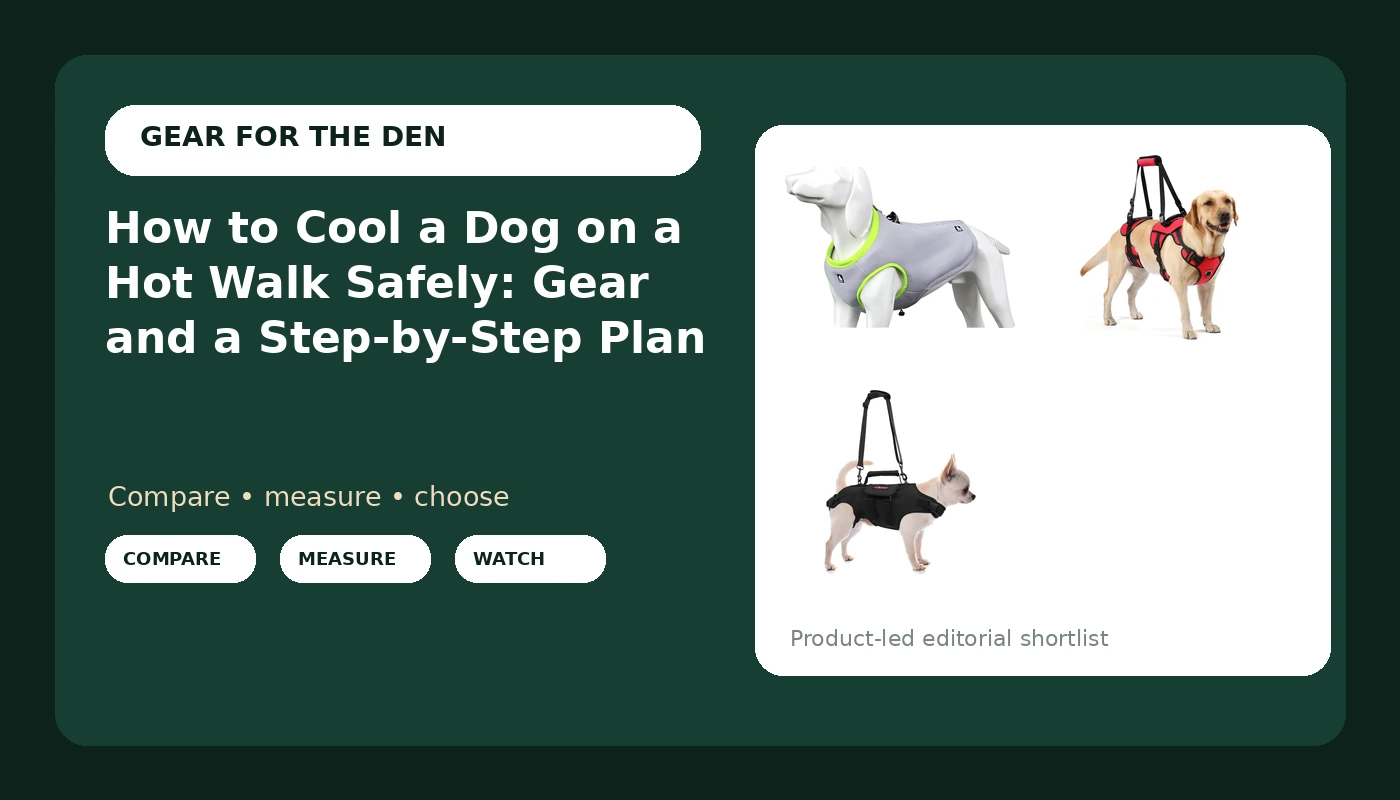
Pavement that has been in the sun all afternoon will burn a dog's pads in under a minute, and a dog in a double coat can push his core temperature into the danger zone before you finish the first block. Most people learn that the hard way, which is why I keep a short, boring routine for the hottest weeks of the year. It answers the only question that matters at 2 p.m. in July: how to cool a dog on a hot walk safely, without turning a 20-minute loop into a vet visit.
Dogs do not sweat through their skin the way we do. They dump heat through their paw pads and by panting, and both of those systems lose the fight against 95-degree air sitting over 130-degree asphalt. A dog who is bred for cold weather, overweight, senior, flat-faced, or simply black-coated will lose that fight faster than the dog walking next to him.
So the gear list below is short on purpose. One item pulls heat out of the dog while you walk. Two more exist for the dog who cannot finish the walk on his own four feet, and if you have ever carried a 70-pound Lab the last two blocks home, you already know why they are on this page.
Why you should trust me
I have walked dogs in southern heat since 2014, from a 12-year-old Lab with hip dysplasia to a foster husky mix who treated January as a personal insult. I have also watched a 20-minute loop turn into a slow walk home more than once, and the pattern is always the same. Heat injury in dogs is not dramatic. The dog slows down, then stops, then sits.
There is no single ideal cool a dog on a hot walk safely setup, because the dog sets the pace, not the plan. A two-year-old cattle dog and a 12-year-old retriever do not share limits, and the gear that helps one can be useless for the other.
I am not a veterinarian and nothing here replaces one. What I can tell you is which gear holds up on a hot sidewalk, which gear gets left in the closet, and what the eight steps actually look like when you are standing outside with a panting dog and a wet vest in your hand.
How I picked and how I tested
Everything on this page has to do one of two jobs: pull heat out of the dog, or take weight off the dog. If it does neither, it does not belong on a walk in July.
For cooling, I look at the fabric first. An evaporative vest only works while it is wet, so the questions are how much water the cooling fabric holds, how long it stays damp in dry heat, and whether it covers the chest and belly where the blood runs close to the skin. Then I check the hardware: a chest strap that will not slip when the dog pulls, a front clip that sits above the vest panel instead of under it, and stitching that holds when a 60-pound dog lunges at a squirrel.
For support gear the checks are different. I look at how the straps load the dog's body, whether the handle lands where my hand naturally falls, whether the rear panel clears the plumbing on a male dog, and whether the whole thing can go on a dog who is already lying down and not helping.
Then comes the boring part. I walk the route, check leash length so the dog is not stepping into traffic, test the pavement with the back of my hand, and keep a tracker on the collar of the dogs who back out of a harness. That is why gps range and battery life matter to me as much as the gear itself. Everything below is judged on a hot sidewalk, not in a product photo.
Gear that helps you cool a dog on a hot walk safely
Three items, three jobs. A vest for the dog who is still walking, and two lift harnesses for the dog who needs help finishing.
Our pick: SGODA Dog Cooling Vest Harness Cooler Jacket Grey Green Large
Our pick
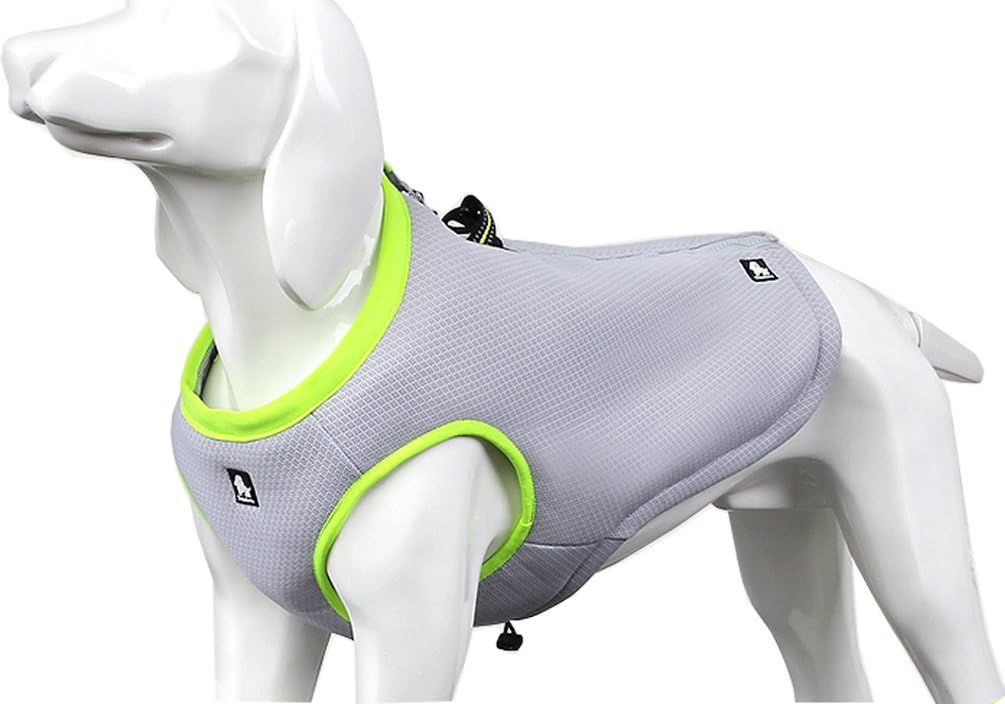
SGODA Dog Cooling Vest Harness Cooler Jacket Grey Green Large
Check current Amazon price.
This is the piece that does the actual cooling work. It is an evaporative vest and a harness in one, which matters more than it sounds. The cooling fabric sits against the chest and back, and the harness hardware is built into the same shell, so you are not stacking a vest under a separate harness and hoping the chest strap stays put.
The way it works is simple physics. You soak the vest, wring it until it is damp rather than dripping, and put it on the dog before you open the front door. As the water evaporates off the fabric, it pulls heat with it. In dry heat that buys you real time. In heavy humidity it buys you less, because the air is already full of water and evaporation slows down. That is not a flaw in the vest, it is a fact about August in the Southeast, and it is why the routine below never leans on the vest alone.
The grey and green colorway is a small thing I appreciate on a hot walk. Dark fabric in direct sun is a heat sink, and a black vest on a black dog is a decision you regret by the second block. The large size covers the chest and a good stretch of the back, and the front clip sits above the panel so the leash is not dragging wet fabric sideways.
Flaws but not dealbreakers: It only works wet. A dry cooling vest is a costume. If you forget the water bottle, the vest is dead weight, so pack the bottle before you pack the vest.
Anyone with a dog who still walks in summer but slows down by the halfway point should start here. If your dog also fights a harness going over his head, my harness fit walkthrough covers the adjustment order.
Runner-up: NOYAL Dog Lift Harness, Full Body Support Sling, M/L Breeds
Runner-up
NOYAL Dog Lift Harness, Full Body Support Sling, M/L Breeds
Check current Amazon price.
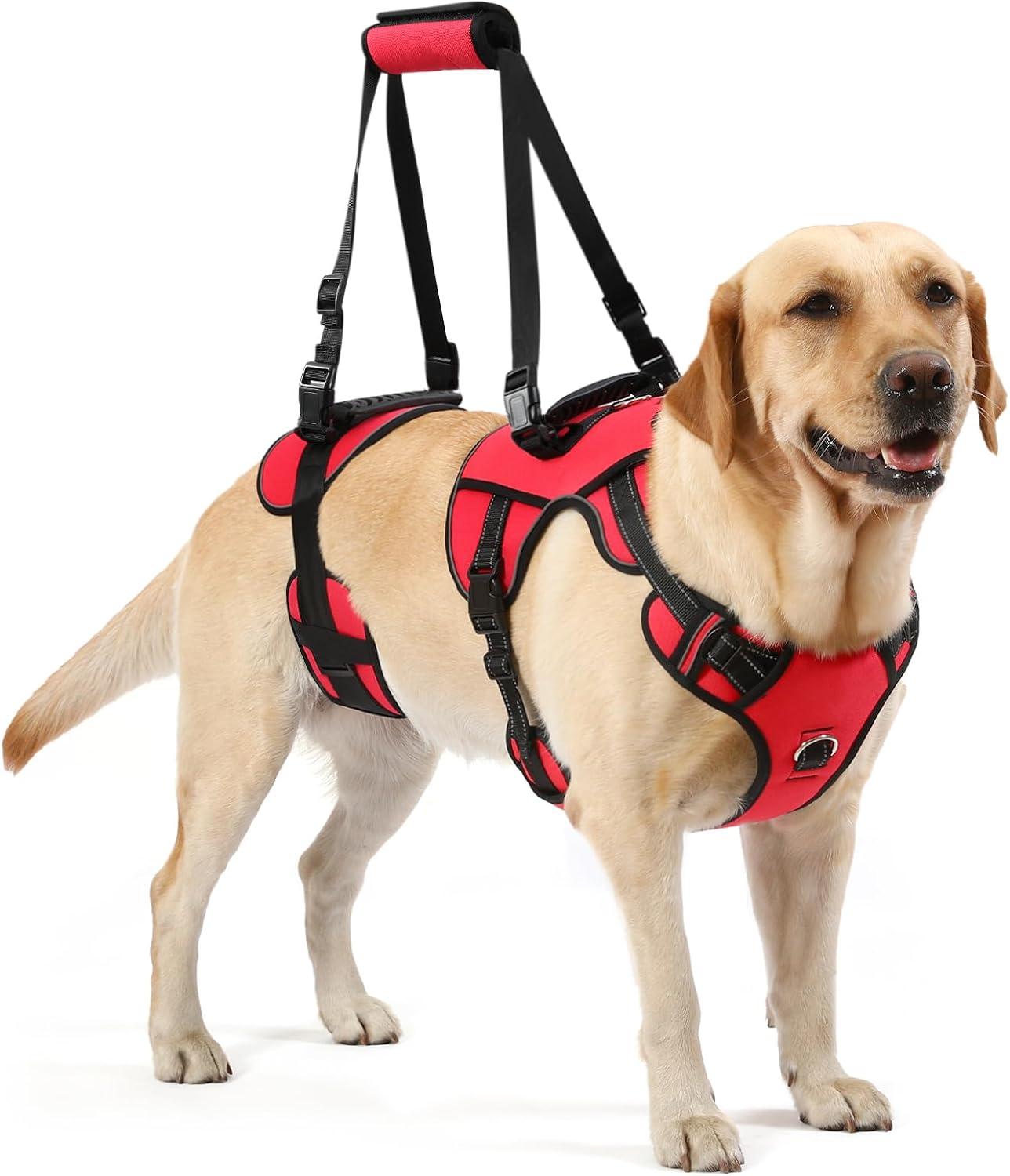
A cooling vest cannot help a dog who has stopped walking. At that point you need to move the dog, and lifting a 60-pound dog by the chest strap of a normal harness is how you hurt both of you. This full body support sling spreads the load across the chest and belly so the weight lands on fabric instead of on one strap.
It is sized for medium and large breeds, which is the size class where a lift sling earns its place. A 15-pound dog can be scooped up and carried. A 65-pound dog cannot, not for two blocks, not in the heat, and not while you are also holding a leash. The sling gives you a handle to take the rear weight while the dog keeps his front feet moving, which is usually enough to get a wobbly dog from the sunny side of the street into shade and then into the car.
Flaws but not dealbreakers: A sling is not a stretcher. If your dog is down and not getting up, you are past gear and into a phone call to your vet. Use this for the dog who is tired and unsteady, not the dog who is collapsing.
Anyone whose dog has arthritis, a recent injury, or a habit of quitting at the far end of the loop will get the most use out of this one.
Upgrade pick: Full Body Dog Lift Harness for Senior Dogs, Oxford Cloth, S
Upgrade pick
Full Body Dog Lift Harness for Senior Dogs, Oxford Cloth, S
Check current Amazon price.
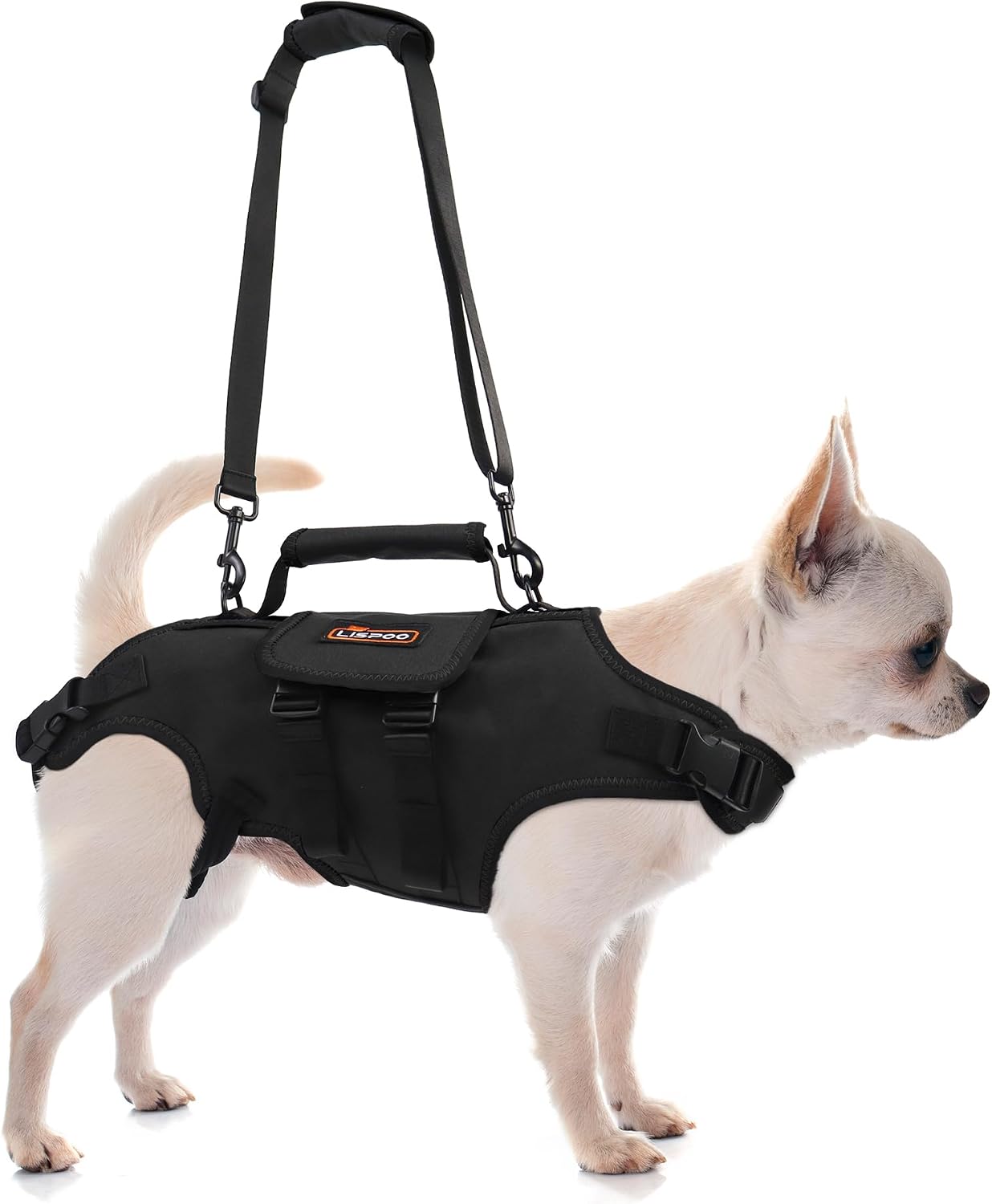
This is the same idea built for smaller senior dogs, with Oxford cloth panels and a full body wrap. The smaller size class is where a lift harness is easiest to use, because you can keep one hand on the handle and one hand on the leash without feeling like you are about to drop the dog.
Senior dogs are the ones who get into trouble on hot walks, because the heart, the hips, and the cooling system are all working with less margin than they had five years ago. A dog who handled a mile in July at age four may be done at a quarter mile at age 12, and that is not stubbornness. The Oxford cloth shell is sturdy and easy to rinse, which matters when the dog wears it in the heat and you want it clean between walks.
Flaws but not dealbreakers: A full body wrap takes a few extra seconds to put on a dog who is already tired and uncooperative. Practice it in the living room on a cool morning, not for the first time on a hot sidewalk.
Anyone with an older small dog who still wants the walk but cannot always finish it should look here first.
The actual cooling workflow
This is the part that matters. Gear helps, but the routine is what keeps a dog safe, and it takes about 10 minutes of planning before you clip the leash. The goal is to cool a dog on a hot walk safely, which is a different job from getting the dog tired. Get the order wrong and the vest is just a wet shirt. The correct cool a dog on a hot walk safely sequence starts before you touch the front door.
Step one: Check the pavement and the clock. Press the back of your hand to the asphalt for five seconds. If you cannot hold it there, your dog's pads cannot either. Walk before 9 a.m. or after sunset, and if the forecast is pushing triple digits, the walk becomes a backyard sniff session in the shade.
Step two: Soak the vest before you leave. Fill a bottle or a sink, soak the cooling fabric, wring it until it stops dripping, and put it on the dog inside the house. A vest that goes on dry at the front door adds a layer and does nothing else.
Step three: Pick the route around shade and water. A loop with tree cover and a fountain beats a shorter loop on open asphalt. Plan your exit points before you need them: the neighbor's porch, the corner store, the shaded side of the block.
Step four: Set your leash length and your pace. Keep the leash short enough that the dog stays beside you and out of the road, but long enough that he is not fighting the vest. Walk at a sniffing pace, not a training pace. Heat is not the time to work on heel.
Step five: Watch the dog, not the clock. Heavy panting that will not slow down, thick ropey saliva, a tongue that looks wider than usual, glazed eyes, weaving, or lying down in the grass are all stop signs. A dog who plants his feet and refuses to move is not being stubborn. He is telling you he is done.
Step six: Cool the hot spots first. If you are still outside and the dog is struggling, get into shade and put cool water on the paws, the belly, the armpits, and the groin, where the big blood vessels run close to the skin. Wet the ear flaps and the neck. Do not dunk a whole dog in ice water, and do not force water into his mouth.
Step seven: Use the lift harness to get him home. This is where the sling earns its keep. Take the rear weight in the handle, keep his front feet moving, and get off the pavement. If he cannot stand or will not get up, call your vet and carry him to the car.
Step eight: Cool down properly at home. Take the vest off, rinse his paws, offer water in small amounts, and let him lie on a cool floor with air moving over him. A wet vest left on a dog in an air-conditioned room will chill him, so it comes off as soon as the walk ends.
One more thing about hot pavement: pads do not show damage until they are already burned, and the fix is a set of boots, which brings its own decisions about traction sole thickness and boot sizing. That is a different guide, but if your dog walks on blacktop in July, it is one worth reading before you need it.
The competition and why it lost
Cooling mats are excellent and they are not walk gear. They live in the crate or on the kitchen floor, and they do nothing for a dog who is 10 minutes from home with the sun on his back.
Cooling bandanas and cooling collars are the other common answer, and they are fine as a supplement. They cover a small patch of neck, they dry out fast in dry heat, and they give people a false sense that the job is done. If you want one, use it with a vest, not instead of one.
Dog boots belong in the conversation about pavement, not about cooling. They protect the pads, and they do nothing for core temperature. Buy them for the pavement problem and solve the heat problem separately.
GPS trackers are the last thing people ask about, and they are a safety net rather than a cooling tool. If you use one, the specs that matter on a hot walk are gps range and battery life, because a tracker that dies at the halfway point is a collar charm.
A plain step-in harness or a standard back-clip harness is what most people already own, and it is not a competitor to anything on this page. It does not cool the dog and it does not lift the dog. It is a leash attachment, which is fine, but it is not a heat plan.
What this all costs
Check current Amazon price on each of the three, because the numbers move. The order of spending is what matters, and it stays the same every summer.
Start with the cooling vest. It is the lowest cost item of the three and the one that works on every single walk, so it pays back faster than anything else here. Buy the right size, soak it every time, and replace it when the fabric stops holding water.
Add a lift harness only if your dog needs one. A dog who finishes every walk without help does not need a sling, and a sling that lives in the closet is money you could have put toward boots. If your dog is senior, arthritic, or has ever stopped mid-walk, the lift harness stops being optional the first time you have to carry him.
Then budget for the boring stuff: a water bottle you actually carry, a set of boots for pavement, and a tracker if your dog is the escaping type. None of it is exciting. All of it is cheaper than the emergency visit you are trying to avoid.
The math on the vest is easy. One summer of daily walks is roughly 90 walks, and the vest is the only item on this list that does something on every one of them. Over three summers it costs pennies a walk. The lift harness is insurance, and insurance is only overpriced until the day it is not.
That is the job. Walk early, soak the vest, watch the dog, and know when to stop. The gear does not make a hot walk safe on its own. The routine does.