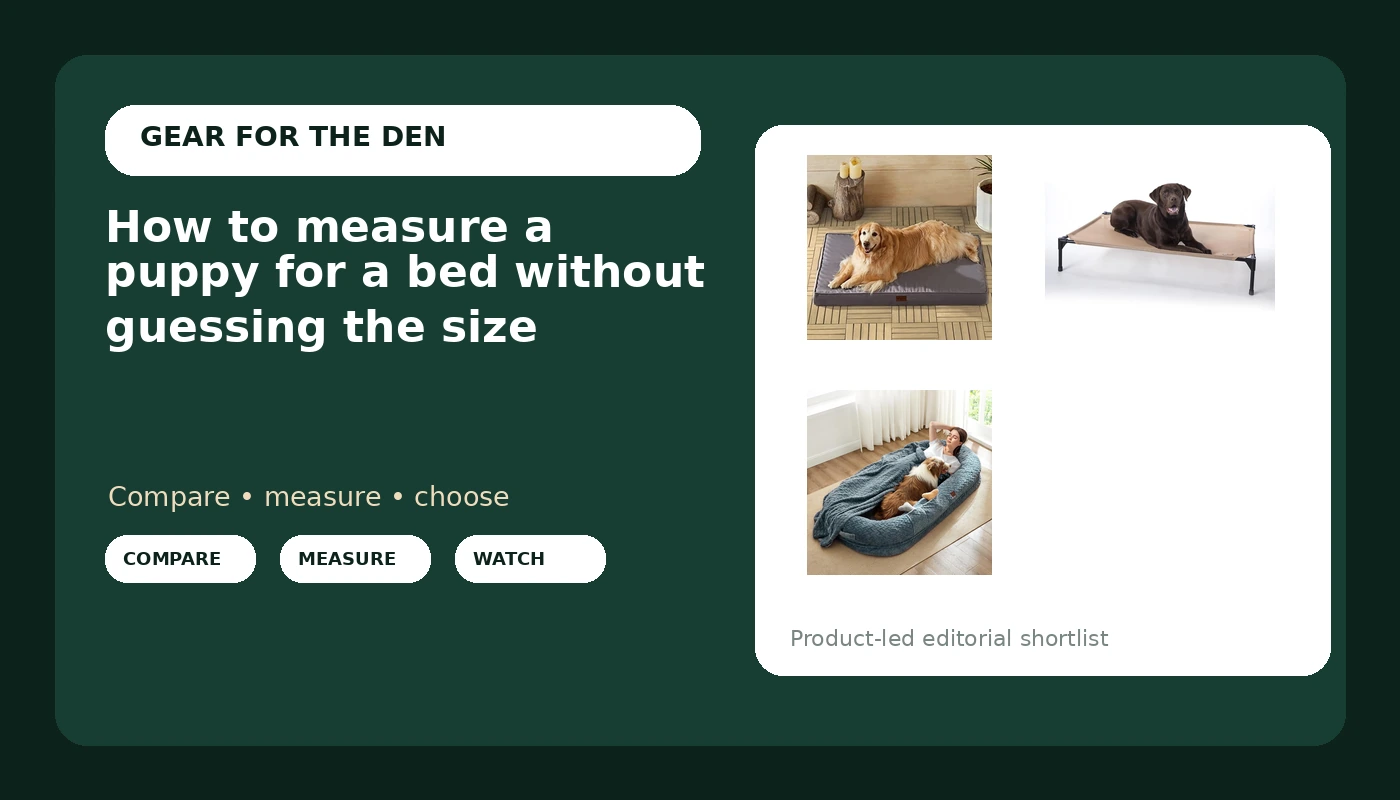
A puppy bed that is too small gets outgrown before the cover finishes its first wash cycle, and a bed that is too big becomes a spare bathroom in the corner of the room. The size chart on the product page will not save you, because it describes an adult dog in a still photograph. The fastest way to measure a puppy for a bed is to measure the dog in front of you, standing and then sprawled out, and then buy for the dog you will have six months from now.
Learning how to measure a puppy for a bed is a two-part job. First you measure the puppy, then you read the bed listing the way you read a crate size, which means paying attention to the parts of the description that are not in the headline.
Two numbers get confused constantly. Nose-to-tail length is the one people photograph, but it says almost nothing about a sleeping dog, because a curled puppy and a sprawled puppy occupy very different footprints. Body length, measured from the point of the chest between the front legs to the base of the tail, is the number that predicts how much room a bed actually needs to offer. Shoulder width is the second number, and it decides whether a bed feels snug or crowded.
Puppies also do not stay the size you measured. Depending on breed and build, most of the growing happens across a handful of months, and a puppy that rattles around a small bed in the fall can be hanging over the edge by spring. That is why the workflow below ends with a re-measure instead of a purchase, and why the beds here are chosen for the dog your puppy is becoming rather than the dog on your lap right now.
Why you should trust me
I have spent years helping people size beds, crate mats, and car covers for puppies, usually in a pet store aisle with a phone in one hand and a wiggling dog in the other. I keep a cloth tape measure in the door pocket of my car for exactly that reason. I have also watched more gear come back to the shelf because of a rushed measurement than because of a bad product.
The method in this guide is the one I walk people through in person, and it is the same answer I give whenever someone asks how to measure a puppy for a bed while standing in a store aisle. Measure the body, not the nose. Measure the sprawl, not the curl. Then read the listing for the numbers that actually touch the dog: the sleep surface, the mat thickness, and whether the cover comes off for washing.
I do not have a lab or a sponsor. What I have is a long history of watching puppies grow out of things and a short list of habits that stop people from buying the same bed twice.
How I picked and how I tested
The three beds below are not a puppy roundup. They are the beds I use to explain sizing, because each one teaches a different lesson about how a listed dimension turns into real sleeping room.
I worked from published dimensions and construction details rather than a showroom nap. For each bed I compared the sleep surface against the body length and shoulder width numbers you get from the measuring steps, checked whether that surface gives or holds its shape, checked whether the cover is a washable fabric that lifts off, and looked for a waterproof layer between the puppy and the filling. I also paid attention to the details people skip: cover ventilation, mat thickness, and how the bed behaves under a dog that likes to stretch out flat.
A bed that compresses under a sleeping puppy is a bed that is smaller than its label, and that is the single biggest reason a measurement that looked generous on paper feels tight on the floor. A taut sleep surface holds the dimension the listing claims. A thick, soft mat does not. Once you know which kind of bed you are reading about, every measurement you take gets more useful.
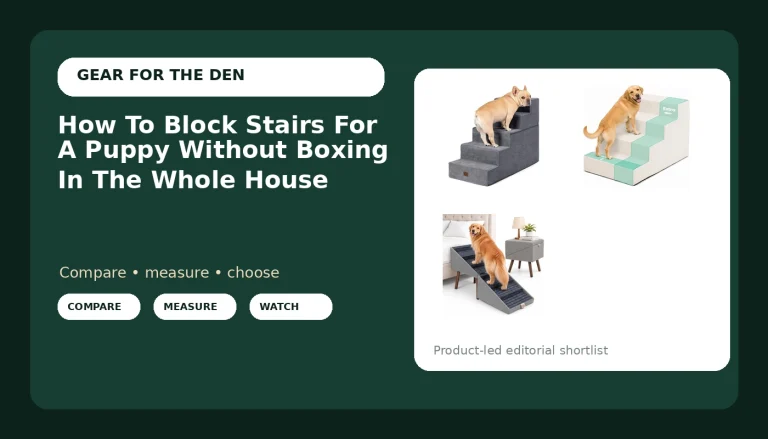
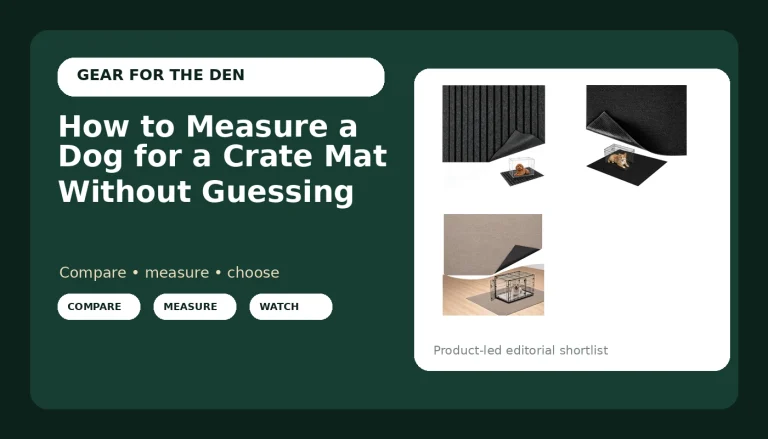
If you are setting up a sleeping spot for the first weeks, my puppy crate setup checklist covers the crate side of the same math, including bar spacing and gate height.
Budget pick: BFPETHOME Outdoor Waterproof Dog Bed for Large Dogs, Washable Cover, 36"
Budget pick
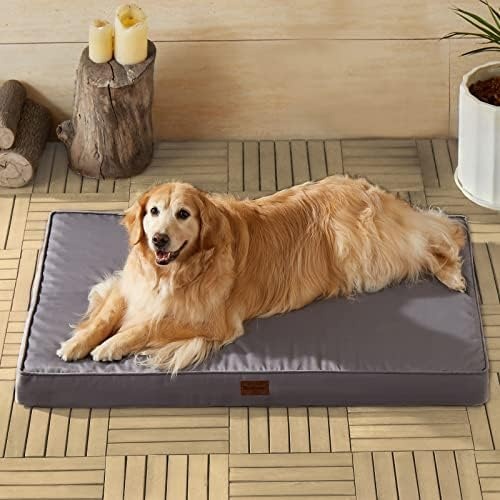
BFPETHOME Outdoor Waterproof Dog Bed for Large Dogs, Washable Cover, 36"
This is the bed to buy when your puppy is in the middle of a growth spurt and you do not want to sink much money into a size you will replace. It is listed as a 36 inch bed for large dogs, and the cover is a washable fabric that lifts off, which matters more than it sounds while a puppy is still learning that the bed is not the bathroom.
The waterproof layer is the feature that earns this one a place in a sizing guide. A puppy that has not finished house training will have accidents on the bed, and a bed with a waterproof layer under a removable cover is a bed you can rescue instead of throw away. Wipe the layer, wash the cover, put it back.
On sizing, treat the 36 inch figure as the outside of the bed and check the actual sleep surface before you commit. A bed this shape works well for a puppy that curls and less well for one that sprawls with its legs out. Measure your puppy's body length against the sleep surface rather than the frame, then decide whether you are buying for the next few months or the next few years.
Check current Amazon price.
Flaws but not dealbreakers: The soft filling compresses under a big dog, so the usable surface is smaller than the label suggests once your puppy is near the top of the weight range for this size.
Anyone raising a puppy through a growth spurt, or anyone who wants a bed that can live on a porch or in a yard, will get the most out of this one.
Our pick: K&H Outdoor Elevated Dog Bed for Medium & Large Pets, Tan, Large 42x30in
Our pick
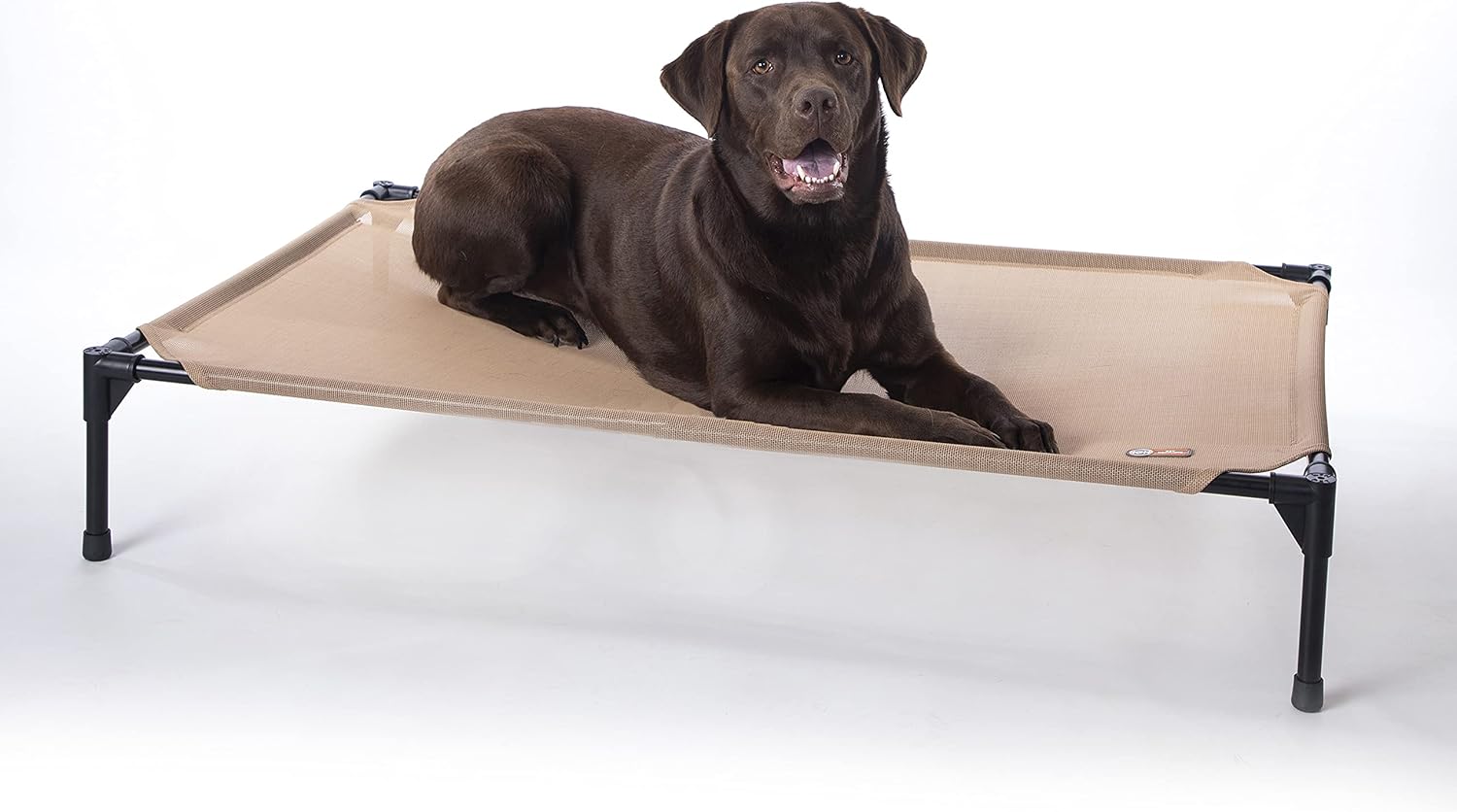
K&H Outdoor Elevated Dog Bed for Medium & Large Pets, Tan, Large 42x30in
This is the bed I point people toward when they want their measurements to mean something. The sleeping area is a taut panel rather than a stuffed mat, so the 42 by 30 inch surface does not sink and shrink under a sleeping dog the way foam does. If you measured body length and shoulder width, that is the surface those numbers should be compared against.
Elevated beds also solve two problems that show up in the middle of puppyhood. Air moves under the panel, which helps a puppy that runs hot, and there is no filling for a teething puppy to dig into. The frame lifts the dog off the floor, which keeps the bed out of the way in a wet yard, and the fabric dries quickly if it gets rained on.
The tradeoff is comfort for a very young or very old dog. A taut panel is supportive, not plush, and a puppy that wants to burrow into something soft will treat this bed as an afternoon nap spot and ignore it at night. Pair it with a blanket if that is your dog.
On sizing, the large size covers medium and large dogs, so a puppy at the front end of that range has room to grow into it. Measure the puppy, then check the sleep surface against the adult size you expect, because this is a bed that stays in service after the growing stops.
Check current Amazon price.
Flaws but not dealbreakers: There is no bolster and no wall, so a puppy that likes to lean on something while it sleeps will look for the couch instead.
Anyone with a puppy that overheats, chews, or spends time outdoors should start here.
Upgrade pick: ChiXnuggle Orthopedic Human Dog Bed,with Faux Fur Washable Cover,Blanket
Upgrade pick
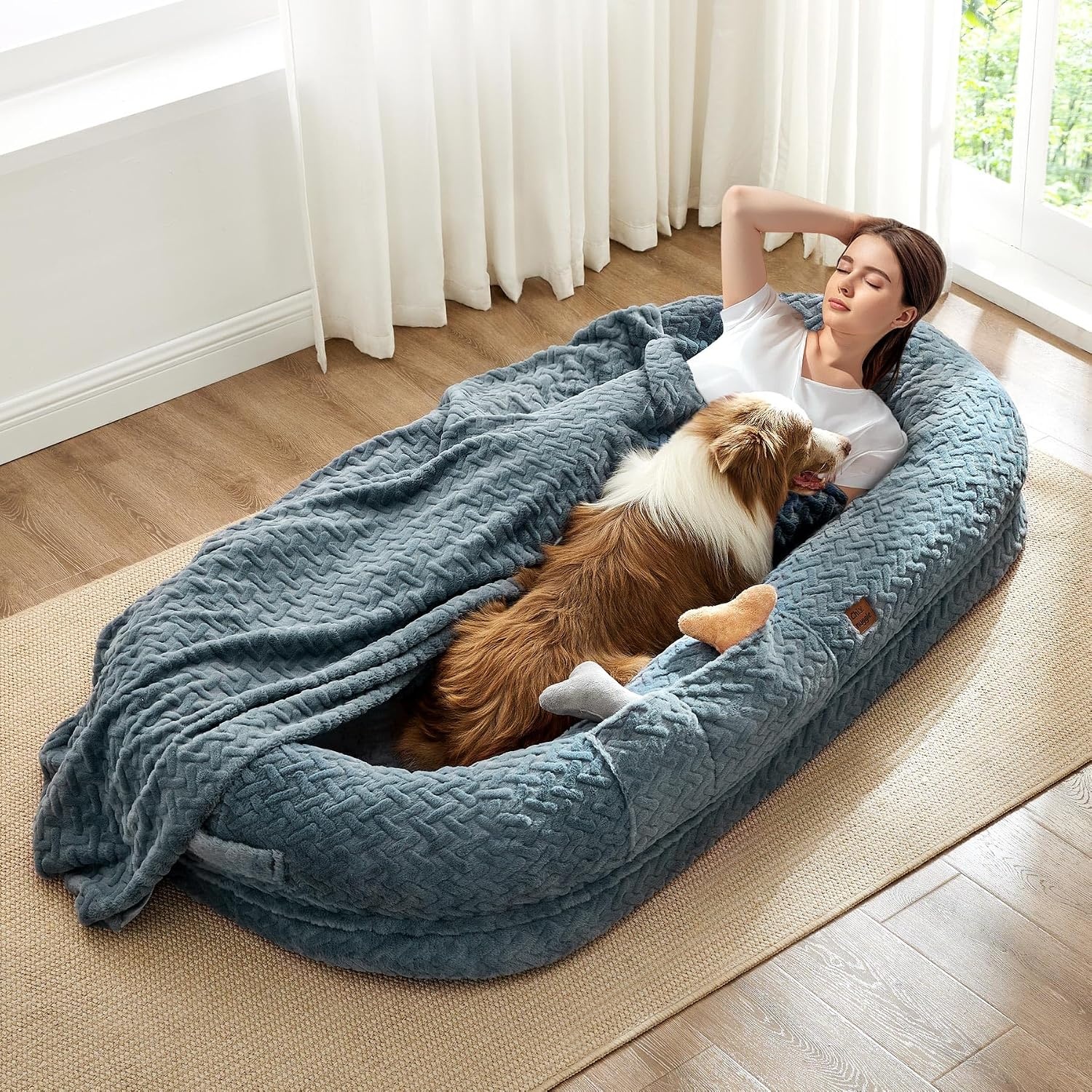
ChiXnuggle Orthopedic Human Dog Bed,with Faux Fur Washable Cover,Blanket
This is the one for the person who wants the puppy asleep next to the desk instead of in another room. A human dog bed is oversized by design, and the orthopedic filling under the faux fur cover gives a large puppy support that a thin mat cannot. The cover is a washable fabric that comes off, and the bed ships with a blanket, which covers the burrowing habit the elevated bed above cannot.
Sizing a human dog bed works differently from sizing a flat mat. The orthopedic filling is thicker and softer than an elevated panel, so some of the listed surface disappears under the dog's weight. If your puppy's sprawl measurement lands close to the edge of the listed size, go bigger or expect a cramped sleeper. Measure the sprawl, allow for compression, then decide.
The faux fur is the detail that divides people. It is warm and it invites a puppy to settle, and it also collects hair and dirt, which is exactly why the removable washable cover matters. Wash it on a schedule rather than when it starts to look bad.
The height of a human dog bed is worth checking too. A tall puppy can step up on its own, but a very young one will need help or a ramp, and a bed the puppy cannot climb into is a bed it will not use.
Check current Amazon price.
Flaws but not dealbreakers: The size and the filling make this a bed you place once and live around, not a bed you drag from room to room.
Anyone who works from home, or who wants one bed that fits a puppy now and an adult dog later, should look here first.
How to measure a puppy for a bed, step by step
This is the whole method, and it works the same whether you are buying a flat mat, an elevated cot, or a human sized bed. If you have ever wondered how to size up a puppy for a bed without a breed chart, start with step one and keep the numbers on your phone.
Step one: Pick the right moment. Measure when your puppy is standing square on all four feet, or when it is fully asleep and stretched out. Not during zoomies, not while it is chewing, and not while it is trying to climb your leg. If you have a second person, have them hold a treat at nose level while you run the tape. A still puppy gives you a number you can trust. A moving one gives you a guess.
Step two: Measure body length. Run the tape from the point of the chest between the front legs to the base of the tail, along the spine. Keep the tape flat against the body and snug rather than tight. Write the number down. This is the measurement that has to fit inside the sleep surface of any bed you buy, and it is the one people most often skip in favor of nose-to-tail length.
Step three: Measure shoulder width. Find the widest point across the front of the chest, just behind the front legs, and measure straight across. Shoulder width tells you how much turning room the bed needs. A puppy that cannot turn around on the bed without stepping off will sleep on the floor beside it, which is a quiet way of telling you the bed is too small.
Step four: Measure the sprawl. Let the puppy fall asleep, then measure the whole footprint: nose to tail tip and front paw to back paw. This is the real number for a flat bed. If your puppy sleeps curled in a ball, the sprawl number is your ceiling rather than your target. If it sleeps flat with its legs out, the sprawl number is the minimum you should shop for.
Step five: Add room to grow. Ask your vet or breeder how much more this puppy is expected to grow and how long that will take. A puppy still in the middle of a growth spurt should be sized for the adult body length plus turning room, or bought cheap now with a plan to replace later. Both are reasonable. Buying an expensive bed in a size the puppy will outgrow in three months is not.
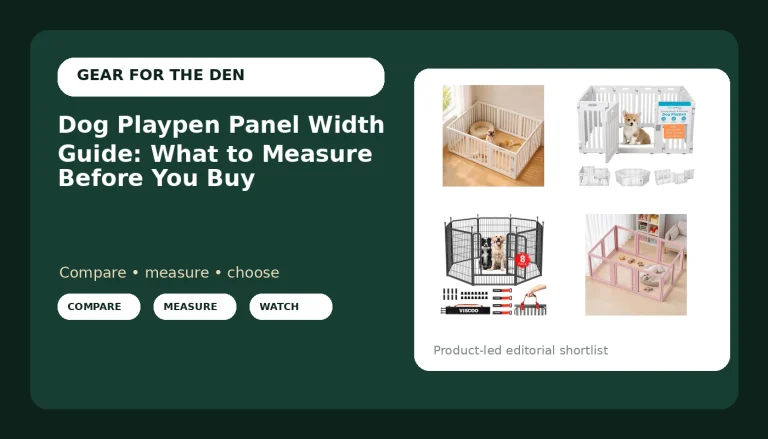
Step six: Compare against the bed, not the frame. Take your body length and shoulder width numbers and compare them against the sleep surface in the listing. Outer dimensions usually include bolsters, rails, legs, and a frame, so a bed labeled large can offer a medium sleep surface. If the bed will sit inside a crate or a pen, compare your numbers against the crate size too, so the mat and the bed agree on how much floor they use.
Step seven: Read the details that touch the dog. Mat thickness decides how much of the listed surface disappears under weight. Cover ventilation decides whether a puppy that runs hot will stay on the bed at all. A waterproof layer matters while house training is still in progress, and a washable fabric matters for the rest of the dog's life. Bar spacing and gate height matter if the bed lives in a crate, and panel count matters if you are using an exercise pen instead.
Step eight: Re-measure on a schedule. Measure again every couple of weeks for the first few months, then monthly until growth stops. Keep the numbers in a note on your phone so you can compare them. When body length starts to close in on the sleep surface, it is time to size up a puppy for a bed again. That is a normal part of raising a dog, not proof that you bought the wrong thing the first time.
The competition and why it lost
Most of what lost here lost on the same technicality: the number in the headline was the outside of the bed, not the surface the dog sleeps on.
Round cuddle beds with deep bolsters look cozy and measure small. The walls eat the sleeping area, so a bed that claims to fit a medium dog gives a large puppy nowhere to stretch, and the puppy ends up beside it. Bolster beds with a high back are worse, because the tallest wall is usually the one the dog wants to lean on.
Flat foam mats lost for the opposite reason. They are honest about their dimensions and dishonest about their thickness. A thin mat under a big puppy flattens to the floor, which means your carefully measured sleep surface is gone by the second week. If you already own one, put it on top of a firmer surface rather than buying another.
Beds sold as one size fits all lost because there is no such size. A bed that suits a curled puppy does not suit a sprawler, and the difference is visible in the first measurement you take. Cooling mats and crate pads also lost, not because they are bad, but because they are accessories to a bed rather than a bed, and they belong in a guide about heat and crate setup instead of this one.
What this all costs
The real cost of this job is not the bed. It is the second bed you buy when the first one turns out to be a size too small, and the third one you buy when a puppy chews through a soft cover during teething.
Here is the honest version of the math. A budget flat bed with a washable cover and a waterproof layer gets a puppy through a growth spurt and can move to the porch or the yard afterward. An elevated bed costs a little more and tends to outlast the puppy stage entirely, because the frame does not care how big the dog gets. A human dog bed costs the most and replaces a piece of your own furniture, which is either the point or the dealbreaker depending on your house.
Check current Amazon price on all three and compare it against the cost of buying twice. Spread across the years a dog actually uses a bed, even the most expensive option here works out to a small amount per day, and the measurement you take in step two is free.
Measure the puppy. Write the numbers down. Re-measure in a month. Learning to measure a puppy for a bed is a ten minute skill that pays for itself the first time it stops you from buying the wrong size.