The first time you try to set up a dog playpen in a small room, the problem stops being the dog and starts being the floor plan. A pen that looks modest in a product photo can swallow the only walking lane between the couch and the kitchen, and then you are the one living in a pen.
I have spent years writing about dog comfort and home gear from apartments where the free wall was behind the door and the only outlet was already taken by a lamp. The pens that survive that kind of room are not the ones that win on a store shelf. They are the ones whose panel count, gate height, and footprint you checked before you ordered.
This guide is the order of operations I use: measure the room, choose the spot, run the geometry, and only then pick the pen that fits the number you got. Get that sequence right and an ideal dog playpen in a small room setup stops feeling like a compromise.
Why you should trust me
I write the dog comfort and home coverage for this site, which means I read more pen listings in a month than most people read in a lifetime. I have set up crates, gates, and pens in apartments where a 10-by-10 bedroom doubled as the office, and I learned the hard way that a pen you cannot walk around is a pen you stop using by the second week.
I am not going to claim I ran these three pens in my living room for a month. What I did was work the numbers that decide whether a small room still functions: panel count, bar spacing, gate height, and the floor area each layout claims once you leave a walking lane. That is the part most listings never mention, and it is the part that matters when the room is ten feet wide.
How I picked and how I tested
Three things got a pen onto this list.
First, it had to fit a real small room. I modeled every layout inside a 10-by-10 foot bedroom, which is close to the smallest room a modern apartment gives you, and I kept a 24-inch walking lane on at least two sides. Any pen that could not leave that lane did not make the cut, no matter how good it looked.
Second, it had to be honest about its own dimensions. Panel count and panel width set the perimeter. Height decides whether your dog can clear it. Bar spacing decides whether a puppy can squeeze through. I checked all three against the size of dog each pen is built to serve, and I noted where a listing's own numbers argue against it.
Third, it had to come apart and go back together. A pen that needs two people and a drill to move is a pen that stays in the wrong spot.
What knocked a pen off the list was usually one number. A footprint that assumed clearance on all four sides, a gate that sat too low to use comfortably in a doorway, or a panel count that only worked if the pen floated in the center of a room. Those are the specs that fail in a small space, and they fail quietly.
What I did not do is treat a spec sheet as a trial. Where I describe how a pen behaves in a room, I am describing geometry and clearance, not a test unit I owned. Where a claim comes from the listing, I say so.
The playpens that make it easier to set up a dog playpen in a small room
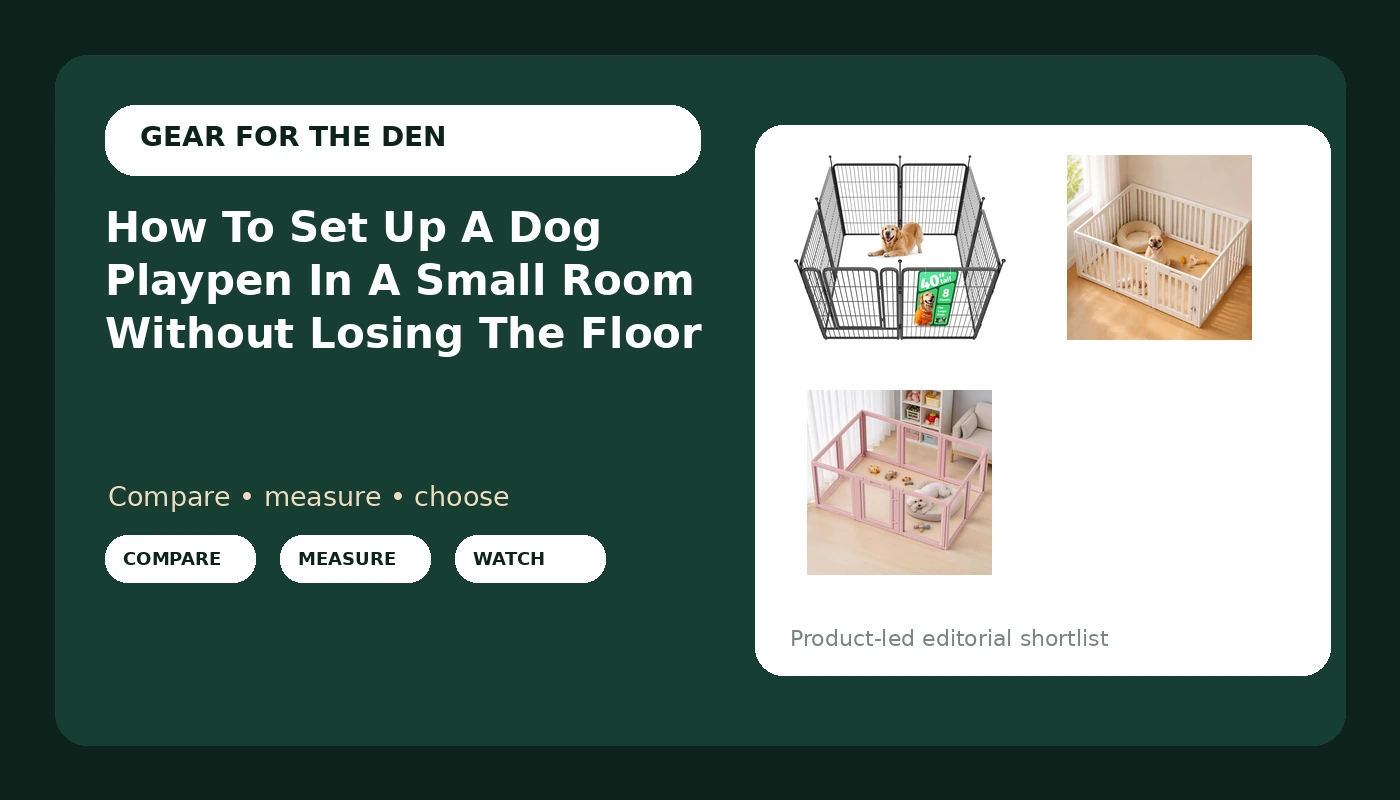
Three pens, three answers to the same problem. All three are indoor pens, and each one fits a small room if you match it to your dog's size and your layout.
Budget pick: FXW Rollick Dog Playpen, Indoor, Yard & RV Camping, 40"H, 8 Panels
Budget pick
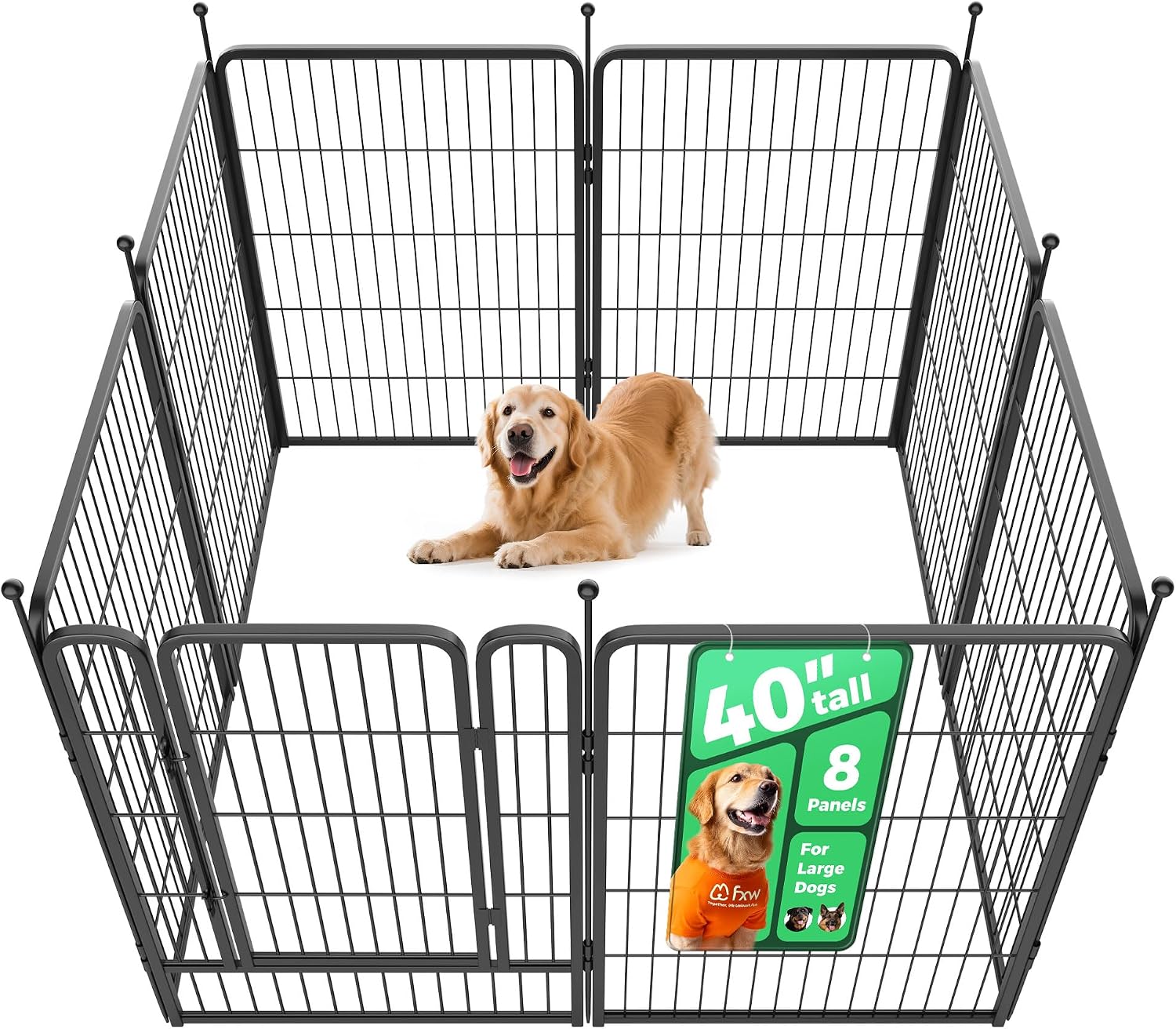
FXW Rollick Dog Playpen, Indoor, Yard & RV Camping, 40"H, 8 Panels
This is the pen for the household that needs height. Forty inches of panel is enough to hold a determined medium or large dog, and eight panels give you a perimeter you can shape into a square, a rectangle, or an L against a wall. Check current Amazon price.
In a small room, that height is the trade. Tall panels read as a wall rather than a fence, so a pen this size visually shrinks a bedroom even when its footprint matches a shorter pen. If your dog does not need the height, you are paying for it in sightlines.
Eight panels is also the reason this one asks more of your layout. Fewer, taller panels mean longer sides, and long sides are hard to fit between a bed and a dresser. This is the best choice here for a big dog in a small room and the worst choice for a small dog in a small room. The panel height is the headline spec in the listing, so check the bar spacing against your own dog before you order.
Flaws but not dealbreakers: At 40 inches tall it is heavier per panel than the shorter pens below, so moving it solo takes two trips and a clear head.
Anyone with a medium or large dog who wants a pen that works indoors and out should start here.
Our pick: EVERFRONT Dog Playpen Indoor, Puppy Playpen, White 24" H, 10 Panels
Our pick
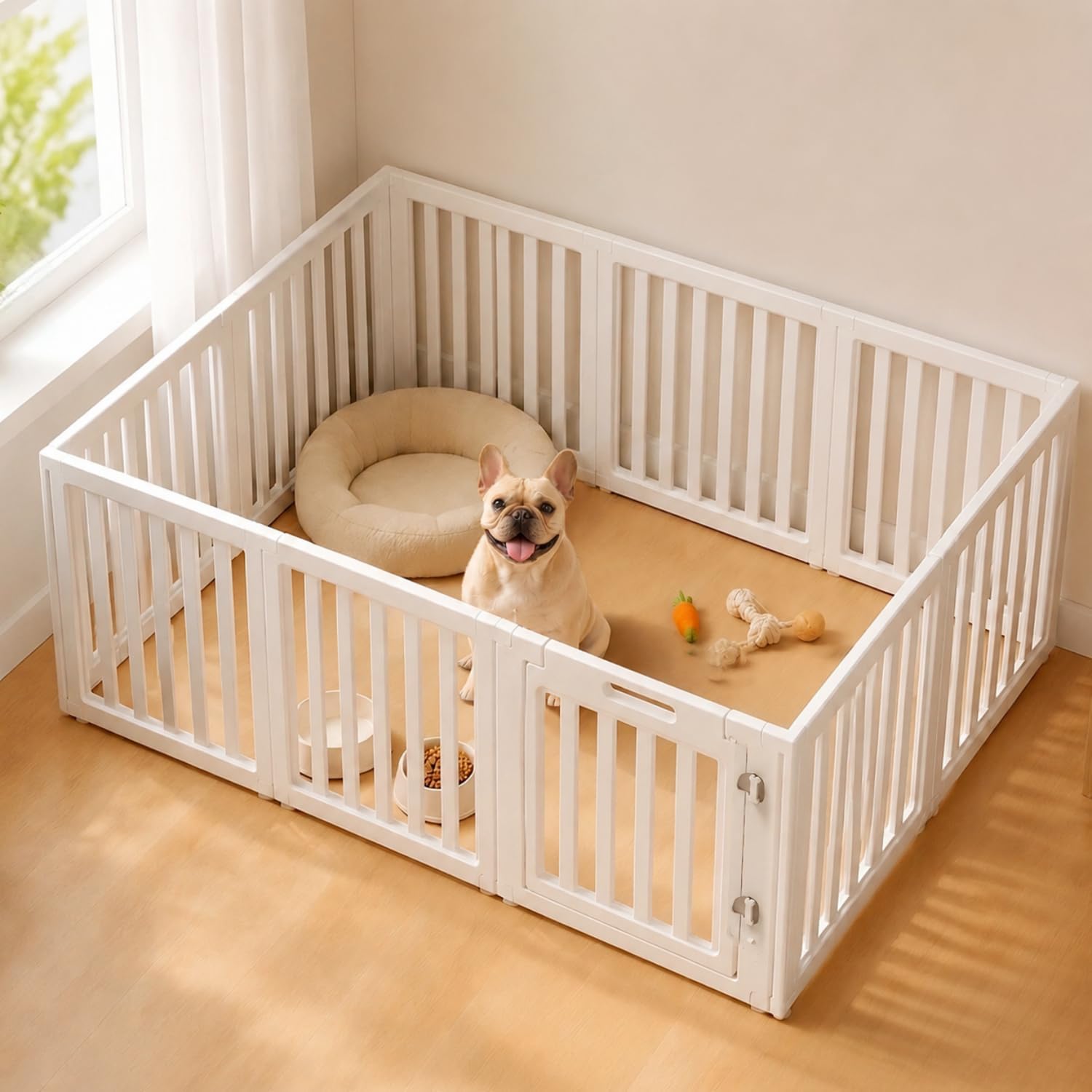
EVERFRONT Dog Playpen Indoor, Puppy Playpen, White 24" H, 10 Panels
Ten panels at 24 inches is the shape most small rooms actually want. More panels mean shorter sides, and shorter sides mean the pen can wrap a corner, hug a couch, or run along a wall instead of standing in the middle of the floor. Check current Amazon price.
The 24-inch wall suits puppies and small breeds. That is a real limit, and I will not pretend otherwise: a dog that likes to jump will treat it as a suggestion. For a puppy still learning the house, the lower wall keeps the room feeling like a room rather than a kennel.
The white finish is the other practical argument. A pale pen against pale baseboards disappears in a way that a dark or bright pen does not, which matters more than it sounds when the pen is going to live in your bedroom for a year. Ten panels also means more joints to check for tightness each week, so plan on a quick walk around the frame when you clean.
Flaws but not dealbreakers: Twenty-four inches will not hold a climber or a jumper, so treat this as a puppy and small-breed pen, not a containment solution for a bored adolescent.
Anyone raising a puppy in an apartment, or penning a small breed in a bedroom or office, gets the most out of this layout.
Upgrade pick: LoveTail Acrylic Dog Playpen Indoor, Pink Dog Pen, Puppy Playpen, 10 Panels
Upgrade pick
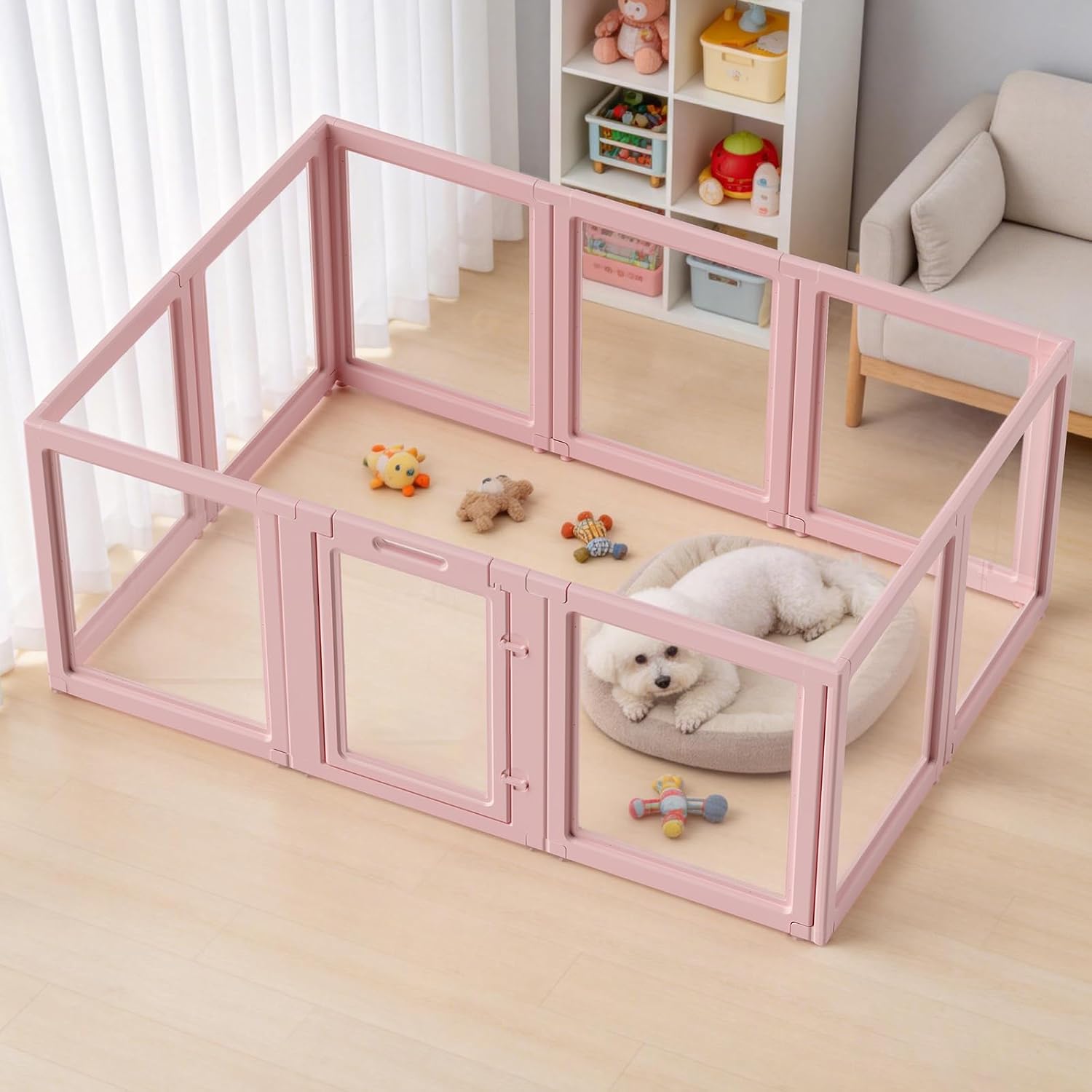
LoveTail Acrylic Dog Playpen Indoor, Pink Dog Pen, Puppy Playpen, 10 Panels
The acrylic panels are the whole point. Clear walls let light through, so a pen in the corner of a small room does not turn that corner into a shadow. Ten panels give you the same flexible footprint as the EVERFRONT above, with a finish that reads as furniture rather than fencing. Check current Amazon price.
This is the pen for someone who cares how the room looks, and that is not a shallow reason in a small space. When the pen sits in your living room, you will keep it up longer if you do not hate looking at it.
The trade is transparency. Acrylic shows every nose print and every paw smear, so a washable fabric mat underneath and a cloth in the drawer become part of the routine. Clear panels also give a puppy a full view of everything it cannot reach, which some dogs find calming and others find motivating.
Flaws but not dealbreakers: Acrylic is the heaviest material here to move, and it scratches if you drag the panels across a hard floor instead of lifting them.
Anyone who wants a pen that looks deliberate in a shared living space, and who has a puppy or a small breed, will like this one.
The actual setup workflow
A dog playpen in a small room setup lives or dies on the order you do things in. Do the measuring before the buying.
Step one: Measure the room, not the pen. Every plan to set up a dog playpen in a small room starts on the floor with a tape measure. Mark the two walls you want the pen to touch and measure the longest straight run between them. That number, minus a walking lane you can actually use, is your maximum pen width. Write it down before you open a single listing. If the number comes out under three feet, you are shopping for a corner pen, not a freestanding one.
Step two: Choose the corner or the wall before the panel count. A freestanding pen needs clearance on every side, which is the fastest way to eat a small room. A wall-backed or corner pen borrows the walls as two of its own sides. Decide which one you can live with first, because it changes how many panels you need and how many stay in the box.
Step three: Run the panel count math. Panel count multiplied by panel width gives you the perimeter. Divide that perimeter by the number of sides you actually need once a wall is doing part of the work. Ten panels go further against a corner than eight panels do in open floor, which is why panel count alone tells you almost nothing until you know the layout.
Step four: Check bar spacing against your dog. Bar spacing is the measurement people skip. A puppy can slip through a gap that a grown dog cannot, and a gap wide enough for a snout to pass through is a gap a puppy will try to follow. Measure the widest part of your dog's head, then compare it to the spacing before you buy.
Step five: Set gate height for you, not the dog. The gate is the part you use ten times a day. If the pen lives in a bedroom and you cross it in the dark, a low gate is a shin injury waiting to happen. If it is a puppy pen and you are reaching in constantly, a gate you can open with one hand matters more than the wall height.
Step six: Build the floor layer before the pen arrives. Hardwood and laminate do not want a metal frame dragged across them, and a puppy does not want to stand on bare floor. Put down a waterproof layer first, then a washable fabric mat on top of it, then the pen on top of the mat. Mat thickness is the balancing act: thick enough to soften the frame, thin enough that it does not catch under the gate. If you are still choosing that layer, this roundup of washable mats for pens and crates is the place to start.
Step seven: Cover it if you must, and vent it if you do. A cover turns a pen into a den and stops a climber, but cover ventilation is the part people forget. A fully covered pen in a warm room traps heat and odor. If you use a cover, leave at least two sides open to the room, and test the temperature on a warm afternoon before you leave a dog in it overnight.
Step eight: Set the crate size before the dog arrives. If the pen will hold a crate along with a bed and a water bowl, the crate goes in first. Match the crate size to your dog's adult weight, not its puppy weight, and push the crate against the wall side of the pen so the open floor stays in one piece. A pen with a crate in the middle is two small rooms instead of one.
Give any layout a week before you change it. Dogs need time to accept a boundary, and you need time to learn where you actually trip.
The competition and why it lost
The pop-up fabric pens sold in every pet store are the obvious alternative, and they lose on floor plan rather than on price. Their sides bow, so the footprint is never quite the rectangle you measured, and mesh walls make a small room feel darker than it is. They are excellent for travel and a poor fit for the room you live in every day.
Wire exercise pens sold as outdoor runs are the other common answer. They are usually taller and lighter than the pens above, and in a yard they are a fine choice. Indoors, the same wire that makes them easy to move makes them easy to shove across a hard floor, and an open top does nothing for a climber.
A baby gate and a closed door are the zero-cost option, and for some dogs they are the right one. A gate gives you a barrier, not a floor. A barrier will not keep a puppy away from a lamp cord in the middle of the room. If your dog's problem is the doorway, use the gate. If the problem is everything in the room, you need a floor plan.
A crate on its own is the fourth option. A crate is the better tool for house training and for a dog that settles when enclosed. It is the wrong tool if your dog needs to move, because a crate gives a dog room to turn around and not much else. Plenty of small-room setups end up with both, a crate inside a pen, which is exactly why step eight exists.
What this all costs
All three pens here land in the same general band, and that is the honest answer to the cost question. Check current Amazon price on each one and you will find a spread of tens of dollars, not hundreds. The pen is rarely the expensive part of a small-room setup.
The real cost is everything around it. A waterproof layer, a washable fabric mat, a cover if you need one, and a crate if the pen is doubling as a bedroom add up faster than the pen itself. Budget for the floor layer first, because it protects the room you are trying to keep, and it is the piece you will replace most often.
Then there is the cost you cannot put on a receipt: square footage. A pen that takes a quarter of the bedroom costs you the room, and no pen on this list is affordable enough to make that trade worth it. Measure first, buy second, leave yourself a walking lane, and check the gate height before you commit. That is how to set up a dog playpen in a small room so that you still want to be in that room a month later.