The phrase limited ingredient dog treats explained can sound like a marketing promise, but it is really a reading skill. A short ingredient list can help you avoid a known trigger, yet it can also leave gaps in nutrition, texture, and coat support. If your dog scratches, sheds, or reacts after treats, the goal is not simply fewer ingredients. The goal is a treat you can trace, repeat, and fit into a skin and coat routine that already works. This guide covers what limited ingredient dog treats mean in practice, how to read a label, and which supplement-style chews are worth considering when treats alone are not enough.
Quick answer
Limited ingredient dog treats are treats built around a shorter, simpler ingredient list, often with one main animal protein and fewer fillers, colors, or preservatives. They are not automatically hypoallergenic, and they are not automatically complete and balanced. The correct limited ingredient dog treats for your dog depend on what you are trying to avoid, what your dog tolerates, and what your vet has ruled out. Start with a protein your dog has already eaten without issue, keep the treat small, and change one thing at a time. If the problem is coat quality rather than a food trigger, a joint or skin support supplement may help more than a new treat. Do not label a treat the best or safest unless your dog's own response and a vet's guidance support that claim.
4 useful options for a limited ingredient routine
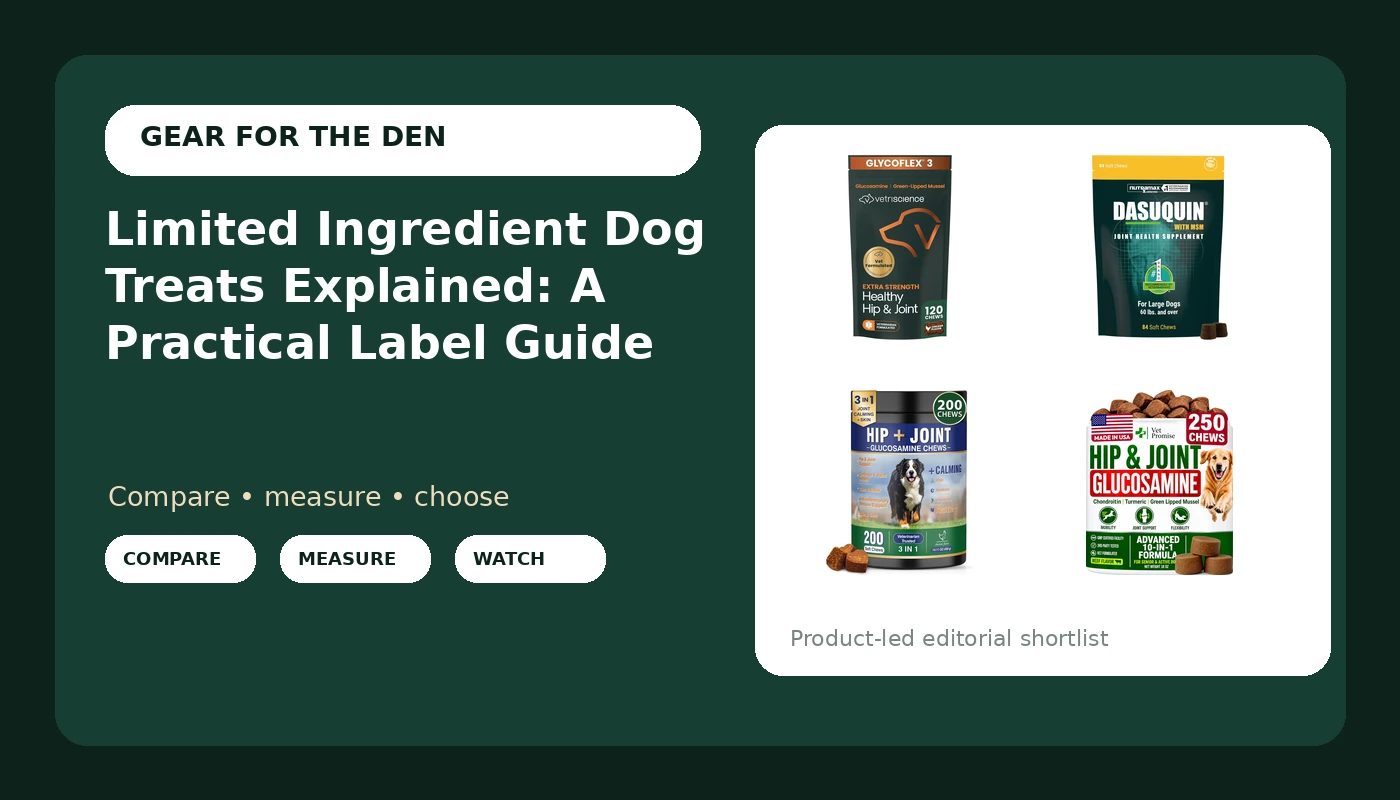
These are supplement-style chews, not treats. They can sit alongside a treat plan when you are already managing a limited ingredient diet and want to add joint, skin, or coat support. Each option below uses the product name as listed.
| Model | Best fit | What stands out |
|---|---|---|
| VetriScience Extra Strength Healthy Hip & Joint for Dogs, Chicken, 120ct | Dogs that do well on chicken and need joint support | Chicken-flavored, extra-strength hip and joint formula in a 120-count bottle |
| Nutramax Dasuquin MSM Joint Supplement for Large Dogs, Soft Chews, 84ct | Large dogs needing MSM joint support | Large-dog formula, MSM in the name, soft chews, 84 count |
| Hip and Joint Supplement for Dogs 200ct, Calming & Skin Support All dogs | Dogs needing a high-count chew with a calming and skin support angle | 200-count bottle, calming and skin support positioning, marketed for all dogs |
| Glucosamine Hip & Joint Supplement for Dogs – 250 Chews with Chondroitin | Dogs needing a high-count glucosamine and chondroitin chew | 250 chews, glucosamine and chondroitin in the name |
Featured joint and skin support: VetriScience Extra Strength Healthy Hip & Joint for Dogs, Chicken, 120ct
Use this as a supplement alongside a treat plan, not as a replacement for one. The chicken flavor is the first thing to check. If chicken is on your elimination list, skip it. If chicken is safe, the 120-count bottle gives you a straightforward daily option. The trade-off is simple: a named protein makes the label easier to read, but it also narrows the dogs that can use it. If you are not sure whether chicken is safe, talk to your vet before starting a new chew. A treat trial and a supplement trial are two different variables, and running both at once makes the result hard to read.
Large-dog MSM soft chew: Nutramax Dasuquin MSM Joint Supplement for Large Dogs, Soft Chews, 84ct
Large dogs often need a different chew size and a different daily count than small dogs. That is the main reason to consider this option. Read the ingredient list before you commit, especially if your dog is on a limited ingredient diet for skin issues rather than joint issues. A large-dog formula is not automatically a limited ingredient formula. If your large dog is also prone to skin problems, do not assume this formula is the right one. Large-dog sizing and skin support are separate questions.
Calming and skin support chew: Hip and Joint Supplement for Dogs 200ct, Calming & Skin Support All dogs
The skin support angle fits the skin and coat category, but the label still deserves a close read. Calming and skin support are broad terms, and they do not replace a diagnosis. If your dog's coat problem is driven by fleas, thyroid disease, or a specific food allergy, a chew will not solve it. Use this as one part of a larger plan. If your dog is anxious and itchy, one chew may not address both, and a vet can help you separate behavior from allergy.
High-count glucosamine chew: Glucosamine Hip & Joint Supplement for Dogs – 250 Chews with Chondroitin
A 250-count bottle can be useful if you have a multi-dog household or a long treatment plan, but bottle size is not a reason to choose a supplement on its own. Check the ingredient list for proteins, flavors, and binders that may matter to your dog. If you are avoiding chicken, beef, or grains, the front of the bottle is not enough. A high count can also mean a larger upfront supply, so if your dog has never tried glucosamine or chondroitin, a smaller trial size may be a safer first step.
Prices and availability may change. Product images, names, and retailer links are matched to verified listings. No current price, rating, stock status, or measured result is stated here without current evidence.
What limited ingredient really means
In practice, limited ingredient dog treats are defined by what is not in the bag as much as what is. The phrase is not a single official category, so brands use it differently. Some use one animal protein. Some use a novel carbohydrate. Some simply remove artificial colors and preservatives. That range is why the ingredient list matters more than the front label.
A limited ingredient treat can still contain a protein your dog reacts to. "Limited" does not mean "safe for every dog." If your dog has a diagnosed allergy, the treat has to avoid that specific allergen, not just look short. If you are doing an elimination trial, keep the treat consistent and keep a log. One new treat at a time tells you more than a bag of mixed flavors.
Some limited ingredient treats use a single novel protein such as venison, duck, or kangaroo. Others use a protein your dog has already eaten. Neither approach is automatically better. A novel protein only helps if your dog has not been exposed to it, and a familiar protein only helps if your dog has tolerated it reliably.
Oatmeal concentration is a good example of why order matters. If oatmeal sits near the top of the ingredient list, it is a major part of the treat, not a minor add-in. For a dog with a grain sensitivity, that difference matters. For a dog with no grain issue, it may be fine. The same logic applies to chicken, beef, peanut butter, and cheese.
Coat type can also shape what you notice. A double-coated breed may show a food problem as a dull undercoat or heavy shedding. A curly coat may show it as mats, odor, or skin flakes. Omega 3 fatty acids, especially EPA and DHA, support skin and coat, but a treat is usually too small to be a meaningful source. If coat quality is the main concern, look at the whole diet and consider a supplement with a clear label.
Calorie density also matters. A small chew can carry a surprising number of calories, especially if it is soft or high in fat. If your dog is overweight, the treat can work against joint support even when the ingredients look clean.
If you also use topical balms or sprays, check whether they are labeled lick safe. A dog that licks a treated paw will ingest some of the product, so lick safe matters even when the product is not a treat. And if you are comparing bottle size, remember that a bigger bottle only helps if the formula fits your dog.
How to read an ingredient list for limited ingredient dog treats
The ingredient list is your main tool. Start with the first five ingredients, because those make up most of the product. Then scan for the protein, the carbohydrate, and any flavor or preservative that you are trying to avoid. If the label uses a broad term like "meat meal" or "animal fat," you cannot know the source, which is a problem when you are avoiding a specific protein.
There is no single formula for ideal limited ingredient dog treats. The ideal choice is the one that matches your dog's known tolerances and your vet's guidance. A treat with one protein and one carbohydrate is easier to evaluate than a treat with a long list. A treat with a named protein is easier to trace than one with a generic term. A treat with a short list is easier to repeat, but it still has to be palatable enough that your dog will eat it.
If the label lists a long "natural flavor" or "mixed tocopherols" line, that is not automatically bad, but it does mean you cannot trace every component. For a dog with a known allergy, traceability is more important than a short list.
Use this method:
- Write down the proteins and carbohydrates your dog has eaten without skin or digestive issues.
- Read the first five ingredients and identify the main protein and main carbohydrate.
- Check for any ingredient your vet has told you to avoid, including chicken, beef, wheat, soy, or dairy.
- Compare the treat's calorie count and size to your dog's daily food intake so treats stay a small part of the diet.
- Change only one treat or supplement at a time, and track scratching, stool quality, and coat condition for at least two weeks.
This is slow, but it is the only way to know what works. A treat that looks limited can still fail if it contains a hidden trigger. A treat that looks ordinary can still work if it matches your dog's history.
Practical guidance for treats, supplements, and skin and coat
- Keep treats to a small share of daily calories, usually no more than ten percent unless your vet says otherwise.
- Choose a named protein and a named carbohydrate when you can, because generic terms make the ingredient list harder to audit.
- If you use a joint or skin supplement, introduce it separately from a new treat so you know what caused any change.
- Store chews and treats according to the label, and check bottle size against your dog's daily dose so the product does not sit open for months.
- If your dog has severe itching, hair loss, or open sores, stop guessing and talk to your vet before adding more products.
Which option should you choose?
Choose the VetriScience Extra Strength Healthy Hip & Joint for Dogs, Chicken, 120ct when your dog already tolerates chicken and you want a named-protein joint chew in a 120-count bottle. Choose the Nutramax Dasuquin MSM Joint Supplement for Large Dogs, Soft Chews, 84ct when you have a large dog and want a soft chew with MSM named on the label. Choose the Hip and Joint Supplement for Dogs 200ct, Calming & Skin Support All dogs when you want a high-count chew that also carries a calming and skin support angle. Choose the Glucosamine Hip & Joint Supplement for Dogs – 250 Chews with Chondroitin when you want a high-count glucosamine and chondroitin chew for a long daily routine.
None of these products is a treat, and none is automatically a limited ingredient product. They are supplement-style chews that may support a broader plan. If your dog's main problem is a suspected food allergy, the treat and diet choices matter more than any supplement. If your dog's main problem is joint stiffness, a supplement may be the better fit. Match the product to the problem, and read the ingredient list before you buy.
The bottom line
Limited ingredient dog treats are a useful tool, not a cure. They work best when you know what your dog is avoiding, you read the ingredient list, and you change one thing at a time. The best treat for your dog is the one that fits an elimination plan, supports skin and coat, and does not introduce a protein or filler you are trying to avoid. Supplements can help with joints, calming, or skin support, but they are not treats and they do not replace a vet's diagnosis. A limited ingredient treat is only as good as the plan around it. Start with the ingredient list, keep the routine simple, and judge results by your dog's coat, skin, and digestion over weeks, not days.