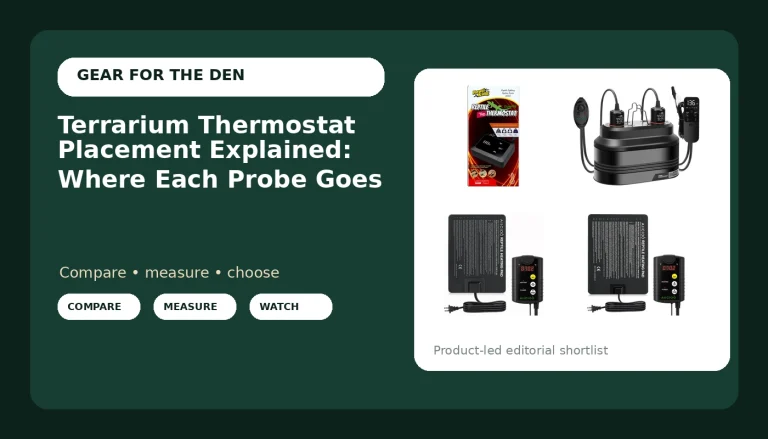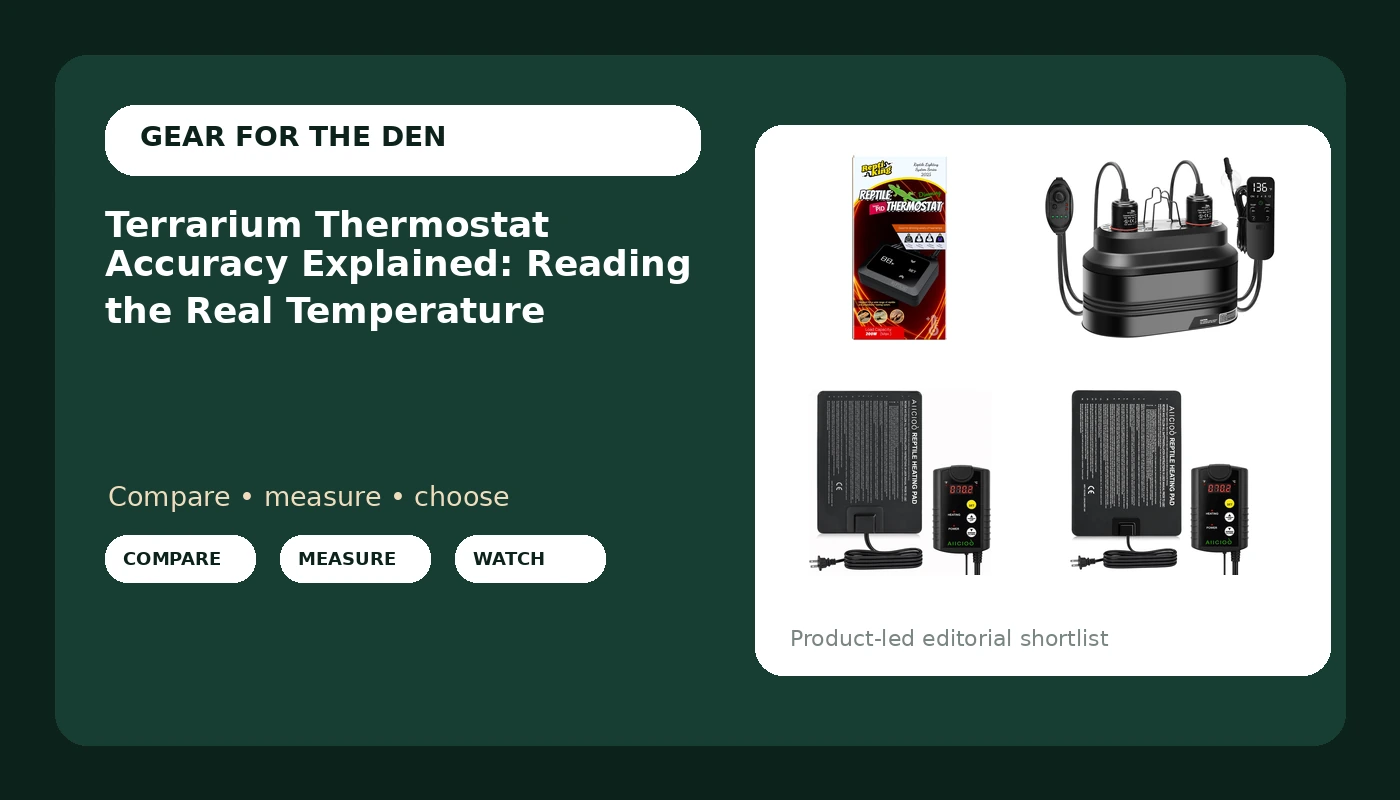
A reptile enclosure only works as well as the heat you can hold steady, and holding heat steady starts with measurement. If a controller's probe reads a couple of degrees off, the basking temperature your animal actually experiences is off by the same amount, and that gap is what turns a workable thermal gradient into a chronic problem. Terrarium thermostat accuracy is the distance between the number on the display and the temperature at the spot the animal uses, and it depends on probe placement, sensor type, heat load, and the way the controller switches power. This explainer covers what accuracy means in practice, where the common errors come from, and how the four heating and control options below differ in the way they hold a set point.
Quick answer
Terrarium thermostat accuracy explained in one sentence: the display is a claim, and an independent thermometer at the basking spot is the evidence. Digital and PID controllers usually hold a set point more tightly than the simple dial thermostats bundled with budget heat mats, because they adjust power in smaller steps instead of switching fully on and off. Dimming controllers suit heat bulbs and ceramic emitters, while on and off controllers suit heat mats. None of the listings below publish a measured tolerance, so treat every set point as something to verify rather than something to trust.
Four useful options
| Model | Best fit | What stands out |
|---|---|---|
| ReptiKing Reptile Dimming Thermostat | Basking bulbs and ceramic heat emitters | PID dimming control instead of on and off switching |
| MECESOR Dual Reptile Light Fixture | Two heat sources in one enclosure | Two sockets with independent thermostat control and timer dimming |
| Aiicioo Under Tank Heater Thermostat 8W | Small enclosures with low under tank heat needs | Mat and thermostat supplied as a matched combo set |
| Aiicioo Under Tank Heater Thermostat 16W | Larger footprints that need more heat from below | The same combo format at a higher heat mat wattage |
Basking control: ReptiKing Reptile Dimming Thermostat
Dimming matters most when the heat source also produces light. An on and off controller cuts a bulb's power completely, then restores it, so a basking bulb under that control produces a pulsing light and repeated thermal spikes at the basking surface. A dimming controller reduces power smoothly, which keeps the basking temperature closer to the set point and keeps the light steadier. The trade off is that dimming controllers are built around resistive heat sources such as incandescent bulbs and ceramic heat emitters, and they are not the right match for every fixture or every heat mat. Probe placement still decides the result: if the sensor sits on the glass rather than on the basking surface, the controller is regulating the wrong location very precisely.
Dual fixture: MECESOR Dual Reptile Light Fixture
Two heat sources in one fixture means two set points to verify, not one. The independent thermostat control on each socket lets you run a warmer basking zone and a cooler ambient zone from the same hood, and the timer function handles the day and night split without a separate plug timer. The trade off is that a built in controller is a convenience, not a substitute for measurement. If you want to see how the enclosure behaves overnight, an external controller or a second thermometer placed at the cool end is still the way to see it. Distance also matters here: the fixture sits above the screen, so the gap between the lamp and the basking surface sets how much of the output actually reaches the animal.
Small tank under tank heat: Aiicioo Under Tank Heater Thermostat 8W
Under tank heat works differently from overhead heat. A mat warms the surface it touches, and the useful warmth reaches the animal through substrate depth and the floor of the enclosure, which makes probe location a bigger deal than the display. Placed on the mat itself, the probe reads the mat; placed inside the enclosure on the floor above the mat, it reads something closer to what the animal feels. The 8W mat in this combo is aimed at small footprints, where a low heat mat wattage is enough to create a warm spot without pushing the whole tank. As with any under tank heater, a reptile heat mat placement guide is worth reading before you stick anything down permanently.
Larger under tank heat: Aiicioo Under Tank Heater Thermostat 16W
More heat mat wattage covers a larger floor area, but it also makes oversizing easier. A 16W mat under a shallow substrate layer in a small tank can push the warm spot past what the species tolerates, and the thermostat then spends its time pulling power back rather than holding a steady state. Match the mat to the footprint first, then use the thermostat to trim the output. In both Aiicioo sets the thermostat and mat are sold together, which removes one compatibility question, though it does not remove the need to check the floor temperature independently.
Prices and availability may change. Product images, names, and retailer links are matched to verified listings. No current price, rating, stock status, or measured result is stated here without current evidence.
What terrarium thermostat accuracy actually means
Accuracy in a terrarium controller is really three things stacked together. The first is sensor tolerance, the small error built into the probe itself. The second is control behavior, meaning how far the temperature swings above and below the set point before the controller reacts; a dimming or PID controller narrows that swing, while a simple on and off thermostat widens it. The third is placement, and this is where most setups lose the most ground, because a probe in the wrong spot reports a real temperature that has nothing to do with the animal.
That is why ideal terrarium thermostat accuracy is a moving target rather than a spec sheet number. A controller holding a set point within a fraction of a degree at the probe can still be wrong by several degrees at the basking surface if the probe is mounted on the back wall. The practical goal is not a perfect number; it is a reading that tracks the place your reptile actually uses, and a set point you adjust based on a second measurement.
A controller's advertised tolerance usually describes the sensor and the electronics, not the enclosure. The number that matters to the animal is the temperature at the basking surface after the controller has done its job, and that number includes the probe's position, the substrate depth below it, and the hide or decor that blocks air movement. Thermostat range matters too: a unit whose adjustable range starts above the temperature a small species needs is not useful in that enclosure, however tight its electronics are.
Where readings drift: probe placement, sensor type, and heat load
Most drift comes from four sources: probe placement, sensor response time, heat load, and air movement. A probe tucked behind a water bowl reads cooler than the basking surface. A probe with a slow sensor lags behind a bulb that cycles quickly. A high heat load, meaning a large bulb or a high heat mat wattage in a small enclosure, makes every error bigger because the temperature changes faster. Air movement from a screen top or a fan pulls warm air away and changes what the probe sees.
Add lighting to that list. A basking bulb that also provides UVB puts out heat and light from the same source, and the animal's exposure depends on distance from the lamp, not on the thermostat alone. A thermostat regulates heat; it does not regulate UVB output, and no controller can compensate for a lamp mounted too high or too low.
Five steps to get a trustworthy reading:
- Place the controller probe at the basking surface, the exact spot the animal uses, and not on the wall behind it.
- Fix the probe in place with tape or a small weight so the animal cannot drag it into a different zone.
- Let the enclosure run through a full day and night cycle before you judge the set point.
- Cross check with a second, independent thermometer at the same spot, ideally one with its own separate sensor.
- Note the difference between the two readings and adjust the controller's set point, not the animal's routine.
Matching thermostat range to tank size and heat mat wattage
The controller is one part of a system, and the rest of the system sets how hard that controller has to work. These are the variables worth checking before you buy.
- Tank size sets the load. A large enclosure with a single small heat source will never hold a gradient, no matter how precise the controller is.
- Heat mat wattage should match the floor area you are trying to warm. Oversized mats in small tanks make the warm spot harder to control.
- Substrate depth changes the surface temperature above an under tank mat. A thin layer passes more heat through than a deep one.
- Hide size and placement matter, because a hide over the warm end becomes a trap for heat if the floor below it is running hot.
- Humidity range and heat interact. A warm, damp enclosure holds heat differently from a dry one, and the probe reading will follow the air as much as the surface.
- Check the thermostat range before you buy. A controller whose adjustable range starts too high for a small species is not useful, even if it is accurate.
Which option should you choose?
Choose the ReptiKing Reptile Dimming Thermostat when your heat comes from a basking bulb or a ceramic heat emitter and you want smooth dimming control rather than a hard on and off cycle. Choose the MECESOR Dual Reptile Light Fixture when you want two heat sources in one hood with independent control and a built in timer. Choose the Aiicioo Under Tank Heater Thermostat 8W combo when you are heating a small enclosure from below and a low heat mat wattage is enough. Choose the Aiicioo Under Tank Heater Thermostat 16W combo when the floor area is larger and you need more output from the mat.
None of these listings publish a measured accuracy figure, and none of them should be treated as the most accurate option without evidence. The right pick depends on whether your heat comes from above or below, how large the footprint is, and whether you are willing to verify the set point with a second thermometer.
The bottom line
Correct terrarium thermostat accuracy comes from the combination of a controller that holds a set point reasonably well and a probe placed where the animal lives. Dimming control helps with bulbs and emitters, matched heat mat sets simplify under tank heating, and dual fixtures handle two zones at once. Whichever route you take, set the thermostat range, let the enclosure stabilize through a full cycle, and confirm the basking temperature with an independent reading before you decide the setup is finished.