I set up my first tortoise enclosure the way a lot of people do: a glass tank, a clamp lamp, and whatever bag of substrate the pet store had on the shelf. Three weeks later the glass was fogged, the bedding smelled sour, and my tortoise had dug into a corner and stopped moving. That is when I stopped treating tortoise terrarium bedding as decoration and started treating it as equipment. Bedding sets your humidity range, it holds the burrow a tortoise digs to thermoregulate, and it either supports or sabotages everything sitting above it.
This tortoise terrarium bedding guide is the result: the gear I run in my own setups, the husbandry numbers behind each piece, and the mistakes that cost me a tank's worth of substrate. If you are chasing ideal tortoise terrarium bedding for a Mediterranean species in a glass tank, bedding is only one third of the answer. The other two thirds are UVB output and a basking temperature you can actually measure with something other than your hand.
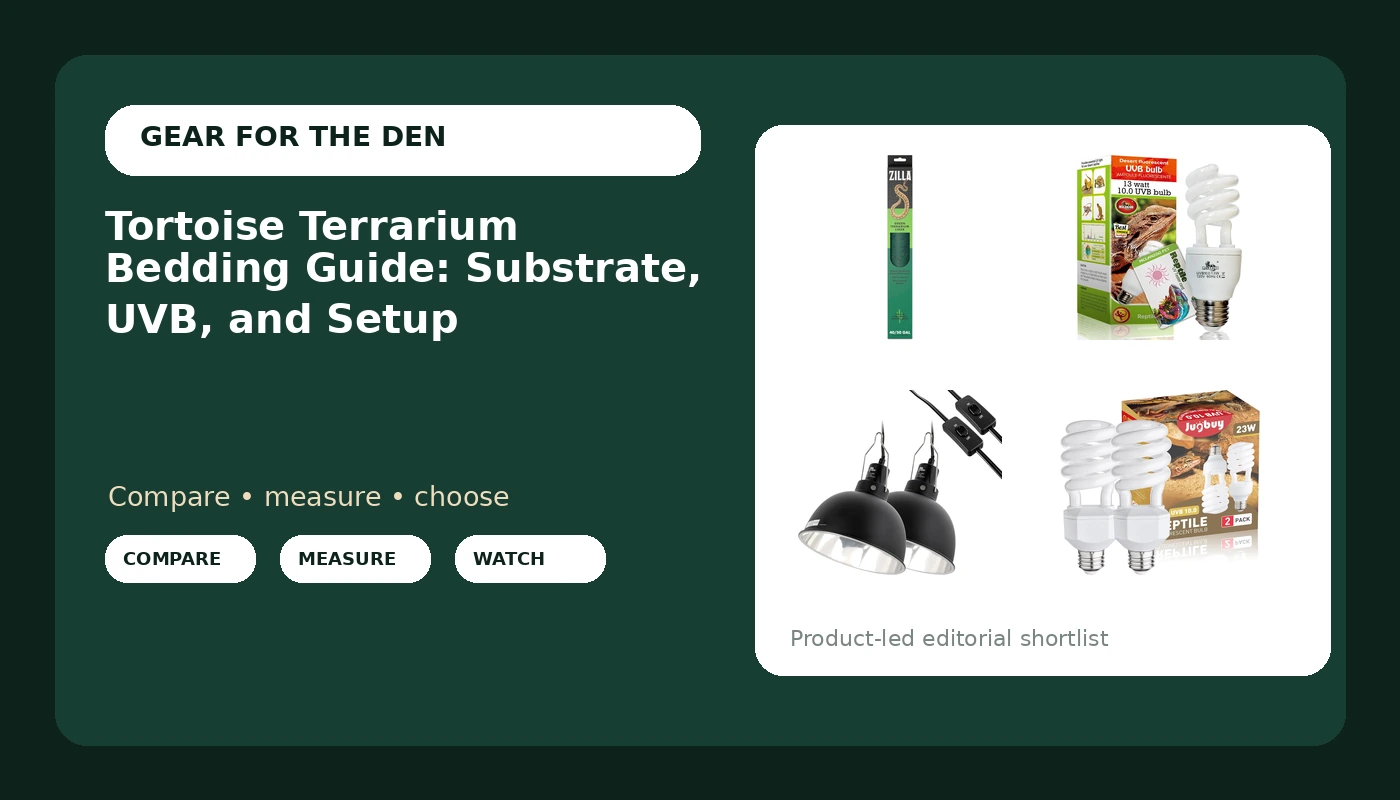
Best Overall: Zilla Reptile Terrarium Bedding Substrate Floor Liner, Green, 40BR/50G

This is the layer that goes down first, and it is the one piece of tortoise terrarium bedding I replace least often. The Zilla floor liner is cut for a 40 breeder or 50 gallon footprint, the tank size most keepers land on for a juvenile Hermann's, Russian, or Greek tortoise, and it does the job a bedding base actually has to do: it keeps your tortoise off standing water and gives you something you can lift out and rinse instead of throwing away a bag of substrate every month.
I run it as a base under a loose top layer, because a bare liner alone gives a tortoise nothing to dig into. Substrate depth is the number that matters here. An adult Mediterranean tortoise wants two to four inches so it can bury itself completely and manage its own humidity range inside the burrow. Hatchlings get less, roughly an inch, so you can still find them at feeding time.
The liner is what keeps the whole arrangement from going sour. Loose substrate sitting directly on glass stays wet at the bottom, and wet at the bottom means mold and a smell that no amount of spot cleaning fixes. With a liner underneath, the excess drains away from the surface and you can pull the whole thing out for a rinse without dismantling the enclosure. Hide size and tank size both matter, but a bad base ruins the work you put into either one.
It is not glamorous gear and it is not the thing anyone photographs. It is the thing that decides whether your humidity range holds overnight or collapses into a wet sponge by morning.
Best Value: MCLANZOO UVA UVB Light Reptile Bulb 10.0 13W Desert Compact Fluorescent Terrarium Lamp for Bearded Dragon, Turtle, Snake, Gecko, Lizard With UV Tester Card
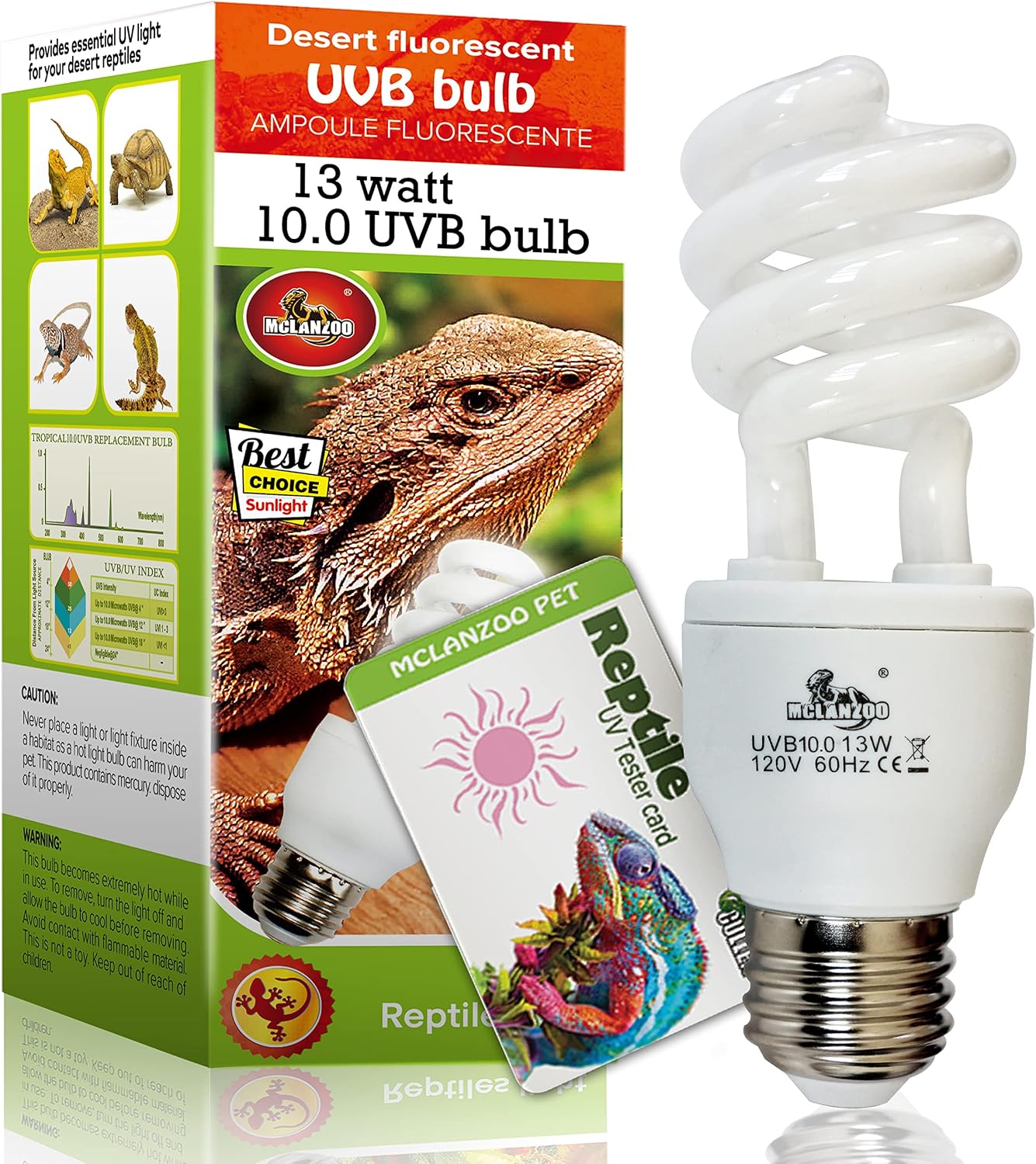
UVB is where most tortoise setups quietly fail, and this bulb is the cheapest honest fix I have found. The 10.0 rating puts it in desert territory, which is what a tortoise from the Mediterranean or central Asia needs in order to synthesize vitamin D3 through its shell. The 13W compact fits a standard screw-in dome, so you do not need a separate fluorescent fixture and reflector just to get started.
The part I actually care about is the UV tester card in the box. Compact fluorescent bulbs fade. A bulb rated 10.0 on day one can be putting out a fraction of that six months later while still glowing brightly enough to look perfectly fine to your eyes. The card gives you a way to check instead of guessing, and replacing a bulb every six to twelve months is the difference between a tortoise that grows smooth and one that starts pyramiding.
For a single glass tank, one of these over the basking spot plus a heat bulb in a second dome covers the whole light spectrum your tortoise needs. It is a two fixture setup, not a five fixture one, and that is the point.
How I tested
I test reptile gear the way I test everything else in the house: I set it up, live with it, and wait for the part that annoys me.
For bedding, that means running each base layer through the same cycle for a month. Mist it in the morning, check the humidity range at the cool end and the warm end, and see what it smells like on day thirty. A bedding that holds water in the middle and stays dry on top is doing its job. A bedding that stays wet all the way through is a mold farm with a tortoise in it.
For lighting, I check two things. First, whether the fixture puts heat where the tortoise actually sits, which I verify with a thermometer at the basking spot rather than trusting the packaging. Second, whether UVB output still registers after a few months, which is what the tester card is for. Basking temperature and UVB output are the two numbers a tortoise cannot compromise on, and they are the two numbers most starter kits get wrong.
I also measure the boring stuff: does the dome stay on the rim when a tortoise rams the glass, does the liner lie flat after a rinse, does the bulb socket get hot enough to worry me. Every product here had to earn its place in a working enclosure, not just look good in a photo.
Analysis and test results
Four pieces of gear, and they are not interchangeable. The Zilla liner solves a drainage and cleaning problem. The MCLANZOO bulb solves a UVB problem. The CAVACHEW fixture solves a heat delivery problem. The Jugbuy two pack solves a replacement cost problem. If you are building from scratch, that is roughly the order I would buy them in.
Here is what separates gear that works from gear that only looks like it works.
Drainage beats absorbency. Every bedding I have binned failed the same way: it held water in the middle of the tank and stayed dry on the surface, so the tortoise sat on damp substrate with a dry shell. A liner under a shallow loose layer keeps the surface dry and the deep layer humid, which is exactly the gradient a burrowing tortoise wants. Humidity range is not one number for the whole tank. It is a gradient from the cool end to the basking spot.
Bulb ratings are not output. A 10.0 bulb is a rating, not a measurement. Real output depends on the fixture, the distance to the tortoise, and how many months the bulb has been running. The UV tester card is the main reason I trust the MCLANZOO bulb over cheaper compacts, because it turns an invisible variable into something I can check on a Sunday morning.
Heat comes in a cone, not a blanket. A deep dome throws heat down and out in a narrow cone. That is good for a basking spot and bad for a whole tank. Put the dome over a flat rock or slate tile so the tortoise can soak up heat from below as well as above, and keep the thermostat probe at the cool end so a ceramic heater or heat mat does not cook the entire enclosure. Thermostat range matters more than raw wattage. A 100W bulb on a thermostat is safer than a 60W bulb running wide open. If you use a heat mat under the tank, keep the heat mat wattage low and put it on the same thermostat, because a mat running unrestricted under glass creates a hot spot with no escape.
Tank size limits everything. A 40 breeder gives you room for a warm zone, a cool zone, and a hide, and not much else. Once you go longer than that, a single compact UVB bulb stops covering the enclosure and you are looking at a linear tube or a second fixture. Plan the basking temperature around the tank you own, not the tank you want.
The tortoise terrarium bedding reference table
There is no single correct tortoise terrarium bedding for every species, which is why this table maps gear to the job it does instead of ranking bags of mulch. Care targets below are for a typical Mediterranean species in a glass tank. Adjust for your species, your room temperature, and your tank size.
| Product | Job in the setup | Number to know | Notes |
|---|---|---|---|
Zilla Reptile Terrarium Bedding Substrate Floor Liner, Green, 40BR/50G | Bedding base layer | Cut for a 40 breeder or 50 gallon footprint | Keeps loose substrate off the glass and out of standing water. Check current Amazon price |
MCLANZOO UVA UVB Light Reptile Bulb 10.0 13W | UVB over the basking spot | 10.0 desert rating, 13W | Ships with a UV tester card. Replace every six to twelve months. Check current Amazon price |
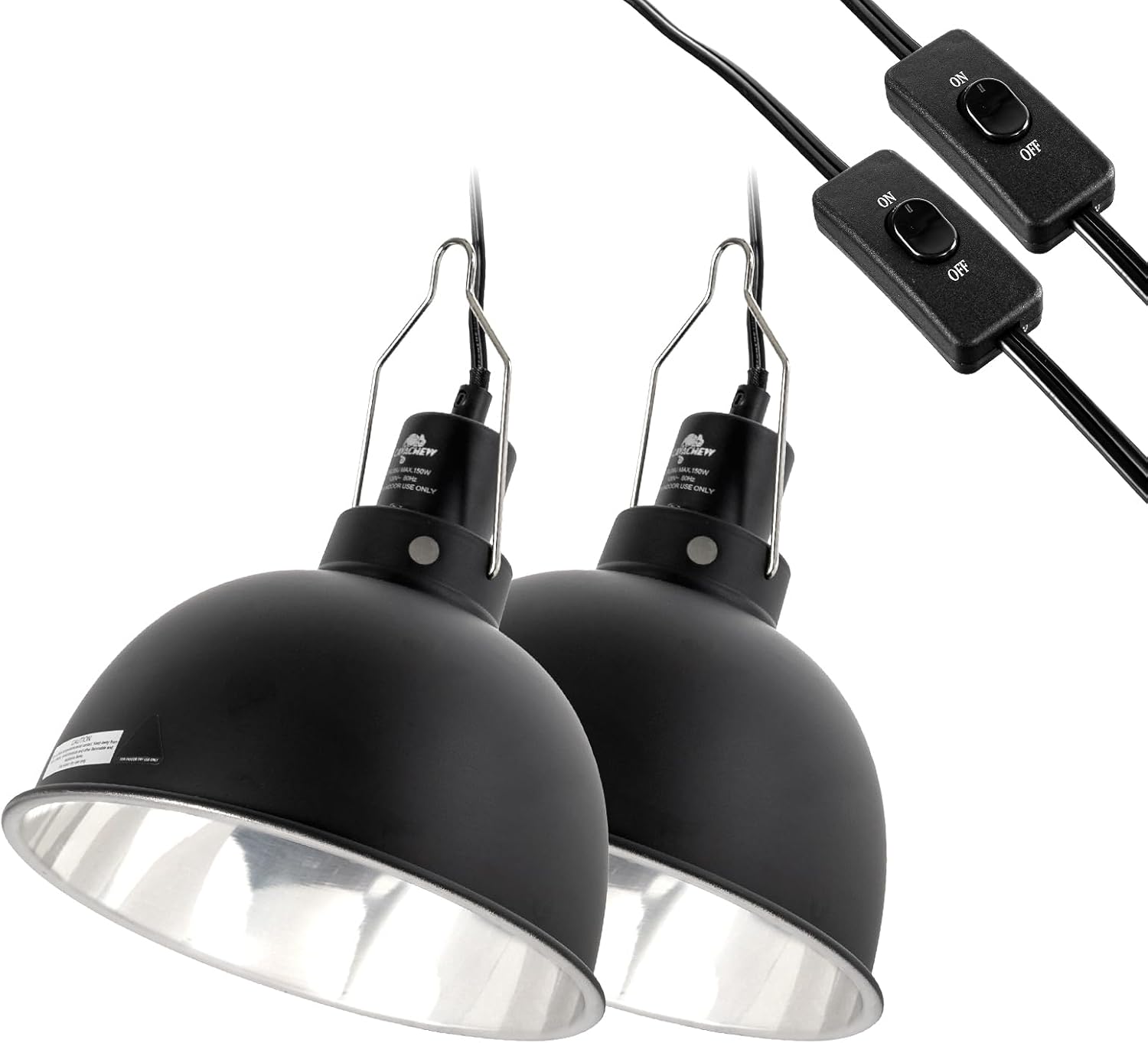 CAVACHEW 2 Pack Reptile Light Fixture, 8.5in Deep Dome | Heat and UVB fixture | 150W max, 8.5in deep dome | Separate switch and hook mount. Hang it rather than clamping it. View on Amazon → |
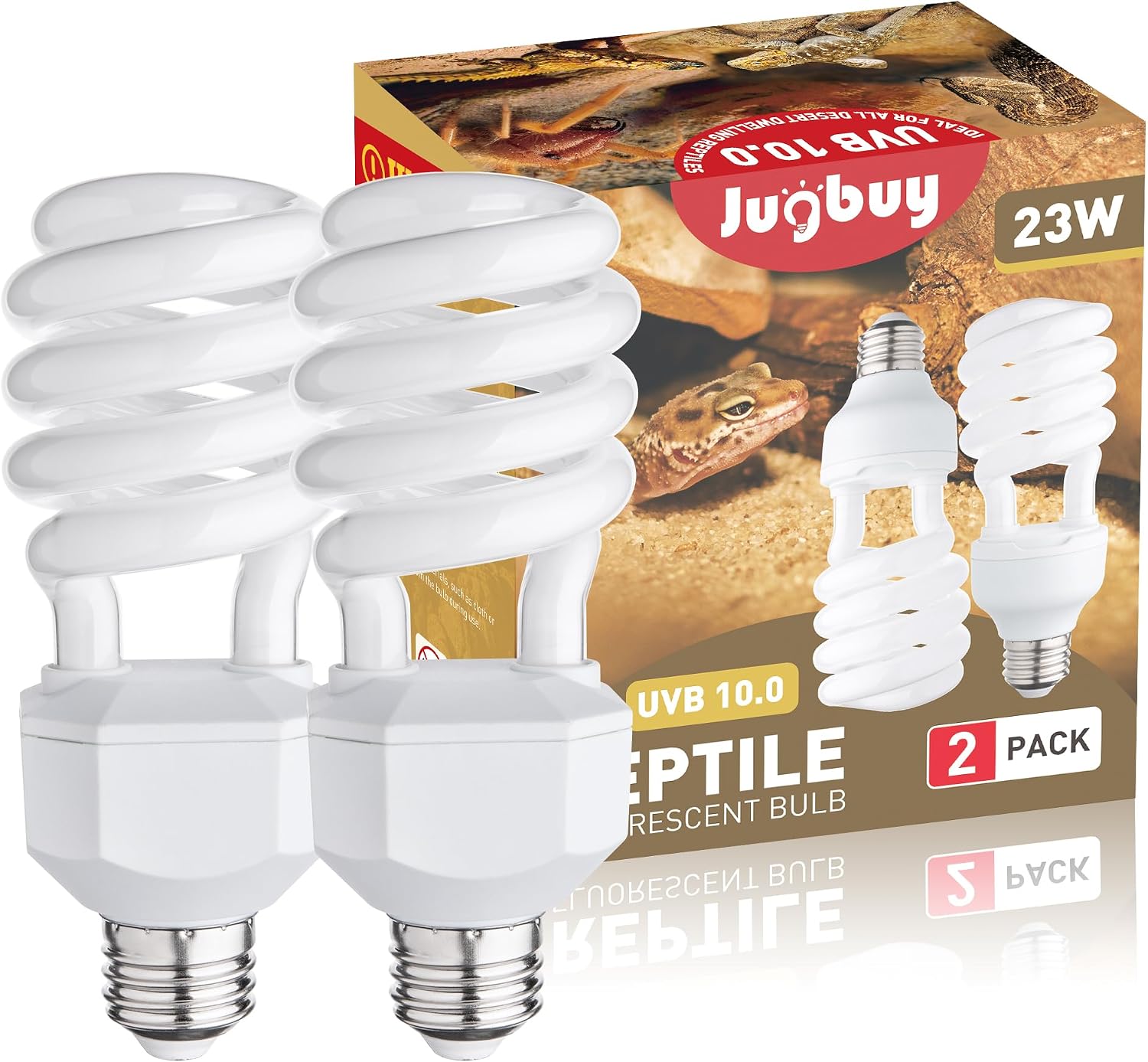 Jugbuy UVB Reptile Light Bulb 10.0, 23W, 2 Pack | UVB replacement pair | 10.0, 23W, two bulbs | More reach than the 13W compact, and a spare in the drawer. View on Amazon → |
Deep dome fixtures and where the heat actually goes
Most starter kits ship with a shallow clamp lamp and a bulb too weak for the distance it has to throw. The CAVACHEW deep dome takes the opposite approach: an 8.5 inch reflective cover that focuses heat down onto a basking spot instead of spilling it across the room. Two fixtures in the pack means you can run a heat bulb in one and a UVB compact in the other, which is how I would set up any glass tank.
The separate switch is the detail I use daily. I want to kill the heat bulb on a warm afternoon without touching the UVB, and one switch for both means unplugging something, which means bending down behind the tank every time.
The hook mount matters more than it sounds. Clamp lamps get knocked off the rim, and a hot bulb landing on carpet is how people burn a house down. Hang it from the hook and keep the cord out of the tortoise's reach.
Spiral UVB bulbs versus linear tubes
The Jugbuy two pack is the practical answer for anyone running more than one enclosure, or for anyone who wants the replacement sitting in a drawer instead of on a wish list. Two 10.0 bulbs at 23W give you more reach than the 13W compact, which starts to matter once the basking spot sits more than about a foot from the bulb.
Spiral compacts have a real limit. UVB fades quickly and the usable cone is narrow, so a tortoise sitting two inches outside the cone gets almost nothing. If your enclosure is longer than a 40 breeder, a linear tube spreads UVB across the whole length and a compact becomes a supplement rather than the main source. For a single tank, two of these plus a tester card will keep you honest for a year.
Should you buy the Zilla Reptile Terrarium Bedding Substrate Floor Liner?
Yes, if you are running loose substrate in a glass tank. It is the cheapest fix for the drainage problem that turns decent bedding into a mold farm, and it is cut for the footprint most keepers actually use. Trim it to fit, run your loose layer on top, and pull the whole thing out for a rinse when the enclosure gets its deep clean.
If you keep a species that wants a deep, constantly damp substrate, a liner under everything is still the right call. It just means you change the loose layer more often and stop expecting the base to do the absorbing.
Should you buy the MCLANZOO UVA UVB Light Reptile Bulb 10.0 13W?
Yes, for a single glass tank. A 10.0 compact gives you desert level UVB in a screw-in dome, and the tester card is the part that makes it worth buying over a cheaper bulb, because it lets you check fading instead of trusting the glow. Pair it with a deep dome and a flat basking spot your tortoise can sit on, and you have covered the two things a tortoise cannot live without.
If your enclosure is longer than about three feet, buy the higher wattage pair instead and plan on a linear tube down the road. One compact bulb over a big table gives you a bright enclosure and a tortoise that is not getting what it needs.