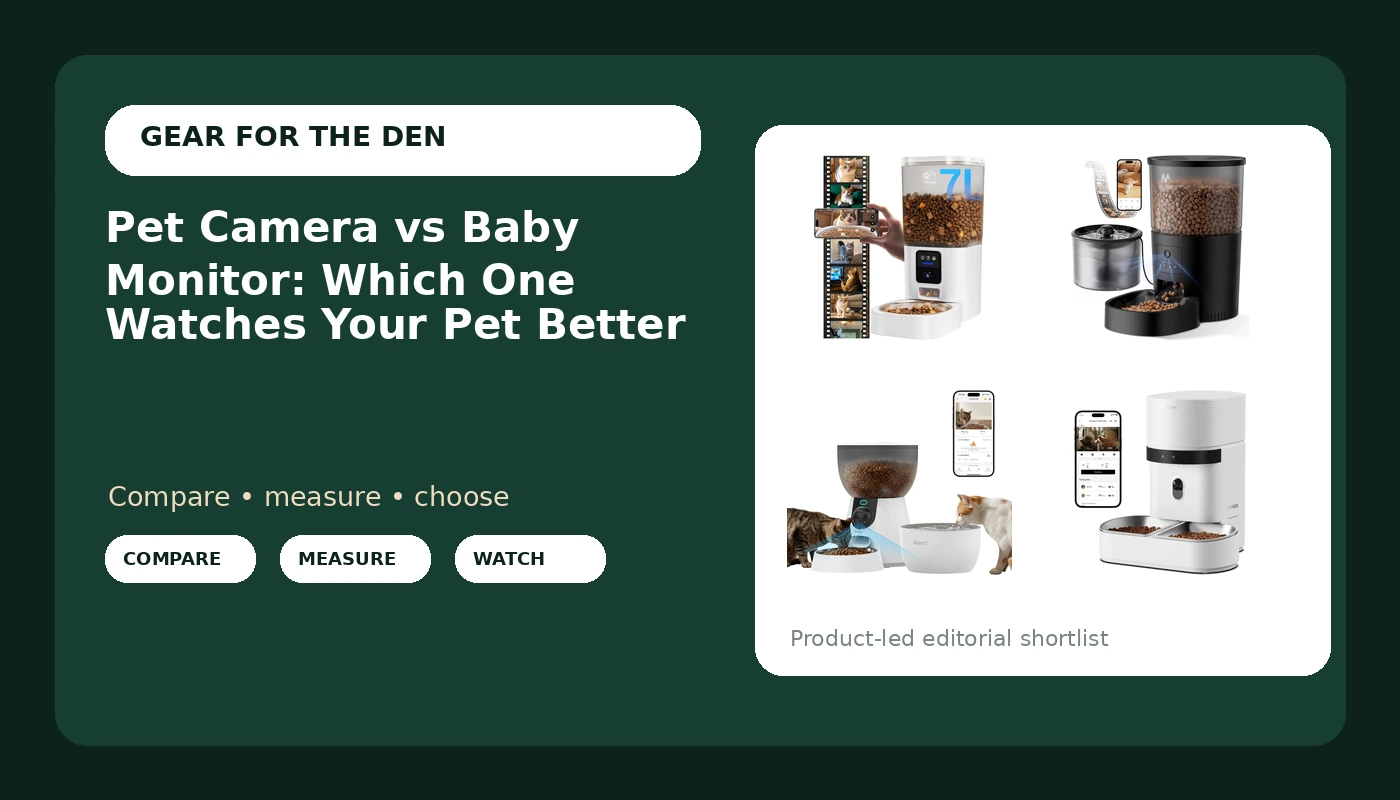
If you are weighing a pet camera vs baby monitor, the two categories look identical in product photos and behave nothing alike once they are plugged in. A baby monitor is designed around one sleeping infant in one fixed room: audio first, low-light video second, and usually a dedicated parent unit that keeps working while your phone charges in another room. A pet camera is designed around an animal that wanders, chews cables, and ignores your notification schedule. Both give you a live view and night vision. The real split shows up in app pairing, signal range, battery life, and how much of the experience sits behind a subscription.
For most pet owners, the practical answer to pet camera vs baby monitor is a camera-equipped automatic feeder: you get the live view plus portion accuracy and power backup in a single device, and you stop worrying about a bowl that runs empty at 4 p.m. That is the short version. The long version involves capacity math, night vision claims, and why two of the four units below look almost identical on paper and are not.
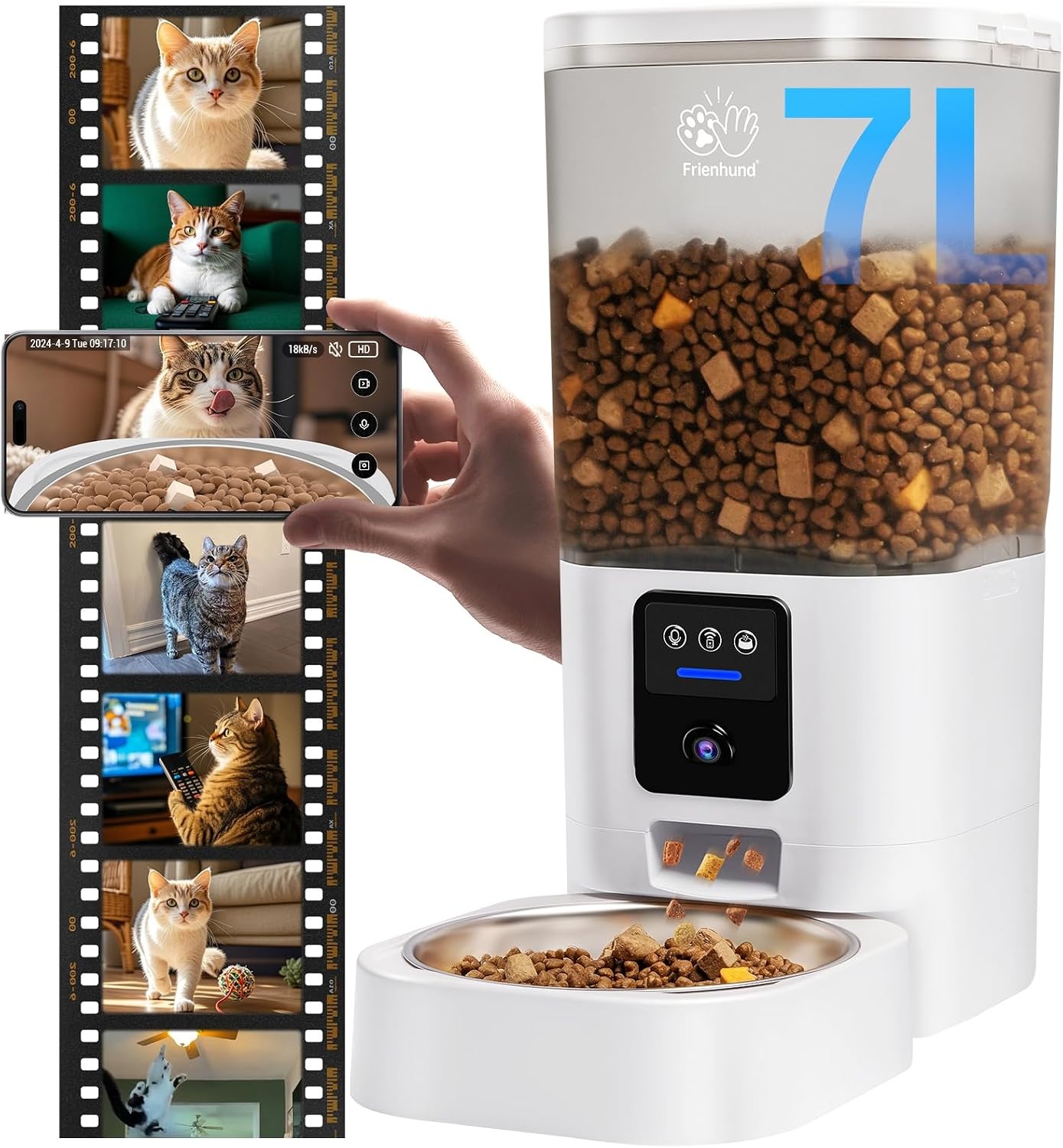
Frienhund Automatic Cat Feeder with 2K Camera: 5G WiFi Automatic Dog Feeder with Night Vision,Cat Food Dispenser with 7L Large Food Storage Container for Multiple Pet,Detachable for Easy Clean -29 Cup
Largest stated hopper here at 7L, plus the highest stated camera resolution and a detachable body
No water fountain, so drinking gear is still a separate purchase
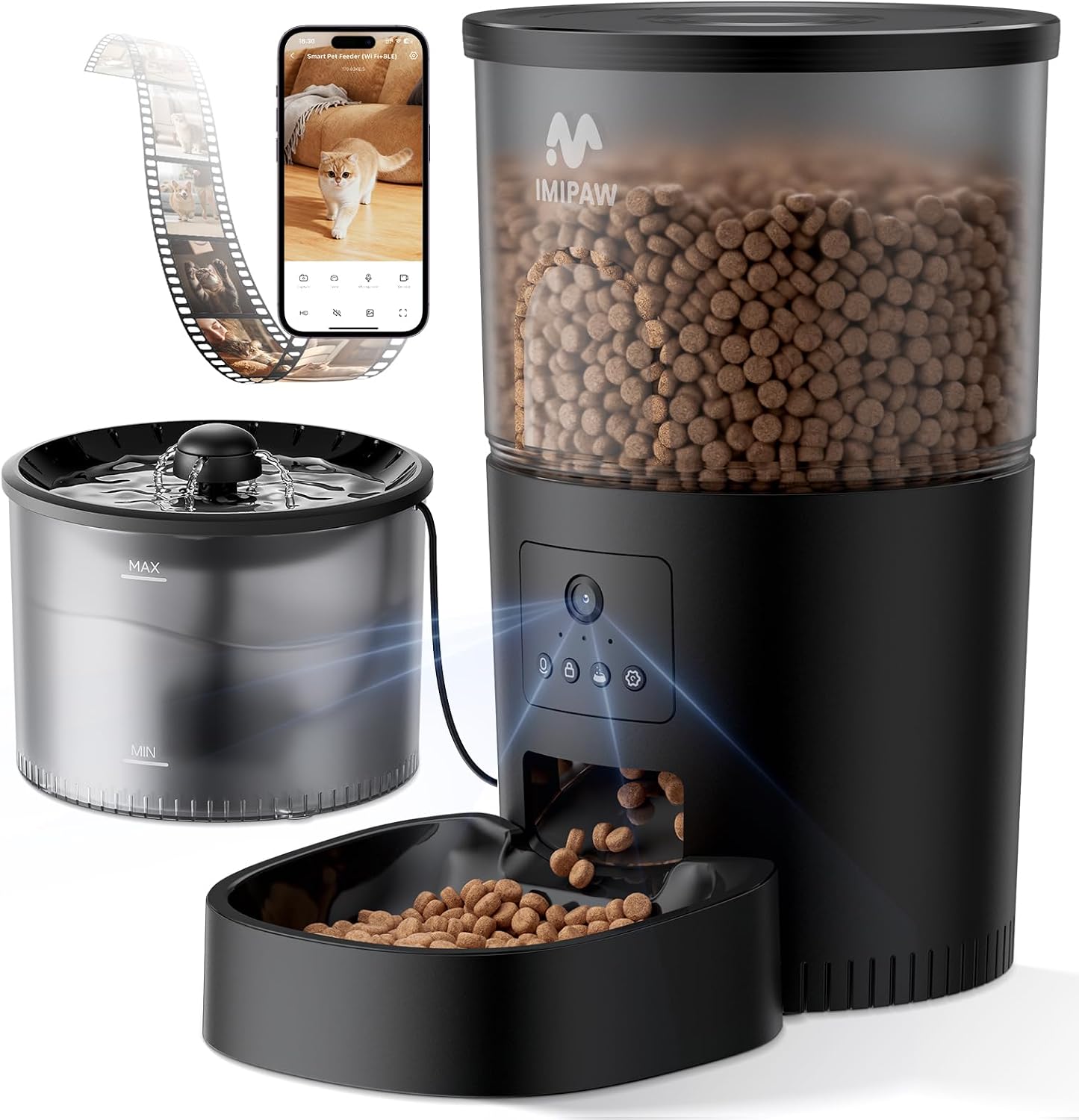
IMIPAW Automatic Cat Feeder with Camera and Water Fountain, HD AI Pet Recognition, APP Remote Control, Timed Food Dispenser, Two-Way Audio, Night Vision Function, 3L Fountains for Drinking with Filter
Feeder and filtered fountain in one body, plus two-way audio and AI pet recognition
Smallest stated water reservoir, and the filter is a recurring cost
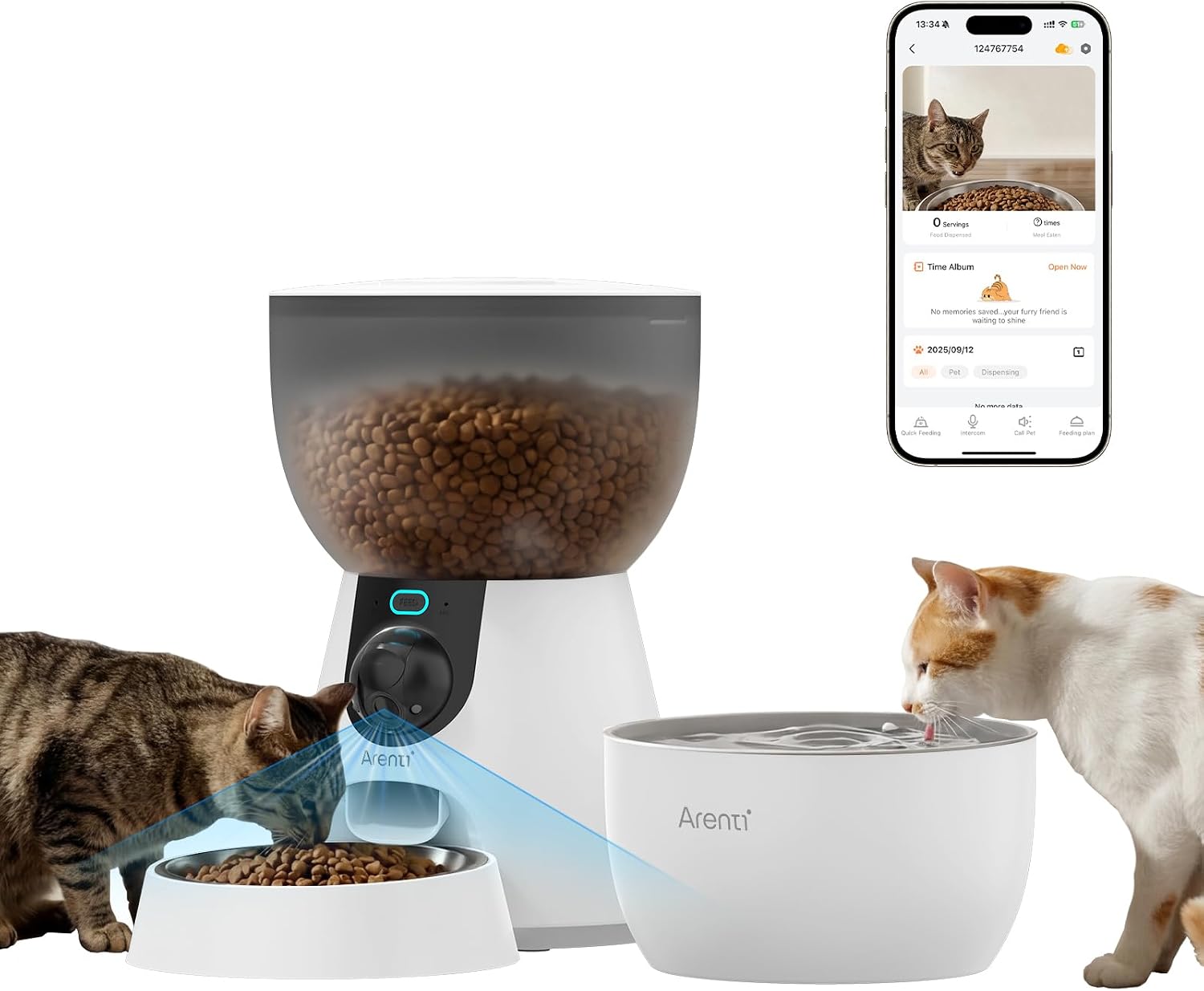
ARENTI 4L/17 Cups Automatic Cat Feeder and Water Fountain with Camera
Food and water from one unit and one app, with a mid-size 4L hopper
Camera resolution and night vision are not stated in the listing name
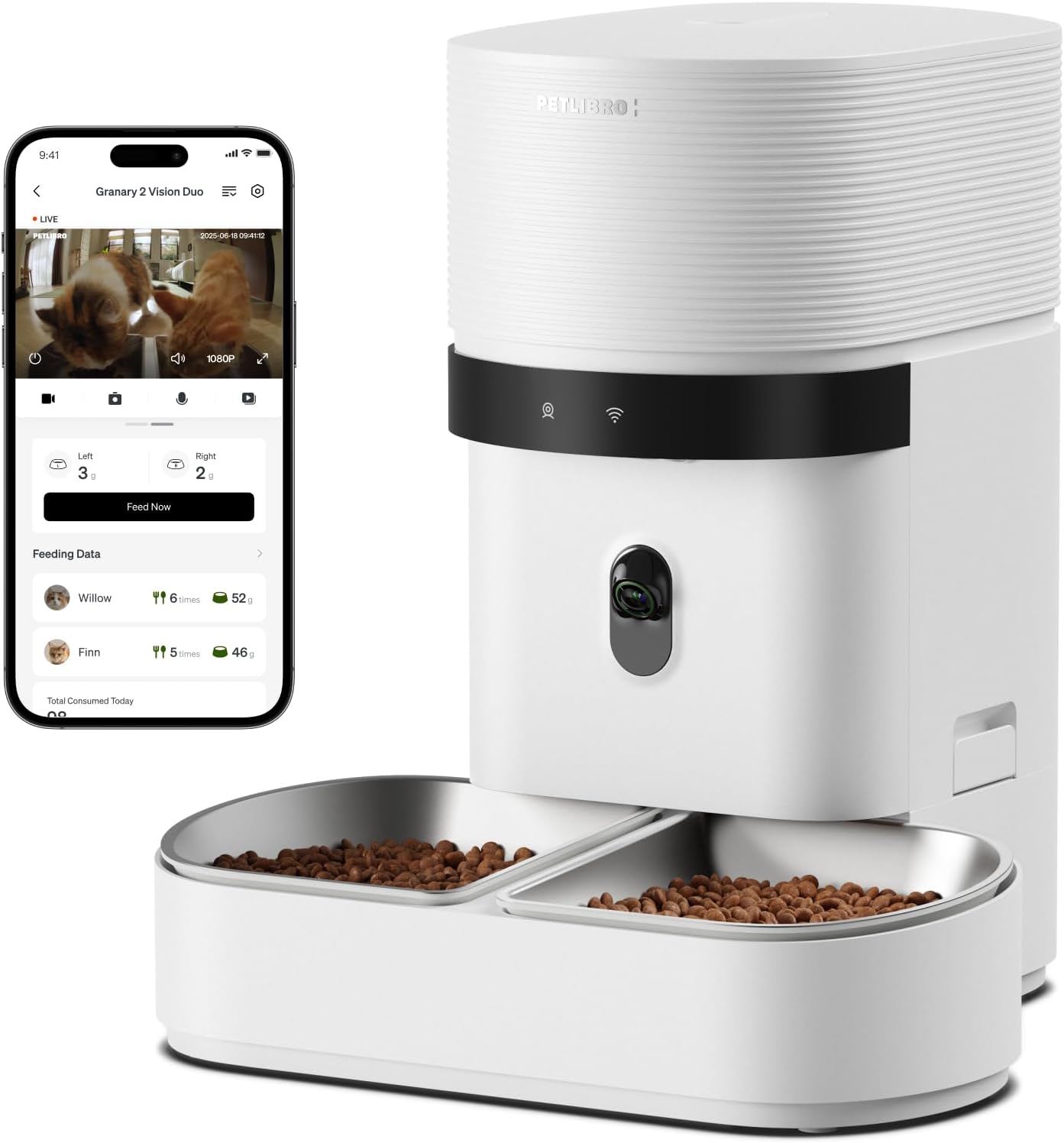
PETLIBRO Automatic Cat Feeder for 2 Cats, AI Recognition Camera Intake Log
Built around two-cat households, with an intake log instead of a plain live view
Feeder only, and the AI features lean hardest on the app
Prices and availability may change.
How a pet camera vs baby monitor decision really works
A baby monitor is not just a camera with a different sticker on it. The hardware is tuned for a crib: the lens is fixed on a small area, the microphone array is optimized for a sleeping baby's breathing and crying, and the alerts fire on sound. Most dedicated monitors ship with their own parent unit on a direct radio link, which means the feed does not depend on your home WiFi or on your phone staying charged.
Pet cameras flip those priorities. The field of view is wider, motion zones matter more than sound thresholds, and the app is the entire interface. That last point is where the difference between pet camera and baby monitor gets expensive: pet cameras increasingly push cloud recording, AI event labels, and multi-camera plans behind a monthly subscription, while a basic baby monitor often carries no recurring cost at all.
If you have been searching baby monitor vs pet camera, the deciding factor is usually where the camera lives. A camera mounted over a crib needs a parent unit, an IR mode that does not glow in the baby's face, and no subscription. A camera pointed at a food bowl, a litter box, or a dog crate needs a wide lens, motion alerts that ignore the ceiling fan, and an app you can check from work.
One more thing to settle before you buy: power. A baby monitor parent unit runs on a rechargeable battery, so battery life is a real spec you compare. A pet camera is usually mains powered, which means power backup becomes the question you actually care about during a storm. Two different products, two different failure modes.
The camera side: camera resolution, night vision, and app pairing
Camera resolution is the spec people shop by and the one that matters least on its own. The Frienhund listing specifies a 2K camera, the highest resolution stated anywhere in this group. The IMIPAW lists HD video with AI pet recognition. The ARENTI and PETLIBRO listings name a camera without stating a resolution, so if pixel count is your deciding factor, open the current product page before you commit.
Night vision is stated on the Frienhund and the IMIPAW, and both describe it as part of the camera package rather than an add-on. That matters more than resolution for a pet setup, because most of what you want to see, a cat at the bowl at 3 a.m. or a dog pacing in a crate, happens in the dark. An IR array that washes out at two feet is useless. A clean black-and-white feed at six feet is the whole point.
App pairing is where pet cameras and baby monitors diverge most. The Frienhund runs on 5G WiFi, which pairs faster and suffers less interference than 2.4GHz in a crowded apartment building, but 5GHz also has a shorter effective range through walls. If the feeder sits in a garage or at the far end of a long house, 2.4GHz is usually the safer band. Signal range is a function of your router as much as the camera, so check which bands the app supports before you buy.
Subscription terms are the hidden line item. Some camera apps charge monthly for recorded clips or AI event labels. Others give you live view and motion alerts for free and charge only for cloud history. Read the current listing for the plan details, because a recurring fee is the part of the total cost that never shows up in the headline.
The feeding side: portion accuracy, capacity, and water resistance
Every unit here is a feeder first and a camera second, which is the right order. A camera tells you the bowl is empty. A feeder keeps it from being empty.
Portion accuracy is the spec nobody advertises well. The mechanism is either a rotating auger, a compartment wheel, or a gate, and the stated portion sizes are estimates, not lab measurements. Expect the first few scheduled meals to run slightly heavy or light, then adjust. For a cat on a weight-management plan, weigh one portion on a kitchen scale and set the schedule from that number rather than from the label in the app.
Capacity decides how often you refill. The Frienhund lists 7L, which the listing equates to about 29 cups. The ARENTI lists 4L, or 17 cups. The IMIPAW pairs its food side with a 3L water fountain. For one cat, even the small end of that range is weeks of meals. For two cats or a large dog, the 7L hopper is the difference between a monthly refill and a weekly one.
Water resistance and cleaning matter more than they sound. The Frienhund is described as detachable for easy clean, which is the feature you will use most often. Kibble leaves oil, oil goes rancid, and a hopper you cannot rinse is a hopper you will replace. The IMIPAW's fountain uses a filter, and filters are a recurring consumable, so price them into the first year.
Power backup is the last piece. If the power blinks during a storm, a feeder without battery backup can forget its schedule or dump a portion. Look for a unit that keeps its clock and schedule on battery, and check whether the camera still records while the mains are out. Battery life on a camera is measured in hours, not days, so plan on mains power with battery as the safety net.
The four units in this comparison
Frienhund Automatic Cat Feeder with 2K Camera
The Frienhund is the capacity and camera play of the group. The listing specifies a 7L hopper, roughly 29 cups, a 2K camera with night vision, 5G WiFi, and a body described as detachable for cleaning. For a multi-pet house or a large dog, that hopper size is the headline: fewer refills, fewer chances to run out over a long weekend. The 2K sensor is also the highest resolution stated anywhere in this comparison, which matters if you want a clearer look at the bowl rather than just confirmation that something moved. The trade-off is scope. There is no water fountain in this listing, so a cat on wet food or a dog that empties a bowl still needs separate gear. Check current Amazon price, then compare the spec sheet. Visit on Amazon
IMIPAW Automatic Cat Feeder with Camera and Water Fountain
The IMIPAW is the all-in-one pick. The listing specifies a feeder plus a 3L filtered water fountain, HD video with AI pet recognition, app remote control, two-way audio, and night vision. Two-way audio is what separates it from the rest of the group on paper: you can talk to a dog through the camera, which is genuinely useful for crate training and mostly ignored by cats. AI pet recognition is the other differentiator, and it is the kind of feature whose accuracy you cannot judge from a listing, only from the app in your own home. The 3L fountain is the smallest water reservoir here, so it suits one or two cats rather than a large dog. Check current Amazon price. Visit on Amazon
ARENTI 4L/17 Cups Automatic Cat Feeder and Water Fountain with Camera
The ARENTI is the middle of the group and the hardest to read from the name alone. It specifies a 4L hopper, 17 cups, a camera, and a water fountain in one unit. That combination covers the two things a pet needs daily, food and water, from a single power cord and a single app, which is the argument for buying it over a feeder plus a separate fountain. What the listing name does not state is camera resolution or night vision, so if you are choosing on image quality, open the current product page and read the camera specs before you commit. Check current Amazon price. Visit on Amazon
PETLIBRO Automatic Cat Feeder for 2 Cats, AI Recognition Camera Intake Log
The PETLIBRO is the two-cat specialist. The listing specifies AI recognition and a camera that logs intake, which is a different job from watching a bowl. It is trying to tell you which cat ate and how much. For a household managing one cat's weight or medication, that log is the reason to pay for this unit over a cheaper feeder with a camera attached. The trade-off is that it is a feeder only, with no fountain named in the listing, and the AI features are the ones most likely to depend on the app and its current terms. Check current Amazon price. Visit on Amazon
What the listings actually tell you
Line the four up and the pattern is simple. Three of the four combine a feeder with a camera. Two of the four, the IMIPAW and the ARENTI, add a water fountain to the same body, which cuts your cord count and your app count. Two of the four, the IMIPAW and the PETLIBRO, lean on AI recognition, which is the newest and least predictable feature class in the group. Two of the four state night vision. One states 2K resolution.
Capacity spans a real range, from a 3L fountain and a modest food side up to the 7L hopper on the Frienhund. If you have two cats or a dog over 40 pounds, that gap is the single most practical number in the table, because it decides how often you touch the machine.
The camera quality claims are where the listings get thin. Resolution is stated on one unit, night vision on two, and the rest ask you to trust the app. That is not a knock on those products. It is a warning about shopping by name alone when you are comparing a pet camera vs baby monitor setup, because a baby monitor's spec sheet is usually more complete than a pet camera's.
Do you need a pet camera or baby monitor for one room?
Answer the room, not the product category. If the room has a crib, buy the baby monitor. A parent unit that works without WiFi, a lens built for a small fixed area, and no monthly fee are the right tools for a sleeping infant, and a wide-angle pet camera with a laggy app is the wrong one at 2 a.m.
If the room has a crate, a bowl, or a litter box, buy the pet camera, and buy it inside a feeder if you want the setup to do something useful while you are away. Live view is a nice feature. Portion accuracy, a schedule that survives a power blip, and a log of who ate what are the features that change your week.
If you have both a nursery and a pet, buy both. They do not cross over well. The baby monitor's fixed lens and dedicated parent unit are wasted on a dog, and the pet camera's wide lens, motion zones, and app dependence are the wrong fit for a baby monitor's job. Two rooms, two tools, one app drawer that is slightly more crowded than you would like.
What I'm watching next
Three things are moving in this category. AI recognition is spreading from the two units that mention it here into cheaper feeders, and the honest question is whether the identification holds up across two cats of the same color. Dual-band WiFi is becoming standard, which finally solves the 5GHz range problem in long houses. And subscription models are still unsettled, with some apps charging for clips and others charging only for history, which makes the current listing the only reliable source for what you actually get.
The next thing worth testing is how these units behave through a power cut, because that is the failure that matters most and the one least often stated on a product page. Until then, match the hopper size and the camera specs to your household, and buy the one that fits the room you actually have.