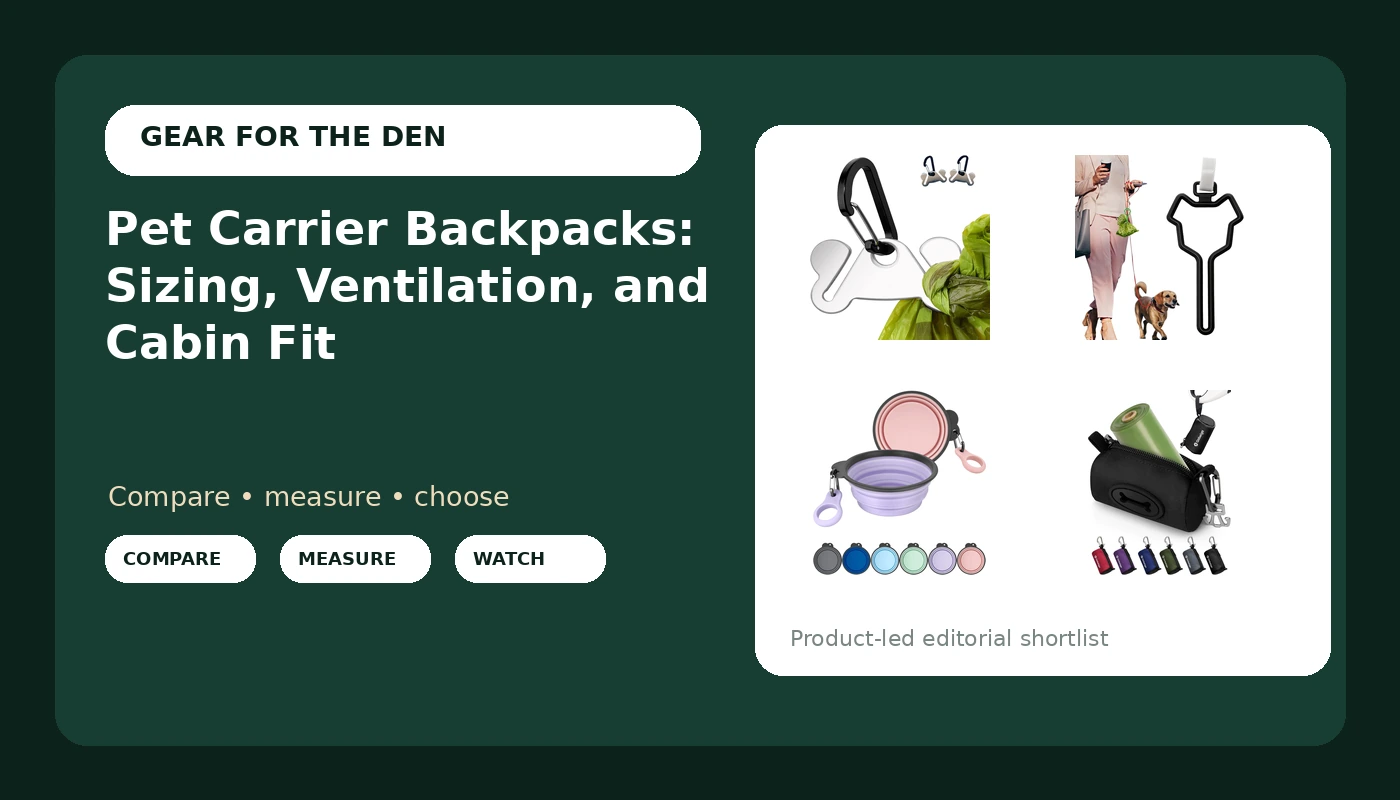
Choosing a travel bag for a cat or small dog often starts with a photo and ends with a return label. The numbers that decide whether a trip actually works, carrier dimensions, weight limit, ventilation, and how the bag carries on your back, are rarely the first thing a listing puts in front of you. This guide walks through how pet carrier backpacks are built, what the listed measurements mean in practice, and which small accessories make a travel day run smoothly once the bag is chosen. Search results for pet carrier backpacks explained tend to show the same handful of silhouettes, so the useful question is not which one looks best in a photo but which one matches your animal's standing height, your airline's cabin size limit, and the way you travel.
Quick answer
Most pet carrier backpacks are sold by exterior size, so start with the space your animal needs inside the bag: enough height to stand without crouching and enough length to lie down flat. Compare that internal figure against the cabin size limit of the airline you fly most often, and check the stated weight limit, which typically covers the animal and everything in the bag rather than the empty carrier alone. A structured backpack frame, mesh ventilation on at least two sides, and a base that does not sag under load matter more than pocket count. Accessories are a separate decision: waste bag holders and collapsible bowl sets are inexpensive and easy to forget at home, so choose them by how you walk and travel rather than by brand.
Four useful options
| Model | Best fit | What stands out |
|---|---|---|
| 2PCS Dog Poop Bag Holder Leash Dogs Waste Bag Clip Dispenser Metal Carrier | Clip-on walks and travel days with a leash setup | A two-piece set with a metal carrier body |
| Dalzom® 2Pcs Dog Poop Bag Holder, Premium Waste Bag Holder Carrier for Leash, Dog Poop Bag Dispenser for Walking Running Bicycle Accessory (Black) | Runners and cyclists who want a black two-pack | Listed for walking, running, and bicycle use |
| AONKEY 2 Pack Collapsible Dog Bowls with Bottle Carrier(Small 15oz) | Water breaks on the road | Two collapsible bowls plus a bottle carrier |
| Gobeigo Dog Poop Bag Holder with Used Bag Carrier(Black) | Neighborhood walks with full bags to carry | A separate carrier for used bags |
Walk kit: 2PCS Dog Poop Bag Holder Leash Dogs Waste Bag Clip Dispenser Metal Carrier
A waste bag holder is the least glamorous part of a travel kit and the one you notice most when it is missing. This set is designed to clip onto a leash, a belt loop, or a bag strap, which keeps a roll of bags within reach without adding anything to the carrier itself. For someone flying with a cat in a carrier backpack, the practical role is the walk at the other end of the trip: the airport lot, the rest stop, the block around the hotel. Because the set ships as two holders, one can live on the everyday leash and the other can stay packed in the travel bag, so it is already there when you arrive.
Runner's option: Dalzom® 2Pcs Dog Poop Bag Holder, Premium Waste Bag Holder Carrier for Leash, Dog Poop Bag Dispenser for Walking Running Bicycle Accessory (Black)
The Dalzom set covers the same job with a different emphasis. It is listed for walking, running, and bicycle use, so the attachment is meant to hold through more movement than a casual stroll produces. Two holders in the pack allow the same split as above: one for the leash you use daily, one for the travel bag or a second leash. The black finish is the kind of detail that matters mostly if you want it to match a leash and harness set. Nothing here changes how a carrier fits, but a holder that stays put during a run is worth more than one that swings loose against your hand.
Water break: AONKEY 2 Pack Collapsible Dog Bowls with Bottle Carrier(Small 15oz)
Water is the accessory that splits a good travel day from a long one. A collapsible bowl flattens into a side pocket of a carrier or a backpack, and this set pairs two bowls with a bottle carrier, which is the piece that usually goes missing between trips. The small size is listed at 15 ounces, a figure better suited to a small dog or a cat than to a large breed. In practice the bowl earns its place at rest stops, in a hotel room, and at the far end of a flight, when an animal is often more willing to drink than to eat. Pair it with a waste bag holder already on the leash and the walking kit is complete.
Used-bag storage: Gobeigo Dog Poop Bag Holder with Used Bag Carrier(Black)
The Gobeigo holder addresses the part of a walk nobody enjoys: carrying a full bag. It pairs a standard holder with a separate carrier for used bags, which keeps a tied bag off your hand and away from the carrier fabric. On a travel day that separation matters more than it does around the block, because a used bag tucked into a side pocket of a carrier backpack is a smell you live with for the rest of the trip. The black finish keeps it quiet against most leashes, and the second carrier is the only thing that separates it from the simpler holders above.
Prices and availability may change. Product images, names, and retailer links are matched to verified listings. No current price, rating, stock status, or measured result is stated here without current evidence.
How pet carrier backpacks are sized
Sizing starts with a tape measure and your animal, not with the listing. Measure three things while the animal stands naturally: the length from the base of the tail to the tip of the nose, the height from the floor to the top of the head or the highest point of the shoulders, and the widest point across the chest or hips. Add a small margin, roughly an inch or two of headroom, so the animal can stand and turn without pressing against the mesh. Those three numbers are the interior dimensions you need. Exterior figures on a product page are almost always larger, because they include the frame, the pockets, and the padding.
The second number is the cabin size limit. Airlines publish a maximum length, width, and height for a bag that travels under the seat, and the limit changes with the aircraft, not just the airline. A soft-sided carrier with a flexible backpack frame can compress slightly when it slides under a seat. A rigid frame cannot, so a bag that is a fraction of an inch too tall simply will not fit. Check the rule for the specific aircraft on your route rather than the airline's general pet page.
The third number is the weight limit. Two separate limits apply: what the carrier is built to hold, and what the airline allows for a pet plus bag. Loaded weight includes the animal, the carrier itself, a collapsible bowl, a folder of paperwork, and anything else in the pockets. A carrier that feels light in the store can pass an airline limit and still be uncomfortable to walk through a terminal with, which is where the backpack frame and straps do their work.
If you drive instead of fly, the same measurements matter for a different reason. A carrier in the back seat should sit level; a booster height adjustment or a secured seat position helps with that, and a hammock anchor point on a seat cover keeps the bag from sliding into the footwell on a turn.
Ventilation, frame, and the checks worth doing before you buy
Ventilation is the specification most often reduced to a single word on a listing. What matters is how many sides are mesh, whether the mesh is tight enough to hold a paw but open enough to move air, and which direction the panels face once the bag is on your back. A carrier with mesh only on the front can end up with its best panel pressed against your spine, which turns a ventilated bag into a warm one. Two or three mesh sides, including one that faces away from your body, is the pattern to look for.
The backpack frame is the other half of comfort. A padded back panel and a simple internal frame spread the load across the shoulders, and a sternum strap stops the bag from swinging. Hip belts help with heavier animals. Look at the base as well: a carrier whose floor panel folds under weight gives the animal a sloping surface to stand on, and a sloping floor is exactly what makes an animal shift and scratch for the whole trip.
Inside the bag, a short tether that clips to a harness is a small feature with an outsized effect, because it stops the animal from bolting the moment the zipper opens. Zipper locks or clips add a second layer of security at that same moment.
- Measure your animal standing and lying down, and write the three interior numbers on your phone.
- Compare those numbers with the cabin size limit for the aircraft on your route.
- Weigh the animal, then add the bag and the accessories you plan to carry, and compare the total with both the carrier's weight limit and the airline's pet limit.
- Check that mesh panels sit on at least two sides and that none of them ends up facing your back.
- Carry the empty bag for ten minutes, then add weight, and see whether the backpack frame and straps keep it steady.
Packing and preparation before travel day
- Set the carrier out at home a week before the trip, with a familiar blanket and a few treats inside, so the bag stops being a strange object.
- Practice short carries indoors and build up to the length of your walk through a terminal, watching for scratching, panting, or a tail tucked tight.
- Keep the leash-mounted waste bag holder packed on the leash rather than inside the carrier, so it is reachable without opening the bag.
- Pack the collapsible bowl and a bottle in an outside pocket, and offer water at every rest stop rather than only at the destination.
- If you drive, secure the carrier so it cannot slide, and check that it sits level; a back seat hammock for dogs with anchor points solves the same problem for animals that ride loose.
- Confirm the airline's current pet rules and the aircraft type a day or two before departure, because cabin size limits can change when equipment changes.
Which option should you choose?
Choose the 2PCS Dog Poop Bag Holder Leash Dogs Waste Bag Clip Dispenser Metal Carrier when you want two simple leash-mounted holders with a metal carrier body for everyday walks and travel. Choose the Dalzom® 2Pcs Dog Poop Bag Holder, Premium Waste Bag Holder Carrier for Leash, Dog Poop Bag Dispenser for Walking Running Bicycle Accessory (Black) when you run or ride with the dog and want a black two-pack described for that kind of movement. Choose the AONKEY 2 Pack Collapsible Dog Bowls with Bottle Carrier(Small 15oz) when water breaks matter and your animal is small enough for a 15-ounce bowl. Choose the Gobeigo Dog Poop Bag Holder with Used Bag Carrier(Black) when you want a separate place for full bags instead of a pocket.
There is no single design that suits every animal, so the ideal pet carrier backpacks are the ones whose interior space, weight limit, and ventilation match the animal you actually have. The correct pet carrier backpacks are also the ones you can carry for twenty minutes without shifting the load.
One caveat applies to all four accessories: they solve organization problems, not fit problems. No holder or bowl makes a carrier legal in a cabin or comfortable for an animal that is too large for it.
The bottom line
A carrier is chosen with a tape measure, a route, and a scale, in that order. Interior dimensions decide whether the animal can stand and turn, the cabin size limit for your aircraft decides whether the bag can board, and the loaded weight against the carrier's weight limit decides how the trip feels on your shoulders. Ventilation, a backpack frame, and a firm base are the features that separate a bag that works for an hour from one that works for a day.
The accessories here are the small ends of the same planning. A leash-mounted waste bag holder and a separate carrier for used bags keep the walking part of a trip tidy, and a two-bowl set with a bottle carrier covers water at rest stops. None of them substitutes for measuring the animal, checking the airline rule, and testing the load before you leave. Check current Amazon price before you buy, since listings change.