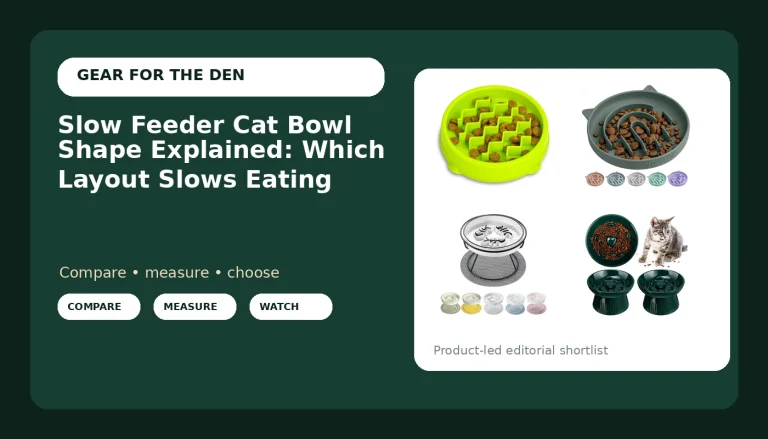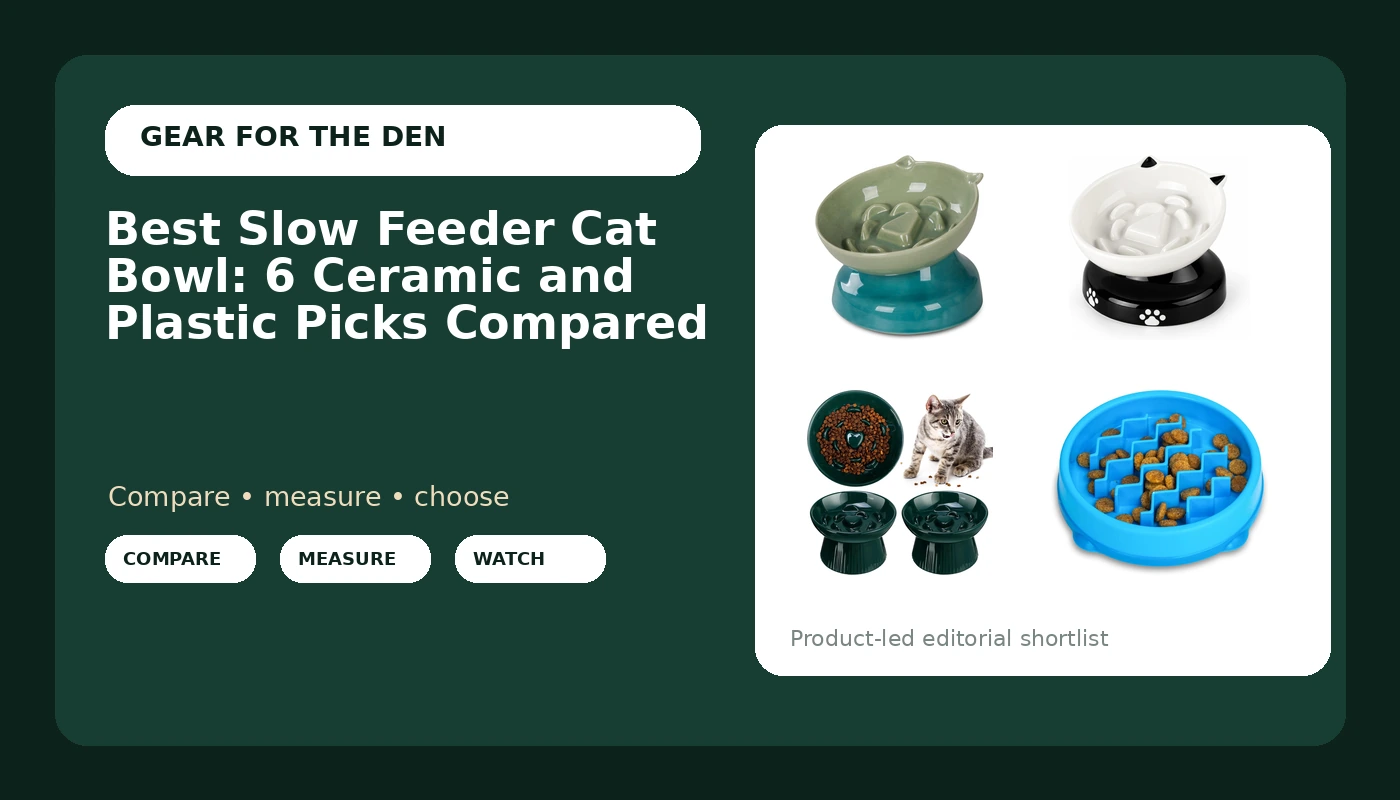
If your cat finishes a meal in under a minute and then brings it back up on the carpet, the bowl is usually the cheapest part of the problem to change. A slow feeder cat bowl uses ridges, honeycomb pockets, or a tilted surface to make a cat work around obstacles for every bite, which stretches a meal from seconds into minutes. This guide looks at six bowls sold specifically for cats, from a small kitten-sized plastic dish to a two-piece elevated ceramic set, and it is written for owners of fast eaters, cats that gulp and regurgitate, flat-faced cats that struggle with deep bowls, and multi-cat homes where one cat steals from another. Each option below is compared on elevation angle, bowl width, whisker clearance, portion size, and how easy the dish is to clean, so you can pick the correct slow feeder cat bowl for the cat in front of you instead of the one with the best photo.
Quick answer
The KittyDine Ceramic Slow Feeder Cat Bowl, 15-Degree Tilted Non-Slip is the strongest fit for most fast-eating cats because its fixed 15-degree tilt lifts food toward the mouth while the ceramic body adds the weight that resists sliding, and it slows a meal without forcing a cat to reach into a deep well. Choose the Catstages Kitty Slow Feeder Bowl for Cats & Kittens, 3/4 Cup, Blue, 5" instead when you need the smallest and lightest option here, for a kitten or a cat on a measured 3/4 cup portion.
Slow feeder cat bowl styles worth comparing
Slow feeders split into four practical shapes, and the shape decides how well a bowl works for a particular cat.
Tilted ceramic dishes, such as the KittyDine and Y YHY bowls, sit at an angle so food gathers at the low edge. The elevation angle matters more than the maze pattern for a cat that eats too fast and then vomits, because the head stays level and the food stays within easy reach. A tilt also helps a cat with a short muzzle, which often cannot reach the bottom of a straight-sided bowl.
Flat maze bowls, like the Catstages dish, use raised ridges on a shallow plate. They are light, inexpensive to replace, and quick to wash, but the shallow depth means a determined cat can still shovel food over the rim. These suit kittens and small cats on small portions.
Honeycomb surfaces, like the 2 cup honeycomb dish, break a meal into many small pockets. That is the classic slow-feeding approach: the cat has to lick or paw each pocket, so a portion that used to take forty seconds takes several minutes.
Elevated bowls with a removable dish, like the black anti-vomit bowl and the two-piece Tioncy set, separate the stand from the dish. The stand stays on the floor and the dish lifts out for washing, which is easier on the wrist than scrubbing a one-piece bowl around a fixed base.
Whisker clearance cuts across all four shapes. A narrow bowl forces the whiskers to press against the sides, and some cats will eat less, or scoop food onto the floor, to avoid that.
Top pick
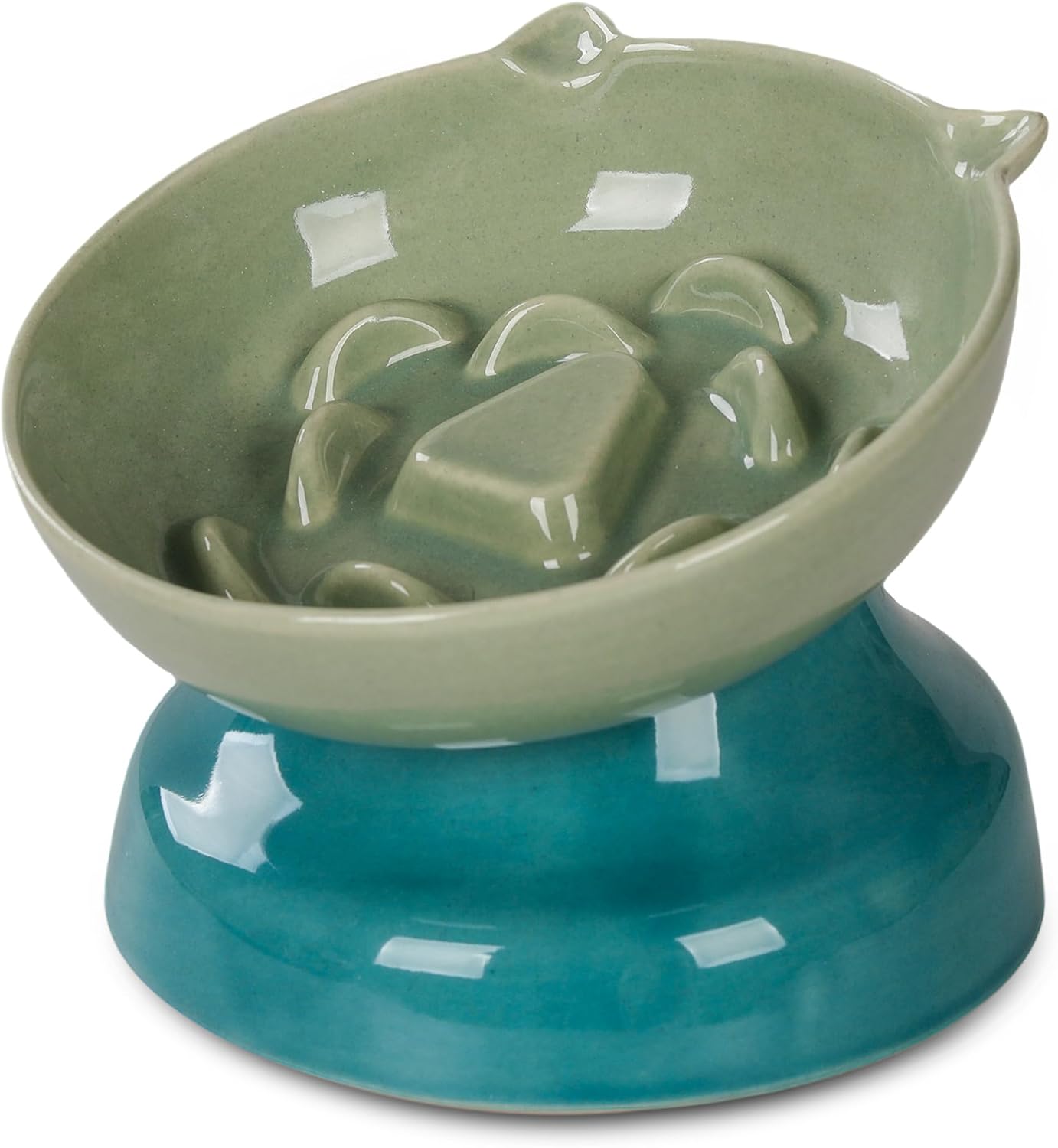
KittyDine Ceramic Slow Feeder Cat Bowl, 15-Degree Tilted Non-Slip
A ceramic dish built at a fixed 15-degree tilt with a non-slip base. The angle lifts food toward the cat instead of leaving it at the bottom of a deep well, and the ceramic body adds weight so the bowl is harder to push across a hard floor mid-meal.
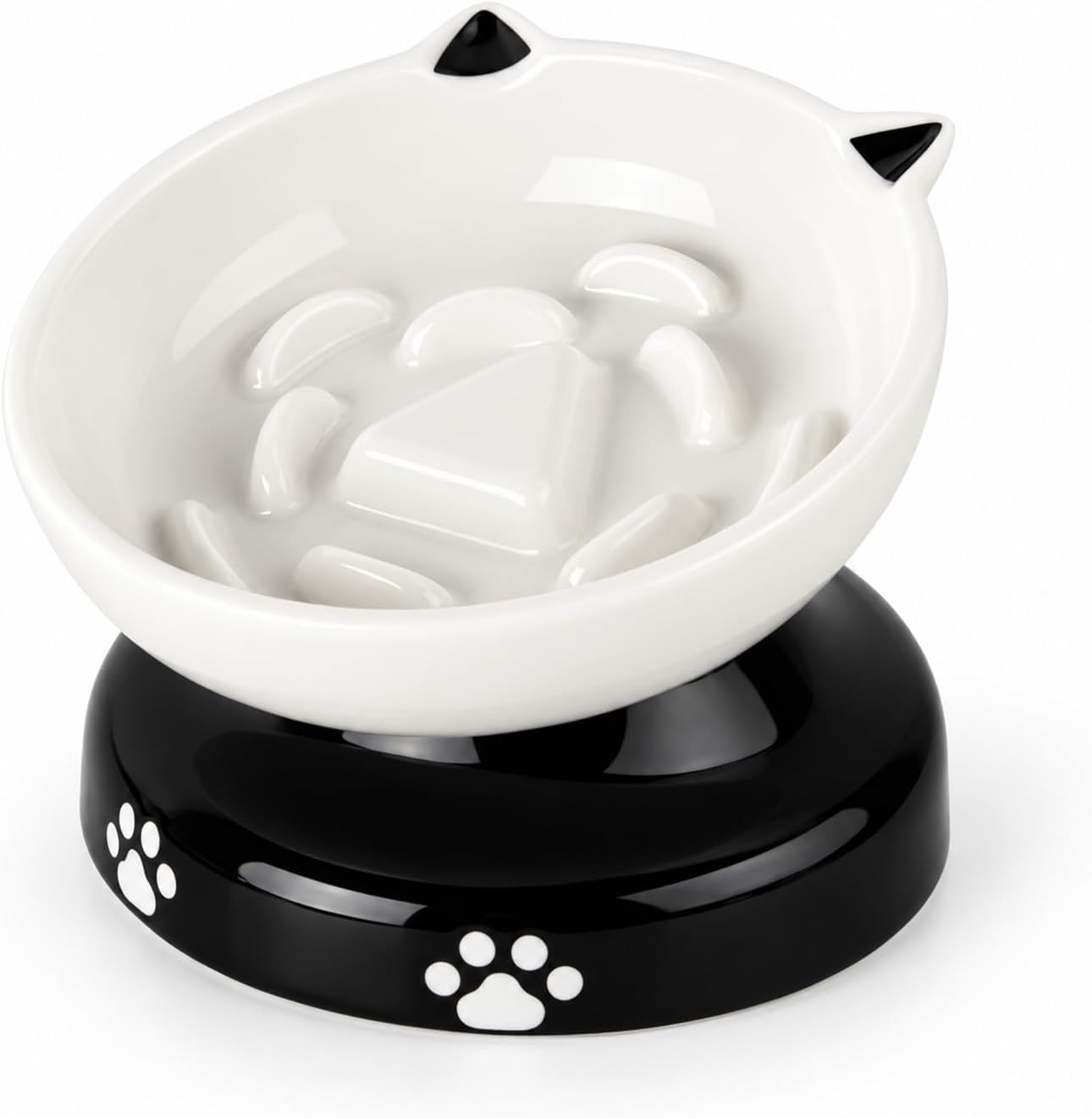
Y YHY Ceramic Cat Slow Feeder, Elevated Dog Food Bowl Tilted Design, Slow Feeder Bowl no Black Chin, Cat Shape for Dry and Wet Food
A tilted, elevated ceramic dish with a cat-shaped interior and a slow-feeding maze. It is sold for dry and wet food and for keeping the chin clean, which is the reason many owners move a light-coated cat off plastic in the first place.
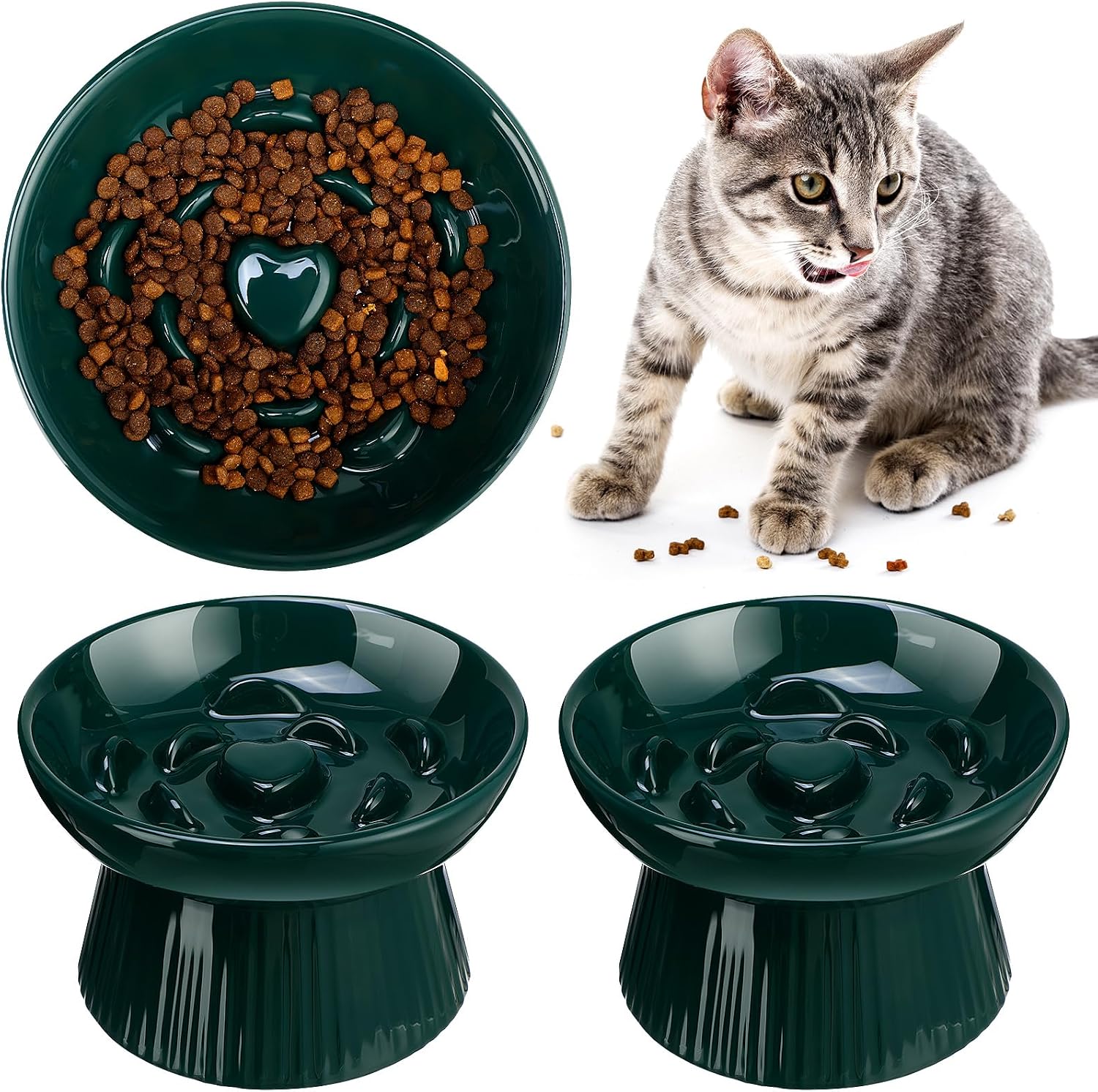
Tioncy 2 Pcs Ceramic Elevated Slow Feeder Cat Bowl, Dark Green
A two-piece set in dark green, with both bowls elevated and slow-feeding. Two dishes means one can soak or go through the wash while the other is in use, which suits a two-cat home or an owner feeding wet food twice a day.
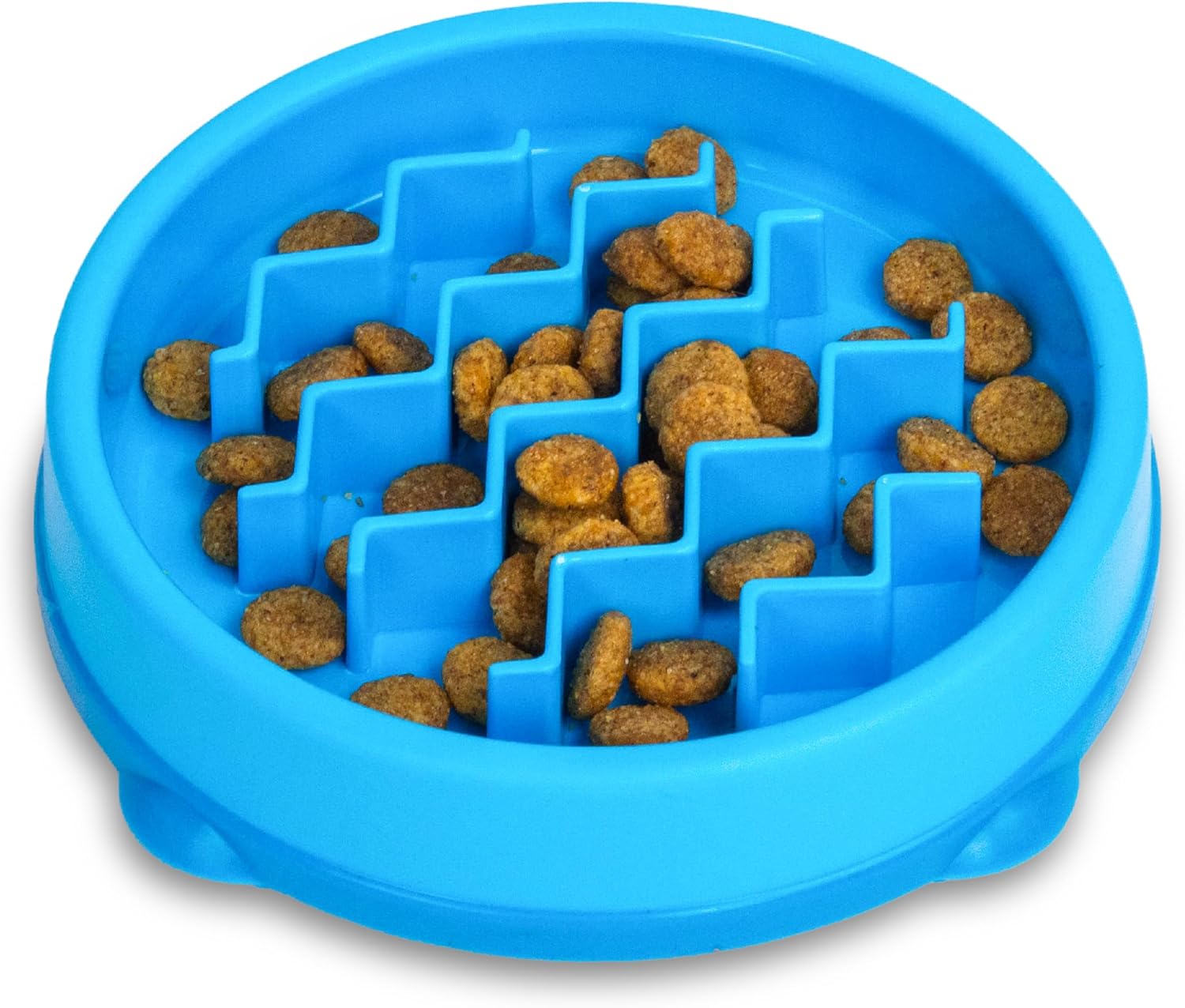
Catstages Kitty Slow Feeder Bowl for Cats & Kittens, 3/4 Cup, Blue, 5"
The smallest bowl in this group, at a stated 3/4 cup capacity and a 5 inch width. It is plastic, light, and aimed at kittens and small cats, so it fits a measured portion better than a full adult meal.
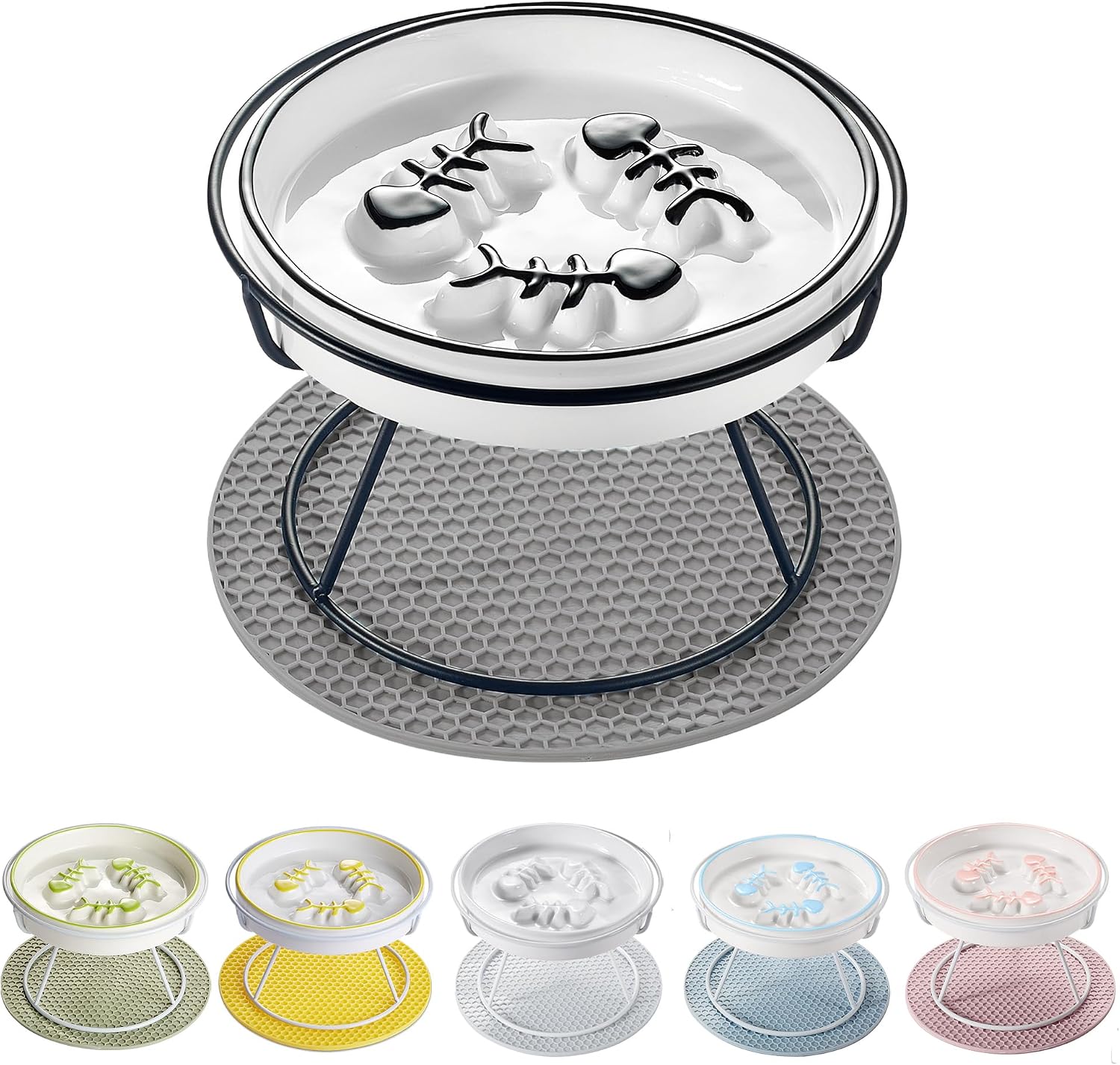
Ceramic Elevated Slow Feeder Cat Bowl, Anti Vomit, Removable Dish, Black
An elevated ceramic bowl with an inner dish that lifts out of the stand, sold as an anti-vomit design. The removable dish is the practical part: the base stays on the floor and only the food surface travels to the sink.
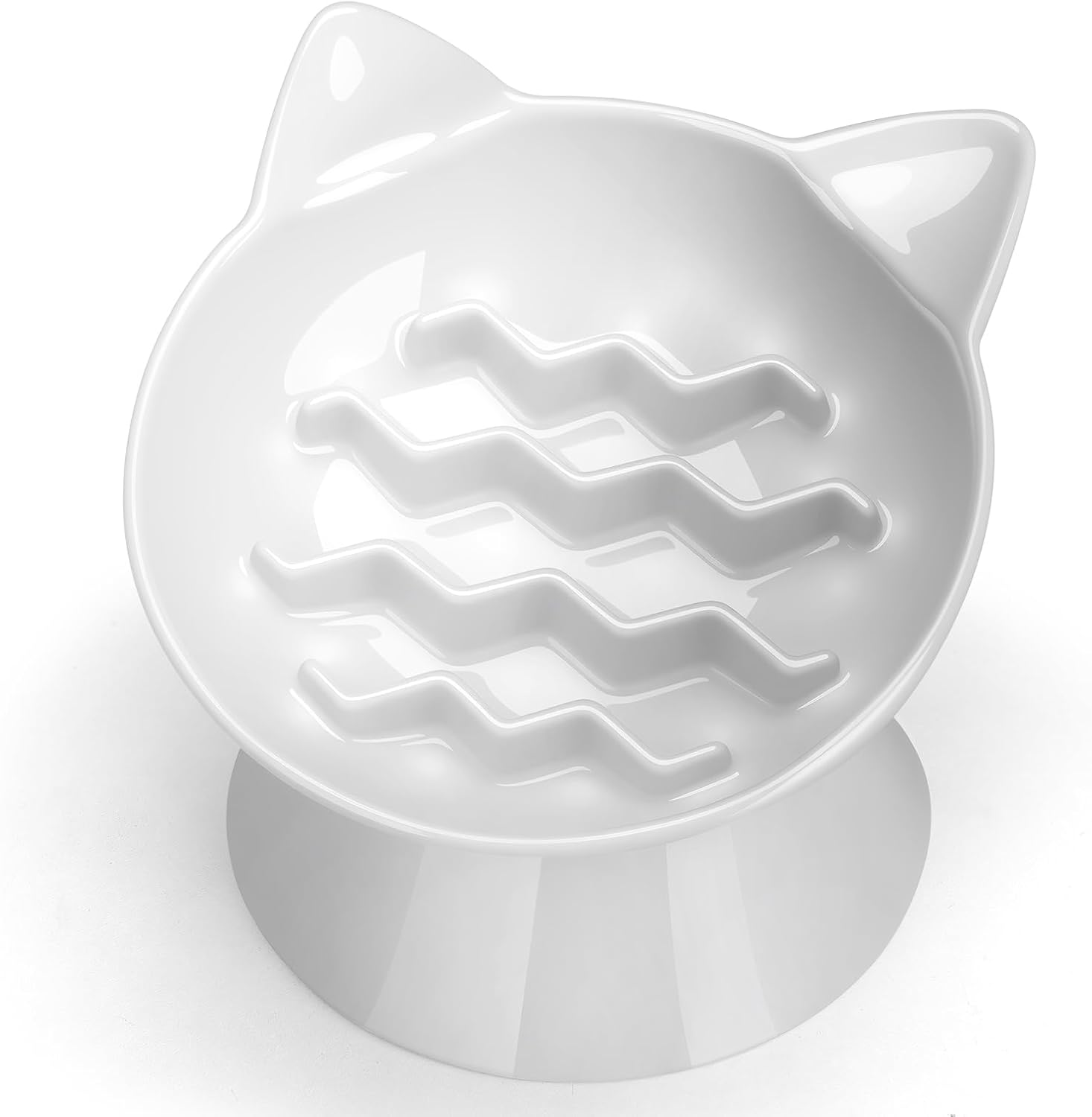
Ceramic Slow Feeder Cat Bowl, 2 Cups Tilted Elevated Honeycomb Food Dish
A tilted, elevated ceramic dish with a honeycomb surface and a stated 2 cup capacity, the largest single-bowl capacity here. The honeycomb pockets force a cat to work each bite out of its own hollow rather than gulping a smooth pile.
How these products were compared
This guide compares five things: elevation angle, bowl width and stated capacity, whisker clearance at the rim, material and weight, and how the bowl is cleaned. Product names, images, and retailer links are matched by ASIN so that every card points to the product shown, and no product appears here that is not part of that verified set.
Nothing in this roundup is presented as hands-on testing. The comparisons come from the manufacturer descriptions of each bowl and the specifications carried in the product names, which is why the capacity and tilt figures quoted above are stated figures rather than measured ones.
No current prices are printed here. Listings move constantly, so each card links to the product page where you can confirm the current price, the stock status, and the return terms before buying.
How to choose the right slow feeder cat bowl
Start with elevation angle, because it decides whether the bowl helps a gulper or just frustrates it. A flat bowl on the floor makes a cat swallow air with each bite. A tilted bowl raises the food so the head stays closer to level and the food slides toward the mouth. A 15-degree tilt is a common middle ground, shallow enough that a cat does not have to stretch and steep enough to gather the food at one edge.
Then check bowl width against the cat. A wide, shallow dish gives whisker clearance, which matters for cats that refuse to eat when their whiskers touch the sides. A narrow, deep bowl is harder on a flat-faced cat than on a long-nosed one.
Portion size decides capacity. If your cat eats a measured 3/4 cup twice a day, a small kitten bowl holds exactly that and no more. If you feed a large adult, or you soak dry food, a 2 cup bowl gives room. Buying the largest bowl available does not make a slow feeder work better, and an oversized bowl with a small portion leaves the food spread thin and easy to gulp.
Material matters for cleaning and for the floor. Ceramic is heavy, so it resists sliding, and it does not hold onto oils the way a scratched plastic dish can, which is why it is often suggested for cats prone to chin acne. Plastic is light, less expensive, and easy to replace, but it can scratch, and a scratched surface traps residue.
If you are shopping for a fountain rather than a food dish, the deciding specs are different: water capacity, pump noise, and filter type, and on microchip feeders the microchip range. Those do not apply to the bowls below, and this guide does not cover them.
If more than one cat eats in your home, the bowl is only half the setup, because a second cat will usually push the slower eater off a single dish. Our guide to setting up a feeding station for two cats covers spacing and how to keep one cat from guarding both dishes. There is no single ideal slow feeder cat bowl for every household. The right one is the bowl that fits your cat's muzzle, your portion size, and your washing routine, which is also the practical way to find the best slow feeder cat bowl for your kitchen.
KittyDine Ceramic Slow Feeder Cat Bowl, 15-Degree Tilted Non-Slip
The KittyDine bowl earns the top spot because it combines the two features that do the most work for a fast eater. The 15-degree tilt raises the food surface so the cat eats with its head closer to level and the food gathers at the low edge instead of sitting at the bottom of a well. The non-slip base keeps the dish planted, which matters with ceramic, since a heavy bowl that skids still ends up against a wall with food behind it.
It is also one of the simplest bowls here to live with. There is one piece to wash, the ceramic surface does not hold onto oils the way a scratched plastic dish can, and there is no stand to take apart before the dish fits in the sink. The tilt is fixed rather than adjustable, so you get the angle the manufacturer chose instead of a setting you tune yourself.
The trade-off is that fixed tilt. If your cat eats happily from a flat plate on the floor and has never gulped a meal, the angle adds a shape you have to wash around without changing much. It is also a single bowl, so a two-cat home will want two of them, or a set like the Tioncy pair, rather than one dish that both cats share.
Alternatives to consider
The Y YHY Ceramic Cat Slow Feeder, Elevated Dog Food Bowl Tilted Design, Slow Feeder Bowl no Black Chin, Cat Shape for Dry and Wet Food is better suited to an owner who wants a cat-shaped maze in a ceramic dish and is also dealing with chin staining, since the listing is built around dry and wet food and a clean chin. The Tioncy 2 Pcs Ceramic Elevated Slow Feeder Cat Bowl, Dark Green is a stronger fit when you need two bowls at once, either for two cats or for one cat on a wet food schedule where a dish is always in the wash.
The Catstages Kitty Slow Feeder Bowl for Cats & Kittens, 3/4 Cup, Blue, 5" covers the small end of the range, with a stated 3/4 cup capacity and a 5 inch width for kittens and small cats. The Ceramic Elevated Slow Feeder Cat Bowl, Anti Vomit, Removable Dish, Black covers the cat that needs an elevated stand with an inner dish that lifts out, and the Ceramic Slow Feeder Cat Bowl, 2 Cups Tilted Elevated Honeycomb Food Dish covers the largest single portion and the classic honeycomb slowing pattern.
Day-to-day use and maintenance
Slow feeders work best when you introduce them gradually. Put a normal meal in the new bowl for the first day or two and let the cat work out the ridges before you make the food harder to reach. A cat that walks away from a new bowl is usually reacting to the shape, not to the food.
Wash the bowl after wet food and at least every few days after dry food. Ceramic dishes are generally dishwasher safe unless the listing says otherwise, and the removable dish on the elevated bowls is the easiest of the group to rinse. Check ceramic rims for chips and retire a chipped bowl rather than risk a cut lip.
Plastic bowls can scratch over time, and a scratched surface is harder to get clean. If your cat has had chin trouble on plastic, ceramic is the usual switch. Whisker clearance is worth watching as well: if your cat scoops food onto the floor with a paw instead of eating from the bowl, the rim may be too narrow.
Finally, keep the portion the same when you change bowls. A slow feeder changes how fast a meal is eaten, not how much the cat needs, and splitting a portion between two dishes in a multi-cat home is easier to manage than one large bowl that everyone shares.
Buying checklist
- Measure your cat's normal portion and the width of the space where the bowl will sit.
- Choose bowl width and capacity based on an ordinary meal rather than an occasional large one.
- Confirm that the exact model includes the features you need, such as a removable dish or a non-slip base.
- Read the cleaning and maintenance instructions before the first meal.
- Check the elevation angle against how your cat already eats.
- Verify the current retailer price, availability, and return terms.
Final recommendation
Choose the KittyDine Ceramic Slow Feeder Cat Bowl, 15-Degree Tilted Non-Slip when you want one well-made tilted ceramic bowl for a fast eater and you do not need a second dish. Choose the Catstages Kitty Slow Feeder Bowl for Cats & Kittens, 3/4 Cup, Blue, 5" when you are feeding a kitten or a small cat a measured 3/4 cup portion and want the lightest, simplest bowl here. If two cats eat at the same time, the Tioncy pair, or two separate dishes, will serve you better than one bowl. The best slow feeder cat bowl is the one that matches your cat's portion and posture, so measure before you buy and use the links above to confirm the current price.