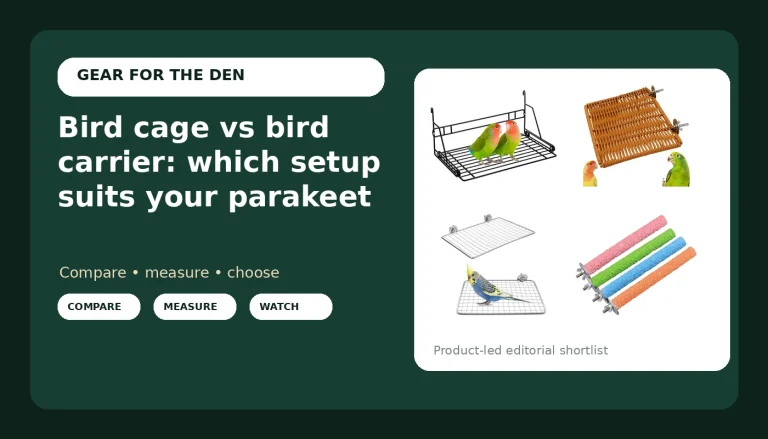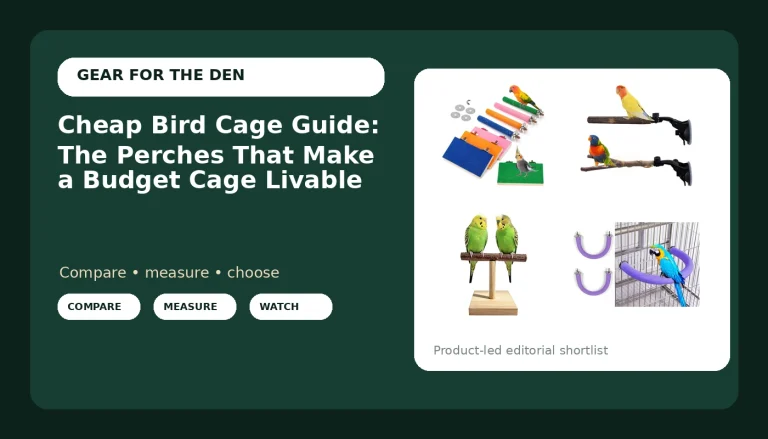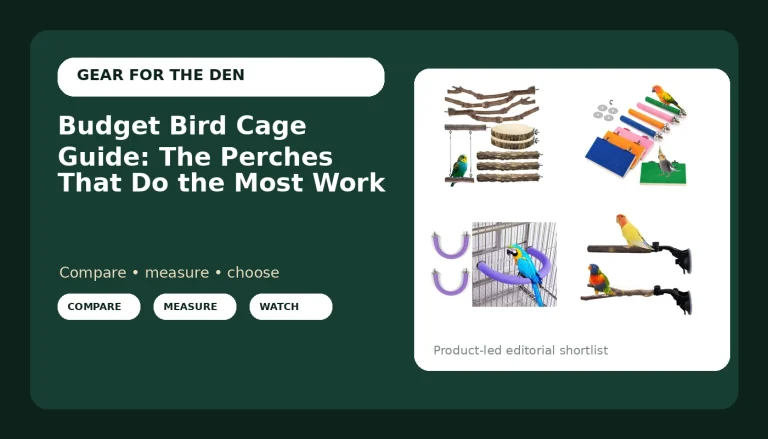
Parakeets are small, but they are not stationary. A budgie that looks content on a single dowel will spend its day climbing the bars, hopping between levels, and hunting for something to chew, and a cage that offers none of that becomes a cage the bird wants out of. Most first-time owners start by searching for a bird cage for parakeets and end up comparing colors and prices while the numbers that decide whether the cage actually works, bar spacing, cage height, perch diameter, and the way the door and the tray are built, sit in the fine print. This bird cage for parakeets explained guide walks through those details in the order they affect the bird, then looks at four perch and platform accessories that answer the most common complaint about a new cage: there is nowhere to stand except the dowel that came in the box.
Quick answer
A bird cage for parakeets works when the bar spacing is narrow enough that a budgie cannot push its head between the bars, the cage is wide enough for short horizontal hops between perches, and the interior holds at least three perches of different diameters plus food and water cups the bird can reach without standing on the rim. Color, wheeled stand, and seed guard are preference, not function. Measure the wall space first, then buy the largest cage that fits it, because a parakeet uses width and height far more than it uses floor area.
Four useful options
| Model | Best fit | What stands out |
|---|---|---|
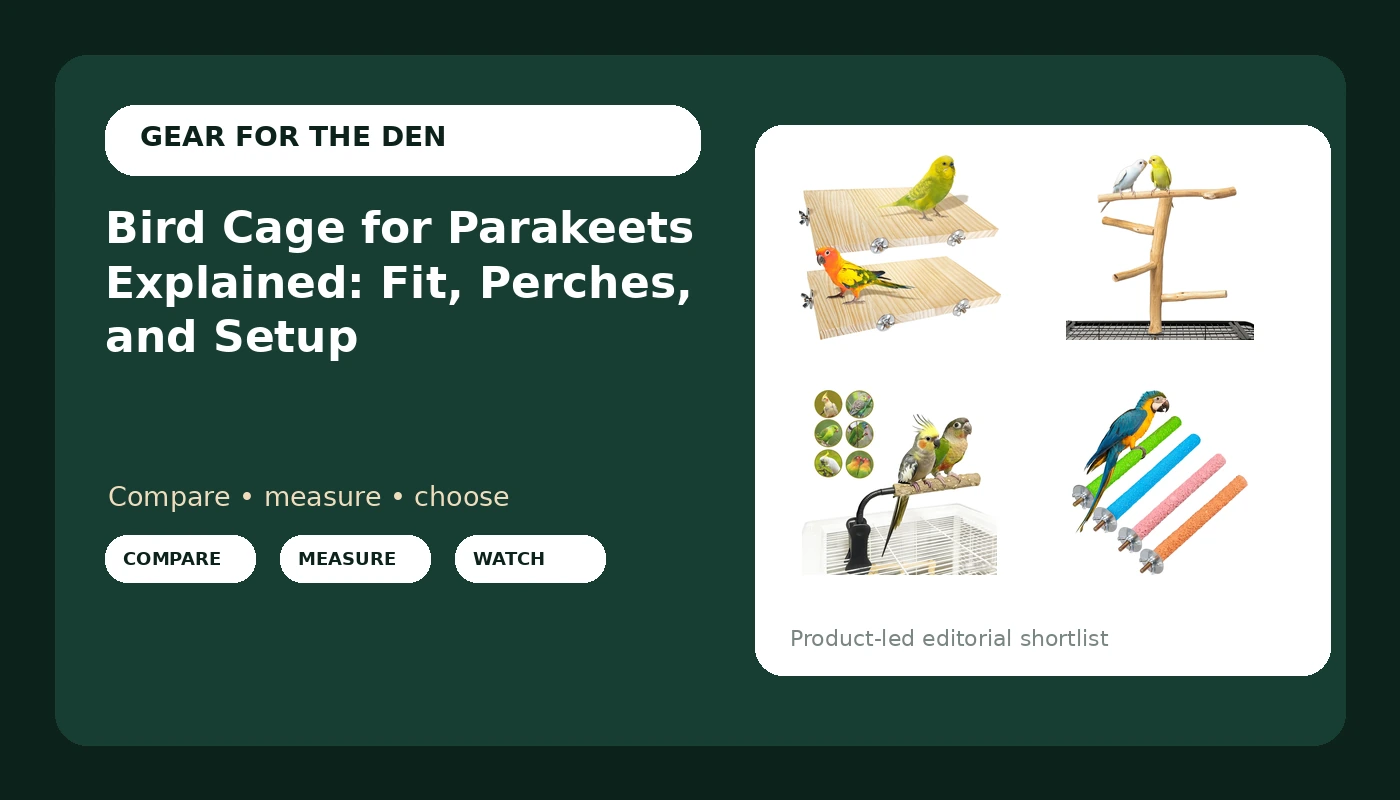
| Arfubye 2PCS 13.8×7.9 inches Large Bird Perch Stand | Corner or side-wall space inside the cage | Two rectangular wood platforms sized 13.8 by 7.9 inches |
| Pecirvoli Bird Perch for Top of Cage, Natural Wood Play Stand | Out-of-cage time on the cage roof | A natural wood play stand built for top-of-cage placement |
| Clip On Bird Perch Stand with Adjustable Gooseneck | A perch that moves between cages or rooms | A gooseneck mount that clips on and repositions |
| 4 Pcs Bird Perch, 7.8inch Random Colorful Wood | Filling a new cage quickly | Four 7.8 inch wood perches in assorted colors |
Corner platform: Arfubye 2PCS 13.8×7.9 inches Large Bird Perch Stand
A flat platform changes how a parakeet uses the upper half of a cage. Instead of one more place to grip a dowel, it gives the bird a surface to stand on, turn around, and rest on, which matters most for a bird that spends a lot of its day on its feet. The trade-off is that a flat surface does not exercise the toes the way a round perch of the right diameter does, so the platform belongs alongside round perches rather than instead of them. Sizing is the other consideration. A 13.8 inch platform needs a cage with enough interior width to hold it without crowding the food cups, and in a small cage the second platform in the set is often more useful in a second cage or kept as a spare.
Top-of-cage stand: Pecirvoli Bird Perch for Top of Cage, Natural Wood Play Stand
A top-of-cage stand is for the part of the day the bird spends outside the cage. It gives a parakeet a defined landing place instead of a bare roof, and it keeps droppings off the bars directly over the interior. It adds nothing to the usable space inside the cage, so it should not be counted when you are judging whether a cage is big enough. If the cage top is already cluttered with a play gym or with storage, or if the bird is not yet reliable about staying put, this is a purchase to delay until the daily routine is settled.
Clip-on perch: Clip On Bird Perch Stand with Adjustable Gooseneck
The clip-on format is the most flexible of the four because the gooseneck lets you set the height and angle, then move the whole thing to a different cage, a play area, or a travel carrier. That makes it useful for step-up practice near the door, where a perch at the right height keeps the bird from climbing the bars to reach your hand. Check the clip tension before trusting it with a bird, and place it away from the tray and the door latch so the perch cannot be used as a bridge to either. A gooseneck also has to hold its position under a bird's weight, so test that before you leave the room.
Multi-pack perches: 4 Pcs Bird Perch, 7.8inch Random Colorful Wood
Four short wood perches in one pack solve the problem most new cages have, which is exactly one perch in the box. At 7.8 inches each they suit small birds, and having several means you can place them at different heights and swap one out while another dries after cleaning. The colors arrive at random, so this is not the pack to buy if you want the cage to look coordinated. Diameter is the detail worth checking before ordering, since a parakeet's toes should wrap around the perch rather than meet underneath it, and a set sold as paw grinding sticks is aimed at birds that benefit from a rougher gripping surface.
Prices and availability may change. Product images, names, and retailer links are matched to verified listings. No current price, rating, stock status, or measured result is stated here without current evidence.
What the ideal bird cage for parakeets setup actually requires
Bar spacing is the first filter, and it is the one buyers skip. The gap between bars has to be narrow enough that a budgie cannot push its head through, which is why cages sold for small birds use tight spacing and cages built for large parrots do not. If a listing describes its spacing in terms of macaws and cockatoos, it is not the correct bird cage for parakeets, however good the price looks.
Cage height and width come next, and they do different jobs. Width gives a parakeet room to fly or hop horizontally from one side to the other, which is the movement it does most. Height lets you separate a sleeping perch from a feeding perch and from a bathing spot, so the bird is not eating where it sleeps. A tall, narrow cage looks impressive on a stand and gives the bird almost nothing. Before ordering, compare the dimensions you are considering against a small bird cage size chart so you are judging interior space rather than the footprint of the base.
Then come the details that decide how pleasant the cage is to live with. A removable tray with a tray liner turns daily cleaning into a two-minute job instead of a scrub. Food cup size and placement matter more than most people expect: a cup the bird can reach from a perch stays cleaner than one it has to climb down for, and cups set directly under a perch collect droppings. The door needs to be wide enough to reach in with one hand, and the latch needs to be one a parakeet cannot open, which rules out some simple slide latches.
Finally, plan for the carrier separately. A carrier size that fits one parakeet comfortably is the right size for vet visits and emergencies, and no full-size cage does that job well.
Bar spacing, perch diameter, and the rest of the checklist
Inside the cage, perch diameter is the number that decides whether the bird's feet are comfortable. A dowel that is too thin forces the toes to meet underneath the perch, and one that is too thick stops the foot from closing around it. Variety is the practical answer: several perches of different diameters, in wood and in rope, let the bird shift its grip through the day. Placement matters too, with at least one perch high enough to sleep on and one positioned so the bird can eat without leaving the perch.
Two more variables are worth building into the layout. Foraging difficulty is how much work a meal takes, and a parakeet that gets everything in an open bowl gets bored quickly, so splitting food between a bowl and a foraging cup adds a few minutes of activity to the day. A swing mount is worth checking for security rather than novelty: a swing that hooks over a bar with a simple clip can be knocked loose, and a swing should never be the only high perch in the cage.
- Measure the space the cage will occupy, including headroom and any shelf above it.
- Filter listings by bar spacing and bird size before you compare anything else.
- Check the door opening, the latch type, and whether the tray and tray liner come out without lifting the cage top.
- Plan the interior: three or more perches of different diameters, one near the food cup and one high for sleeping.
- Add platforms, swings, and clip-on perches last, once the basic layout is settled.
Living with the cage after setup
- Line the tray before the liner is soiled, and keep a spare liner on hand so cleaning does not wait on laundry.
- Rotate perch positions every few weeks, since a parakeet that always grips the same spot wears the same part of its feet.
- Wash food and water cups daily, and check the cup size against how much the bird actually eats in a day.
- Keep the cage out of the kitchen and away from drafts, and set the highest perch at a height where the bird can watch the room.
- Supervise out-of-cage time, and treat a top-of-cage stand as a supervised destination rather than a second cage.
Which option should you choose?
Choose the Arfubye 2PCS 13.8×7.9 inches Large Bird Perch Stand when you have a wide cage with an empty corner and want a flat surface the bird can rest on. Choose the Pecirvoli Bird Perch for Top of Cage, Natural Wood Play Stand when your parakeet already spends time on the roof and you want that time to happen on a stand instead of bare bars. Choose the Clip On Bird Perch Stand with Adjustable Gooseneck when you want one perch that can move between a cage, a training spot, and a carrier. Choose the 4 Pcs Bird Perch, 7.8inch Random Colorful Wood when a new cage arrived with a single dowel and you need several perches at different heights right away.
None of these four accessories changes whether a cage is the right size. Bar spacing, cage height, and interior width are decided by the cage itself, and no perch fixes a cage that is too small or spaced for a larger bird. Treat the accessories as the last step in a setup that starts with dimensions.
The bottom line
The correct bird cage for parakeets is the one whose bar spacing keeps the bird inside, whose width lets it move horizontally, and whose interior can hold a varied perch layout with cups the bird can reach. Get those three things right and the cage is doing its job. Perches and platforms, including the four options above, are how you make that cage interesting enough that the bird does not spend its day trying to get out.