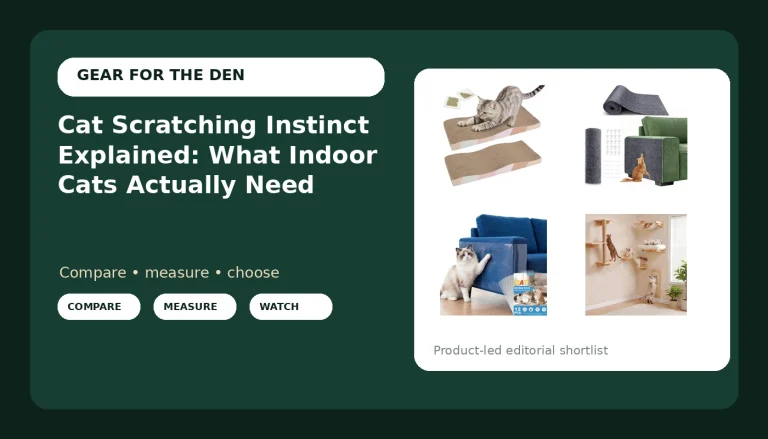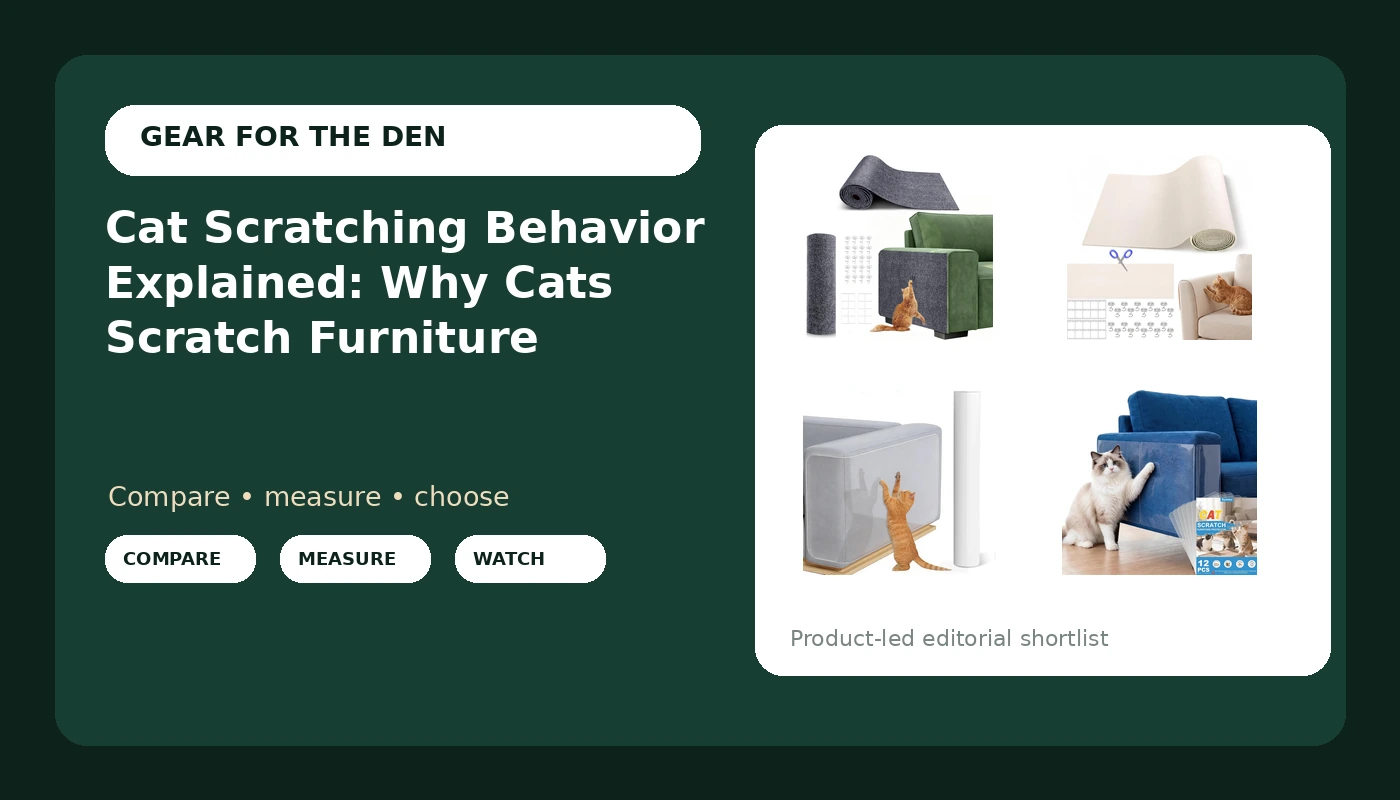
Scratching is one of the most reliable things a cat does, and one of the most misunderstood. A cat scratches to shed the worn outer layers of its claws, to leave visual and scent marks, and to stretch through the shoulders and back. None of that is misbehavior, which is why punishment usually changes nothing except the cat's willingness to be near you. The practical question is not how to stop cat scratching behavior but where to send it. Give a cat a surface that feels better than the couch and most of the conflict fades, which is what the four protectors below are for: buying time, saving upholstery, and pointing the habit somewhere else.
Quick answer
Cat scratching behavior explained in one line: it is normal claw maintenance and communication, so the fix is redirection rather than punishment. Cover the spot the cat has already chosen, put an acceptable scratching surface right beside it, and keep the claws trimmed while the new habit forms. The four protectors here solve different versions of the same problem. One is a self-adhesive mat for targeted spots, one is a long mat for a full couch front, one is a clear adhesive roll for visible upholstery you would rather not hide, and one is a pin-free multi-piece set for fabric sofas with several problem corners. None of them teaches the cat anything on its own. Each one buys time while you build a better target.
Four useful options
| Model | Best fit | What stands out |
|---|---|---|
| Self-Adhesive Cat Scratching Mat, Durable Couch Protector from Cat Claws | Couch arms and seat edges a cat already targets | Adhesive backing, so no pins or straps |
| Cat Scratching Mat, 118" × 15.8" Cat Scratch Couch Furniture Protector | A long run along the front of a sofa | 118 by 15.8 inches, the widest single strip in this group |
| Houlishu Cat Scratch Furniture Protector, Clear Flexible Plastic Adhesive Cover, Single Side Sticky Sofa Couch Guard, 7.87 x 196.8 Inches | Visible upholstery you want to keep looking untouched | Clear flexible plastic with one sticky side, 7.87 by 196.8 inches |
| 12PCS Symmu No Pins Anti Cat Scratch Furniture Protector for Fabric Sofa | Fabric sofas with several separate trouble spots | Twelve separate pieces and no pins |
The targeted mat: Self-Adhesive Cat Scratching Mat, Durable Couch Protector from Cat Claws
Adhesive mats are the least fussy option for a cat that has picked one or two spots. There is no hardware to install and nothing to thread through the upholstery, so a couch arm can be protected in a couple of minutes. The trade-off is that adhesive placement is close to permanent in practice. Press it down crooked and peeling it back to try again usually leaves the backing less sticky, so line the piece up carefully the first time. The other limitation is coverage. A mat this size handles an arm or a seat edge, while a cat that scratches along the entire front of a three-seat sofa needs something longer.
The long-run mat: Cat Scratching Mat, 118" × 15.8" Cat Scratch Couch Furniture Protector
This is the option to choose when the damage runs in a line. At 118 inches long and 15.8 inches wide, one piece covers a full couch front without a seam in the middle, and the width means the cat meets the mat even when it reaches a little to either side. Because it is built as a scratching mat rather than only a barrier, the surface is meant to be scratched, and that is a real difference: a cat redirected onto this piece is doing the behavior you want it to do, in a place that can absorb it. The trade-off is that a long, wide strip is harder to hide. If the couch is the centerpiece of the room, the clear film below keeps a lower profile.
The clear film: Houlishu Cat Scratch Furniture Protector, Clear Flexible Plastic Adhesive Cover, Single Side Sticky Sofa Couch Guard, 7.87 x 196.8 Inches
Clear plastic is for the household that wants protection without changing the look of the room. The film is flexible, so it follows the curve of an arm or a cushion edge instead of sitting on top of it like a rigid panel, and the adhesive is on one side only, so the outward face stays smooth. The 7.87 inch width and 196.8 inch length mean you cut what you need, which is useful for wrapping a front edge or covering a corner where the cat has already done damage. The trade-off is that thin film is a barrier, not a scratching surface. A cat that wants to dig its claws in will still look for a real target, so pair this with a post or a mat.
The no-pin set: 12PCS Symmu No Pins Anti Cat Scratch Furniture Protector for Fabric Sofa
The twelve-piece set suits a fabric sofa with a scattered problem. Instead of one long cover, you get a dozen pieces to place wherever the cat has been working, which also makes it the easiest option to rearrange as habits shift. No pins means nothing is pushed through the fabric, an advantage on upholstery that would show a hole or a run. The trade-off is coverage per piece and the number of seams: a dozen small protectors can look busier than one continuous mat, and each one has to be positioned separately. On a couch with one long damaged edge, the 118 inch mat is the cleaner answer.
Prices and availability may change. Product images, names, and retailer links are matched to verified listings. No current price, rating, stock status, or measured result is stated here without current evidence.
What cat scratching behavior actually is
Scratching serves three jobs at once. The first is claw maintenance: the outer sheath of a claw loosens and comes away as the cat drags it across a rough surface, which keeps the claw sharp underneath. The second is marking. Cats have scent glands between the paw pads, and a scratch leaves both a visible score and a chemical note that says a cat was here. The third is stretching. A good scratch pulls the front legs forward and the back legs back, working the shoulders, spine, and hindquarters together.
That combination explains the timing. Cats often scratch after waking, after eating, and after any moment of tension, such as a stranger at the door or a new cat in the house. Scratching is also social: in a multi-cat household, the cat that scratches at a doorway or the side of the couch is often the cat with something to say about the shared space. This is why damage tends to concentrate in a few predictable places, near sleeping spots, near entryways, and right beside the piece of furniture the people care about most.
It also explains why a plain "no" does not work. You are asking a cat to give up a behavior that manages its claws, broadcasts its presence, and feels good, and you are offering nothing in return. Redirection keeps all three functions and changes only the address.
Why the ideal cat scratching behavior needs the right surface
The ideal cat scratching behavior is not a cat that stops scratching. It is a cat that scratches hard, daily, and on something that is not your furniture. Three properties decide whether a surface gets used.
Material comes first. Sisal rope, corrugated cardboard, and wood are the common choices, and cats tend to have opinions. A cat that ignores a carpeted post and destroys a woven couch arm is telling you it prefers a tight weave with some give.
Stability comes second, and it is where most setups fail. A post that rocks or a tree that shifts under a full stretch teaches the cat that the surface is unreliable. That is a hardware question: anchor type, weight limit, and whether the base is wide enough for the cat to lean into the scratch.
Size and shape come third. A post has to be tall enough for the cat to stretch to full height and thick enough for the paws to grip, which is where post diameter matters. If the plan includes a cat tree, the numbers to check are platform height for a full vertical stretch, shelf depth and perch width for lying down, hammock fabric for cats that lounge rather than climb, and the weight limit for a cat that is bigger than average. Carrier size belongs in the same conversation for a different reason: a cat that cannot stand and turn in its carrier arrives at the vet already stressed, and stressed cats tend to scratch more in the days that follow.
Placement finishes the job. The new surface has to sit within a step or two of the old one, at roughly the same height and angle. A perfect post in a back bedroom will lose to a couch arm every time.
Five steps to redirect the behavior
- Map the damage. Note every place the cat scratches, whether the marks are vertical or horizontal, and how high they reach. The pattern tells you whether you need a post, a pad, or both.
- Match the material to the cat. Offer sisal, cardboard, and wood, and watch which one gets used. Cats often prefer the opposite of the texture they are currently shredding.
- Put the new surface beside the old target, not across the room. The first version should sit within a step of the couch arm, at the same height.
- Anchor it so it cannot move. Check post diameter, platform height, shelf depth, and anchor type before deciding a cat has rejected a post; a wobbly post is a rejected post.
- Protect and reward. Cover the damaged spot with one of the protectors above, then praise or treat the cat when it uses the right surface. Once the new habit is steady, the protector can come off.
Setting up a scratch zone that gets used
- Clean and dry the fabric before applying any adhesive protector. Dust, lint, and fabric softener residue give the adhesive less to hold onto.
- Test the adhesive on a hidden area first, such as the back of the couch or the underside of a cushion, and give it a day before trusting it on a visible panel.
- Trim claws every week or two while the new habit forms. Shorter claws do less damage during the transition, and the trimming is easier when it is routine.
- Keep the protector in place for at least a few weeks. Pulling it off the moment the cat looks calm usually sends the cat straight back to the same seam.
- Cover only the spots the cat uses. Wrapping an entire sofa changes the texture of the room and can push a cat toward a chair, a mattress, or a door frame instead.
- Expect a spike after change. A new cat, a move, or a houseful of guests often shows up as fresh scratches, and the answer is more scratching surfaces, not fewer.
- Keep a scratching surface near every sleeping area, because cats scratch most often right after they wake up.
Which option should you choose?
Choose the Self-Adhesive Cat Scratching Mat, Durable Couch Protector from Cat Claws when one or two spots on a couch arm or seat edge are taking the damage and you want a small patch that goes on without hardware. Choose the Cat Scratching Mat, 118" × 15.8" Cat Scratch Couch Furniture Protector when the damage runs along a long front edge and you would rather cover it with one wide piece than with several smaller ones. Choose the Houlishu Cat Scratch Furniture Protector, Clear Flexible Plastic Adhesive Cover, Single Side Sticky Sofa Couch Guard, 7.87 x 196.8 Inches when the sofa is visible and you want the protection to disappear into the upholstery, or when you need a long roll you can cut to fit an awkward shape. Choose the 12PCS Symmu No Pins Anti Cat Scratch Furniture Protector for Fabric Sofa when a fabric sofa has several separate corners under attack and you prefer pin-free pieces you can move around.
The goal underneath all four is correct cat scratching behavior: the cat scratches hard and often, just not on the couch. None of these protectors reaches that goal by itself. Each one is a barrier that holds the line while a post, a pad, or a tree becomes the better option in the cat's mind. Adhesive products also vary by fabric, so test a hidden area before committing a visible panel, and expect that a determined cat may simply scratch the protector instead.
The bottom line
Cat scratching is maintenance, marking, and stretching wrapped into one behavior, and it is not going away. What you can change is the surface. Map where the damage happens, put an acceptable scratching material within a step of that spot, anchor it so it does not move, and cover the old target while the new habit settles. The four protectors here split that last job by shape: a self-adhesive mat for targeted spots, a 118 by 15.8 inch mat for long couch fronts, a clear flexible roll for upholstery you want to keep looking untouched, and a twelve-piece pin-free set for fabric sofas with scattered damage. Pick the one that matches the pattern of the damage, keep the claws trimmed, and give the new surface a few weeks before you judge the result.