A 10-gallon tank near a window can lose several degrees overnight and gain them back by mid-afternoon, and that swing is harder on fish than any single number on a thermometer. Most of the setup questions we get about small freshwater tanks come back to the same piece of hardware: aquarium heaters. Choose one that is undersized and it runs continuously without ever holding a steady temperature. Choose one that is oversized and a thermostat that sticks can push a small tank up several degrees in a hurry. The tank around the heater matters just as much, because an open-top rimless aquarium loses heat differently than a covered one, and water movement decides whether warmth spreads through the tank or sits in one corner. This guide covers how heater wattage is matched to tank volume, where a heater belongs in a rimless setup, and how the tank you choose changes the plan.
Quick answer
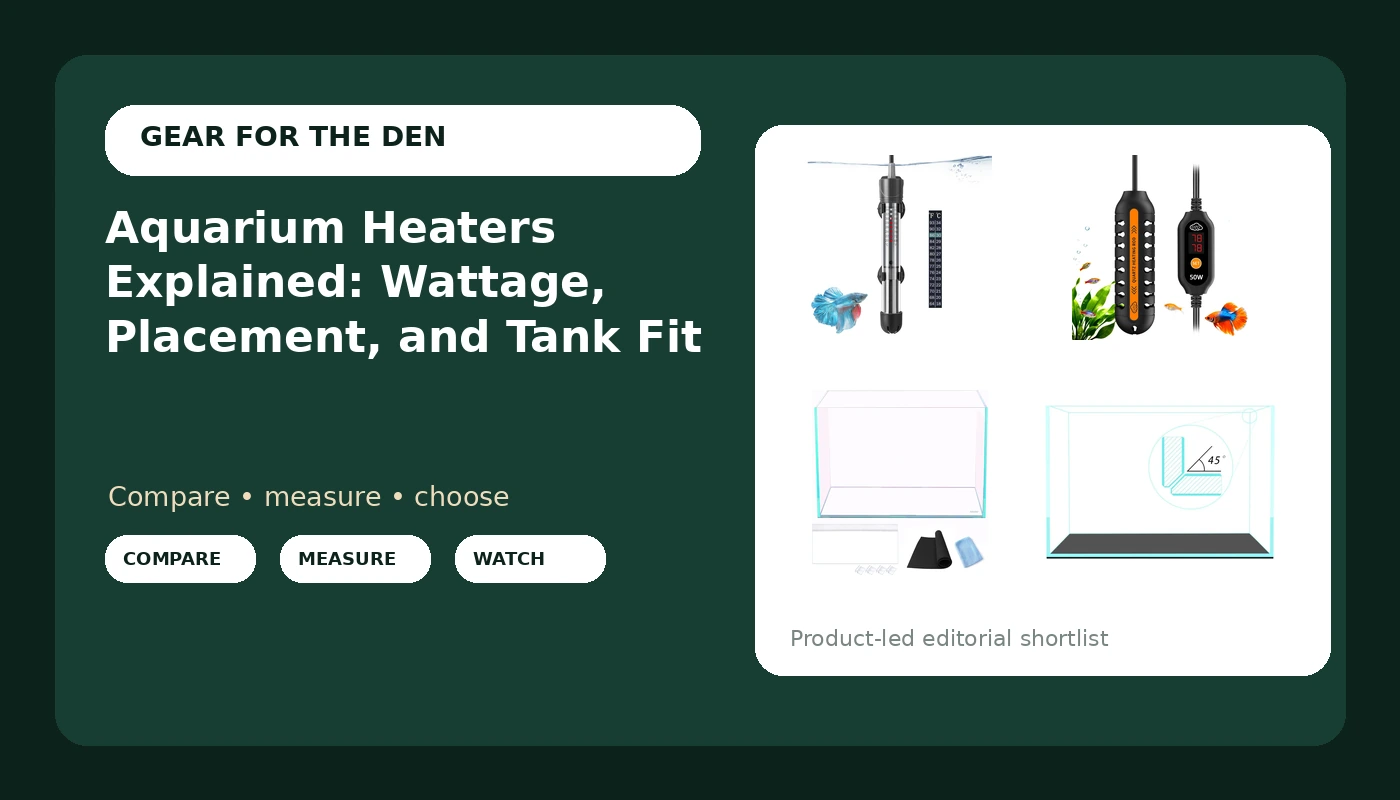
For a 10-gallon freshwater tank in a typical heated room, a 50W adjustable heater is the usual starting point, about five watts per gallon with headroom for a cool night. Here is aquarium heaters explained in its shortest form: size the heater to the tank volume and to the coldest temperature the room reaches, mount it where water actually moves, and confirm the result with a separate thermometer instead of trusting the dial. Adjustable models are easier to troubleshoot than fixed preset units because you can see and change the set point. Both heaters below are 50W adjustable models, and both tanks below are 10-gallon rimless aquariums in low iron glass, so pairing one heater with one tank is a simple decision.
Four useful options
| Model | Best fit | What stands out |
|---|---|---|
| HITOP 50W Adjustable Aquarium Heater, Submersible Fish Tank Heater Thermostat with Suction Cups for 6-15Gal | Small tanks that want a simple dial thermostat | 50W adjustable output with suction cup mounting, listed for 6 to 15 gallon tanks |
| QZQ Aquarium Heater, 50W Adjustable Fish Tank Heater with Digital Display | Tanks where you want the set point visible at a glance | Digital display on a 50W adjustable heater |
| Low Iron Glass Ultra Clear Rimless Aquarium Tank,Classic Silhouette(10Gal) | A classic rectangular rimless look | Low iron glass, rimless, 10-gallon capacity |
| FZONE 10Gal Rimless Aquarium, Low Iron Glass, 45° Mitered Edges (S45-W30) | A rimless tank with sharper corner detailing | Low iron glass panels joined with 45 degree mitered edges |
The straightforward thermostat pick: HITOP 50W Adjustable Aquarium Heater, Submersible Fish Tank Heater Thermostat with Suction Cups for 6-15Gal
The appeal here is simplicity. A dial thermostat and a suction cup mount mean there is nothing to program and nothing to read beyond the mark you set. The trade-off is resolution: a dial is easy to nudge by accident during a water change, and it gives you no digital confirmation of where the set point sits. That is why a separate thermometer belongs in the tank no matter which heater you buy. Suction cups also lose grip over time as they collect biofilm, so plan to reseat the heater on the glass every few weeks and keep the cord above the water line with a drip loop. If this is the only heater in the tank, keep a spare on the shelf, because a failed heater in winter is a same-day problem, not a next-week one.
The digital display pick: QZQ Aquarium Heater, 50W Adjustable Fish Tank Heater with Digital Display
A digital display changes how you interact with the heater rather than how it heats water. You can glance at the tank and see the set point without pulling the heater out or counting clicks on a dial, which makes it easier to notice that someone bumped the setting during maintenance. The trade-off is that a display is another electronic part sitting in a warm, humid spot, and the number on it describes the heater's own sensor, not the water at the far end of the tank. Use it as a set point reference and let an independent thermometer be the source of truth. As with any submersible heater, unplug it before you drain the tank so the element never runs dry.
The classic silhouette tank: Low Iron Glass Ultra Clear Rimless Aquarium Tank,Classic Silhouette(10Gal)
Rimless low iron glass is chosen for how it looks: the panels carry less of the green tint that standard aquarium glass shows at the corners, and there is no plastic trim to interrupt the waterline. The trade-off is that an open top evaporates more water than a covered tank, which matters in a small tank where a week of evaporation moves the water level noticeably. There is no hood fit to plan around, so a lid becomes an afterthought rather than a given, and that affects both heat retention and how often you top off. Low iron glass also scratches more readily than people expect, so keep abrasive pads away from the inside panels and set the tank on a level, padded surface.
The mitered edge tank: FZONE 10Gal Rimless Aquarium, Low Iron Glass, 45° Mitered Edges (S45-W30)
The 45 degree mitered edges are the reason to look at this tank. Instead of a butt joint hidden behind silicone, the panels meet at an angle, which produces a crisp corner line and a different look from a standard rimless build. Mitered joints reward careful handling, since the bond is doing more visible work, and they reward a level stand, because a tank that rocks puts uneven stress on the seams. Like the other tank here, it is a 10-gallon rimless aquarium, so the stand load is modest but real: water, substrate, and rock add up, and a flimsy shelf is not a stand. Plan on roughly 80 pounds of water before you add anything else.
Prices and availability may change. Product images, names, and retailer links are matched to verified listings. No current price, rating, stock status, or measured result is stated here without current evidence.
Sizing aquarium heaters by tank volume and room temperature
Heater wattage is chosen from two numbers, not one. The first is tank volume. A common freshwater rule is two and a half to five watts per gallon, with the lower end for a warm room and the upper end for a cold one. That puts a 10-gallon tank in the 25W to 50W band, which is why 50W adjustable units are so common at this size.
The second number is the gap between the temperature you want and the coldest the room gets. A tank set in the upper 70s Fahrenheit in a room that never drops below 70F asks very little of a heater. The same tank in an unheated room that falls to 60F asks much more. This is why heater wattage charts disagree with each other: they assume different room temperatures.
Tank design feeds into that second number. An open-top rimless tank loses heat from the surface, and evaporation carries heat away with it, so a rimless aquarium with no lid behaves like a slightly colder room. A tight hood reduces both evaporation and heat loss, which is one reason hood fit is worth thinking about before you buy a heater rather than after. Substrate depth does not change heater sizing directly, but a deep bed of gravel or sand reduces the water volume the heater is warming, so a heavily scaped 10-gallon holds less water than the label suggests.
The ideal aquarium heaters for a small tank hold their set point without cycling wildly, and they are adjustable rather than fixed, because a preset unit gives you no way to correct a reading that drifts. Buy for the coldest week of the year, not for the average afternoon.
How aquarium heaters fit into your equipment list
A heater is one line on the equipment list, and it only performs when the rest of the list cooperates. Water movement is the piece people miss. Heat collects around a still heater and shuts it off early, so the far end of the tank stays cool while the thermostat thinks the job is done. Mount the heater in a spot with steady flow, often near the filter return, and leave the intake clear.
Placement rules are short. Keep the heater fully submerged up to its marked waterline, do not bury it in the substrate, and leave room around it so it never touches rock or plants. Route the cord with a drip loop so water runs off the cord instead of into the outlet, and unplug the heater before any water change that drops the level below its body.
Two smaller heaters instead of one larger unit is a common approach on big tanks, because if one fails the other keeps the tank from crashing. On a 10-gallon tank, one 50W unit is the norm, and a spare heater in a drawer is the practical version of redundancy. If you are still choosing the rest of the gear, our filter picks for small freshwater tanks cover the flow side of this.
Filter media and cycle time matter to the heater only indirectly, but they matter to the tank. A new tank that has not finished its cycle can be stressed by any temperature swing, so it pays to have the heater settled and verified before fish go in. A thermometer at the opposite end of the tank from the heater is the cheapest insurance in the whole setup, and an external controller is the next step up if you want a hard ceiling on temperature.
- Measure the coldest room temperature the tank will see, ideally over a full week, and write it down.
- Pick a target temperature for the species you keep, usually the mid to upper 70s Fahrenheit for common tropical freshwater fish.
- Work out heater wattage from tank volume and that temperature gap, then round up to the next common size, such as 50W for a 10-gallon tank.
- Choose an adjustable heater, mount it in moving water, and set the dial or display while watching a separate thermometer.
- Recheck the reading over the first 48 hours and again after each water change, and keep a spare heater on hand for winter.
Practical guidance for a rimless tank
- Treat evaporation as part of the plan. An open-top tank loses water steadily, and a heater that is partly exposed during a dry week is a real risk, so top off with treated water before the level drops near the heater's minimum line.
- Set the tank on a level, solid surface. A rimless aquarium has no trim to hide a gap, and a stand that rocks puts uneven stress on the seams.
- Skip the fixed preset heater. A locked temperature is fine until the room changes, and then you have no adjustment.
- Verify with a second thermometer. The heater's own sensor reads the water right around it, not the corner where the fish sleep.
- Keep the heater clean. Mineral film and biofilm on the glass insulate the element and make it run longer for the same result.
Which option should you choose?
Choose the HITOP 50W Adjustable Aquarium Heater when you want a simple dial thermostat and suction cup mounting for a small tank, and you plan to verify the temperature with a separate thermometer. Choose the QZQ Aquarium Heater when you would rather read a digital display than count clicks on a dial and want the set point visible at a glance. Choose the Low Iron Glass Ultra Clear Rimless Aquarium Tank, Classic Silhouette when a classic rectangular rimless footprint in clear glass is the look you want and you are ready to manage evaporation and top-offs. Choose the FZONE 10Gal Rimless Aquarium when the mitered corner detail is what drew you in and you will give it a level stand and careful handling.
Getting correct aquarium heaters for a 10-gallon tank comes down to two numbers and one habit: watts that match both the volume and the room, and a thermometer you actually read. Nothing here is a claim about a measured result in our own tanks. The specifications come from the product listings, and the sizing rules are general freshwater guidance that you should confirm against your own room temperature.
The bottom line
For most 10-gallon freshwater setups, a 50W adjustable heater plus a separate thermometer covers the basics, and the tank choice is mostly about looks and how much evaporation you want to manage. The HITOP unit is the straightforward dial option, the QZQ unit adds a digital readout, and both rimless tanks are 10-gallon low iron glass aquariums that will need a lid decision, a level stand, and a top-off routine. Match heater wattage to tank volume, mount the heater where water moves, and check the temperature with something other than the heater's own dial.